You can read the letters of a word and still have no idea what it means. Try sounding out a sentence in an unfamiliar language that uses the Roman alphabet. The shapes are accessible; the vocabulary and grammar are another matter. Meroitic brings that distinction into the study of an ancient African kingdom.
The language was used in Kush, centred in what is now Sudan. Researchers have recovered the basic sound values of its writing, yet understanding many extended passages remains difficult. This is neither a fully unlocked archive nor a complete blank. It is a field in which different parts of reading have progressed at different speeds.
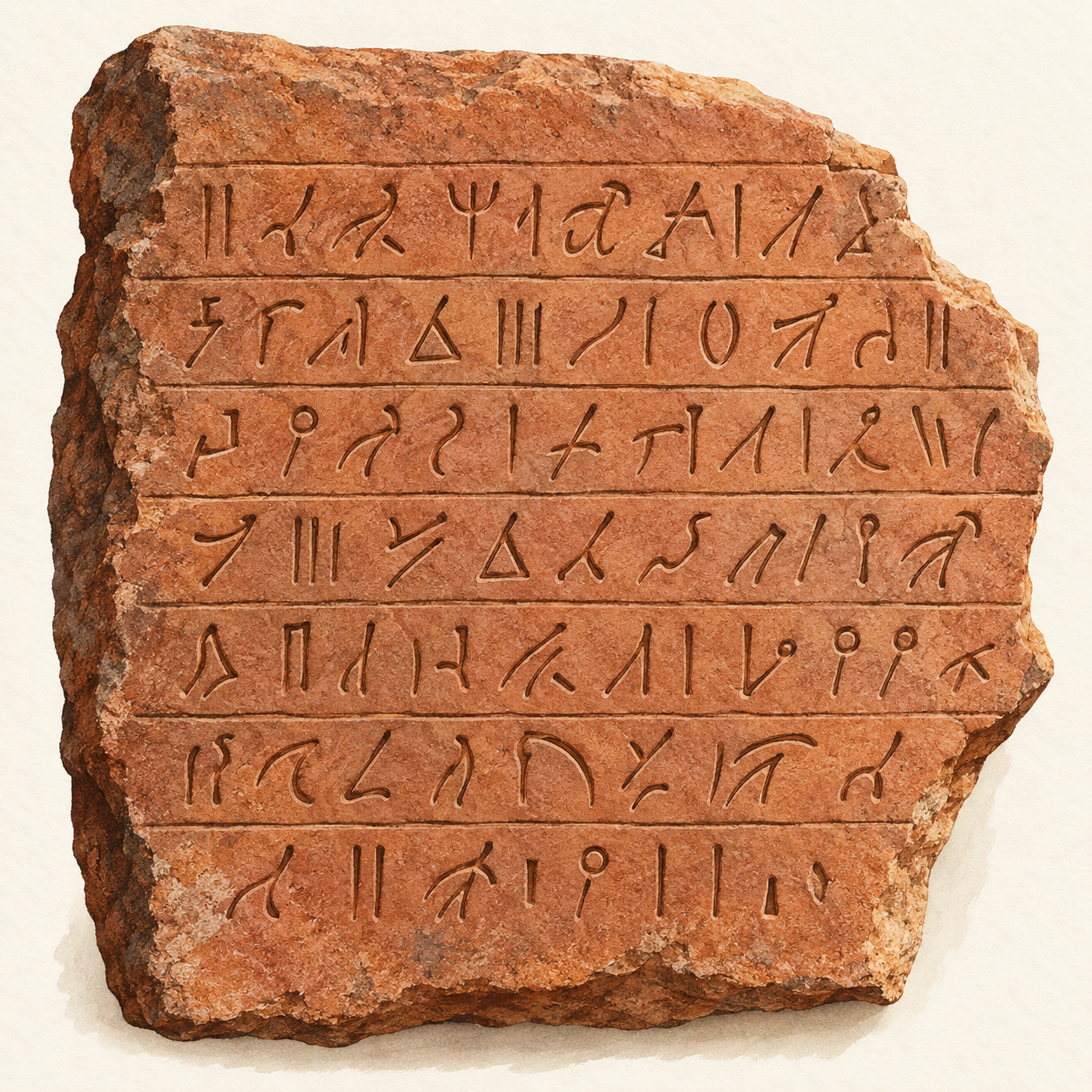
Two related scripts, one difficult language
Meroitic has two written forms conventionally called hieroglyphic and cursive. The Unicode Standard describes their visual relationships to Egyptian hieroglyphic and demotic writing. Shared visual ancestry does not make the underlying language Egyptian; the adaptation served a different language.
The system is compact compared with Egyptian writing. Many consonant signs carry an inherent vowel unless another vowel is indicated, while some signs represent particular syllables. Calling the whole system simply an alphabet is a useful first approximation, but the conventions need to be learned rather than inferred from modern English spelling.
The label cursive also does not mean that all its signs join as in a modern handwriting exercise. Script names are historical conventions. Look at an inscription before allowing the name to decide what its lines must look like.
Francis Llewellyn Griffith's early twentieth-century work established the fundamental sign readings. A later researcher can consequently transliterate much of a text, representing its signs in another script. That makes comparison possible even where a complete translation is not available.
Meet a particular inscription
The Hamadab stela in the British Museum, EA1650, provides a concrete example. It combines an upper figurative scene with a long inscription. The museum record identifies the names Amanirenas and Akinidad. Recognition of names provides a foothold, but does not make every surrounding sentence transparent.
Mohamed Bashir's archaeological study places the inscription within Hamadab's sanctuary and urban setting. The monument belonged to a built environment, not simply a museum wall. Where a text stood, what a visitor could see and which figures appeared above it all belong to its public effect.
The text's length makes the remaining difficulty especially striking. A long inscription contains much information, but recovering it requires more than supplying a plausible historical narrative. Names, repeated sequences, grammatical forms and parallels have to fit together.
What a repeated name can—and cannot—do
Imagine an unfamiliar document in which you recognise the same person's name in several places. You have learned where the name appears. You may be able to compare what comes immediately before or after it. But without further knowledge, you cannot decide whether the person gives, receives, commands, remembers or is remembered.
This simple thought experiment explains why names matter without becoming a magic key. They anchor part of a sequence. Other inscriptions can then supply comparable contexts, and those comparisons can help identify grammatical patterns or recurring formulae.
Formulaic texts are particularly useful because recurrence reduces the number of changing elements. A repeated structure may reveal where a name, relationship or action belongs. More varied royal narratives pose different challenges, since they can introduce rarer vocabulary and more complex claims.
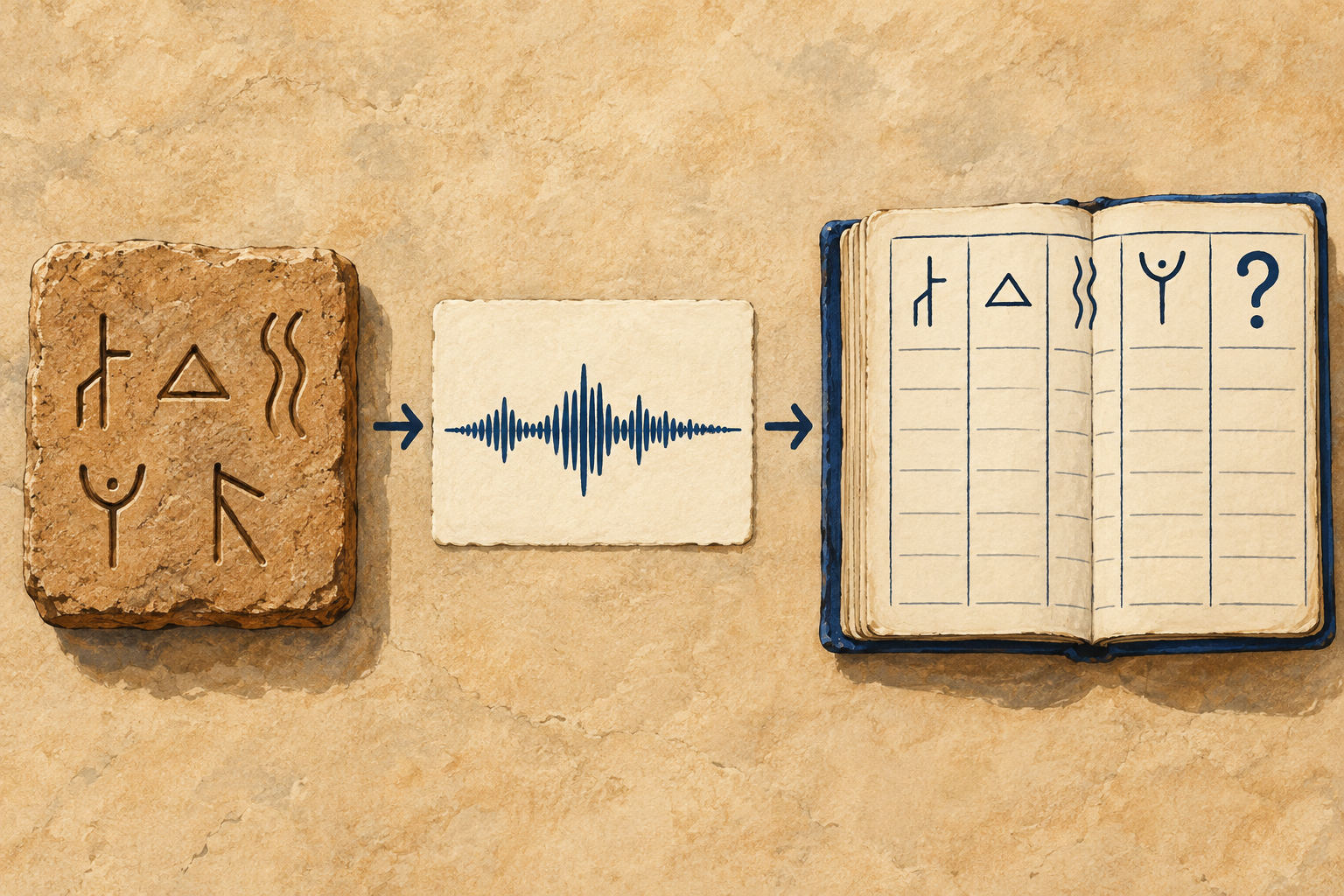
The illustration separates recognising a sign, rendering its sound and understanding a statement. None of its marks forms a verified Meroitic sentence. For a genuine inscription, use the museum record and its linked photography.
A five-minute stela study
Open the Hamadab stela record. Begin with the whole object. Where does the figurative area end and the inscription begin? How much of the monument is assigned to each? Then enlarge a short passage and follow the line arrangement without attempting a translation.
Write a two-part description. In the first part, record things visible in the image: surviving edges, line divisions, damage and the relation of figures to writing. In the second, record information supplied by the catalogue or a scholarly study: names, site and proposed historical setting.
Now ask a more demanding question: which part of your description would change if a linguist revised the interpretation of one word? The physical placement of the inscription would remain. A statement about exactly which event it describes might change. This separation lets progress in language research enrich the object without making every earlier observation worthless.
Progress has several forms
Claude Rilly's research addresses phonology, syntax and linguistic relationships. Those are related projects with different evidence. Classifying a language can help frame comparison; it does not supply a translation automatically. Identifying a grammatical ending can be a significant advance even when a long passage remains incomplete.
Modern digital encoding contributes another kind of infrastructure. Unicode provides characters for the two scripts, helping specialists represent text consistently in software. Encoding preserves distinctions a researcher has chosen to represent. It does not authenticate a proposed meaning or turn a font into a decipherment.
The word unreadable can therefore conceal too much. It blurs a damaged surface with an unidentified sign, an uncertain sound and a word whose meaning remains disputed. Naming the actual difficulty makes the research easier to understand and its achievements easier to recognise.
Meroitic's importance extends beyond the challenge it presents to modern scholars. These inscriptions belong to a society that recorded authority, relationships and beliefs in its own language. Each secure reading adds to our ability to study that history through local records. The work remains unfinished, and that is a reason to follow it carefully rather than replace its gaps with an invented fluent voice.




