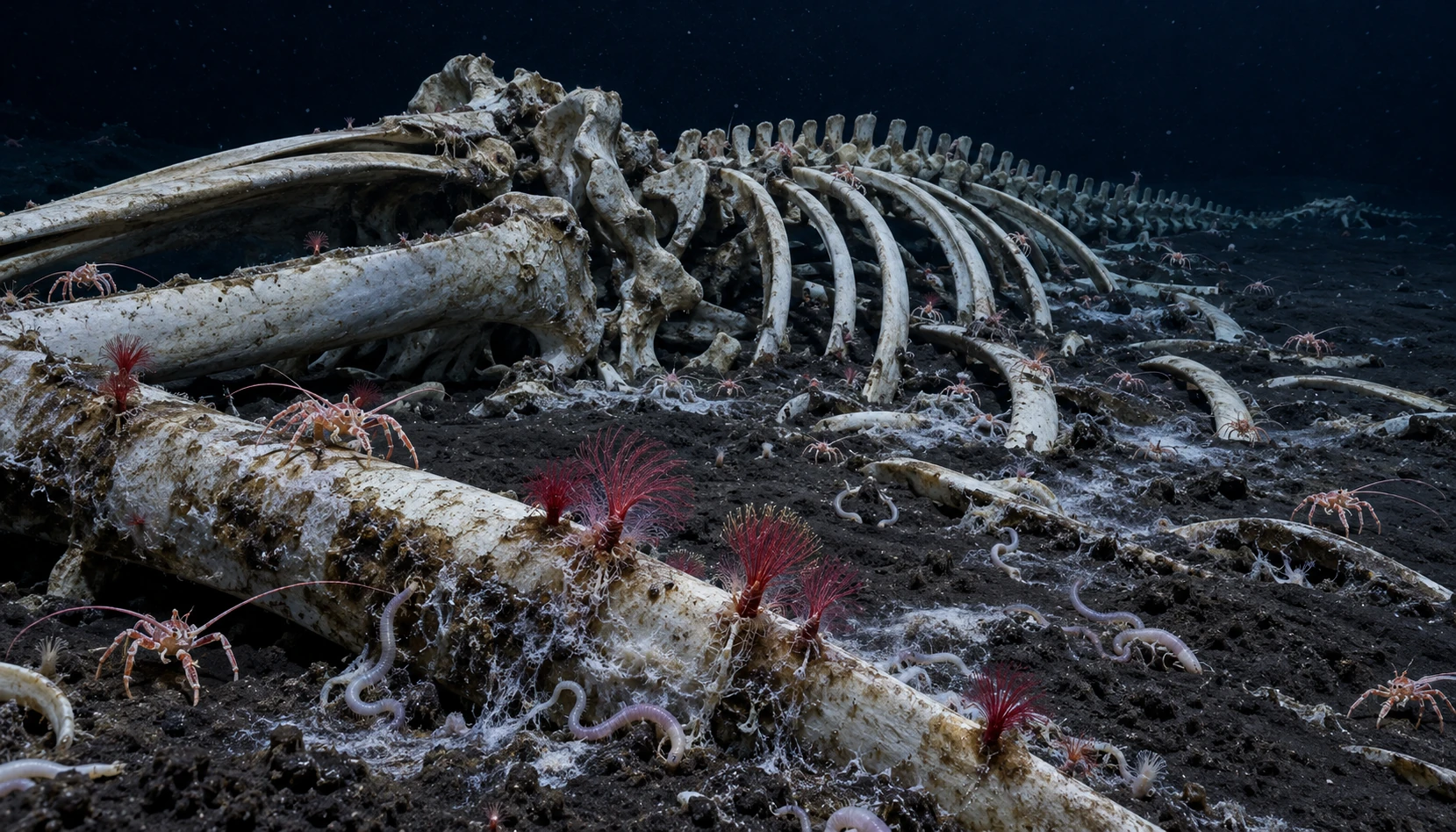
A whale skeleton on the deep seafloor can look like the final frame of a story. For the animals around it, the skeleton belongs to a changing opportunity. Flesh, bone, oil, microbes, and chemically altered sediment provide different resources on different schedules. A whale fall is therefore both a large meal and a small landscape with a history.
The most useful question is not simply “what eats a dead whale?” It is “what becomes available as one group feeds, and who can use what remains?” An animal that can tear soft tissue from a fresh carcass faces a different task from a worm living in a bone months or years later. Decomposition does not erase biological structure all at once. It changes which structures matter.
A succession of resources
The Smithsonian's illustrated whale-fall film introduces the familiar stages. Mobile scavengers first consume soft tissue. Smaller animals exploit organically enriched remains and surrounding sediment. Later, microbial processes associated with the remaining organic material can support communities using reduced sulfur compounds. The stages describe changing opportunities, not a universal clock that every carcass follows precisely.
That last point matters when an image circulates without a date. A bare skeleton does not necessarily mean the site has become biologically unimportant. Conversely, a dramatic carpet of animals need not be a permanent community. Depth, whale size, the condition of the carcass, local organisms, and the rate of decomposition can influence the sequence.
The research synthesis by Smith and Baco established whale falls as ecological systems worth studying across those stages. It also framed questions about connections with other deep-sea habitats. A carcass is isolated to a human observer looking through a vehicle camera, but colonists can connect it to a wider ocean through dispersal and shared habitat requirements.
The bones are still food
One of the most surprising residents is Osedax, a genus of bone-eating worms. The visible plume is only part of the animal. Root-like tissues extend into bone, and microbial associations help the worm use the resource. MBARI's research program follows these animals and the communities associated with them. Their feeding is a reminder that “picked clean” is a judgment made from the perspective of an animal interested in flesh.
Bone is not merely a mineral scaffold with no nutritional possibilities left. Materials locked within it remain accessible to specialized biology. Access changes the habitat in turn: organisms that penetrate and break down bone can affect how long it remains available to themselves and others.
Discovering the worms also changed estimates of diversity. MBARI's account of subsequent research describes a growing collection of distinct Osedax species after the first discovery. What initially looks like one kind of red fuzz can hide multiple evolutionary lineages. A distant camera view and a genetic identification are different kinds of evidence.
An island does not have to contain only island specialists
Because whale falls are unusual, it is natural to imagine every resident as a whale-fall specialist. MBARI research using five experimentally placed carcasses found a more mixed picture: many animals also occurred in other deep-sea environments, while some abundant residents were particularly associated with bones. A habitat can be distinctive because of the density and combination of its inhabitants, even when many species are not exclusive to it.
Experimental placement helps answer questions that a chance discovery cannot resolve as easily. Researchers know something about the starting material and can revisit it. Yet a placed carcass is still one set of circumstances, not a substitute for surveying the range of naturally occurring falls. Combining controlled opportunities with observations across different places produces a stronger account.
This changes how to read the common “island of life” metaphor. It captures the concentrated resource, but can conceal connections. The whale's body accumulated material during its life in the wider ocean. After death, dispersing organisms find it, microbes transform it, and some residents may use other habitats between such opportunities. The island belongs to a network, even when the camera shows only darkness beyond its edge.
The generated panorama here compresses a late-stage community into an explanatory scene. It is not a record of a single dive, and the small organisms are made legible for the reader. For genuine close-up footage and the full sequence, the linked research organizations provide a better next step.
The whale's end is real. So is the beginning of a series of other lives around its remains. What makes a whale fall compelling is not a comforting promise that death disappears, but the specific work of transformation: one body becomes different resources, and each resource opens a different biological door.
Follow the evidence: Smithsonian: whale-fall succession and film; MBARI: experimental whale falls and community overlap; MBARI: Osedax studies and decomposition; MBARI: diversity of bone-eating worms; Smith and Baco: ecology of whale falls at the deep-sea floor.
More curious connections, art and independent projects at Incoprea.