Begin with three pages rather than a legend about a distant city. One has a diagram of the heavens. Another turns commercial obligations into verse. A third uses examples to teach arithmetic. The manuscripts associated with Timbuktu become more vivid when we ask what a reader was expected to do with a particular page.
Timbuktu, in Mali, was a place people travelled towards for learning, trade and religious study. Its handwritten books preserve an intellectual culture of teaching, copying and argument. Their value is not confined to age or rarity. They let us investigate scholarship as a set of activities carried out by people.
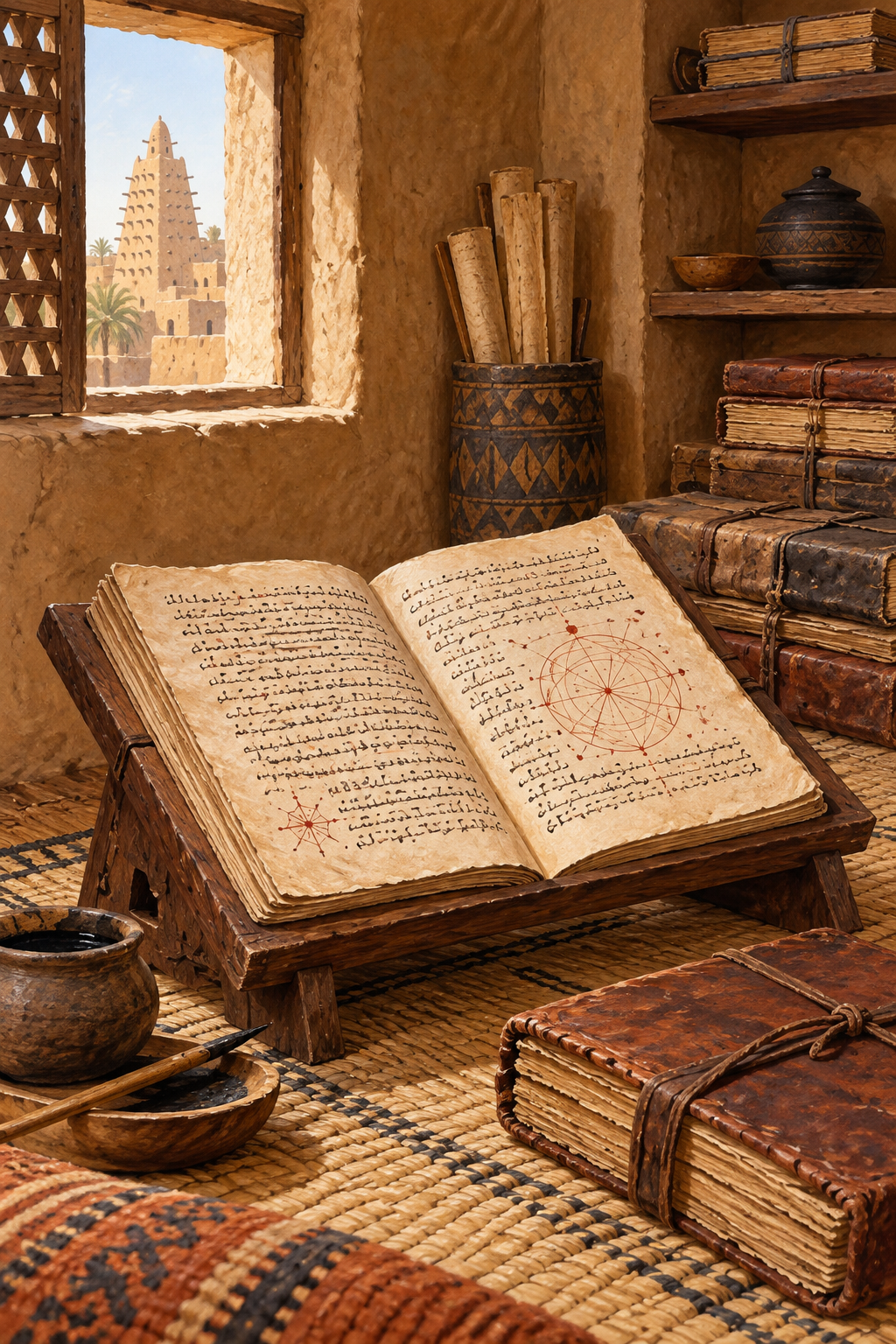
Three objects with different jobs
The Library of Congress's online exhibition includes an astronomy work copied in 1733, with a diagram of the rotation of the heavens. Its description connects stellar motions with reckoning the seasons. A diagram organises relationships visually, giving the reader a different route into an explanation from continuous prose.
A second item presents laws of commerce in verse. The exhibition explains that verse supports memorisation of obligations in transactions. Here a form we may associate chiefly with poetry also serves instruction. Rhythm and verbal organisation can help a learner retain material needed beyond the page.
The arithmetic commentary by al-Rasmuki explains a work by al-Samlali through charts and worked problems. The exhibition places it within teaching in Timbuktu and North Africa. The example is concrete: a commentary can transmit a prior work while actively making its rules usable for another reader.
All three were loaned to the exhibition by the Mamma Haidara Commemorative Library. Keeping that custodial connection attached to them helps prevent the pages from becoming anonymous illustrations of an entire continent's scholarship.
Look for the teaching in the layout
A page is a set of decisions about attention. A diagram sets some relationships beside one another. A heading separates a new subject. A chart can make a procedure easier to follow. A copied page has to arrange those elements within the writing surface available.
Even if you do not read the script, you can begin by noticing differences in density, spacing and the placement of images or tables. Those observations do not translate the text, but they help you ask the catalogue a more precise question: how is this page helping someone learn?
Try comparing a dense page of explanation with a diagrammatic one. Which could be followed line by line? Which asks the eye to move around a field? Which parts might a teacher point to while explaining? These are questions about an object's use, rather than judgements about whose page looks more familiar.
Copying is intellectual work
Many surviving manuscripts are copies of works that existed earlier. That does not make them interchangeable duplicates. A copy requires materials, time and skilled decisions, and can later accumulate evidence of reading and ownership.
The University of Hamburg's project on scribes in the “Timbuktu archive” examines copying as a practice of preserving, transmitting and producing knowledge. It asks how professional scribes, students and scholars differed, and what material and decorative features can reveal about their work.
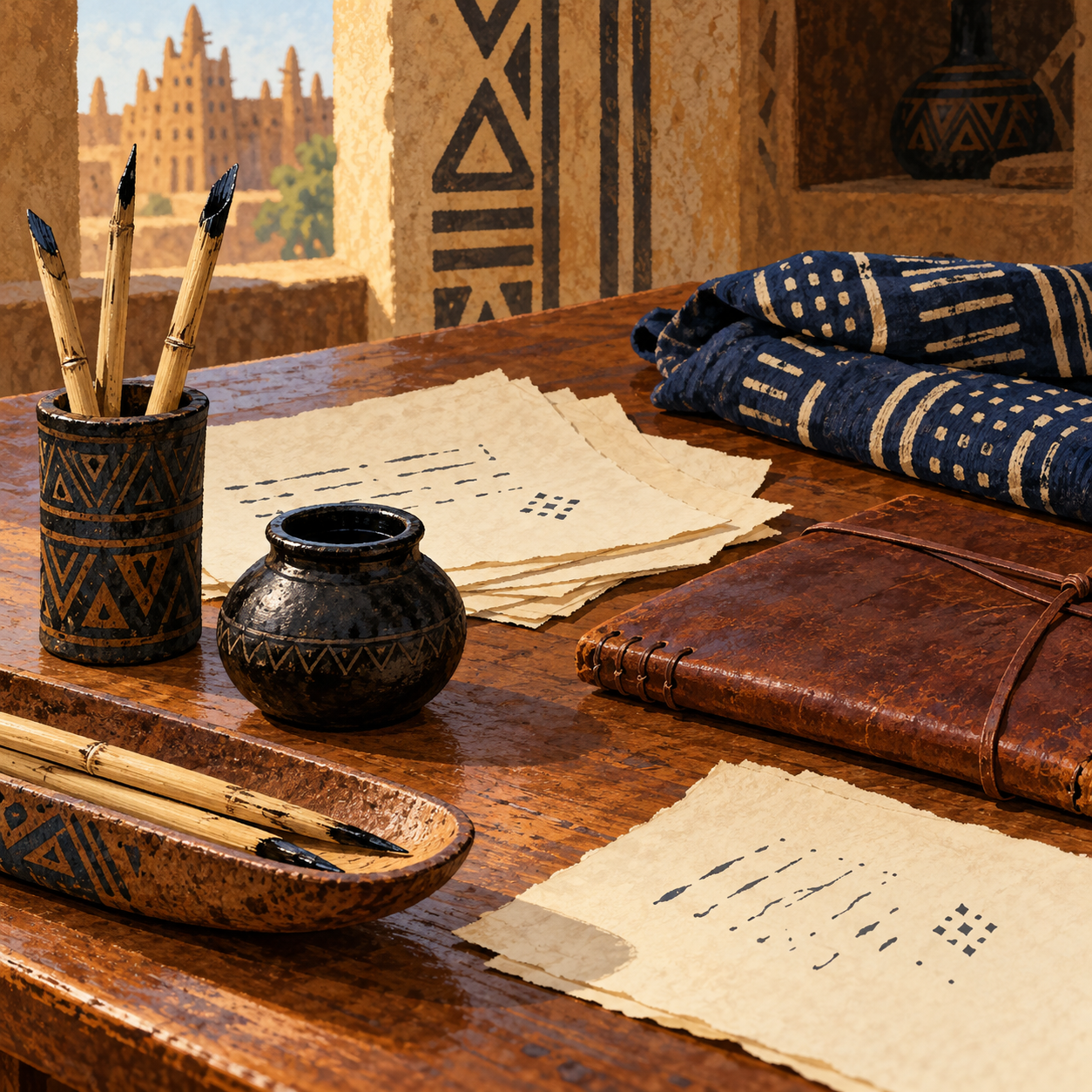
The writing-tool scene is an interpretation, not a reconstruction of one manuscript's production. The research questions direct us back to actual objects: the hand, paper, ink, structure and evidence of use. Each can contribute information that a transcription of the words alone would leave out.
The project also draws on testimony and practices of living scribes. A manuscript tradition contains knowledge carried by people as well as by pages. Understanding a tool or a copying convention may require conversation and observation alongside the examination of an old book.
Make a small digital seminar
Open the Library of Congress exhibition. Use its enlarged images to visit “Structure of the Heavens,” “Laws of Commerce in Verse” and “Arithmetic Primer.” You can inspect all three without needing to turn them into a single story.
- For the astronomy page, describe how the diagram occupies space and how it relates to the writing.
- For the verse text, read the exhibition's explanation of its purpose. What does the chosen form help a student do?
- For the arithmetic page, look for divisions or organised examples. What would you want a teacher or translation to clarify?
Finish by assigning each object a verb: compare, remember, calculate, explain, or another action supported by its description. “Treasure” tells us that a page is valued. A verb starts to explain why someone needed it.
Keep the copy date separate from the dates of the author and underlying work. A later manuscript can carry earlier learning, and an earlier author can be encountered through several later copies. The movement of a text through time is part of the history a collection preserves.
A city connected through books
The Library of Congress overview places Timbuktu within commercial and scholarly connections extending beyond the city. People came for knowledge as well as goods. A book could be copied, taught, owned and transported through those relationships.
The broad phrase “Timbuktu manuscripts” can consequently gather objects with different histories and connections to a wider region. A particular item still needs its own provenance. Knowing where it is kept today is a beginning; knowing where and how it was made, read and moved enriches the account.
This also changes what preservation means. Saving a page protects future possibilities for reading and research, including questions that have not yet been asked. Digital photographs widen access, while records of ownership, materials and interpretation keep the photographs meaningful.
Return to the three opening pages. They no longer stand chiefly for distance or a hidden archive. They show people organising the heavens, remembering obligations and working through numbers. Timbuktu becomes a place of intellectual labour, and the manuscript becomes an invitation to join the work of looking closely.




