A little cylinder can hold a picture too long to see at once. Turn it in your fingers and one figure disappears while another emerges. Roll it across soft clay and the curved surface unfolds into a continuous scene. The image has changed medium, shape, and direction in a single controlled movement.
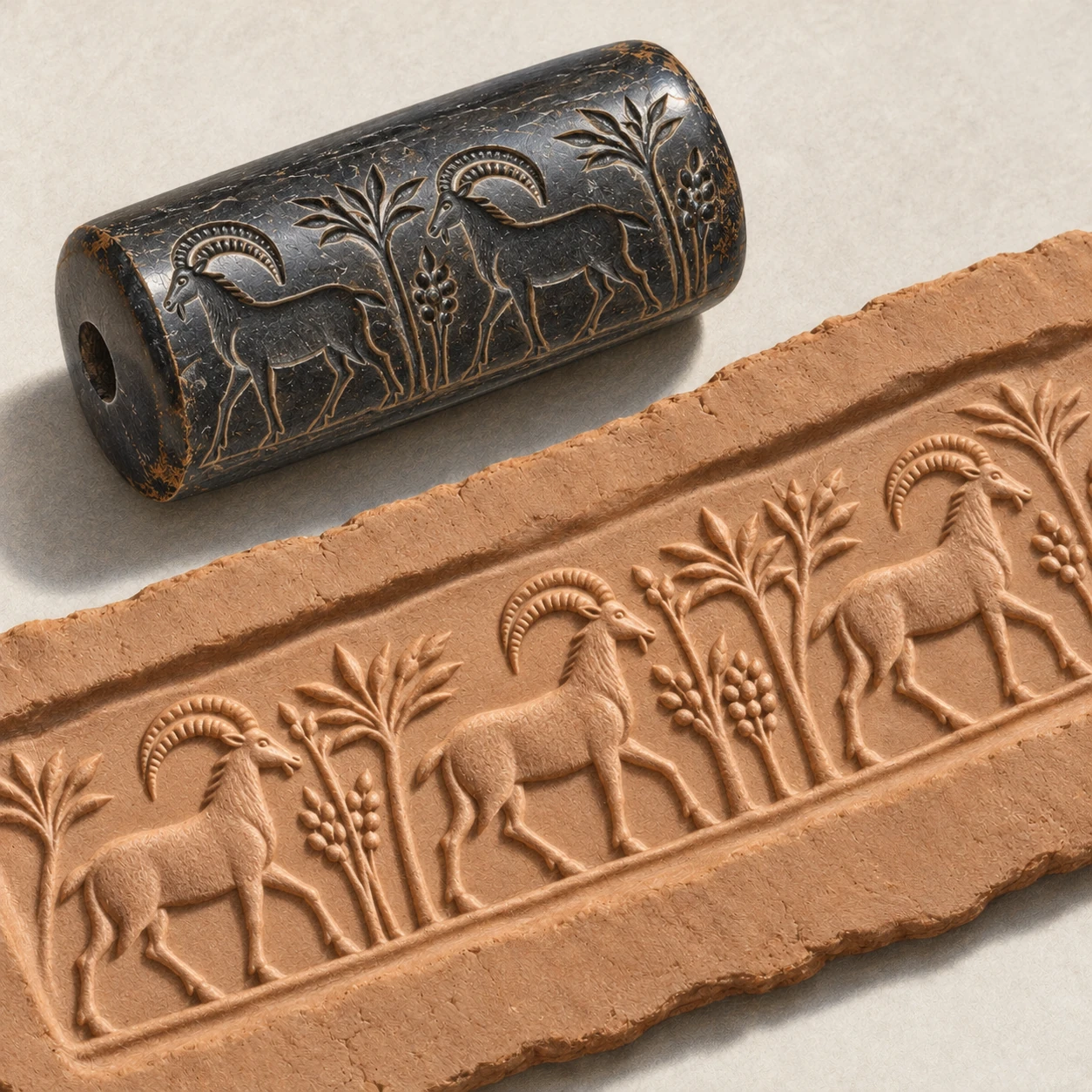
Mesopotamian cylinder seals make that transformation useful as well as beautiful. They could leave recognizable impressions on clay associated with records, containers, and closures. The mark connected an object or action with an identity or authority. Calling it a signature is a helpful first comparison, provided we do not assume an ancient administrative world operated exactly like a modern bank.
Start with one small stone
The Metropolitan Museum’s hematite seal X.304.13 is approximately three centimeters high and dates to the Old Babylonian period, around the eighteenth to sixteenth centuries BCE. Its catalog presents the cylinder beside a modern impression. That pairing is essential: the ancient carved object and the present-day rolled image are two different things.
The record places cylinder seals’ emergence in the fourth millennium BCE and describes their use on clay closures and written records. It also notes possible amuletic significance. A seal could participate in more than one domain of life; an administrative function does not exclude religious meaning.
Keep the scale beside the enlarged image. Three centimeters is a short distance across which to organize bodies, gestures, headgear, and boundaries. A large screen can make the design look spacious. The physical object reminds us that carving and recognition operated at a different scale.
A hollow becomes a raised line
Curator Yelena Rakic’s Met introduction explains the reversal: an image cut into a cylinder appears in reverse when rolled, with the impression standing out from the clay. It also shows seals in different materials, including shell, carnelian, and chalcedony. The category is a working form, not a single substance or standardized size.
That reversal gives the maker two connected design problems. The carved surface must work on a curved body, and the resulting impression must remain intelligible on a flattened field. Our impression of a figure’s direction should therefore specify which surface we mean. A figure facing left on a modern roll may face right in the engraved matrix.
There is another problem at the edge. A cylinder has no natural left-hand margin. The beginning of a rolled picture depends partly on where the rolling starts. A museum photograph may choose a convenient boundary that makes a continuous scene look like a rectangular composition. That presentation helps us study it, but the original surface does not possess a paper page’s corners.
A mark needs a setting
Imagine three hypothetical finds. One is a seal on its own. Another is a clay impression detached from whatever it closed. The third is an impression still associated with a documented tablet. They offer different kinds of evidence.
| Evidence | Useful question | Limit |
|---|---|---|
| Carved cylinder | What image could it produce? | It may not identify its user or a specific transaction. |
| Detached sealing | What surface or cord traces survive? | Its original container or location may be missing. |
| Impression and associated text | How does the mark relate to this record? | The relationship still needs contextual interpretation. |