Stand beside a window, then take two steps to the left. A branch that seemed to grow out of a roof suddenly separates from it. A distant building disappears behind the frame. Nothing outside has moved, yet the composition has changed. That small experience offers a useful entrance to the classical gardens of Suzhou: their subject is not only the ground inside a wall, but what a moving person can see, anticipate, and imagine.
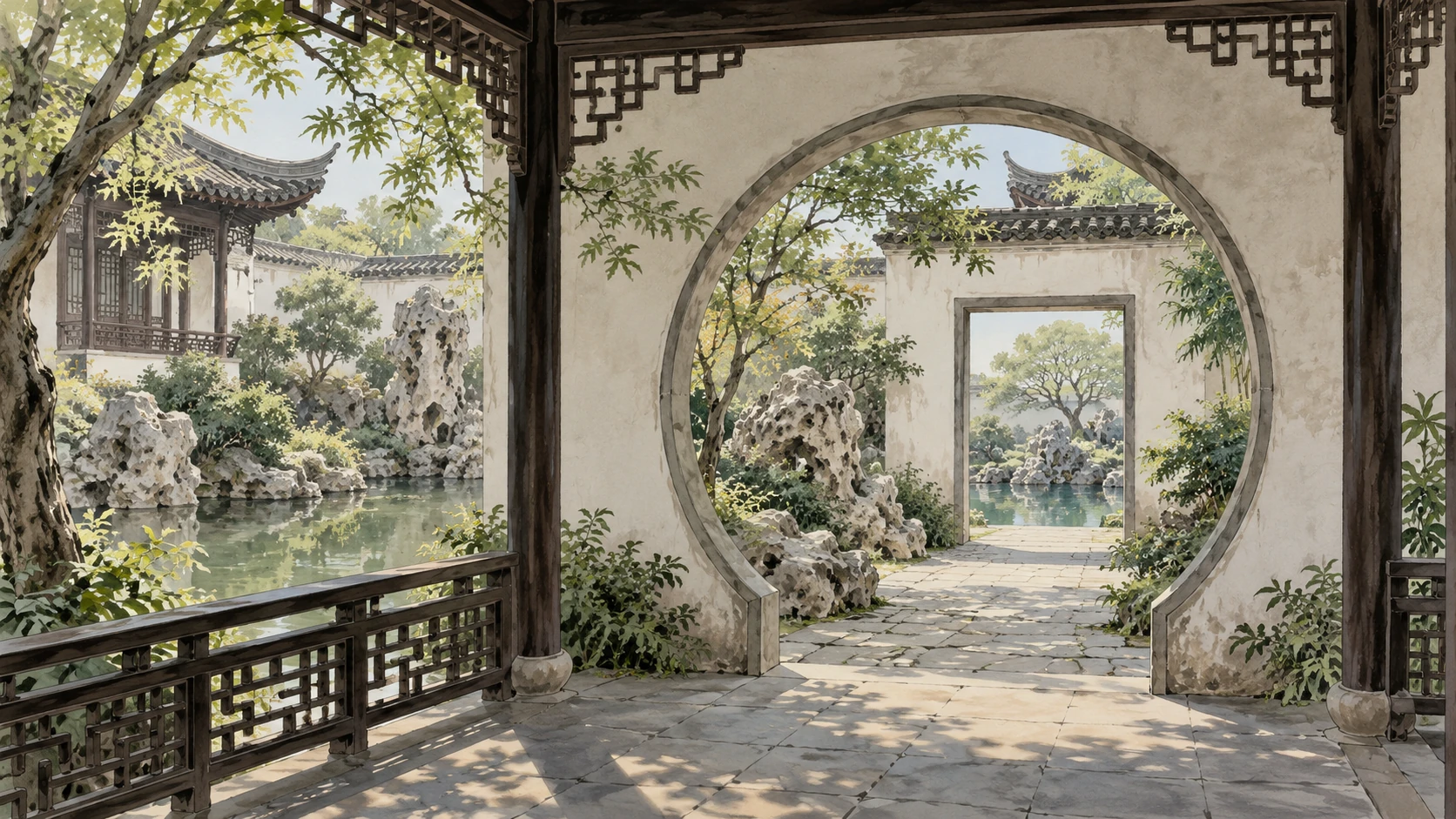
The nine gardens recognized by UNESCO date from the eleventh through nineteenth centuries. Their designers assembled water, rocks, plants, buildings, and literary associations within constrained urban sites. UNESCO describes a miniature natural world shaped partly through the language of landscape painting. A garden could therefore offer a mountain journey without possessing a mountain.
A wall can edit a landscape
A useful way to begin looking is to treat an opening as a decision. A wall conceals most of what lies beyond it. Its doorway reveals a selected portion. A visitor approaches, the opening grows, and the view becomes a passage. The same architectural feature can be a picture frame at one moment and a route at the next.
That observation is an interpretation of spatial experience, not a claim that every garden has an identical hidden code. Suzhou gardens have different histories, patrons, rebuilding campaigns, and arrangements. The phrase “borrowed scenery” is helpful when a composition recruits something beyond its immediate enclosure, but not every framed view is borrowed from outside the property. Some frames connect one carefully designed internal scene to another.
Make that distinction when looking at a photograph. Is the tree beyond the opening in the next courtyard, beyond the garden wall, or impossible to locate from the image? A beautiful composition cannot answer a property-boundary question by itself. A plan and a sequence of views may be needed.
A modern court that makes the choices visible
You can examine this spatial vocabulary through the Metropolitan Museum’s Astor Chinese Garden Court. It is a modern construction in seventeenth-century style, not an ancient Suzhou garden transplanted intact. Its material record names Taihu rocks, granite, ceramic tiles, several woods, and brass fittings. Even the catalog encourages you to see an assembled environment rather than an abstract “Chinese style.”
The Met’s educator guide identifies its model as a Ming-period scholar’s courtyard in Suzhou’s Garden of the Master of the Fishing Nets. It proposes looking at pathways, transitions between interior and exterior, and contrasting qualities of materials. Rock groups can suggest mountains; a small body of water can invite the imagination of a much larger one. Scale is something the visitor negotiates.
A separate Met account of the court’s construction records Chinese craftspeople building it in 1980 using materials brought from China. That modern history matters. A museum court is also an act of translation, made for a different building, public, and setting. It teaches through particular choices; it does not contain the whole history of the gardens that informed it.
Read a view in three distances
Try this looking sequence with institutional photographs or a garden you can visit. Begin with the nearest edge: a door jamb, eave, screen, or stone at your feet. It tells you where your body is. Next identify the middle distance: a pond edge, pavilion, path, or planting. Finally locate the farthest visible element, even if it is only a branch against the sky.
Now ask which of those layers overlaps another. Overlap can suggest depth without requiring a long uninterrupted vista. A narrow gap can imply that more space continues behind an obstruction. That does not make the garden a trick. It makes the limits of your view part of the work.
On a second pass, search for an invitation to move. A half-hidden doorway may make you curious about the next enclosure. A path that turns may postpone the answer. A seat may offer a reason to remain with one composition. These are observations you can test against the actual layout, rather than a universal formula imposed on every garden.
A five-minute framing experiment
Cut a rectangle from a scrap of paper, leaving a broad border. Hold this simple frame at arm’s length toward an ordinary scene. Avoid photographing people without permission. Choose a view containing something near and something distant: perhaps a houseplant and a tree outside.
- Keep your feet still and move only the paper. Record what the border removes.
- Keep the paper in the same position relative to your face and move sideways. Notice how nearby objects shift against distant ones.
- Lower the frame and choose a path toward what attracted you. Does the view improve, dissolve, or reveal something previously hidden?
- Write two sentences: one describing what you actually saw, and another describing what the view made you imagine.
This is a study of framing, not a miniature reconstruction of a Chinese garden. Its value is that it separates physical arrangement from imaginative association. You can demonstrate the first and discuss the second without pretending everyone experiences the same response.
Keep the work behind the view in sight
Garden photographs often exclude maintenance. A view that appears effortless still depends on decisions about plants, water, structures, surfaces, and access. When visiting, look for what a still photograph cannot preserve: the sound of movement, changing light, another visitor passing through the frame, or the distance between two scenes that look adjacent online.
Also notice the conditions of your own viewing. A crowded afternoon, a mobility limitation, a closed path, or a small phone screen changes what is available. There is no requirement to achieve a supposedly perfect contemplative state. An attentive question about a doorway is already a serious encounter with design.
The most rewarding souvenir may be a revised habit of looking. Once you notice how a wall selects a tree, an opening connects spaces, or a reflected edge doubles a roof, an urban garden becomes larger in a precise sense: it gives you more relationships to discover within the same ground.
Sources and a closer look
UNESCO: Classical Gardens of Suzhou; The Met: Astor Chinese Garden Court collection record; The Met: Garden Court educator guide; The Met: Poetry, Pavilions, and Patterns.
Find more art, ideas, and unexpected connections at Incoprea.