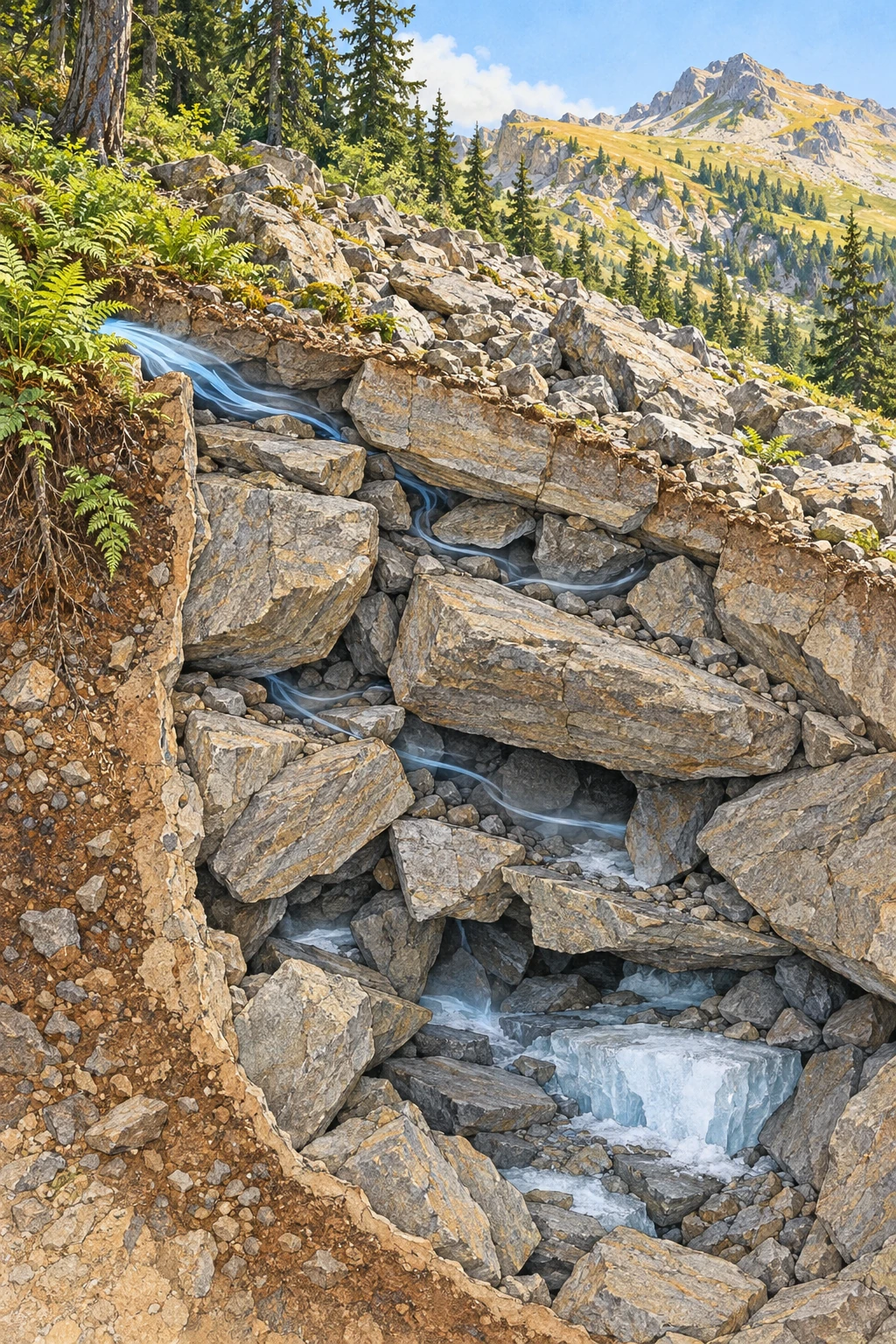
On a hot day, a small opening between boulders can breathe surprisingly cold air. In some mountain rock piles, winter’s cold is stored below the sunlit surface, and ice can persist into the warmer months. The surprise is not an exception to thermodynamics. It is thermodynamics operating through a complicated arrangement of stone, air, water, and time.
Talus is accumulated rock debris below a slope or cliff. Its interconnected spaces can create a thermal environment very different from the air a meter above it. But there is no single “natural refrigerator” mechanism that explains every cold boulder field.
A rock pile contains an air network
Large blocks can leave open voids through which air moves. Their arrangement controls ventilation, while the rock mass stores heat or cold and limits the speed of conductive temperature change. Snow and ice add insulation and phase-change energy to the system.
The National Park Service’s talus-cave guide explains how mechanically accumulated boulders can leave interconnected spaces. Such cavities differ in origin from limestone caves dissolved by water. A talus cave also does not automatically contain perennial ice.
That last point matters in photographs. A dark opening among rocks establishes a void, not its annual temperature regime. You need measurements through the seasons to know whether ice persists, forms seasonally, or is absent despite cool summer air.
Winter can charge the cold store
In a ventilated slope, density differences between outside and internal air can drive circulation. During cold conditions, cold air may enter lower openings while warmer internal air escapes higher up. The resulting chimney effect can cool parts of the debris mass.
Numerical research on convective heat transport in permafrost talus investigates how airflow changes the thermal regime. Geometry and permeability are not minor details: if fine material blocks the pores or ice seals routes, the ventilation changes.
Summer circulation and cold-air outflow can then expose the stored cold at low vents. The seasonally changing flow is not simply a fan that runs identically all year. The direction and strength depend on the contrast between the slope interior and the outside atmosphere.
Ice adds a thermal delay
Melting ice requires energy without immediately raising the ice-water mixture’s temperature. This latent heat can buffer warming. Rock shade and restricted air exchange further affect how quickly summer heat reaches the interior.
A useful idealized calculation uses ice’s latent heat of fusion, about 334 kilojoules per kilogram. Melting 100 kilograms requires roughly 33.4 megajoules, even before warming the meltwater. At a hypothetical net heat input of 100 watts, that energy alone corresponds to nearly 3.9 days.
Those numbers are not a prediction for a real vent. Natural heat exchange varies with airflow, water, geometry, and weather. The calculation simply explains why a modest ice reservoir can delay a temperature response rather than disappearing the moment the air becomes warm.
A specific place, with a specific season
The Nature Conservancy’s Ice Mountain Preserve in West Virginia describes a sandstone talus that produces cool air from openings near its base. Its account notes winter ice that can remain into summer and a local plant community associated with the cool conditions.
This is a place-based example, not proof that all cold vents preserve ice year-round. A research abstract on Ice Mountain airflow explicitly notes that year-round ice persistence is not essential to summer cold-air flow. Stored cold in the rock and the pattern of air exchange belong in the explanation too.
It also changes how the landscape should be treated. Moving a boulder, blocking an opening, or repeatedly entering a small refuge can alter airflow or damage sensitive vegetation. An inviting cool spot may be part of a fragile microclimate.
Imagine replacing the coarse open blocks with tightly packed fine gravel while leaving the slope and outside weather unchanged. The altered air pathways would change ventilation. Now restore the blocks but add an insulating snow cover over selected openings. That changes the boundary conditions again. These hypothetical alterations show why the size distribution of debris and the seasonal snow pattern belong in a thermal study rather than being treated as background scenery.
Several mechanisms can coexist
Ventilation is not the only possible heat-transfer route. Conduction from adjoining rock walls, snow distribution, water movement, and ice formation can influence the thermal pattern. Modeling of rock-wall and talus heat flow examines a conductive contribution while discussing its interaction with ventilation.
The distinction between demonstrating a possible process in a model and establishing its dominance at a field site is essential. A process can be physically real yet small compared with another process under the conditions actually observed.
Different regions also have different boundary conditions. A snow-covered Alpine talus, a shaded Appalachian boulder field, and a lava-tube cold trap should not be folded into one story merely because all can preserve summer ice.
An observation plan that keeps the slope intact
From an established path or authorized guided visit, compare air temperature in shade near a vent with shaded air away from it. Use the same sensor and allow it to equilibrate. Record time, weather, recent rainfall, and the exact measurement height without placing equipment inside unstable voids.
Repeat across seasons if access is permitted. A single cool reading demonstrates a local contrast at that moment; it does not show the annual minimum, the presence of permafrost, or the volume of buried ice. Photographs should document the observation position so a later comparison uses the same setting.
Avoid digging, moving stones, entering unassessed cavities, or treating old visitor instructions as current access permission. The scientifically useful activity is a careful comparison, not an attempt to open the refrigerator door.
The mountain keeps a delayed weather record
What feels like impossible summer cold is a lag between external weather and internal heat storage. The talus has a memory because air routes, rock, snow, and ice exchange energy on different timescales. The cold breath at its base is the moment that hidden seasonal history meets your hand.
Sources and a next step
- NPS: talus-cave development
- Wicky and Hauck 2017: convective heat transport in talus
- The Nature Conservancy: Ice Mountain Preserve
- GSA research abstract: Ice Mountain cold-air flow
- Frontiers 2019: conductive heat flow and talus
Continue exploring art, ideas, and unexpected connections at Incoprea.