Showing posts with label Networks. Show all posts

Saturday, October 24, 2026

Your Message Can Arrive in Pieces Before It Becomes a Sentence

Send a sentence across a room by writing it on four cards. Give each card to a different messenger. One stops to talk, one takes a longer hallway and two arrive together. The recipient may hold the final words before receiving the beginning.

That small inconvenience points toward a powerful design idea. A message does not have to occupy one continuous reserved path as a single physical object. A network can carry smaller units of data while different conversations share its links.
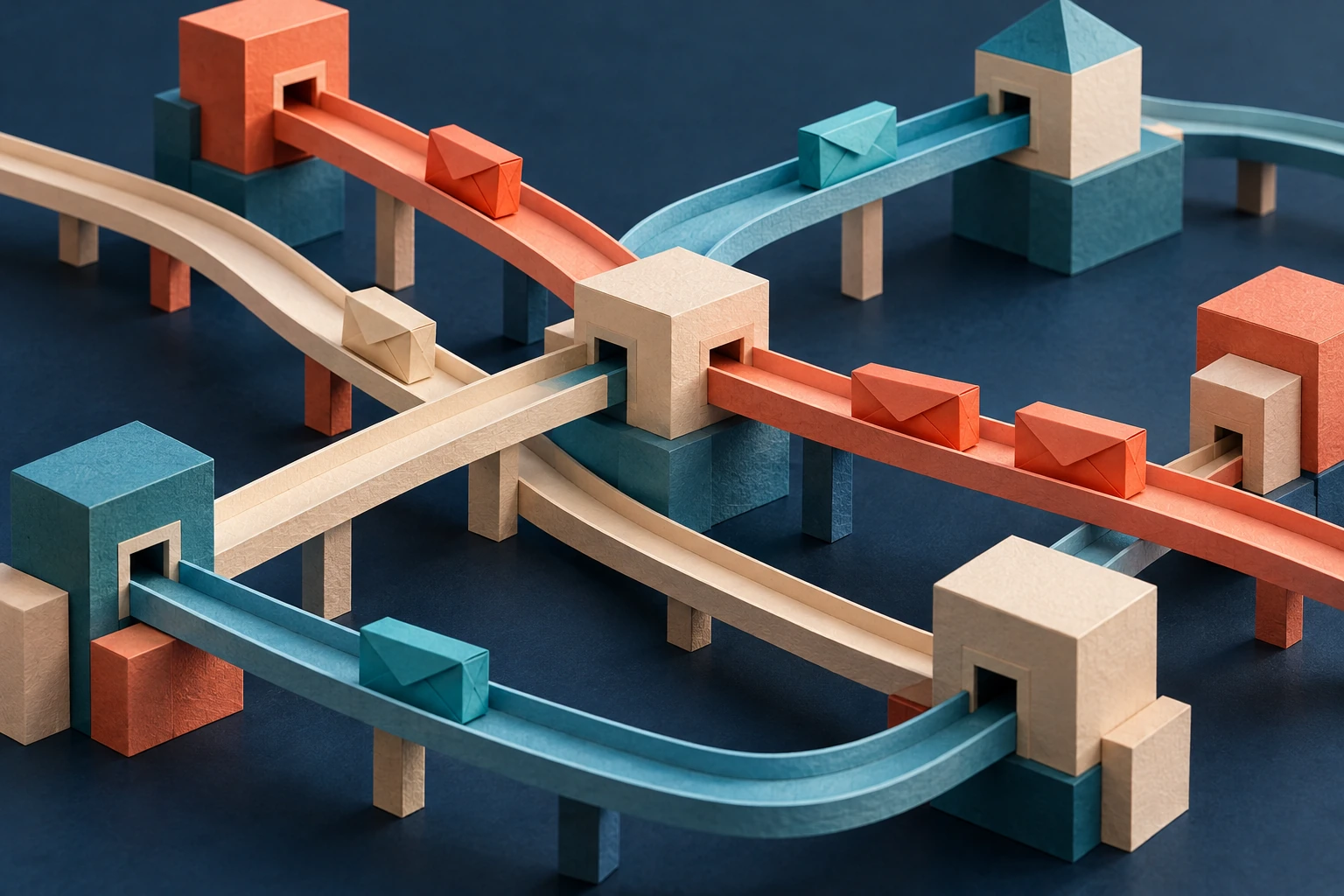
Separate paper envelopes follow intersecting channels between geometric stations.
A visual metaphor for shared links and separate units. Real packet routing does not require every successive packet to take a different path.

Share the link in small turns

Imagine two senders, one with a long document and another with a short question. If a link must finish the entire document before carrying anything else, the short question waits behind it. Dividing data into smaller units creates opportunities to interleave traffic.

The opportunity is not a guarantee of perfect fairness or short delays. Scheduling and congestion still matter. Small units also need addressing and other control information, which takes space. The engineering exchanges one set of constraints for another rather than making communication free.

The National Physical Laboratory’s account of Donald Davies describes his contribution to packet-switched communication. The Internet Society’s history, written by people involved in its development, places the idea among multiple research threads and the construction of networks that could connect with one another.

For a second paper experiment, make four equal cards for a long message and one for a short one. Sending all four long-message cards first puts the short one fifth. Interleaving it after the first puts it second, while the long message finishes later. No traffic has disappeared. You have changed who waits, and when. Now double the number of competing messages and decide on a scheduling rule before starting; the word “shared” alone does not select one.

The network moves units; the receiver needs meaning

The Internet Protocol specification, RFC 791, describes datagrams treated as independent entities. Its job is limited: it does not itself supply reliable, in-order delivery of an application’s data. That division of responsibility is essential to understanding the pieces.

It is possible for packets to experience different routes or delays, but it is misleading to insist that every packet in a conversation must take a different path. Often many follow the same route. Packet switching is about how traffic is organized and forwarded, not a requirement to scatter each successive piece geographically.

Try the destination’s job in the exercise below. Deliver the second card first. It has arrived, but the beginning of the sentence is still missing. Then deliver the first card and notice how much ordered text can be released.

Deliver the pieces out of order

A manual destination-side exercise separates arrival order from delivery of one ordered message.

Open deliver the pieces out of order in its own window.

Next reset and deliver cards 1, 2 and 4. The final card is present, but releasing it as though nothing were missing would conceal the gap. When card 3 arrives, the remaining sequence can be completed. The teaching model makes that wait visible without simulating an entire network.

Reliability belongs to a specified protocol

RFC 9293, the TCP specification, describes a reliable, in-order byte stream. Sequence information, checksums and retransmission support that service. Our word-card model uses whole numbered pieces for convenience; real TCP tracks bytes, and it does not preserve application message boundaries as four tidy word cards.

This distinction explains why “the packet arrived” and “the application has the complete message” are different statements. Other transport designs make other choices. A live application may value a timely recent update differently from an exact copy of an old one. The appropriate behavior depends on the service and its protocol.

Even a reliable ordered transport does not by itself prove that a person understood the sentence, that the sender was truthful or that the application processed it correctly. Each promise has a boundary. Keeping those boundaries explicit prevents a technical word such as “reliable” from expanding into a claim it never made.

Play the network around a table

Write one sentence on four numbered cards. Give a friend instructions to deliver them in a chosen order, including one delayed card. Ask another friend to maintain two areas: “arrived” and “can be read from the beginning without a gap.”

In a second round, remove a card entirely. The receiver can identify the missing number, but identifying a loss does not recreate the missing text. Agree on a request-and-resend rule, then try again. You have added a recovery mechanism, rather than discovered that all networks automatically recover every loss.

The apparently seamless sentence on a screen can be the result of many separate movements and several layers of rules. The interesting achievement is not that every piece travels together. It is that the system can present something coherent even when the journey is divided.

Sources and further exploration: NPL: Donald Davies; Internet Society: participant history; RFC 791: Internet Protocol; RFC 9293: TCP.

Explore all 50 new articles · Browse the complete illustrated collection

Explore more art, ideas, and independent projects at Incoprea.

Friday, October 23, 2026

A Telegraph You Could See Only When the Weather Allowed

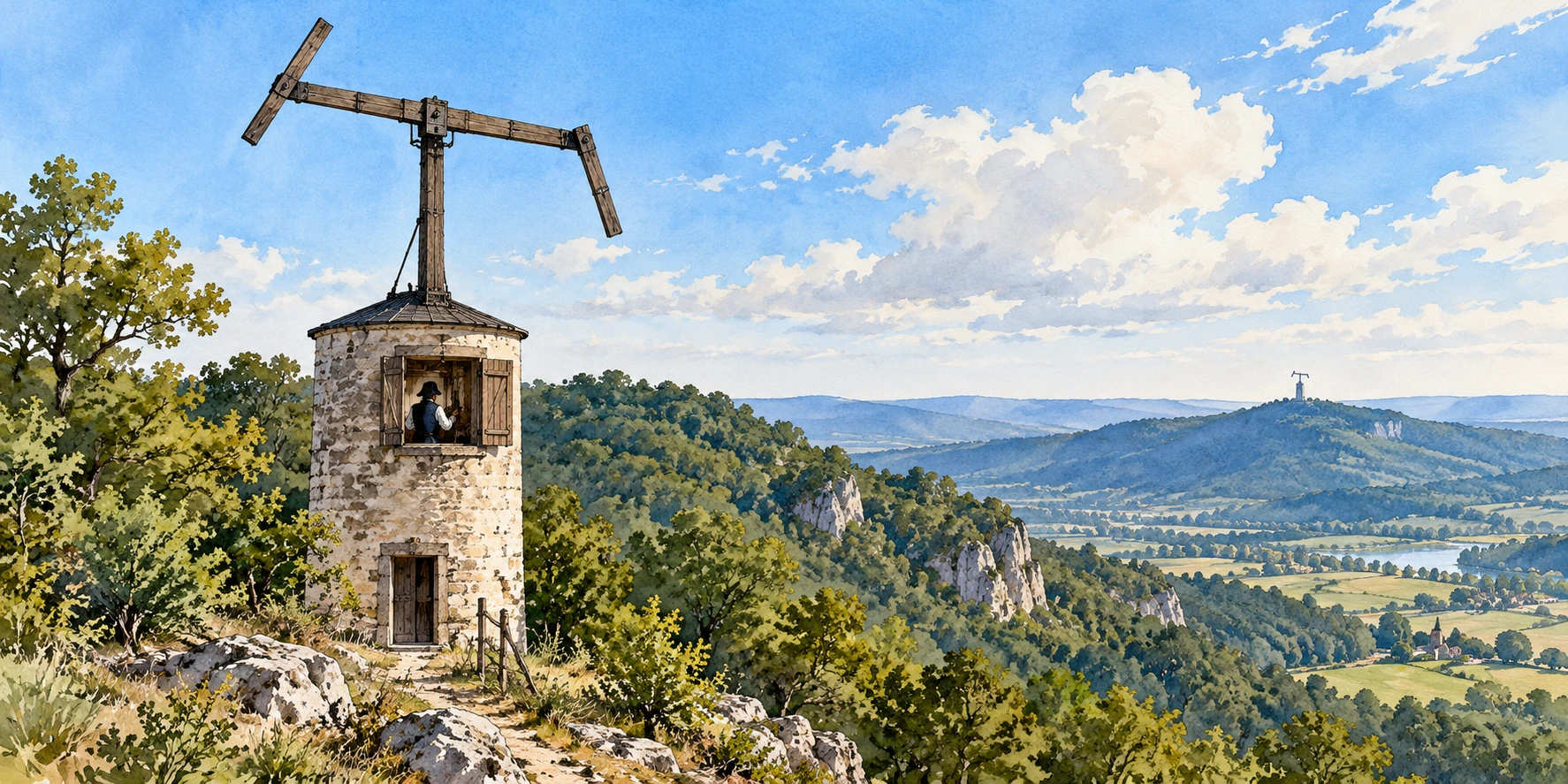
Stand below a hilltop tower and look at the sky around its mast. A large beam has moved. Two shorter arms have changed angle. To a traveler, the shape may look like a strange mechanical person. To an operator watching through a telescope at the next station, it can be a signal that needs to be copied accurately.

An optical telegraph mast rises above a hilltop tower, with another ridge beyond.
The gaps between stations belong to the technology: a visible signal needs a usable line of sight. Reconstructed scene.

The Chappe optical telegraph makes a network visible. Its stations needed a view of one another, its moving parts needed recognizable positions, and its operators needed shared rules. The message traveled as a sequence of shapes, while the physical apparatus stayed on its hill.

Do not begin by guessing letters

The Musée des Arts et Métiers' explanation describes a succession of semaphores on towers or elevated points. The mechanism's central regulator and its shorter indicators could form distinguishable configurations. The system required both a visible signal and a convention for using it.

That does not mean every position simply stood for one letter of the alphabet. Historical optical telegraphy involved codes and operating signals as well as apparatus. A clear view of the arms would not automatically reveal a message to someone without the relevant code and procedure.

Imagine you and a friend agree that an upright hand means “ready,” a sideways hand means “repeat” and two hands mean “finished.” Those are instructions about the conversation itself. They do not belong inside the sentence being sent, but the sentence becomes difficult to send reliably without them.

Build a deliberately tiny relay

The interactive exercise uses invented symbols with an invented four-item vocabulary. It is not a reconstruction of Chappe's historical code. Choose a message, pass its symbols through a relay and decide what to do when one symbol becomes uncertain.

Send a message through a visible relay

An invented four-symbol relay shows why repeat and uncertainty rules matter.

Open send a message through a visible relay in its own window.

First, relay the sequence with every symbol visible. Next, hide the middle symbol. Notice the difference between “I saw a shape that means B” and “I think B would make sense here.” A plausible guess can produce a convincing wrong message. A request to repeat may feel slower, but it makes uncertainty explicit.

The model counts your transmissions, including repeats. It does not calculate a historical dispatch time. Real towers had distances, sightlines, mechanical movement and staffing conditions that the small demonstration omits.

Weather is part of the communications channel

The museum's Chappe model record places the optical apparatus within a broader history of telegraphy. Its preserved mechanism lets us study how movement became a reproducible signal. It does not remove the basic requirement that the next station must see that signal.

Fog, terrain and darkness are not decorative background in this story. They affect whether the channel is available. A beautifully articulated arm cannot solve a hidden horizon. Raising the station, improving observation and choosing a route are therefore parts of the technology just as surely as the gears are.

Try a paper planning exercise. Put three hills between two towns. Draw one line of sight that reaches every intermediate station. Then add a ridge that blocks the middle segment. Would a taller mast solve your drawing, or would you need another station? You have created a geometry problem before sending a single word.

A photograph is not a transmission

A Paris Musées record of a Chappe monument documents a later public image of the inventor and apparatus. That is evidence for commemoration, rather than a photograph of a working message on its way between stations. Museum objects and later monuments answer different questions.

The distinction matters when browsing historical images online. An engraving might simplify the mechanism so readers can recognize it. A restoration might choose one position for display. A model might expose parts normally hidden inside a tower. Ask what the image was made to show before using it as a record of operation.

One question to take outside

Find a distant building you can see clearly. Without approaching it, list which changes you could distinguish: a large flag, an open window, a hand gesture, a written word. Visibility has a scale. Designing a signal means choosing differences that survive that scale.

Chappe's towers are memorable because the message was briefly part of the skyline. Their deeper lesson is that communication needs more than a clever symbol. It needs a usable channel, a way to acknowledge doubt and people who agree when a shape has been seen well enough to pass onward.

Sources and further exploration: Musée des Arts et Métiers: how the Chappe telegraph works; Musée des Arts et Métiers: optical telegraph model; Paris Musées: Chappe monument record.

Explore all 50 new articles · Browse the complete illustrated collection

Explore more art, ideas, and independent projects at Incoprea.
Wednesday, October 14, 2026

The Slime Mold That Builds Routes Without a Brain

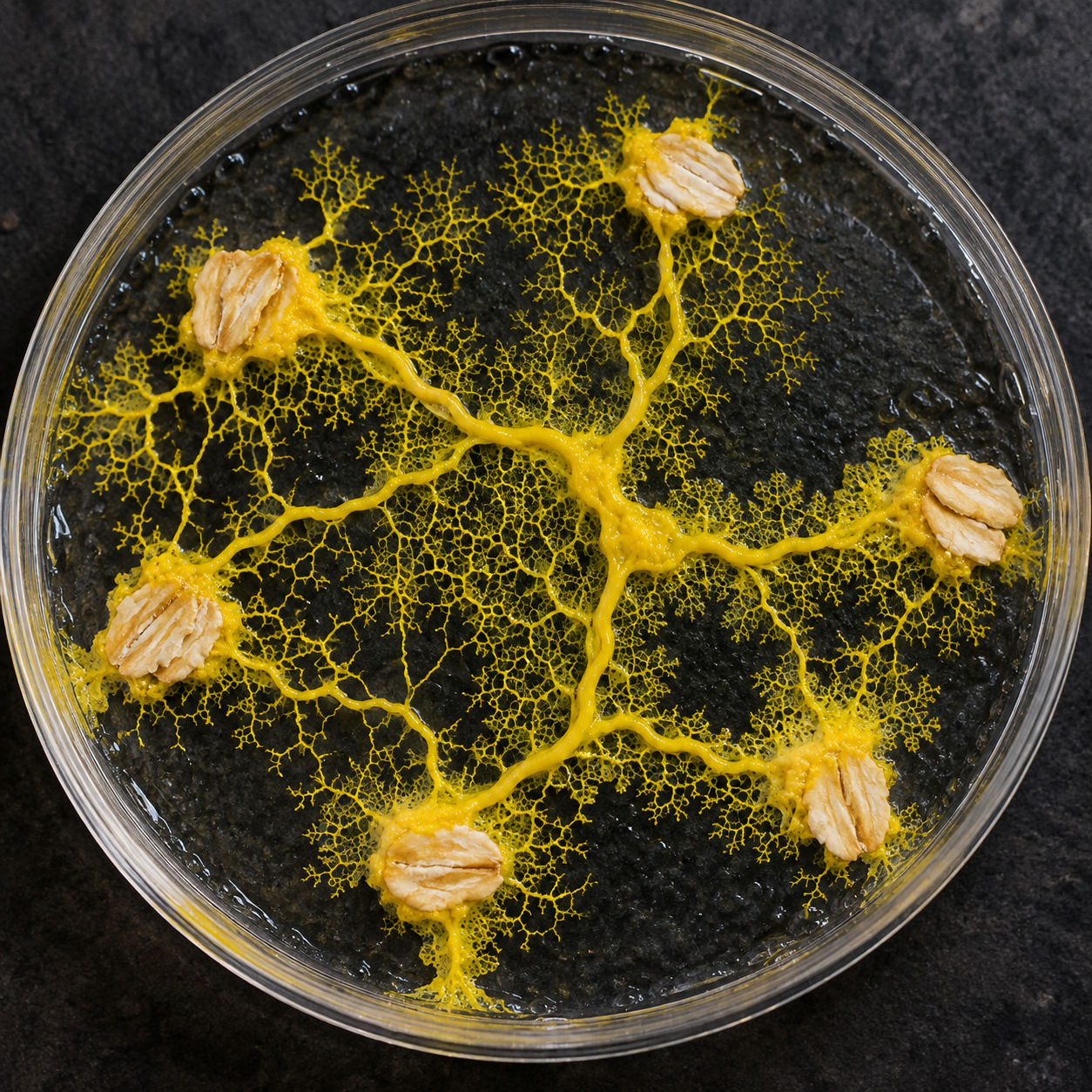
A yellow network spreads across a surface, linking patches of food. Later, some tubes have thickened and others have disappeared. The route is not a map left by a traveling organism. It is the changing body of Physarum polycephalum itself, an organism that reorganizes how its material reaches nourishment.

A yellow slime mold network connects oat flakes inside a round laboratory dish.
A conceptual feeding network of Physarum connecting oat flakes; this is not an image of the Tokyo experiment.

Despite the name slime mold, Physarum is not a fungus. Its feeding plasmodium is a large cell containing many nuclei. It has no brain or neurons, yet can adjust to complicated spatial conditions. The interesting question is how local processes within a living body generate an organized result, rather than where a tiny planner might be hiding.

A maze experiment begins with a body already spread out

Toshiyuki Nakagaki and colleagues studied path finding by placing nutrients at two selected positions in a maze occupied by an extended plasmodium. The organism withdrew from dead ends and reorganized into a connecting tube along a short route. The setup matters: this was not simply a tiny creature standing at the entrance and mentally choosing its first turn.

Food locations changed which parts of the existing body were retained and reinforced. The final route emerged as other possibilities diminished. An endpoint photograph can make the process look like drawing a correct line through a puzzle. The experimental sequence shows something different: exploration and refinement through changes in living material.

That difference is useful when reading any maze headline. Ask where the organism started, what information it could encounter and what counted as success. Finding a route, retaining the shortest route and learning a route across repeated trials are different experimental questions. The word “solved” can hide those distinctions unless the method comes with it.

A transport network has more than one good property

In a 2010 study, Atsushi Tero and colleagues arranged food sources to represent urban locations around Tokyo and compared the resulting networks with rail infrastructure. The slime mold achieved a comparable balance among selected measures of cost, transport efficiency and tolerance of damage. It did not recreate every engineering or social requirement of a real railway.

A network's economy is not the same as the shortest journey through it. Connecting everything with very little material can create long detours. Adding an alternate connection costs material but can preserve access after a break. The study is interesting because those goals compete, leaving a range of useful compromises rather than one obviously perfect design.

Try the four-corner problem

Imagine four places at the corners of a square, labeled A, B, C and D clockwise. Allow links only along the sides, with every side costing one unit and taking one unit to traverse. Compare two designs: the chain A–B–C–D, and the same chain with an additional D–A link closing the loop.

Before reading the table, answer three questions. Which design costs less? What is the longest shortest trip between any pair of places? And can every place still reach every other after any one link breaks? Count trips along links, not straight through the square's interior. This is an invented puzzle with stated rules, not a reconstruction of the Tokyo experiment.

Four equal sides, two network choices
DesignTotal link costLongest shortest tripAll places connected after any one break?
Chain A–B–C–D3 units3 stepsNo
Loop A–B–C–D–A4 units2 stepsYes

The loop spends one extra unit to improve the worst trip and provide a fallback route. After a break it becomes a chain, so journeys may lengthen even though everything remains connected. If construction material is scarce, the cheaper design may still have an advantage. The preferred answer depends on how strongly you value cost, distance and failure resistance.

Now imagine that food at D disappears. A fixed diagram remains unchanged unless someone edits it. A living network can redistribute material as conditions change. That continuing adjustment is one reason biological networks interest researchers: the construction process and later maintenance are parts of the same active system.

Flow and tube shape influence one another

The tubes contain moving cytoplasm. Rhythmic contractions drive internal flow, and their changing diameters affect how that flow is distributed. Nutrient encounters can alter contractions and tube architecture. Feedback between transport and structure helps explain how a response can become coordinated without an observer outside the organism directing every connection.

Mirna Kramar and Karen Alim investigated tube-diameter changes following a nutrient stimulus in 2021. They combined experiments with a model in which a locally released softening influence spreads through flows, favoring the enlargement of some tubes at the expense of others. Their interpretation described the resulting architecture as a form of memory of nutrient location.

That use of “memory” has been debated in a published critique. Demonstrated remodeling in response to nutrients is more specific than a claim of human-like recollection or consciousness. You can appreciate the experimentally observed relationship between food, flow and shape while keeping stronger cognitive interpretations as separate questions.

The solver is part of the solution

Oxford researcher Mark Fricker describes mathematical models that capture core features of these adaptive networks. A useful model identifies mechanisms sufficient to reproduce particular behavior; it need not reproduce every property of the organism. Comparing a model with observations can reveal which assumptions explain the network and which need revision.

The yellow tubes challenge a familiar expectation that organized problem solving must begin with a central representation of the whole task. Here, sensing, movement and the route itself are embodied in changing material. Understanding that process does not require deciding whether every successful adjustment deserves the word intelligence. It requires watching how the organism's next form grows from its current connections.

Explore more creative curiosity at Incoprea.

publications

New this week Two novels in six stories each, from The Night Shift . New — a novel in six documents Small Print A Novel in Six Do...