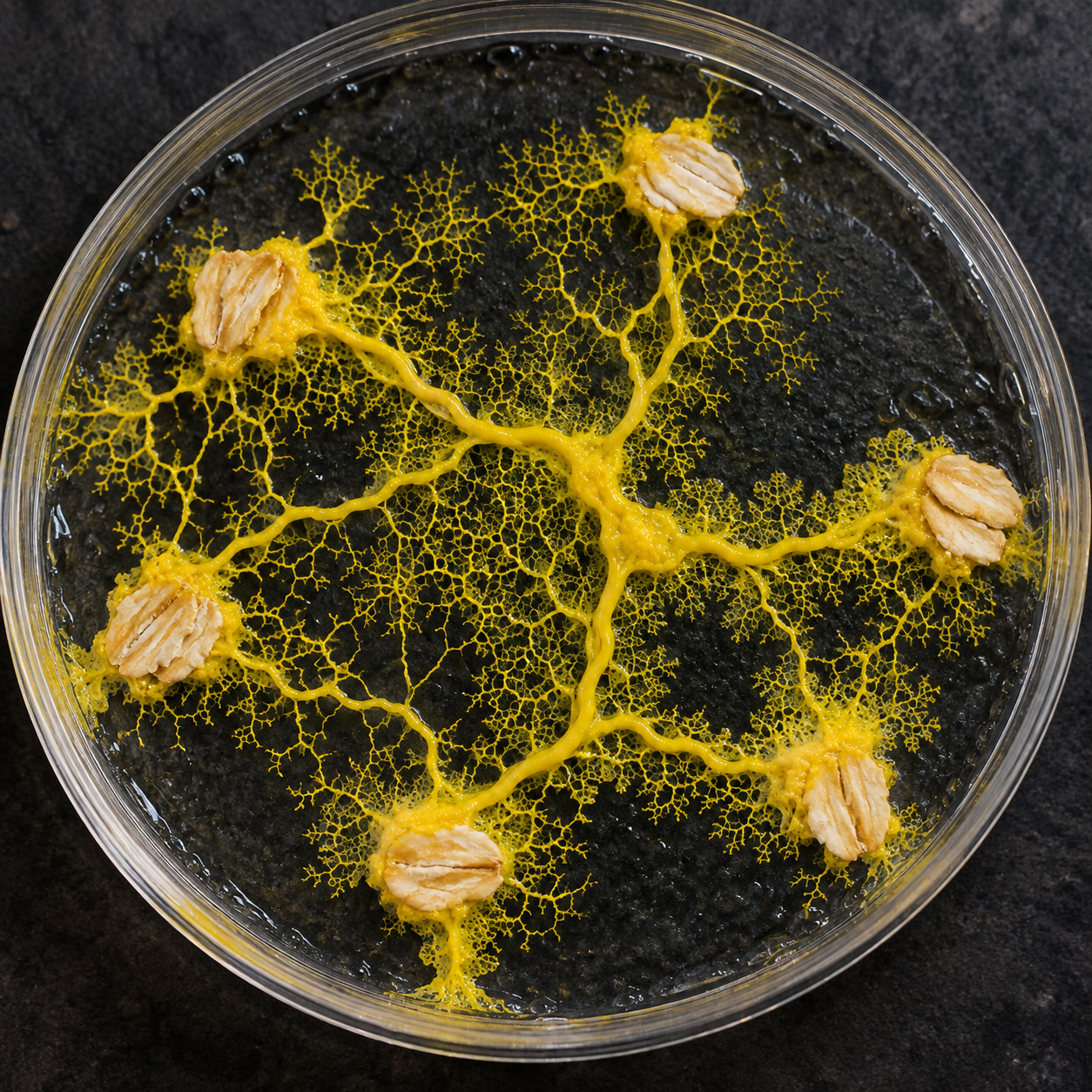
Place a few oat flakes around a laboratory dish, add a golden slime mold, and wait. A branching yellow network spreads across the surface. Some connections thicken, others disappear, and the resulting structure can resemble a small transport system. There is no tiny planner hidden inside.
The organism often used in these experiments is Physarum polycephalum. During its feeding stage, it forms a large, many-nucleated cell called a plasmodium. Despite the familiar name, it is not a fungus. It has no brain or neurons, yet its changing body can produce solutions to surprisingly complicated spatial problems.
Food turns the dish into a network problem
In a well-known 2010 study, researchers arranged food sources to represent cities around Tokyo. They compared the slime mold's connecting tubes with the region's railway network. The organism produced networks with a comparable balance of efficiency, cost, and tolerance of broken connections.
The careful wording is “comparable balance.” The mold did not discover Tokyo's exact railway plan, read a timetable, or solve every engineering problem faced by a city. Researchers created a simplified landscape with food in selected positions and measured particular network properties. Within that controlled task, the biological network performed impressively.
A shortest possible connection is not always the most useful network. Adding an alternative route costs material but can preserve a connection when one branch fails. This tradeoff between economy and resilience is relevant to both living networks and human infrastructure.
Its body is part of the computation
The tubes carry flowing cell contents. As conditions change, the organism redistributes its material and changes the thickness and arrangement of connections. Researchers can capture important parts of this adaptive behavior in mathematical models, using local feedback rather than an all-knowing central controller.
Earlier maze experiments exposed a related ability. When food was supplied at two locations within a maze, Physarum could reorganize into a connecting tube along a short route. An initially widespread body was refined into a more economical connection.
For the mold, the practical goal is feeding and surviving. “Solving a maze” describes the experiment from our viewpoint. The animal-like language is convenient, but there is no evidence that the organism pictures the maze in its mind as a person might.
A useful challenge to our assumptions
It is tempting to call every successful behavior intelligence, or to reserve that word only for brains. Slime mold research makes the disagreement productive. It shows that organized, adaptable behavior can arise through interactions among chemistry, movement, geometry, and the environment.
That does not make a slime mold conscious. It does make it an excellent subject for studying decentralized systems. A network can adjust through many small local changes, without a manager inspecting the whole structure.
The yellow web in the dish is compelling because the solution and the solver are the same changing material. What looks like a drawn route is alive, and what looks like deliberation can emerge from a body continually responding to where nourishment flows.
Sources and further reading: Tero and colleagues: Rules for Biologically Inspired Adaptive Network Design; Oxford: Mark Fricker's slime mold network research; Nakagaki and colleagues: Path finding by tube morphogenesis.
Explore more creative work at Incoprea.