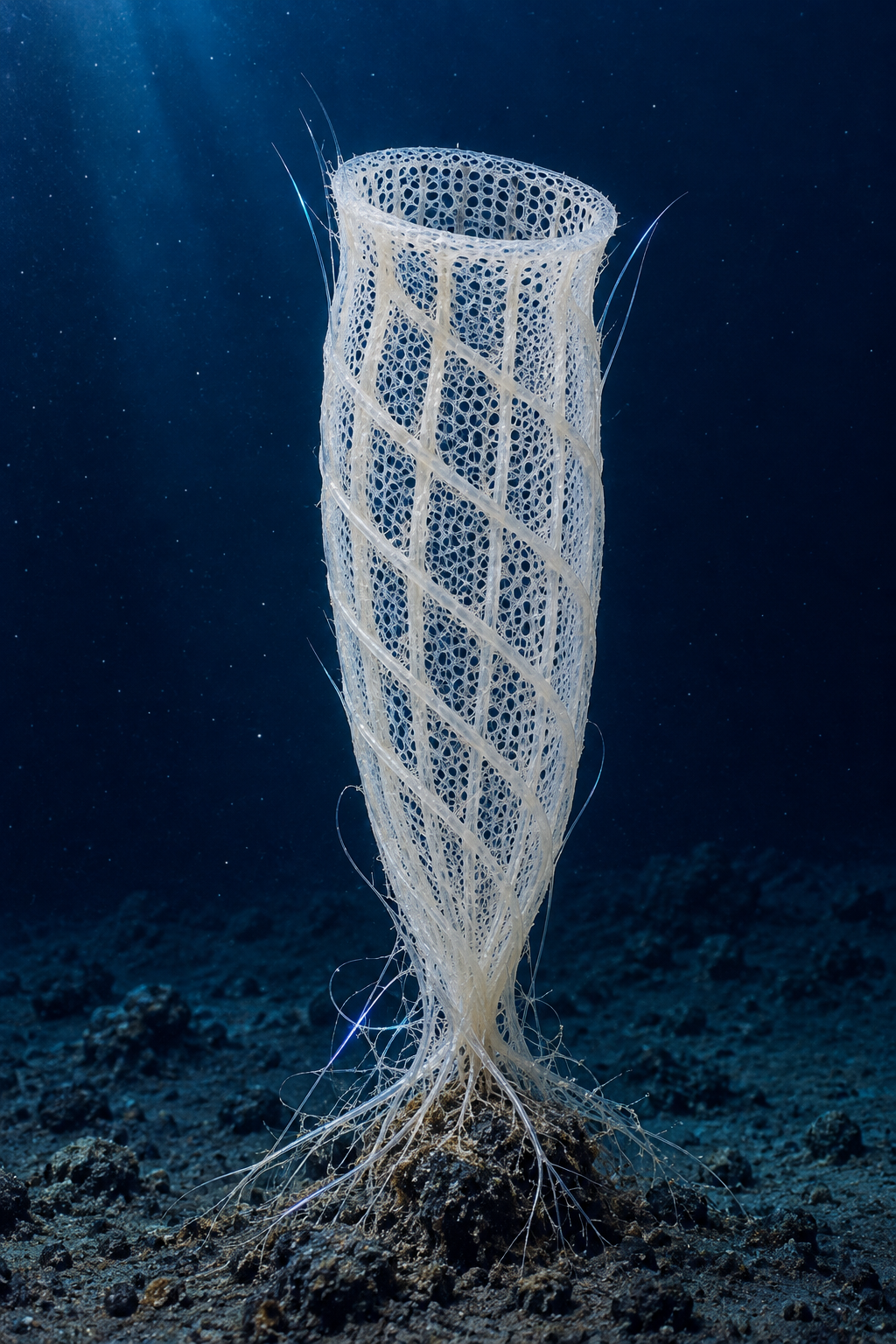
At first glance, a Venus' flower basket looks like a delicate vase woven from pale thread. It is actually the skeleton of a deep-sea sponge. The apparent threads are made largely of silica, the material at the heart of ordinary glass, arranged into an elaborate biological structure.
This animal has attracted scientists for two different reasons. Its basket-like framework resists mechanical damage, and some of its slender anchoring structures can guide light. A creature with no workshop produces a material that invites comparison with both architecture and optical engineering.
An animal made for moving water
Sponges are animals, although an adult sponge does not chase food around. Water flowing through the body supplies suspended food and oxygen. Their structures belong to that watery way of life, rather than to the ornamental purposes we see in them.
Glass sponges have silica-based skeletal elements called spicules. In the genus Euplectella, these elements join into a lattice with reinforcing patterns at several scales. The result combines thin components into a surprisingly effective whole. A fine strand can be fragile; a carefully organized network of strands can behave very differently.
The outer form is only the beginning. As materials scientist Joanna Aizenberg's work emphasizes, biological materials often achieve their properties through layers, interfaces, and geometry, rather than through one exceptional substance.
Follow the structure from basket to strand
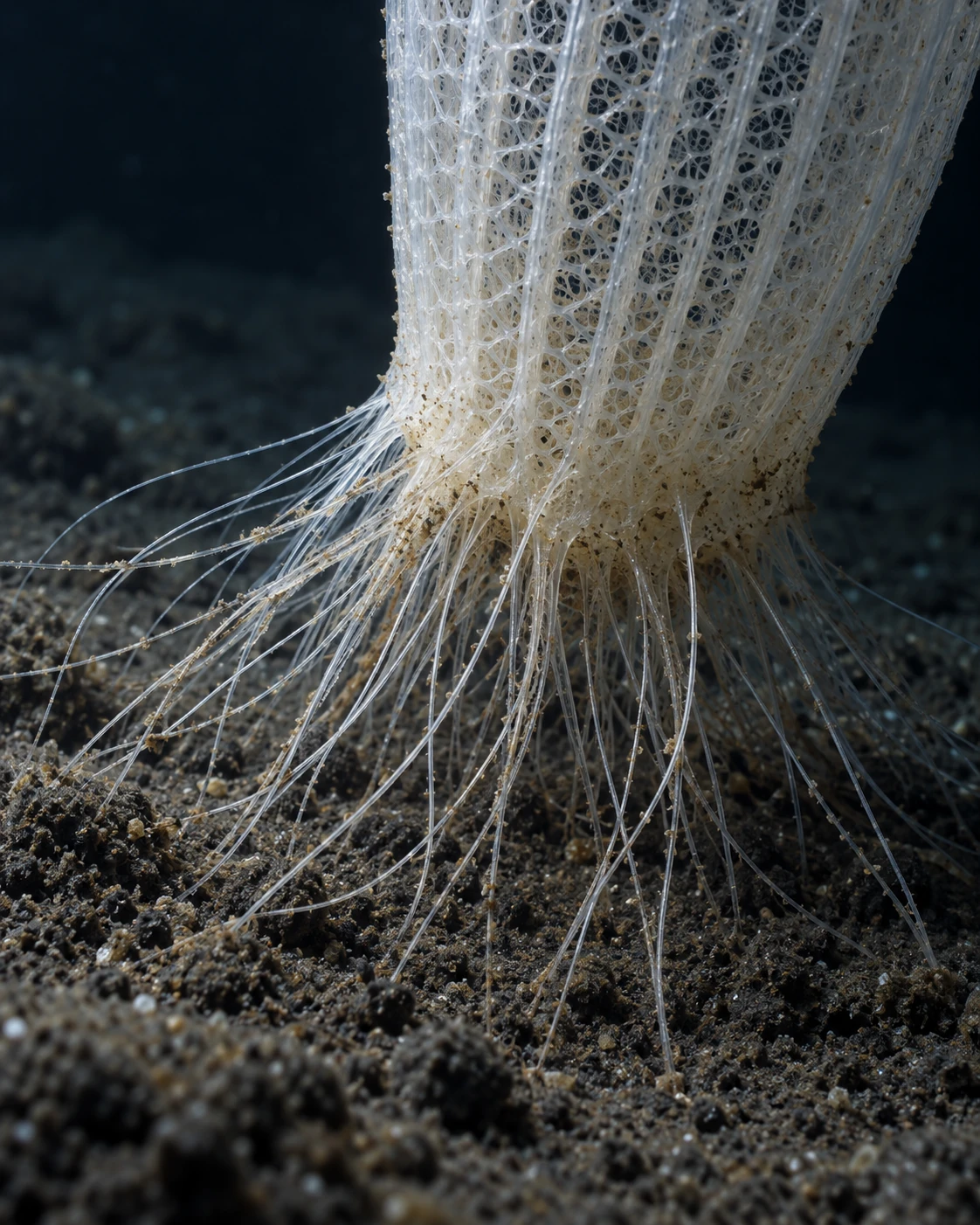
The vase-like outline and the long anchoring spicules are different parts of the animal's skeletal system. A description of one measured fiber should not be transferred automatically to every segment of the basket wall. Before comparing the sponge with a manufactured device, identify which structure the study actually examined.
The lattice supplies a larger-scale lesson. Connecting slender elements in a repeating framework can change how the whole responds to loading. At a smaller scale, layers and interfaces within a strand can influence how a crack travels. Material chemistry, internal architecture and the arrangement of parts contribute at different levels.
This makes a useful comparison with an ordinary bundle of glass threads. Putting the same material into a pile would not reproduce the basket's geometry. Drawing the same basket silhouette with a different material would not reproduce every property of the silica and its organic interfaces. Neither shape nor ingredients alone finishes the account.
The fibers inside the basket story
A 2003 Nature study examined long anchoring spicules from Euplectella. Researchers measured a refractive-index structure resembling the core and surrounding cladding of manufactured optical fibers. Experiments confirmed that the spicules could act as waveguides, directing light through their structure.
They also found a layered construction with organic material at interfaces. Such interfaces can help interrupt crack growth. That gives researchers a useful combination to investigate: glassy fibers that carry light and have structural features associated with resistance to fracture.
The sponge builds these structures under ambient biological conditions. Industrial glass-making and fiber production commonly involve much higher temperatures. Understanding biological fabrication offers ideas for making useful materials in different ways.
The anchoring spicules described in the 2003 report were generally 5–15 centimeters long and only 40–70 micrometers across. Their slenderness explains why a whole-basket picture can hide the structure being studied. Investigating an individual strand requires moving from the animal’s visible outline to a much finer physical scale.
Guiding light depends on boundaries as well as glass
The 2003 study measured how refractive index varied across anchoring spicules and tested transmission. A higher-index region surrounded by lower-index material can help confine light. This arrangement is the basis of the comparison with a core and cladding, rather than the mere fact that a long object looks transparent.
The experimental surroundings also mattered. Embedded spicules and free-standing spicules in air showed different distributions of the guided light. In air, the greater optical contrast at the outer boundary could involve much more of the strand. The result is a reminder that an optical component's behavior depends on what surrounds it and how light enters it.
For a close reading, separate three pieces of the paper's evidence: the cross-sectional structure, the refractive-index profile and the transmission observations. A structural image alone suggests a possible mechanism. Measuring the optical profile and sending light through the material test whether the suggestion works.
The layered interfaces add a mechanical question alongside the optical one. A crack that encounters a change in material or organization may be interrupted or redirected, affecting fracture behavior. That does not turn a delicate natural fiber into an unbreakable cable. It gives researchers a specific architecture to investigate rather than a vague claim that natural glass is always superior.
Finally, keep the laboratory measurement separate from an evolutionary explanation. A material can have a measurable optical property without that property having been selected for communication. The open question about biological purpose does not weaken the transmission result; it identifies a different claim that needs its own evidence. The sponge is most revealing when its architecture and optical behavior are examined precisely, rather than turned into an imagined underwater telecommunications network.
Sources and further reading: Aizenberg and colleagues: Fibre-optical features of a glass sponge · Harvard: Scientists explore nature's designs · NOAA: What is a glass sponge?




