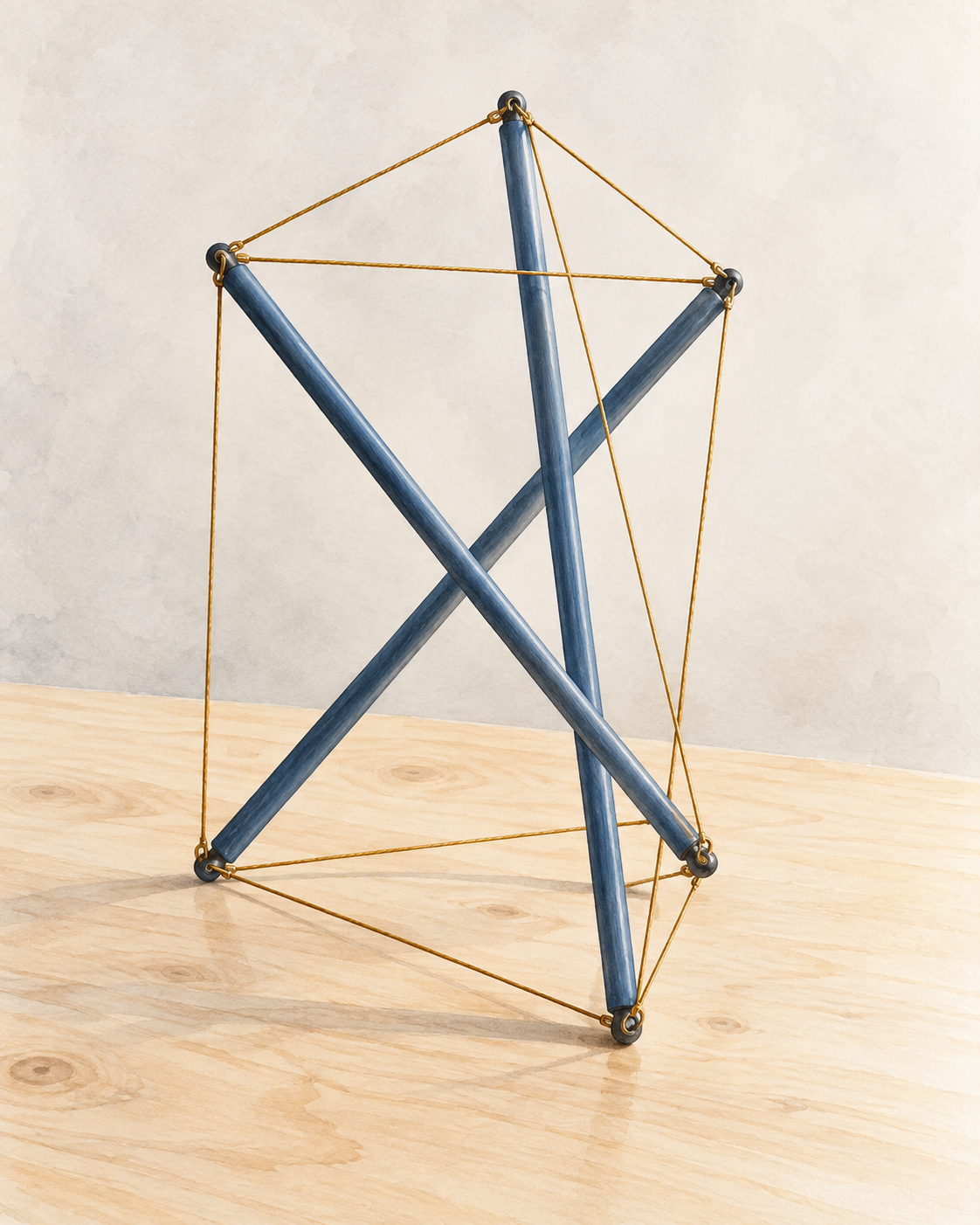
A skeletal arrangement of rods and cables can look as though its solid pieces ought to fall apart. Follow the cables, and the apparent puzzle becomes a structural system: the parts pulling against one another help keep the whole shape together.
This is the appeal of tensegrity. An open structure can balance tension and compression in a way that produces both striking sculpture and useful engineering questions.
A connected network holds separated pieces
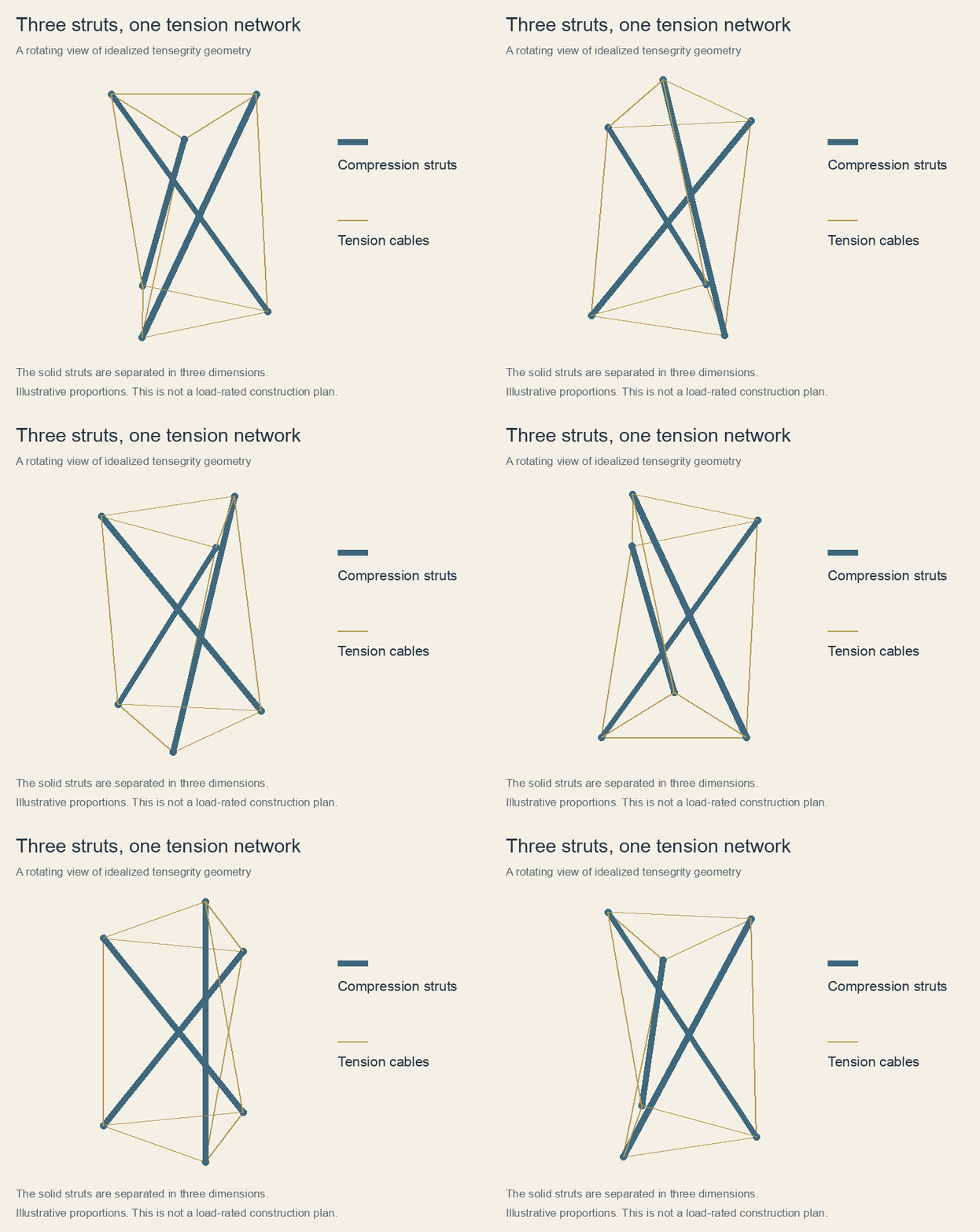
In the familiar Snelson-style form, rigid compression members are separated within a continuous tension network. The rods resist being shortened; the cables pull between their attachment points. The solid members need not stack directly on one another.
Looking from a single angle can obscure the arrangement. Two rods may cross in a photograph while passing at different depths in space. Moving around a model reveals how the cable network connects the ends and how the struts remain separate.
The tension is part of the structure's condition. A collection of loose strings and rods has the same ingredients, but it does not necessarily have the same stability. Geometry and the forces carried by the members must work together.
An artist made the structural puzzle visible
Kenneth Snelson explored such arrangements in sculptures that turned engineering relationships into a visual experience. The Smithsonian's Archives of American Art documents his work, including towers, drawings, project records and patents.
Snelson studied at Black Mountain College during the summers of 1948 and 1949, where his teachers included Buckminster Fuller and Josef Albers. His subsequent career also encompassed photography and early computer art.
The Hirshhorn's collection records Needle Tower, made in 1968 from aluminum and stainless steel. Its listed height is 720 inches, or 60 feet. The open outline lets a viewer notice both the material and the spaces through which the system extends.
A small classroom model and a large sculpture share an interesting question: how can visibly separate rigid pieces participate in one coherent structure? The answer becomes easier to appreciate when the thin connecting elements receive as much attention as the rods.
The network can protect a payload
NASA has investigated tensegrity robots as possible landing and mobility platforms. The Super Ball Bot research considered structures that could absorb impact, protect instruments and change configuration to move.
The proposal's objectives included building rolling hardware and developing controls for navigation and difficult terrain. These were research goals, rather than evidence that a tensegrity robot had already been deployed on another planet.
A 2023 NASA account described a related terrestrial application from Squishy Robotics: sensor-equipped structures that could be dropped into difficult areas to gather information for responders. The account distinguished the company's stationary devices from mobile systems under development.
The structural principle therefore offers more than an illusion of floating bars. Its network can distribute forces around a protected center, while deliberate changes in shape provide another avenue for experimentation. What begins as a visual puzzle becomes a way to think about how a structure can hold, yield and recover.
Sources and further reading: Smithsonian: Kenneth Snelson papers; Hirshhorn: Needle Tower collection record; NASA: Super Ball Bot research proposal; NASA: Tensegrity sensor robots and terrestrial applications.
Explore more creative work at Incoprea.




