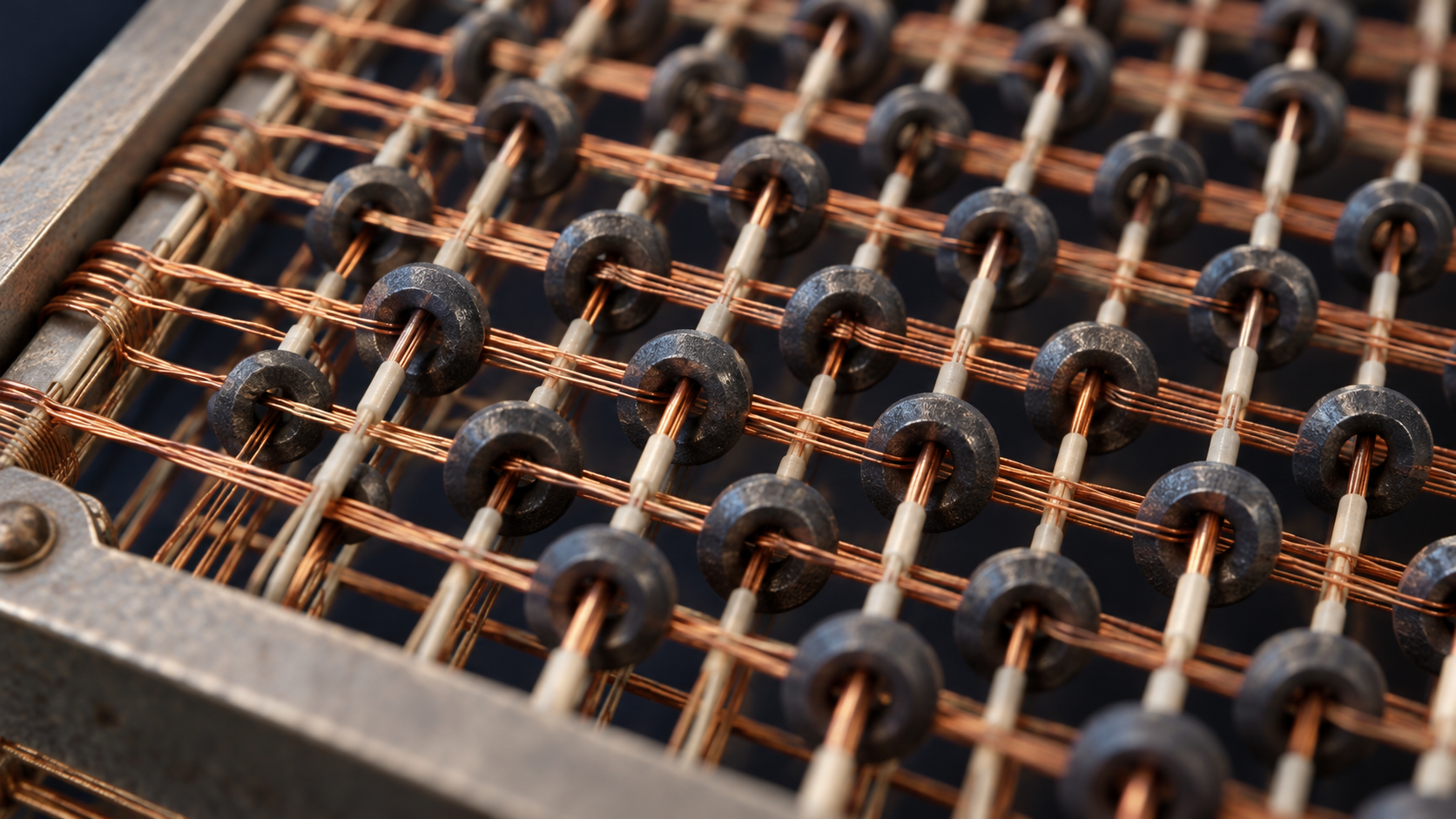
Before memory became a collection of microscopic devices on a silicon chip, a computer could remember with tiny magnetic rings. Viewed close up, a core-memory plane resembles an intricate woven surface: wires threaded through ferrite rings, each carrying a small piece of information.
The construction makes a digital idea unusually tangible. A bit has a place in a physical grid, and changing a magnetic state changes the information stored there.
One ring can represent one bit
A core can be magnetized in two opposite directions, assigned the meanings zero and one. A plane contains many such cores, with wires arranged to select and operate on them. The wire network is essential to the memory, rather than merely a way to fasten its parts together.
The Computer History Museum places core memory in MIT's Whirlwind computer in 1953. It credits Jay Forrester with perfecting the technology while acknowledging that several inventors contributed to its development.
The underlying idea separates a value from its ordinary appearance. A ring need not visibly change color or position when a bit changes. Electronics create and detect the magnetic condition that encodes the value.
Reading changes what is stored
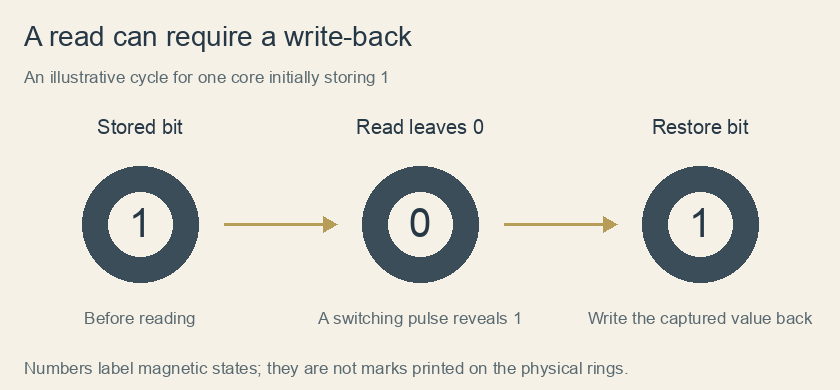
Ken Shirriff's direct examination of an IBM 1401 core module explains a particularly surprising feature. Selected currents in crossing address wires operate on the chosen core. During a read, the circuitry drives it toward the zero state.
If the core previously held one, switching its magnetization produces a signal in a sense wire. If it already held zero, that switching signal is absent. The electronics can distinguish the former value, but the read has left the core at zero.
The system therefore writes the desired value back. “Destructive read” describes this controlled change of state, rather than physical damage to the ferrite ring. Reading and restoring are cooperating parts of the memory operation.
The process turns measurement into an active event. The circuit learns a value through a change, then uses the captured result to restore the information.
Manufacturing mattered as much as the clever bit
IBM's history of dynamic random-access memory describes magnetic-core storage in the mid-1960s as arrays of hundreds of thousands of ferrite elements laced with thin wires. By then, assembly had become highly automated.
That detail corrects the tempting image of an entire era depending exclusively on people threading every ring by hand. The technology developed along with methods for producing it, while its density, cost and performance still faced practical limits.
Semiconductor approaches offered a route to placing memory elements on chips. Robert Dennard's work on dynamic memory used a different storage arrangement, with charge and an integrated device taking the role previously served by an individually wired magnetic core.
The older grid remains fascinating because it exposes the physical work behind remembering. Its rings show how a computer's abstract zeros and ones can arise from material states, carefully selected currents and a sequence that even includes repairing the information after it has been read.
Sources and further reading: Computer History Museum: Memory and storage timeline; Ken Shirriff: Direct examination of IBM 1401 core memory; IBM: Magnetic-core manufacturing and the development of DRAM.
Explore more creative work at Incoprea.




