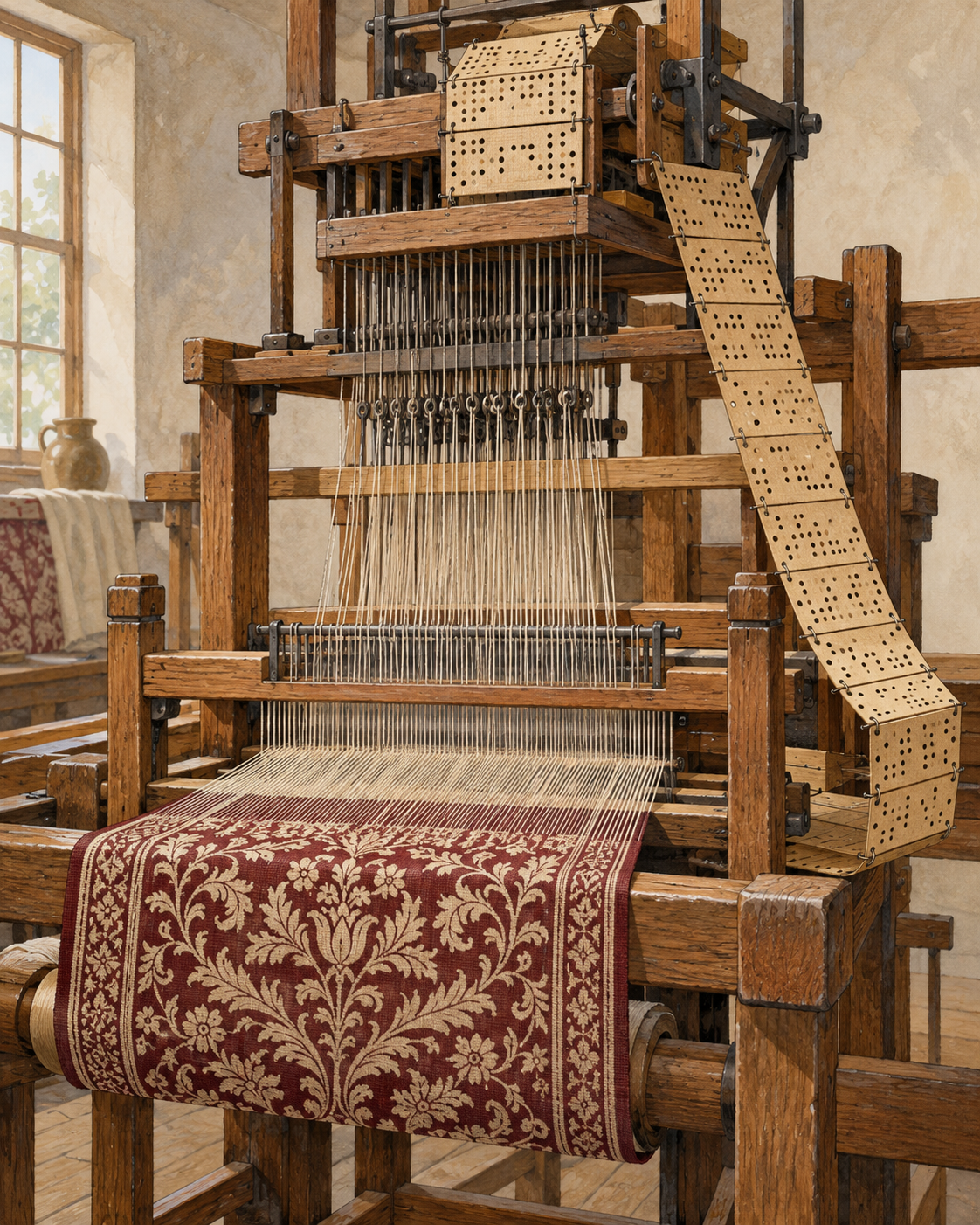
A woven flower can begin as a sequence of holes in stiff cards. In a mechanical Jacquard system, those holes help control which warp threads are raised, turning stored instructions into a pattern that gradually appears in cloth.
The card chain is striking because the design exists in two forms at once: a sequence the machine can read and a textile someone can wear or display. The connection helped inspire later ideas about programmable calculation.
Small decisions accumulate into a pattern
A loom interlaces warp and weft. Producing a complex pattern requires selecting particular warp threads as weaving proceeds. A Jacquard attachment automates that selection through a mechanism responding to punched cards.
The Science Museum Group describes holes controlling a task previously carried out by a weaver's assistant. The pattern is distributed across the card sequence, so the order of the cards matters as much as the arrangement of holes on one card.
The museum also preserves a hand-operated hole punch made for a model Coventry ribbon loom in 1870. That modest tool is a useful reminder that the instructions themselves had to be produced. A machine-readable pattern still depended on preparation and care.
The information can be separated from the cloth
National Museums Scotland's historical handloom has a Jacquard attachment and came from silk weaving in Stonehouse, Lanarkshire. Its account describes thousands of cards laced together for complex designs, with rows of holes corresponding to rows in a textile pattern.
The arrangement lets a pattern be stored outside the woven object. A sequence can guide repeated production, while a different sequence gives the mechanism different selections to make. The physical machine and the instructions are connected, but they are not the same thing.
| Part of the process | Its role |
|---|---|
| Pattern design | Specifies the intended arrangement |
| Punched-card sequence | Stores selections the mechanism can read |
| Weaving | Turns those selections into cloth |
The textile is therefore evidence of both material skill and organized information. Its flowers and geometric forms are the visible outcome of decisions made earlier.
A loom suggested another kind of machine
Charles Babbage drew on the Jacquard system when developing plans for his Analytical Engine. The Science Museum's discussion of those plans identifies punched-card input alongside calculating and memory mechanisms.
The proposed engine would have handled calculations with mechanical parts such as gears, cams and clutches. The analogy to weaving concerned how instructions could guide a sequence of operations, rather than a loom already performing general-purpose arithmetic.
A museum account of the Jacquard-computing connection shows how a drawn pattern could be transferred to cards and read by the loom head. That passage between representation and action is the especially interesting feature: marks on one medium determine what a machine does in another.
A card can look plain beside the rich fabric it helps create. Yet the holes are part of the beauty's production history. They make a pattern portable, repeatable and available to a mechanism—an early, concrete example of instructions becoming physical results.
See the mechanism: The Science and Industry Museum includes a film explaining the loom-computing connection.
Sources and further reading: Science Museum Group: Jacquard-card hole punch; National Museums Scotland: Jacquard weaving and computing; Science Museum: Babbage's engine plans and punched-card input; Science and Industry Museum: Weaving numbers.
Explore more creative work at Incoprea.




