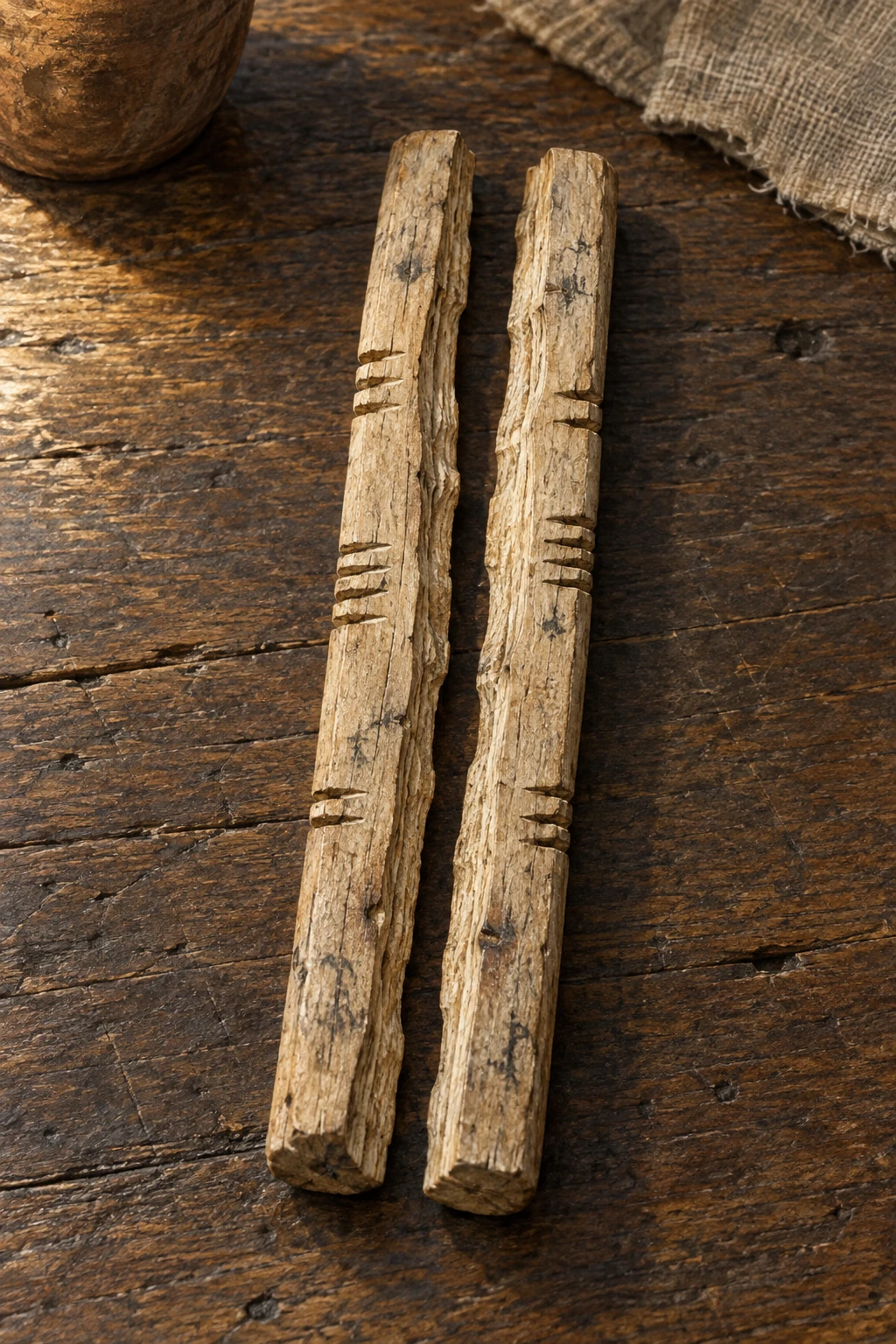
Imagine being asked to prove that a payment had been made, with neither a screen to consult nor a paper receipt in your pocket. You bring out a thin piece of notched wood. Someone else retrieves its partner. The two pieces meet along a split, and the record becomes a physical comparison.
A split tally is wonderfully direct, but it is more interesting than the familiar claim that medieval people “used sticks as money.” It combines a number, a material, a procedure, and an institution willing to recognize the result. Look at those four things separately and an apparently primitive object becomes a sophisticated answer to a specific administrative problem.
One record, two custodians
The National Archives’ financial-record glossary defines a tally as a notched stick split in two, with one half retained at the Exchequer and another given to a collector receiving credit for payment. The Exchequer was the government’s financial department. Wood was therefore participating in a system that also involved officials, accounts, and written records.
The important move was to mark one object before separating it. In a modern explanation of a surviving example, the Bank of England Museum points out why the sequence mattered: extra notches cut later in one half would fail to appear on the other. A comparison could reveal an alteration.
This does not make the tally a magic fraud-proof machine. It protects a particular relationship between two physical records. It cannot independently tell you whether an official entered the right sum at the start, whether a transaction was legitimate, or whether the institution later treated the holder fairly. Those are different questions, requiring different evidence.
The wood is only part of the document
A tally was not necessarily an anonymous row of cuts. A British Museum specimen preserves one full-length half, 25 large notches, and an ink label; it is 117.5 centimetres long. Its length alone is a useful antidote to imagining every tally as a little pocket token. Surviving objects need to be examined individually.
The label and the notches perform different jobs. A notch can register a value without expressing a person’s name, a place, a date, or the circumstances of the entry. Writing can supply information that the cut pattern does not. A split surface supplies another sort of information again: a possible relationship between this half and another object.
When a museum photograph shows only one face, it may conceal precisely the surfaces you most want to compare. That is a practical reading lesson. Ask which face is being shown, whether a partner survives, whether the catalog transcribes an inscription, and whether damage has removed part of the original record. An attractive photograph is an invitation to read the catalog, not a substitute for it.
A real audit could still go wrong
The National Archives’ account of fourteenth-century Irish Exchequer records describes payments made without the expected tally authorization and other tallies made incorrectly. The records concern the troubled accounts of Alexander Bicknor’s period as treasurer. Surviving rolls allowed officials, and now historians, to examine administrative failure.
That example changes the story. The interesting historical question is not simply whether a clever device existed. It is whether people followed the procedure, checked the result, preserved the evidence, and could challenge a discrepancy. A tally gains meaning from the work around it.
The Archives’ guide to pipe rolls explains that these written records preserve the audit of the monarchy’s accounts for a financial year. The wooden objects and the written audit should be thought about together. They are different components of the same broad effort to make obligations visible and accountable.
Try the matching principle, without a knife
This simple paper exercise models one feature of the tally. It is an analogy, not a reconstruction of medieval accounting practice.
- Draw an uneven line across a strip of scrap paper. Place several marks across the line so that each mark has a portion on either side.
- Tear the strip along that line and give one half to a partner. Keep the other.
- On your half alone, add another mark that ends at the torn edge.
- Bring the halves back together. Compare both the torn contour and the marks crossing it.
The unmatched mark is easy to spot. Now consider a harder problem: what if the two of you wrote the wrong number before tearing the paper? The fit would still be excellent. Physical agreement proves agreement between the records; it does not prove the truth of every claim recorded on them.
That distinction travels well beyond medieval history. Whenever a system advertises a strong check, ask what the check actually checks. Matching, identity, authorization, and correctness are related tasks, but they are not interchangeable.
Size changes the question
Two collection records make a revealing pair. A Science Museum Group medieval stock measures 174 millimetres along its longest dimension. Its 1822 stock-and-foil set includes a stock 580 millimetres long and a foil 465 millimetres long. These are separate objects from different dates. The comparison is useful because it stops the mental picture of “a tally” from settling into one standard size or two perfectly equal halves.

Try giving the objects a physical scale without copying their marks. Lay an ordinary measuring tape on a table and locate 17.4, 46.5, and 58 centimetres. Then close the catalog photographs and imagine storing twenty records of each length. A record is something an institution must put somewhere, retrieve, carry to a comparison, and keep associated with the right account. Those practical questions become harder to ignore once the wood occupies real space.
The stock-and-foil terminology also makes the two custodians visible. The catalog identifies the stock as the longer portion and the foil as the shorter one. Length is not a substitute for knowing the procedure, however. A detached object in a case cannot tell us who most recently presented it, whether its partner survived, or whether anyone actually performed the check when a dispute arose.
The short exercise below tests three different kinds of agreement. Its descriptions are invented examples, with no medieval denomination code. First ask whether two records match. Then ask whether the recorded event is supported. Finally ask whether the person presenting the record has an established claim. A strong answer to one question leaves the others open.
What does a match establish?
Three fictional evidence cases distinguish agreement, truth, and entitlement.
Notice the asymmetry between a successful comparison and a failed one. A mismatch gives a specific reason to investigate; a match removes that particular objection. It does not close every possible investigation. This is the intellectually interesting part of the stick: it turns one large, vague question about trust into a smaller question that two people can actually inspect together.
On returning to an authentic specimen, check whether its record supplies a partner, dimensions, inscription, date, and collection history. Missing information is not a defect in your visit. It tells you which of those questions the surviving object can presently help answer.
A long life, followed by a disastrous disposal
The Bank of England’s collection includes a tally recording one of its first loans to government in 1694. Tallies therefore belong to a history that extends well beyond the medieval period. Their use in recording obligations does not mean every example circulated in the same way as a coin.
On 16 October 1834, old Exchequer tallies were burned in underfloor stoves at the Palace of Westminster. According to Parliament’s historical account, the stoves ignited panelling in the Lords Chamber and the fire destroyed much of the palace. The famous ending can overwhelm the objects’ working lives. It is worth returning from the flames to the quiet act of comparison: two halves, an entry, and a person asking whether the account agrees.
One final question to keep beside the object is who could demand the comparison. A matching technology only helps a holder if there is somewhere to present it and some recognized process for considering it. That question is a prompt for further historical research, rather than a claim that every tally holder enjoyed equal power.
Sources and a closer look
The National Archives: financial glossary; Bank of England Museum: The Future of Money guide; British Museum: tally OA.9453; The National Archives: Bicknor and the Irish accounts; The National Archives: pipe rolls research guide; Bank of England: payments through time; UK Parliament: destruction by fire, 1834.
Find more art, ideas, and unexpected connections at Incoprea.




