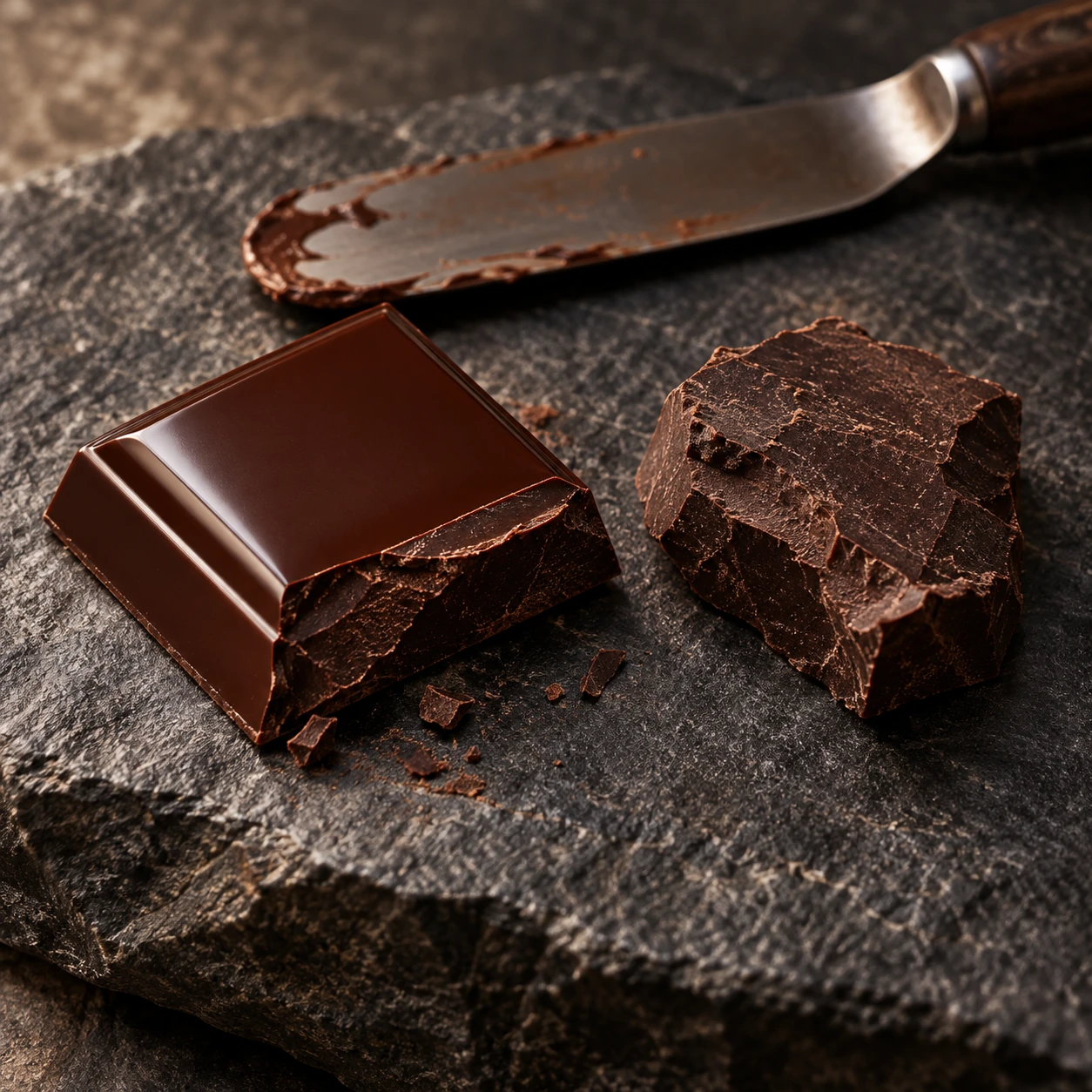
Two pieces of the same chocolate can look and break differently. One has a clean glossy surface and a crisp fracture. Another looks dull or uneven. The ingredient list alone may not explain the difference. The arrangement of the cocoa butter, and the route by which it solidified, belong to the story.
Tempering is often introduced as a sequence of temperatures. That is useful for a particular product, but it can conceal the more interesting idea: a material remembers how it reached its current state. A thermometer gives a present reading. It does not show every crystal already formed inside the chocolate.
Same molecules, different arrangements
The Royal Society of Chemistry's fact sheet introduces cocoa butter's crystal forms and the desirability of Form V in well-tempered chocolate. Polymorphism means that the material can organize into different solid arrangements. Changing that arrangement changes physical behavior without requiring a completely different ingredient.
Imagine the same set of books stacked flat, stood upright, or interlocked in small piles. The objects have not changed identity, but their arrangement changes the structure's properties. Molecular packing is not literally a stack of books; the analogy helps separate composition from organization.
Look again at the hero. You can observe gloss and the shape of a broken edge. You cannot identify Form V from a photograph. Surface appearance can suggest a question about processing, but a microscopic structural claim needs appropriate evidence.
A useful crystal can become a starting point
Tempering encourages a suitable crystal population while managing unwanted arrangements. The maker cares about more than whether the chocolate is currently liquid or solid. Seeds, temperature history, agitation, and time influence how solidification proceeds.
Callebaut's technical teaching material stresses time, temperature, and movement together. Its examples explain why reaching a listed temperature does not guarantee success if the rest of the process differs. Product-specific instructions matter; milk solids and other formulation differences make one universal curve a poor assumption.
Rather than improvising a recipe here, use a thought experiment. Two bowls reach the same final temperature. One contains many useful seeds; the other has a different crystal history. Should they behave identically? A temperature-only explanation predicts yes. A structure-and-history explanation leaves room for different outcomes.
Too simple a story misses the microstructure
In a 2021 original study, researchers investigated minor lipid components and their effects on cocoa-butter and chocolate crystallization. The work illustrates that small constituents and crystal-network organization can matter alongside polymorphic form. It is not a home method for adding laboratory chemicals to chocolate.
This adds a second scale to the question. Which crystal arrangement is present? How are crystals distributed and connected through the material? Two structures can share a broad label while differing in the network that supports a bite. The language of “the right crystal” is a useful introduction, not the entire physics.
Make a modest observation, not a diagnosis
If you already have ordinary chocolate, inspect a small piece at room temperature. Note the surface, the edge, and how it breaks. Use the same product and similar-sized pieces for a comparison. Wash your hands and follow ordinary food handling; this task requires no heating and no tasting.
Write what you actually observe: glossy, matte, streaked, clean fracture, crumbly edge. Do not turn those words into a certainty about crystal form or spoilage. A white surface change can have different causes, and visible appearance alone cannot establish a complete storage or safety history.
A production-history detective exercise
Read a manufacturer's tempering guidance for one named chocolate. Identify which steps erase previous crystals, which encourage crystallization, and which establish a workable fluid state. Keep the maker's exact formulation context beside the instructions. Then ask what information a single final temperature leaves out.
Why the history is worth following
The best question is no longer “How can chocolate be solid at this temperature?” It becomes “Which solid structure formed, and how did the process encourage it?” That shift connects a familiar food to a larger materials idea: controlled sequences can select properties that composition alone does not determine.
On your observation card, put the sample's storage history in a separate column if you know it. Otherwise write unknown. That modest word prevents a rough surface from acquiring a made-up story about overheating or manufacturing failure. Materials can carry history, but they do not always reveal that history unambiguously to the eye.
The next time a square breaks with a satisfying snap, consider the invisible preparation behind that moment. Ingredients supplied the possibilities. A managed history helped choose among them. The result is something you can see, hear, and feel, even though the crystal network itself remains out of sight.
Sources and further exploration: RSC: melting chocolate fact sheet; Callebaut: tempering theory; Nature Communications: minor lipid components.
Explore all 50 new articles · Browse the complete illustrated collection
Explore more art, ideas, and independent projects at Incoprea.


