Showing posts with label Ecology. Show all posts

Sunday, October 25, 2026

The Living Crust That Holds a Desert Together

Between the shrubs of a dry landscape, the ground may look empty until you lower your gaze. A dark film, a pale lichen patch, or a cluster of miniature mosses can belong to biological soil crust. The crust is not one organism. It is a community living at and within the soil’s upper surface, where small structures can influence the behavior of a much larger landscape.

Mosses and lichens cover a dryland soil crust, with a cutaway revealing a conceptual web of filaments below.
An imagined cutaway reveals filaments beneath a surface mosaic of lichens and mosses.

The USGS biocrust research program describes communities that can include cyanobacteria, algae, fungi, lichens, and mosses. Their mixture varies with place and conditions. Some crusts are visually conspicuous; others are difficult for a casual visitor to distinguish from ordinary soil. “Bare-looking” is therefore a description of what an observer sees, not proof that a surface lacks important living cover.

A community can function as infrastructure

In a city, infrastructure supplies conditions that let other activities continue: stable routes, water delivery, and the movement of materials. A biocrust can be considered ecological infrastructure in a limited, useful sense. Filaments and sticky extracellular materials bind soil particles, while the roughness and chemistry of the surface influence what moves across it. This is an analogy about function, not a claim that microbes build toward a shared plan.

The National Park Service introduction explains why even a thin living layer deserves attention. In sparsely vegetated country, retaining surface soil matters because loose particles can leave as dust or sediment. The biological cover occupies the spaces a visitor may otherwise treat as convenient gaps between the “real” plants. Its small height makes it easy to overlook and easy to compress.

Different community members contribute different capacities. Photosynthetic organisms take up carbon, while certain cyanobacteria and cyanobacteria-containing lichens can fix nitrogen. It would be inaccurate to assign nitrogen fixation to every moss or every crust organism. The study of bacterial communities along environmental gradients illustrates how composition varies. A community name describes an association, not a single recipe or a guarantee that all functions occur at the same rate everywhere.

Water does not have one universal route

A crust changes the surface that rainfall encounters. Yet the attractive phrase “a living sponge” can become misleading if it implies that all crusts always increase infiltration. A global synthesis of 2,997 observations examined several hydrological processes separately. On average, greater biocrust cover was associated with reduced sediment production and greater moisture storage, while infiltration responses depended on scale, soil, crust type, and climate.

Some of those effects may sound contradictory until the questions are separated. How quickly does water begin to pond? How much passes into the soil at one small point? How much is retained over a wider area? How much sediment travels with runoff? These are different outcomes. Water that leaves one patch may reach another patch nearby, and reducing eroded soil does not require maximizing infiltration in every square centimetre.

This makes biocrust an excellent lesson in choosing a measurement. If we declare only “more water is better,” we miss where the water goes and what it carries. A field study has to define its patch size, rainfall conditions, soil texture, and comparison surface. The global synthesis is valuable partly because it exposes these differences rather than turning an entire group of communities into a single hydrological mechanism.

Damage is a biological change as well as a broken surface

A footprint can disrupt filaments and compress the structure. Repeated disturbance can also change which organisms remain and how they respond when water returns. A study using metatranscriptomic sequencing examined responses to a wetting pulse after chronic physical disturbance. It followed patterns of expressed biological activity, adding evidence beyond the visible outline of a track. A surface may still look like soil while its living community has changed.

Recovery is consequently not one event with one universal completion date. The return of a microbial film, the recovery of a moss cushion, and the restoration of a previous community’s functions are different milestones. Weather, substrate, nearby sources of colonists, and the severity of disturbance can influence them. A fixed number of years borrowed from one location is a poor promise for another. Protecting intact patches avoids having to solve that uncertain reconstruction afterward.

Next ask what the drawing cannot show. Are filaments present under a surface that looks pale? Which lichens contain nitrogen-fixing partners? Where would a brief shower move dissolved nutrients? These questions turn uncertainty into a research agenda. They also show why a photograph alone cannot substitute for measurements of soil stability, water flow, or community composition.

The crust changes our sense of scale. A feature only millimetres high can help determine whether a patch retains fine soil, how a wetting event unfolds, and which resources remain available afterward. A desert’s functioning is not confined to the tall plants and visible animals. Some of its most consequential work takes place in the apparently empty spaces between them.

Sources and further exploration

Two more connections

Visit Incoprea

Thursday, October 22, 2026

Fig Wasps: A Nursery Hidden Inside a Fruit

A fig looks like a sealed parcel. A bee cannot simply land on its surface and brush against an exposed flower. Yet inside that parcel is a whole inward-facing flowering structure, and for many wild figs the pollinator must enter through a narrow doorway. The result is one of the most intimate plant–insect partnerships on Earth: a nursery that is also a pollination chamber.

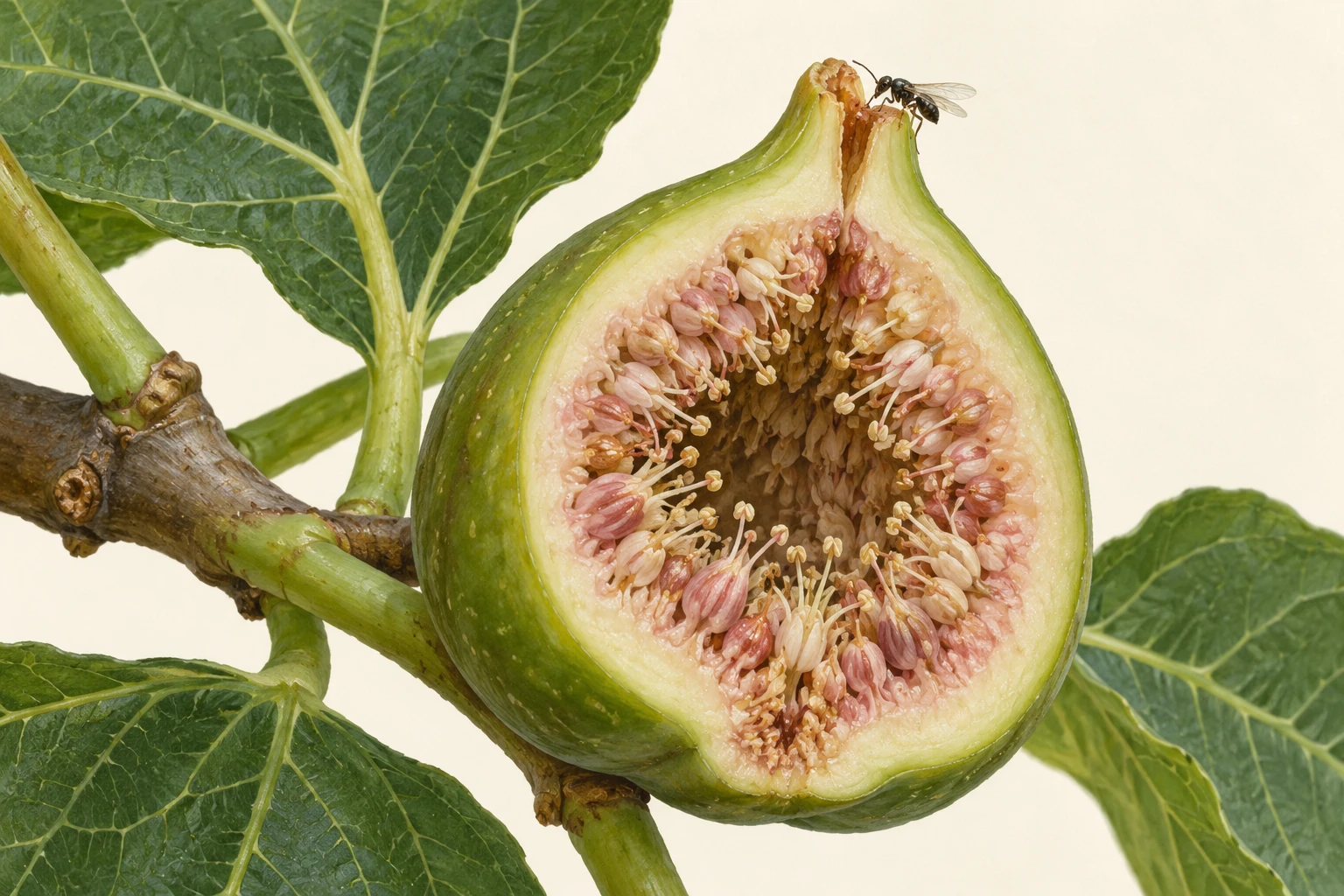
Conceptual cutaway of a green fig showing small inward-facing flowers and a tiny wasp at its opening.
Conceptual botanical cutaway; the wasp and internal structures are illustrative, not a species-identification diagram.

Cutting a ripe fig in half gives a useful first clue, although it does not reveal the whole life cycle. The little structures that seem like seeds belong to numerous tiny individual fruits. The surrounding fleshy structure encloses the flowers from which they develop. Botanists call that enclosed inflorescence a syconium. Kew's common-fig profile explains the arrangement. A fig is therefore not one oversized flower with its petals missing; it is a different way of organizing many flowers.

Finding an entrance to a hidden garden

Female pollinating fig wasps leave the fig in which they developed and search for receptive figs. According to the specialist FigWeb account, host-specific airborne chemicals help guide them. Their target has to be the right kind of fig at the right stage. Finding any green sphere on any tree is not enough.

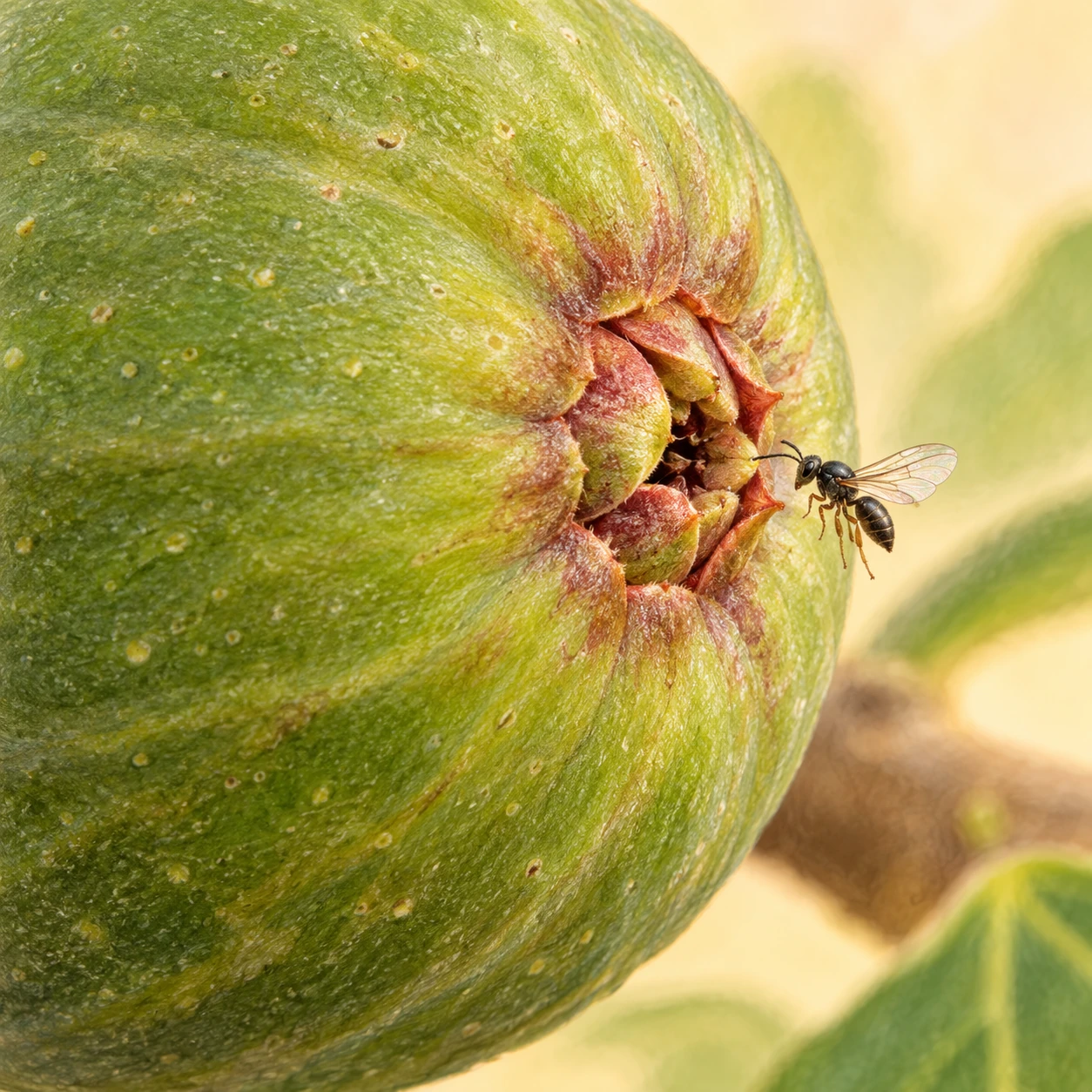
The entry passage, the ostiole, is lined with tightly overlapping bracts. A female's flattened head and thorax help her negotiate it. Once inside, she can pollinate flowers and place eggs in suitable floral structures. This is an awkward place for our usual language of visitors: the insect is not casually stopping for nectar and flying away. Her reproductive future becomes bound to the developing fig, while the tree's reproductive future depends on pollen reaching its hidden flowers.

That dependency should not be flattened into the claim that every fig species has exactly one wasp species, forever paired with it. A comparative study of New World fig-wasp communities examines host specificity and the evolutionary relationships of pollinating and nonpollinating wasps. The system includes variation, multiple interacting lineages, and other wasps using the same resource. A famous mutualism is still an ecological community.

Two ways to move pollen through the doorway

Getting inside a fig does not tell us exactly how pollen arrives at its flowers. Pollinating wasps include active and passive systems. In an active system, a female collects pollen, carries it in specialized structures and deliberately deposits it during her work inside a receptive fig. In a passive system, pollen carried on the body can reach flowers without that same sequence of collecting and placing.

Close botanical view of a fig ostiole with overlapping bracts and a tiny approaching wasp
The narrow entrance is only one stage of the job. Pollen transport and deposition can follow different routines in different fig–wasp systems.

A comparative study based on direct observations in 88 wasp species examined which traits predicted those modes. Coxal combs, structures associated with handling pollen, were informative. Pollen pockets alone were not a reliable diagnosis across the comparison. A structure can remain even when its present behavioral role differs from the one a viewer expects.

That is a useful complication to the familiar image of a pollinator dusted with pollen. Dust on the body and a managed pollen load are different transport arrangements. The difference also changes the plant's investment: how many pollen-producing flowers are needed depends partly on how efficiently the available pollen gets delivered.

A study of eight related fig species and their Eupristina pollinators investigated that relationship among pollination mode, floral investment and other wasps using the interior. It found that the same enclosed architecture can accommodate a more varied set of participants than the famous pair alone suggests. The additional wasps should not all be assigned the pollinator's role merely because they developed in a fig.

A close-view challenge: what would establish active pollination?

A photograph of a wasp near an anther establishes proximity. A pollen pocket establishes a possible carrying structure. To document the behavior, follow collecting, loading, transport and deposition, with the individual actions actually visible. A pocket without that sequence cannot settle the mode by itself.

When watching a research film, pause before the animal enters. Ask what it is carrying. Pause inside and ask what action brings pollen to the flowers. Finally compare those actions with egg laying. The two may occur in the same visit, but their products differ. This small separation lets you see cooperation as work performed through particular motions, rather than as a label attached to two species.

The ostiole is therefore a gateway to more than a protected room. It connects two phases of a transport job. Understanding the cargo and its handling deepens the story hidden behind that tiny external opening.

A partnership with an internal conflict

The tree needs seeds. A pollinator needs surviving offspring. A flower used for a wasp larva cannot also provide the same reproductive outcome as a flower that becomes a seed. The partners benefit from the relationship, but their interests are not identical. That is why figs are useful for studying cooperation without assuming either kindness or conscious agreement.

In experiments on four Panamanian fig species, researchers manipulated pollination and measured developing figs and wasp offspring. Unpollinated figs had less dry mass in their walls and in offspring, and fewer initiated galls produced live wasps. Jandér and Herre's 2016 study found selective resource allocation a more economical explanation of the combined results than the alternatives they evaluated. Better-pollinated figs received more resources; poor pollination could leave wasps with a poorer nursery.

The word “sanction” is used for consequences that reduce the success of an uncooperative partner. It does not mean a tree recognizes a villain. Resource allocation can produce an evolutionary incentive without a nervous system, a plan, or moral judgment. Describing the mechanism precisely makes the partnership more remarkable than imagining a miniature courtroom inside the fruit.

Does this mean every fig you eat contains a wasp?

No single answer applies to every common-fig cultivar or crop. The University of Florida extension explanation distinguishes common, Smyrna, and San Pedro types. Some familiar cultivated figs develop without pollination; other types or crops require it. A statement about a wild pollination partnership is not automatically a statement about a particular supermarket fig.

This is a helpful check on a viral fact. Start by asking whether the claim concerns the genus Ficus, the common fig Ficus carica, a named cultivar, or one particular harvest. Then ask whether it concerns pollen, seeds, larval development, or the remains of a pollinator. Those are related questions with different evidence. The sensational sentence often gains its certainty by sliding between them.

The deeper surprise is not a hidden ingredient in a snack. It is the organization of an exchange. A tree builds flowers in a protected chamber; an insect can reach that chamber and reproduce there; the consequences of successful or unsuccessful pollination affect the next generation. Neither participant needs to understand the system. The partnership persists through the reproductive results of what each does.

A fig therefore offers two kinds of hidden interior. One is anatomical: the garden folded inward. The other is evolutionary: competing interests held in a relationship that can benefit both sides. Looking beyond the sealed surface reveals both, and gives us better questions to ask about every other biological partnership described as perfectly harmonious.

Follow the evidence: Kew: edible fig anatomy; FigWeb: how fig wasps pollinate; Jandér and Herre: resource allocation and sanctions; University of Florida: common fig types; Host-specificity and coevolution among New World fig wasps.

More curious connections, art and independent projects at Incoprea.

Desert Locusts: How a Solitary Insect Becomes Part of a Swarm

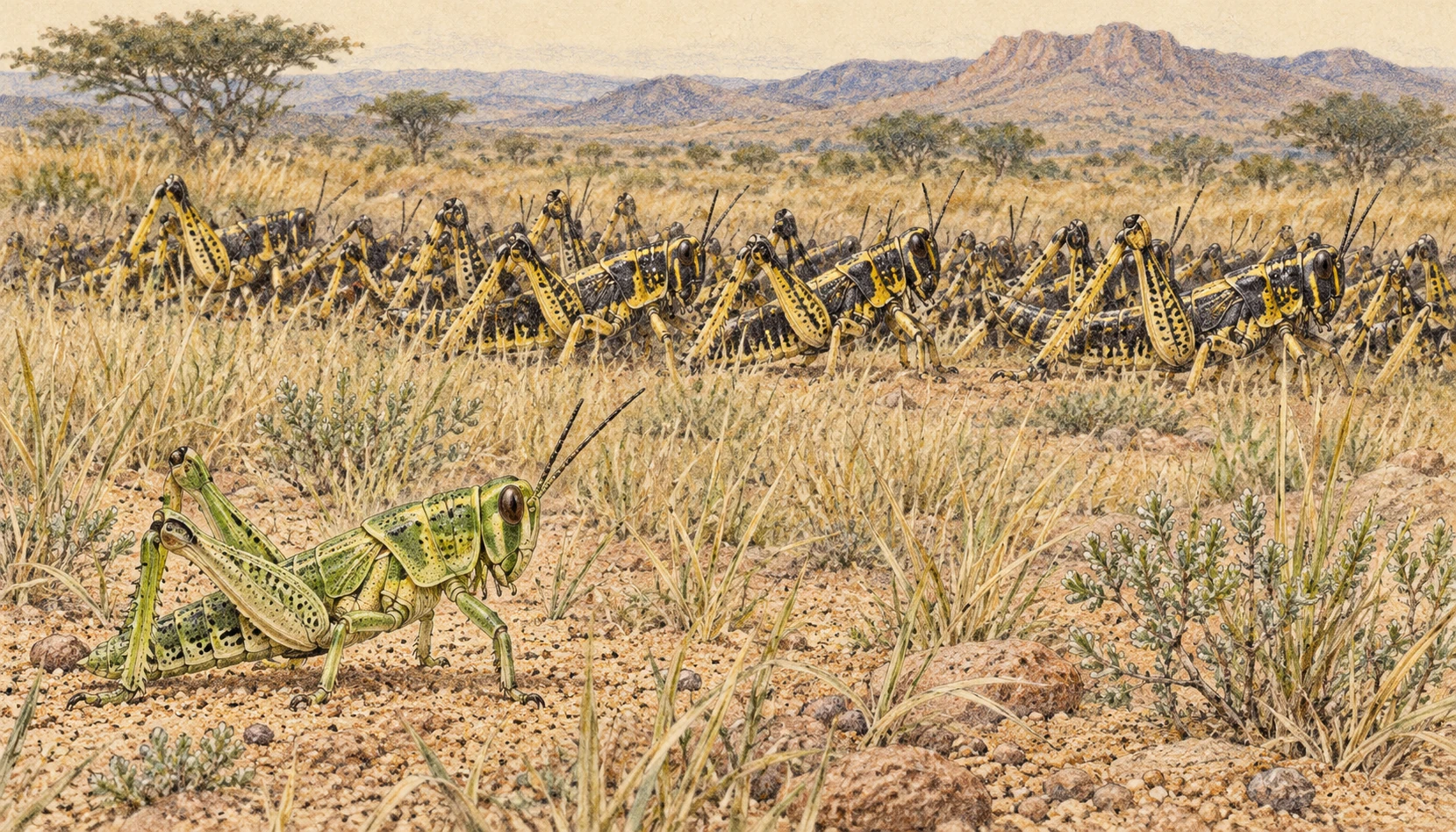
A solitary greenish locust hopper separated from a band of dark yellow-and-black hoppers in dry grass.
Conceptual field-guide comparison of locust social phases; illustrative coloration and setting, not a diagnostic field photograph.

Two young desert locusts can belong to the same species yet behave as if the presence of another insect means opposite things. One avoids company. The other moves toward it. Once attraction begins to reinforce crowding, a scattered population can start becoming a coordinated band. A swarm is not merely a large number of unchanged solitary insects accidentally sharing the sky.

Locusts are particular grasshoppers capable of a density-dependent transformation called phase change. In the desert locust, Schistocerca gregaria, that transformation can alter behavior, appearance, physiology, and body proportions. The FAO's biological overview distinguishes wingless hopper bands from flying adult swarms. “More insects” describes abundance; “different responses to one another” describes an important part of what makes the abundance dangerous.

The change begins with an insect-sized world

A broad environmental sequence can create the opportunity. Suitable rainfall and vegetation allow breeding and survival; population growth and later concentration bring individuals together. But the insect does not experience a regional population estimate. It experiences contacts, sights, smells, and its own changing internal state. Connecting those local inputs to large collective behavior is the scientific problem.

Research described by the University of Cambridge in 2009 identified a role for serotonin in the behavioral transition. Under the study's experimental conditions, changes in this signaling chemical helped initiate gregarious behavior. Sensory stimulation associated with crowding could therefore be linked to a measurable nervous-system response, rather than merely correlated with the final sight of a swarm.

It is tempting to turn that into “serotonin makes locusts swarm.” That sentence hides several scales. A behavioral shift in a test arena, a gradual change in body coloration, synchronized breeding, and a flying swarm crossing a landscape are not one event. Nor does a chemical's familiar name tell us what it does in every species or tissue. The useful question is which response was measured, where the chemical acted, and what else the experiment held constant.

A disagreement that improves the story

Not every experiment produced the same result. A 2013 study by Tanaka and Nishide reported that significant changes in attraction or avoidance took at least three days in their tests, and serotonin injection did not alter those behaviors or body color as it had been expected to. That is a substantive qualification, not a reason to erase the earlier work.

A 2014 study of rapid gregarization examined activity and attraction together and addressed how experimental design and behavioral measurement affect interpretation. A locust that moves more may encounter a stimulus more often even if attraction has not changed in the same way. Combining several measures into a behavioral score can be useful, but it also makes the score's construction matter.

For a reader, this is the best part of the research story. The uncertainty has a shape. It concerns protocols, rearing conditions, timescales, and the behaviors used to define transition. “Scientists disagree” would be too vague; “everything is settled by one chemical” would be too strong. The studies show why a phenomenon can be real while particular claims about its speed or mechanism still require careful comparison.

Three measurements that answer different questions
ObservationWhat it can showWhat remains open
Distance moved in an arenaActivity under the test conditionsWhether the insect is attracted to other locusts
Time near a group behind a barrierAttraction or avoidance in that setupHow it will behave in a complex landscape
Color and body proportionsPhysical features associated with phaseWhether every behavioral change happened at the same time

A coordinated band can contain many small pauses

From far away, a marching band seems to flow. Following one hopper reveals another rhythm: walk, pause, change direction, walk again. A collective can move coherently while its members remain intermittent. This is a different question from how a solitary-phase insect becomes gregarious.

2014 experiments on desert locust nymphs examined that pause-and-go pattern and its relation to interactions in a crowd. The work connected individual movement rules with the persistence of ordered marching. It did not require every animal to move at one constant speed or receive a command from a leader.

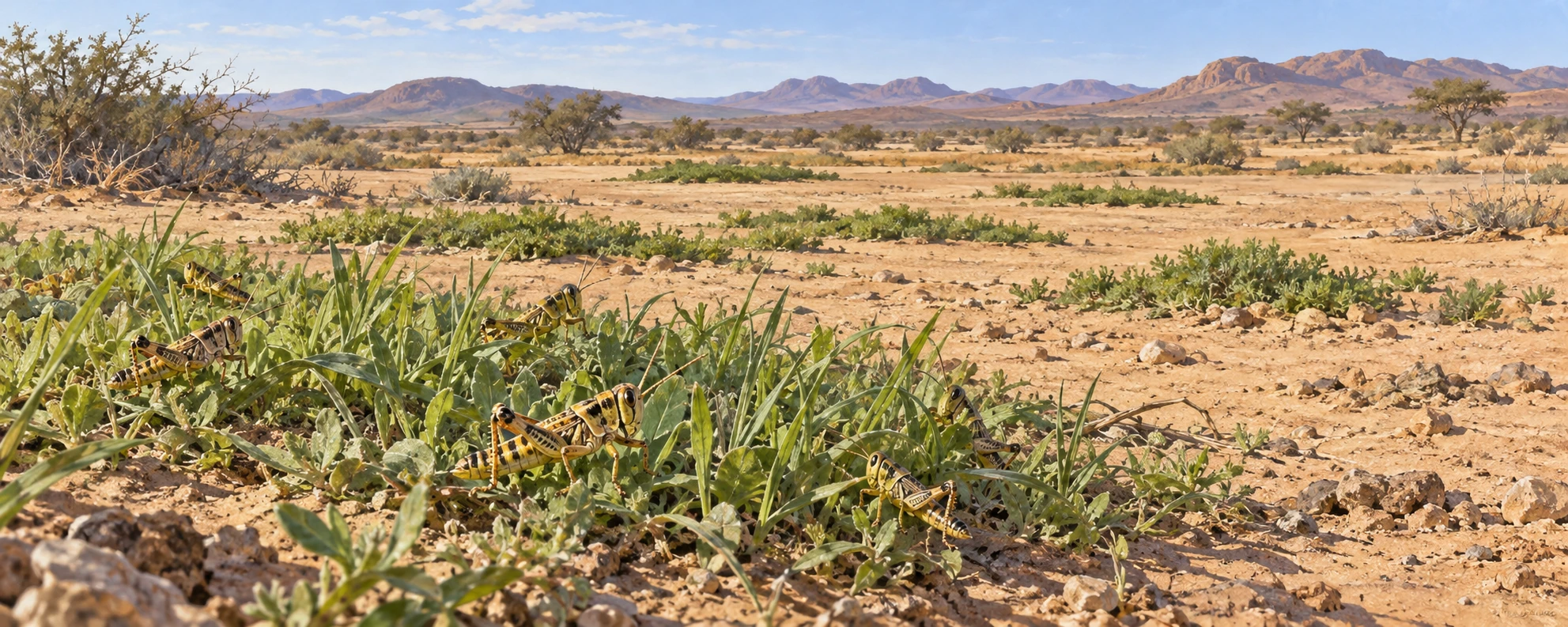
Remaining green patches concentrate locust hoppers in a broad drying landscape
Habitat can concentrate encounters. The later order of a marching band still depends on how individuals move and respond.

A 2023 visual experiment separated parts of the scene further. Tethered locusts saw moving dots whose direction, speed and coherence could be changed. Responses depended on those features, and the animals showed a tendency to maintain or join a heading. The researchers restricted comparisons to a responsive interval because the open-loop display did not change as a real scene would when the animal turned.

That methodological detail matters. A screen can isolate a cue while also removing the consequences of acting on it. A result from that arrangement supports a specific sensory-behavioral relationship. It is not a forecast of the speed or direction of a wild band.

Count movement and agreement separately

Imagine eight fictional hoppers on a straight track. Five walk right and three walk left at equal speeds. Eight animals moving vigorously would not tell you how coordinated the group is; you need the headings. A simple illustrative agreement score is the absolute difference between the two counts divided by eight: 2/8, or 0.25. Seven right and one left give 0.75. Eight walking right give 1.

What happens if half the animals stop?

The answer depends on the definition. A score calculated only among moving animals can remain high, while the fraction of the entire group that is walking falls. Report both. These fictional calculations illustrate why activity and directional agreement need separate measures; they are not a reproduction of the studies' tracking analysis.

In a research video, try following one individual for a short interval instead of following the front of the band. Mark its pauses, then look back at the group. The individual and collective views are complementary. The apparently smooth stream is made from many histories that do not look smooth at all.

From a behavioral switch to a food-security problem

A simple thought experiment clarifies the feedback. Put ten imagined insects among many scattered food patches. If each tends to move away from others, encounters help maintain separation. Change only that tendency so that encounters encourage proximity. The same starting abundance can now yield denser clusters. This is an illustration of feedback, not a simulation of real swarm prediction; food, development, weather, and many other influences would have to be added.

The distinction matters to monitoring. Waiting for an enormous flying cloud means waiting until several earlier processes have already unfolded. The FAO desert-locust guide describes surveillance, weather and habitat information, and coordinated early response. The biological story helps explain why prevention depends on dispersed field observations as well as dramatic satellite-scale events.

It also puts responsibility in the right place. A farmer facing a band is dealing with a material threat to food and livelihoods, not an entertaining behavioral puzzle. Understanding the transition can improve how we interpret reports without turning affected communities into scenery. Population stage, location, date, and the conditions for further breeding are more useful information than an isolated photograph captioned “plague.”

The generated artwork accompanying this article separates a solitary-looking hopper from a band to make the contrast readable. It is an interpretive comparison, not evidence that a particular green individual is about to transform, and not a diagnostic guide to every age and phase. Color is one part of a changing system, not an infallible label.

The deepest transformation is relational. An insect's response to neighbors changes; those changed responses alter the density of neighbors it encounters; the emerging group creates new conditions for its members. The swarm has no single commander, but it is also no accident of identical isolated individuals. It is a population whose members have become different through their experience of one another.

Follow the evidence: FAO: locust phase change; Cambridge: serotonin and behavioral change; Tanaka and Nishide: a different experimental result; Rogers and colleagues: activity and attraction in rapid gregarization; FAO: desert locust questions and monitoring.

More curious connections, art and independent projects at Incoprea.

Why Sea Otters Can Protect a Kelp Forest Without Rebuilding the Next One

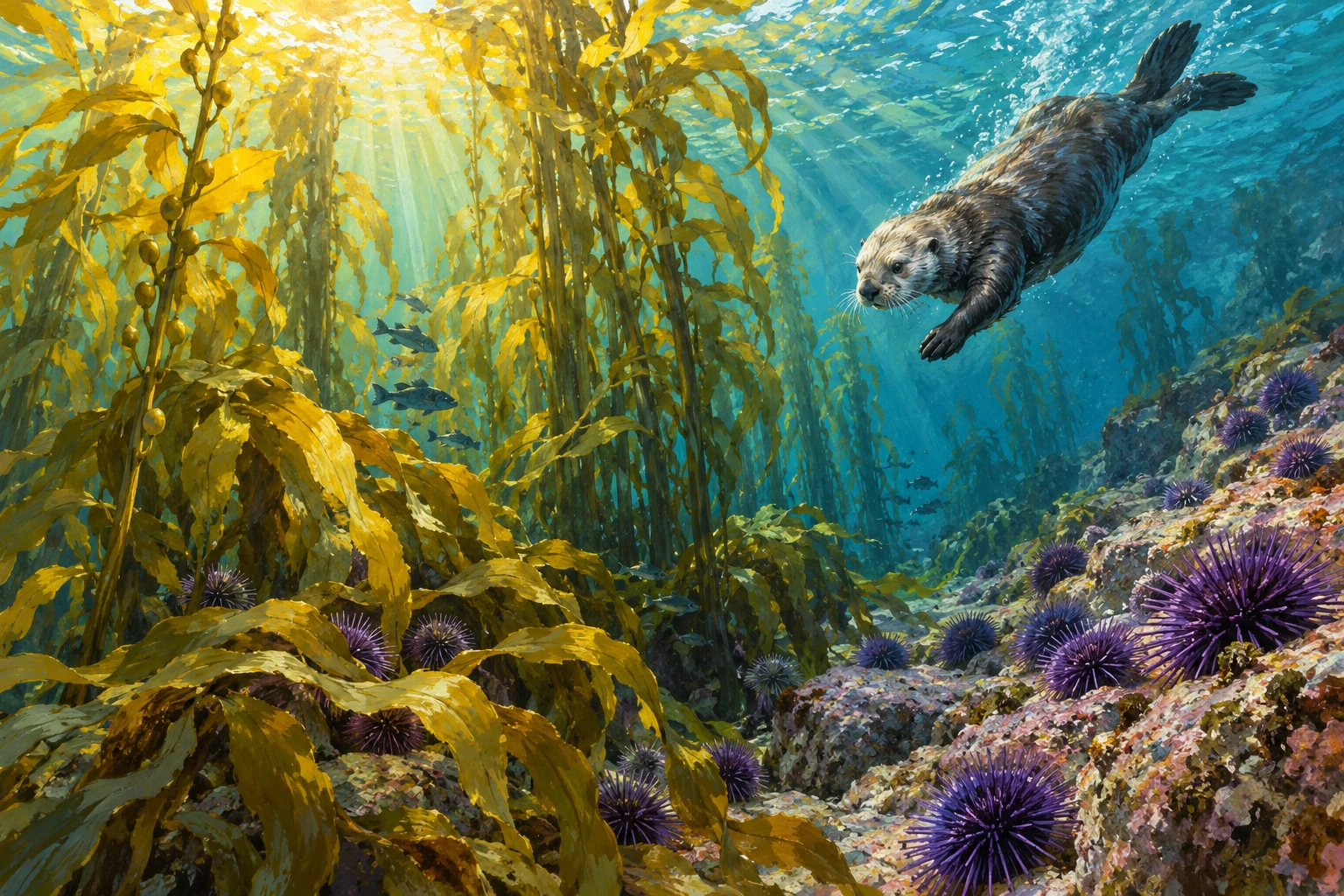
A sea otter dives toward the edge of a kelp forest beside rocky habitat dotted with purple urchins.
Conceptual ecological painting combining contrasting habitat patches; not a survey image or map.

The familiar kelp-forest story fits neatly into three links: sea otters eat sea urchins; sea urchins eat kelp; otters therefore help kelp forests persist. It is a real and influential example of a trophic cascade. But imagine seeing healthy kelp beside an urchin-covered barren while otters remain in the same bay. The next question is not whether the textbook was entirely wrong. It is what those three links left out.

A predator does not consume an abstract unit labeled “urchin.” It encounters individual prey with different nutritional value in different places. An urchin does not always graze in the same way. It may remain sheltered while drifting food reaches it, or emerge when that supply declines. Once behavior and prey condition enter the picture, the food chain becomes a landscape of choices and feedbacks.

A useful first diagram, followed by a harder question

NOAA's aquatic-food-web introduction uses otters to explain how a predator can have indirect effects on organisms it does not eat. More grazing pressure can reduce the kelp that supplies structure and habitat. Reducing grazers can therefore have consequences well beyond the predator's immediate meal.

The diagram is a starting model. It directs attention to a mechanism and predicts a possible response. It does not say every kelp forest has the same species, temperature, disturbance history, or resource supply. It also does not specify whether the predator will spend equal effort in every patch after the ecosystem changes.

That distinction became especially useful in Monterey Bay. A 2021 PNAS study examined the mosaic of kelp patches and urchin barrens. Researchers combined underwater surveys, otter foraging observations, and long-term ecological information. Rather than treating otter presence as a simple yes-or-no variable, they asked how the animals responded to different states of the habitat.

Many urchins can make a poor buffet

The UC Santa Cruz account of the research describes a crucial result: urchins in remaining kelp forests could be more rewarding prey, while urchins in barrens were often nutritionally poor. Otters concentrated feeding where the return was worthwhile. This could help defend existing forest patches without automatically clearing neighboring barrens.

It is easy to see the mistaken assumption in hindsight. A patch carpeted with prey looks like an abundant food resource to a distant observer. But abundance is not equivalent to edible energy. An animal foraging for a living must encounter, capture, process, and digest food. The visible number of prey is only part of the return on that effort.

Now the persistence of the mosaic makes more sense. In a forest patch, otter predation can limit exposed, rewarding urchins. In a barren, hungry urchins may remain abundant while being unattractive to otters. The same predator can contribute to the survival of one state without readily reversing another. Maintaining a forest and restoring a forest are related but distinct ecological outcomes.

The average otter can be an animal that does not exist

A coast's otters may consume many prey types without every individual eating the same mixture. That distinction adds another layer to the patchwork of kelp and barrens. Knowing the population is present still leaves the question of which particular animals are doing the foraging.

In 2008 research comparing food-rich and food-poor conditions, greater population-level dietary diversity under food limitation was largely associated with differences among individuals. Otters specializing on particular prey also differed in related foraging behavior and handling efficiency. The population's broad menu did not simply mean every animal had expanded its own menu equally.

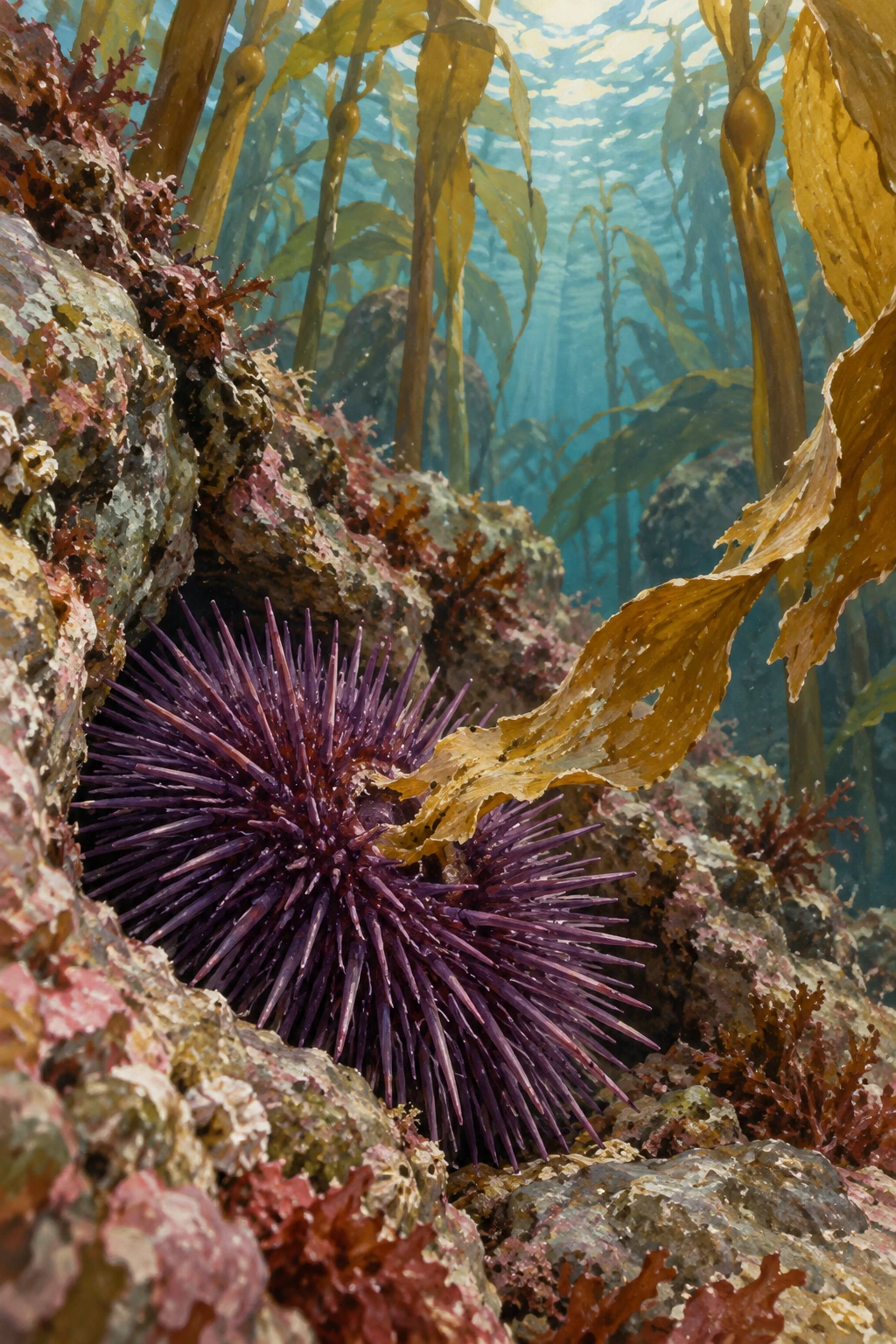
Purple sea urchin sheltered in a crevice near a drifting kelp fragment
An urchin occupies a particular feeding setting. The predator encountering it also has an individual foraging history.

The USGS record of the study describes the comparison made possible by translocation and long-term records of recognizable individuals. Following an otter repeatedly matters because an isolated meal cannot distinguish a persistent specialization from an opportunistic choice.

Try two fictional observation books. Each records 100 meals from five otters. In Book A, every otter supplies 20 meals of one prey type: one animal takes only crabs, another only urchins, and the remaining three each specialize on a different prey. In Book B, each animal takes four meals of each of the five prey types.

Pool either book and every prey type represents 20 percent of the 100 meals. Yet the individual stories are entirely different. The pooled chart cannot tell us which book produced it. It follows that a population diet graph alone cannot establish how any one otter will respond when a particular prey declines.

One extra column changes the question

Add individual identity beside every fictional meal. Group records by animal before calculating the pooled average. Then add date and observation effort. You can now ask whether preferences persist and whether apparent specialists were simply watched in different places or seasons.

This exercise does not explain the kelp mosaic by itself, and the invented meals are not survey data. It shows why behavioral diversity deserves a place beside prey abundance and prey quality. A rich ecological account can need several scales at once: the contents of one urchin, the history of one forager and the condition of an entire reef.

When the next restoration report describes “otter predation,” look for how it was measured. The same count of predators can conceal different diets, different skills and different distributions of effort across the coast.

Context is something to measure

A 2025 study of two long-term datasets compared kelp-community changes during sea-otter recovery at Vancouver Island and San Nicolas Island. Its focus was the dynamic, context-dependent strength of the cascade. The comparison is valuable because a mechanism can operate differently across places and through time. “Keystone species” does not mean a species produces one identical outcome wherever it arrives.

Long-term monitoring is what makes those comparisons possible. The USGS San Nicolas Island report describes population, foraging, and habitat surveys. These answer complementary questions. Counting otters tracks a predator population. Watching dives and identifying prey investigates feeding. Subtidal surveys record the community in which that feeding occurs. None can substitute entirely for the others.

For a reader following restoration news, a practical set of questions follows. Is a report describing a remaining forest, a recovering forest, or a barren that has not recovered? Did it measure prey quality and behavior, or only abundance? Is the evidence a short before-and-after comparison or a sustained record? Those questions do not dismiss a hopeful result; they help identify what the result can support.

The painting accompanying this article brings a kelp patch and an urchin-rich rocky patch into one conceptual view. It is an invitation to see a mosaic, not a map of a particular survey site. Real surveys attach places, dates, depths, and methods to such contrasts.

The sea otter remains a powerful ecological actor. The richer story explains its power more accurately. An otter can alter the future of a forest through repeated decisions about dinner, while the forest's condition changes what counts as a worthwhile dinner. The relationship is a loop, unfolding through individual animals and particular patches of coast. That is why the three-link diagram is memorable—and why the living coast rewards a second look.

Follow the evidence: NOAA: direct and indirect effects in aquatic food webs; Smith and colleagues: behavioral responses across kelp and barrens; UC Santa Cruz: otters maintain remaining kelp patches; 2025 study: context-dependent keystone effects; USGS: San Nicolas Island monitoring and foraging surveys.

More curious connections, art and independent projects at Incoprea.

Whale Falls: The Communities That Inherit a Body

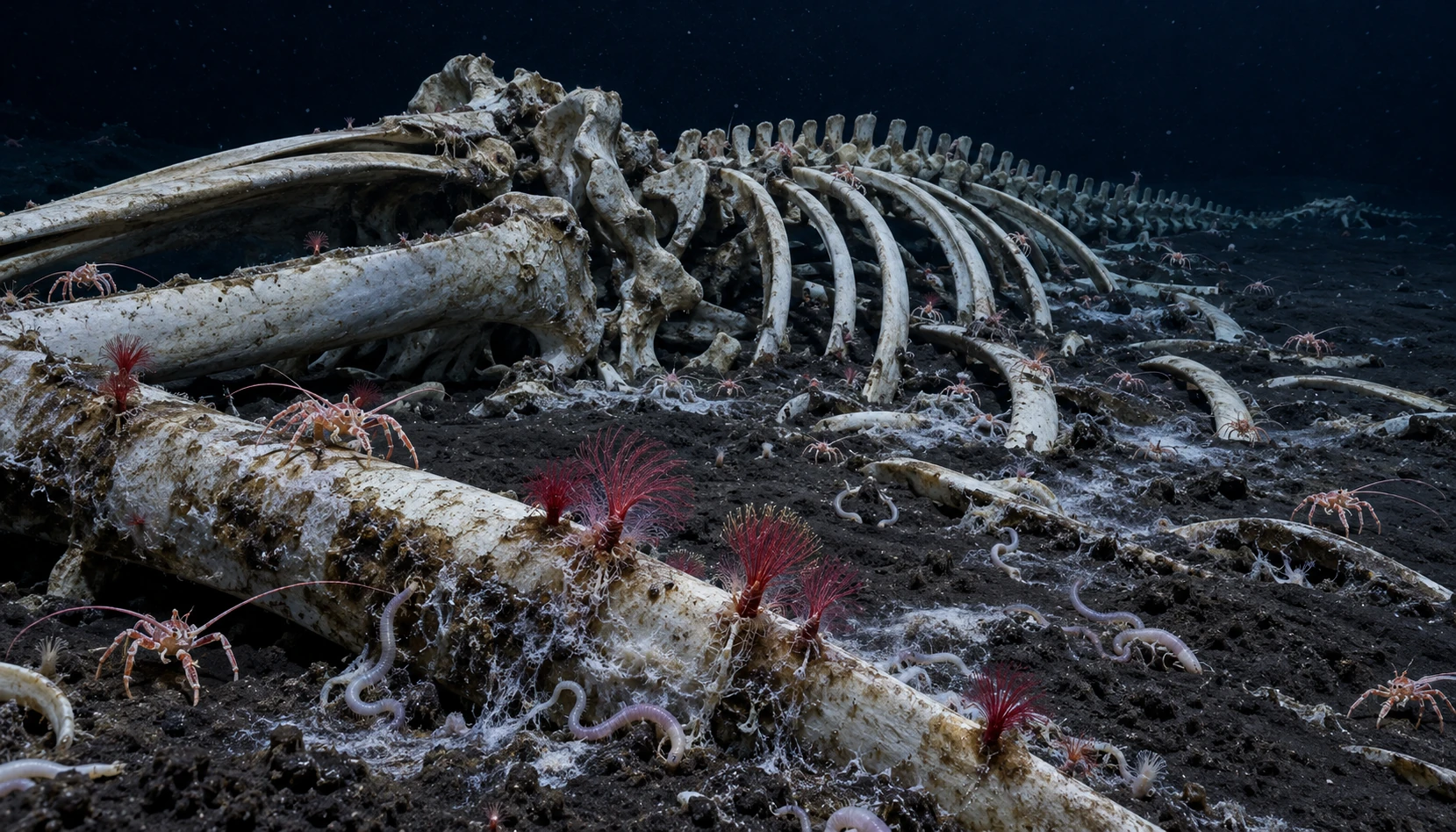
A whale skeleton on deep-sea mud with small crustaceans, worms and red Osedax plumes on a foreground bone.
Conceptual late-stage whale-fall community; organisms and visibility are arranged for explanation, not a recorded dive.

A whale skeleton on the deep seafloor can look like the final frame of a story. For the animals around it, the skeleton belongs to a changing opportunity. Flesh, bone, oil, microbes, and chemically altered sediment provide different resources on different schedules. A whale fall is therefore both a large meal and a small landscape with a history.

The most useful question is not simply “what eats a dead whale?” It is “what becomes available as one group feeds, and who can use what remains?” An animal that can tear soft tissue from a fresh carcass faces a different task from a worm living in a bone months or years later. Decomposition does not erase biological structure all at once. It changes which structures matter.

A succession of resources

The Smithsonian's illustrated whale-fall film introduces the familiar stages. Mobile scavengers first consume soft tissue. Smaller animals exploit organically enriched remains and surrounding sediment. Later, microbial processes associated with the remaining organic material can support communities using reduced sulfur compounds. The stages describe changing opportunities, not a universal clock that every carcass follows precisely.

That last point matters when an image circulates without a date. A bare skeleton does not necessarily mean the site has become biologically unimportant. Conversely, a dramatic carpet of animals need not be a permanent community. Depth, whale size, the condition of the carcass, local organisms, and the rate of decomposition can influence the sequence.

The research synthesis by Smith and Baco established whale falls as ecological systems worth studying across those stages. It also framed questions about connections with other deep-sea habitats. A carcass is isolated to a human observer looking through a vehicle camera, but colonists can connect it to a wider ocean through dispersal and shared habitat requirements.

The bones are still food

One of the most surprising residents is Osedax, a genus of bone-eating worms. The visible plume is only part of the animal. Root-like tissues extend into bone, and microbial associations help the worm use the resource. MBARI's research program follows these animals and the communities associated with them. Their feeding is a reminder that “picked clean” is a judgment made from the perspective of an animal interested in flesh.

Bone is not merely a mineral scaffold with no nutritional possibilities left. Materials locked within it remain accessible to specialized biology. Access changes the habitat in turn: organisms that penetrate and break down bone can affect how long it remains available to themselves and others.

Discovering the worms also changed estimates of diversity. MBARI's account of subsequent research describes a growing collection of distinct Osedax species after the first discovery. What initially looks like one kind of red fuzz can hide multiple evolutionary lineages. A distant camera view and a genetic identification are different kinds of evidence.

An island does not have to contain only island specialists

Because whale falls are unusual, it is natural to imagine every resident as a whale-fall specialist. MBARI research using five experimentally placed carcasses found a more mixed picture: many animals also occurred in other deep-sea environments, while some abundant residents were particularly associated with bones. A habitat can be distinctive because of the density and combination of its inhabitants, even when many species are not exclusive to it.

Experimental placement helps answer questions that a chance discovery cannot resolve as easily. Researchers know something about the starting material and can revisit it. Yet a placed carcass is still one set of circumstances, not a substitute for surveying the range of naturally occurring falls. Combining controlled opportunities with observations across different places produces a stronger account.

This changes how to read the common “island of life” metaphor. It captures the concentrated resource, but can conceal connections. The whale's body accumulated material during its life in the wider ocean. After death, dispersing organisms find it, microbes transform it, and some residents may use other habitats between such opportunities. The island belongs to a network, even when the camera shows only darkness beyond its edge.

The generated panorama here compresses a late-stage community into an explanatory scene. It is not a record of a single dive, and the small organisms are made legible for the reader. For genuine close-up footage and the full sequence, the linked research organizations provide a better next step.

The whale's end is real. So is the beginning of a series of other lives around its remains. What makes a whale fall compelling is not a comforting promise that death disappears, but the specific work of transformation: one body becomes different resources, and each resource opens a different biological door.

Follow the evidence: Smithsonian: whale-fall succession and film; MBARI: experimental whale falls and community overlap; MBARI: Osedax studies and decomposition; MBARI: diversity of bone-eating worms; Smith and Baco: ecology of whale falls at the deep-sea floor.

More curious connections, art and independent projects at Incoprea.

Mast Years: Why a Forest’s Seed Schedule Matters

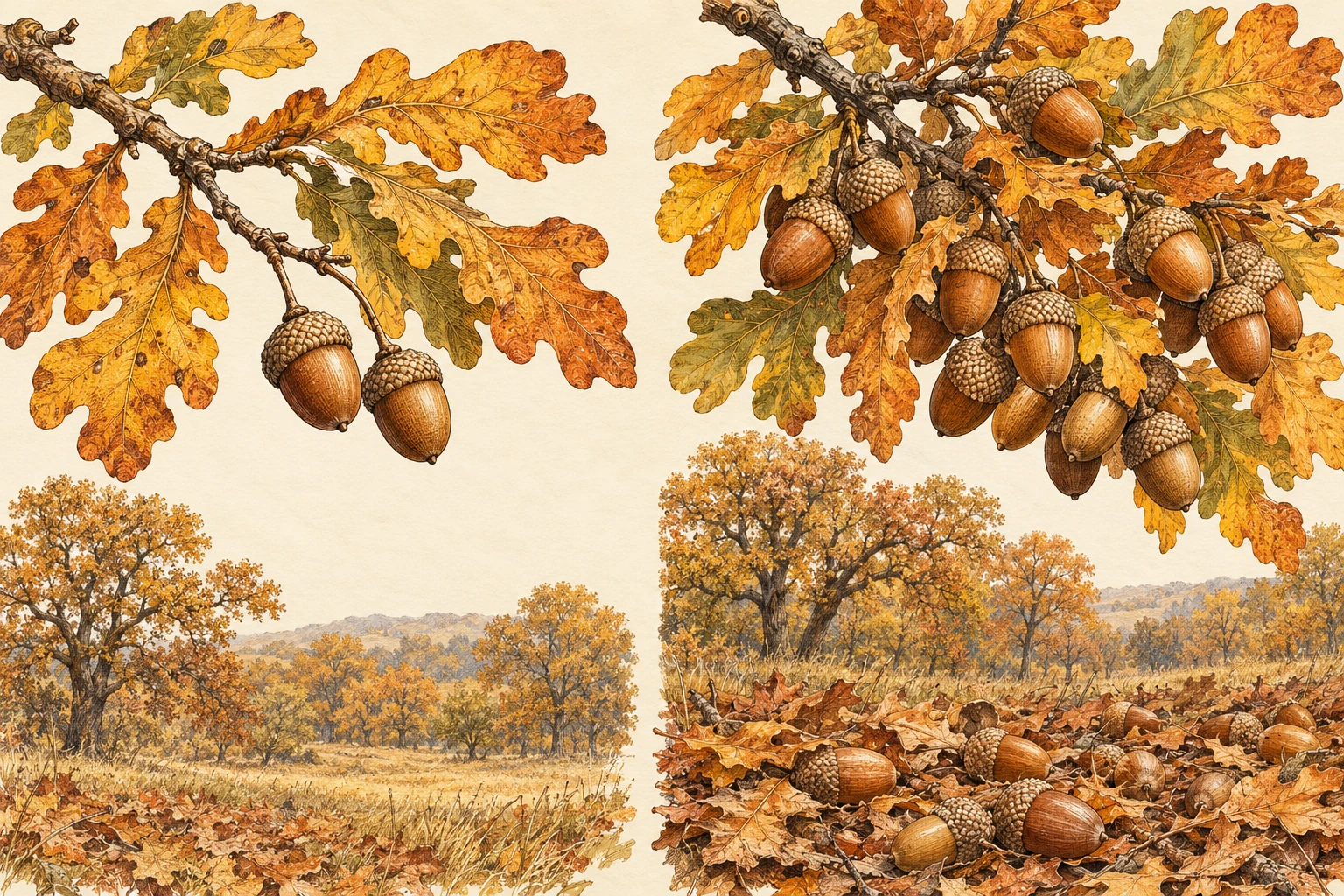
Conceptual comparison of an oak branch with few acorns and a heavily fruiting branch above autumn woodland.
Conceptual comparison of sparse and heavy seed production; not observations from two measured years.

One autumn the ground beneath an oak seems paved with acorns. Another year, the same walk yields only a few. Extend the view beyond one tree and the puzzle becomes larger: many trees can produce heavy crops together, then share lean years. The forest's reproductive effort has a rhythm, but it is not usually a simple clockwork alternation.

This highly variable, synchronized production is called mast seeding, or masting. It occurs in many perennial plants, with different patterns and mechanisms. Calling every unusually productive individual tree a mast event misses the population component. The interesting signal includes how much crops vary through time and how closely individuals vary together.

Why make seeds in pulses?

The review by Kelly and Sork separates several explanations. A large synchronized crop can overwhelm some seed consumers, leaving a greater proportion uneaten. Synchronized flowering can also improve pollination, particularly in wind-pollinated systems. These are possible benefits of concentrating reproductive effort, not identical mechanisms.

The relevant calculation is often a proportion. A heavy crop can feed more animals while still leaving more surviving seeds per seed produced. Likewise, producing flowers simultaneously can improve opportunities for pollen exchange even when total flower production over many years is held conceptually constant.

But an advantage does not by itself explain how trees achieve the pattern. A plant has resource constraints; flower development unfolds over time; and weather can influence both cues and the success of reproduction. “It saves up and floods the market” is a vivid summary, but not an adequate model for every masting species.

How can distant trees share a year?

Individuals need not communicate directly to respond similarly to a shared environmental signal. Weather patterns can cover large regions. A 2017 analysis combined long-term tree-reproduction records with atmospheric circulation indices to investigate broad synchronization in European beech and Norway spruce. Shared climatic variation can help coordinate organisms separated by distances far beyond neighboring roots.

A 2024 study of European beech investigated another part of the timing problem: responses associated with summer temperature and the solstice. The findings supported a role for a seasonal timing window in coordinating responses across a large range. This is not a discovery that all trees drop seeds on the longest day. The cue can concern the development of a later reproductive event.

That temporal distinction is crucial. Weather during flowering, weather while seeds develop, and a cue influencing the following year's flowering can all matter differently. A correlation between this autumn's crop and last summer's temperature should not be rephrased as this autumn's weather causing every stage of the crop.

Variability and synchrony can be separated on paper

Two trees can each have a dramatic mast year without sharing that year. Their individual variability may be identical while their combined crop looks very different. This is why a forest's timing cannot be recovered simply by averaging the size of each tree's biggest harvest.

The continental synchronization research treats coordinated timing as a feature to explain across places. The beech study of warming and reproductive efficiency likewise distinguishes the timing pattern from the average crop. The small ledger below isolates that distinction without adding any new field measurements.

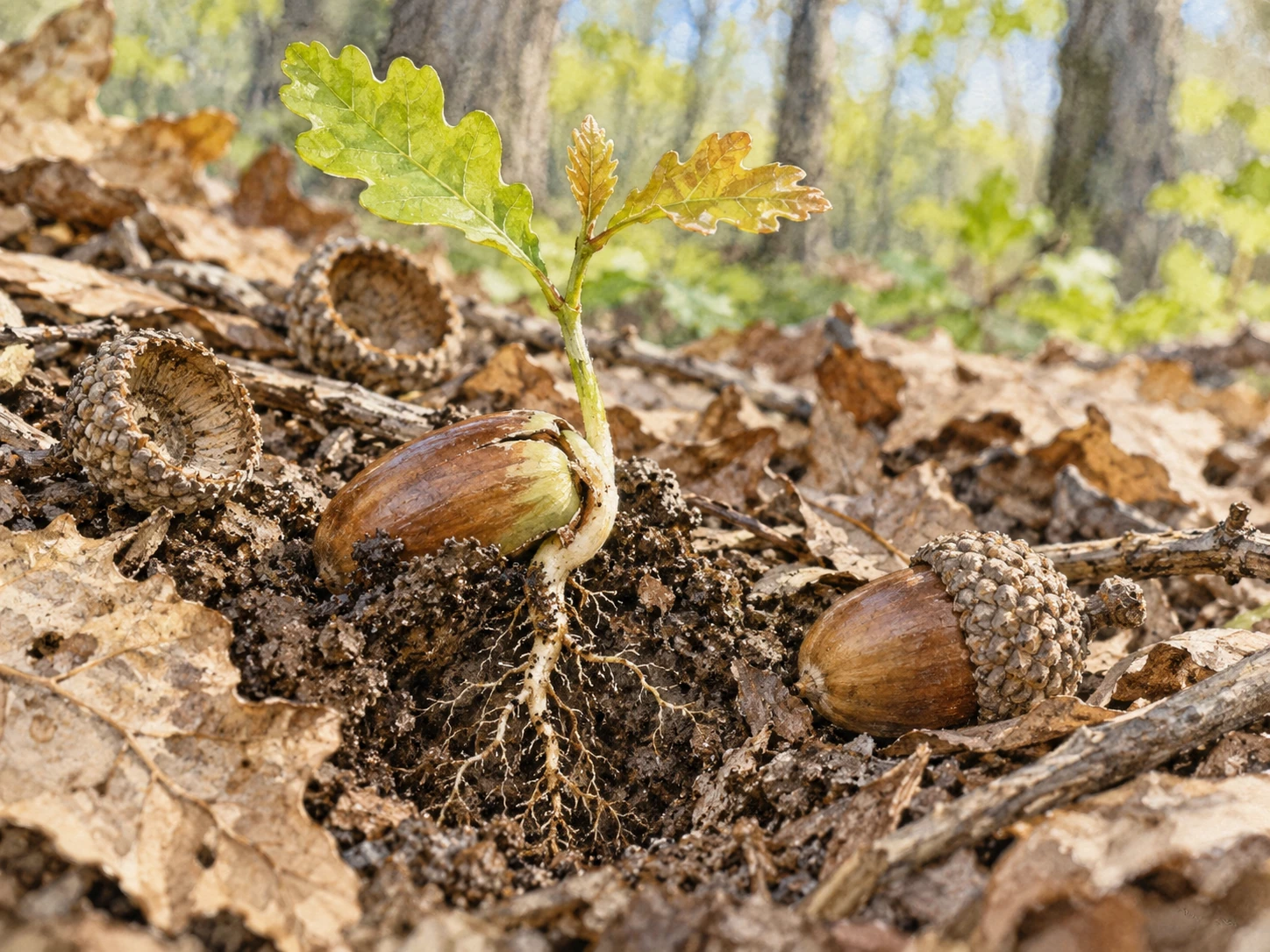
Young oak seedling emerges beside an acorn among leaf litter
A seed crop and a recruited seedling are different outcomes. The arithmetic stops before viability, germination and later survival.

Give each of two fictional trees a four-year record:0, 40, 0, 0 seeds. Both produce 40, and both peak in the second year. Now shift the second tree's record to 0, 0, 40, 0. Its total and individual variability are unchanged. Only its agreement with the other tree has changed.

The synchronized combined schedule is 0, 80, 0, 0. The shifted schedule is 0, 40, 40, 0. Each contains 80 seeds. Under an invented rule in which consumers can take at most 30 from the combined crop each year, the synchronized schedule leaves 50 uneaten. The shifted schedule leaves 20 across its two productive years.

Same trees, different synchrony

A four-year invented ledger isolates synchrony, with fixed-capacity arithmetic and an explicit limitations check.

Open this activity in its own window.

The result comes from the model's fixed consumer capacity. It is not a discovery that synchrony must always win. Increase capacity to 80 and neither schedule leaves a seed. Let consumer abundance change through time, or add pollination and resource costs, and the comparison becomes another model with other questions.

Which outcome is still missing?

Seeds left uneaten are not automatically seedlings. Some may be empty, damaged or unsuitable for germination. Others germinate and fail later. A full reproductive outcome follows the sequence beyond the point where this arithmetic stops.

This is where the new close view of a seedling earns its place. The autumn crop is a starting distribution, while the emerging plant is a later outcome. The scale between them contains weather, consumers and the seed's own condition.

For your mast diary, keep each tree's record separate before combining them. That preserves the information needed to distinguish one productive individual from a coordinated year. The forest's shared rhythm becomes something you can describe precisely rather than a vague impression of abundance.

More seeds can still mean weaker reproductive efficiency

A 2020 study of European beech in England examined records from 1980 to 2018. Warming was associated with changes in variability and synchrony that weakened benefits linked to mast seeding. The lesson is counterintuitive: increasing average seed production need not compensate for losing the timing pattern that helps seeds avoid consumers or become fertilized efficiently.

Imagine two hypothetical forests with the same ten-year total of seeds. One produces a very large crop in a few shared years and almost none in others. The second produces a steady moderate crop every year. A consumer population may respond differently to those schedules. Equal totals do not guarantee equal outcomes because other organisms respond through time too.

The example does not prove which schedule is best. It isolates the reason a mean alone is insufficient. A serious comparison needs the timing, consumer response, pollination conditions, and actual seedling establishment. A 2024 synthesis of masting brings resource budgets, environmental cues, and evolutionary benefits into a combined framework.

This also helps interpret a neighborhood saying that “lots of acorns predict a hard winter.” A present crop reflects a history of reproduction and environmental conditions; it is not evidence that the tree has forecast the coming season. To test a prediction, one would need defined records and comparisons across many years, rather than remembering the striking autumn before one difficult winter.

The generated comparison above is a conceptual sparse-year and heavy-year illustration, not a dataset. Real trees do not politely arrange their output into two labeled categories, and a good study preserves the variation between extremes.

Masting makes a forest audible and tangible: seeds striking roofs, shells underfoot, animals collecting the pulse. Beneath that abundance lies a relationship among timing, resources, and other lives. The forest has not simply made more. Many individuals have made more together, and that “together” can change what reproduction achieves.

Follow the evidence: Kelly and Sork: mast seeding mechanisms and evolutionary explanations; Journé and colleagues: summer-solstice synchronization in beech; Bogdziewicz and colleagues: warming and masting benefits; Ascoli and colleagues: continental-scale climate synchronization; Evolutionary ecology of masting: mechanisms and climate change.

More curious connections, art and independent projects at Incoprea.

Freshwater Mussels Begin Life by Borrowing a Fish

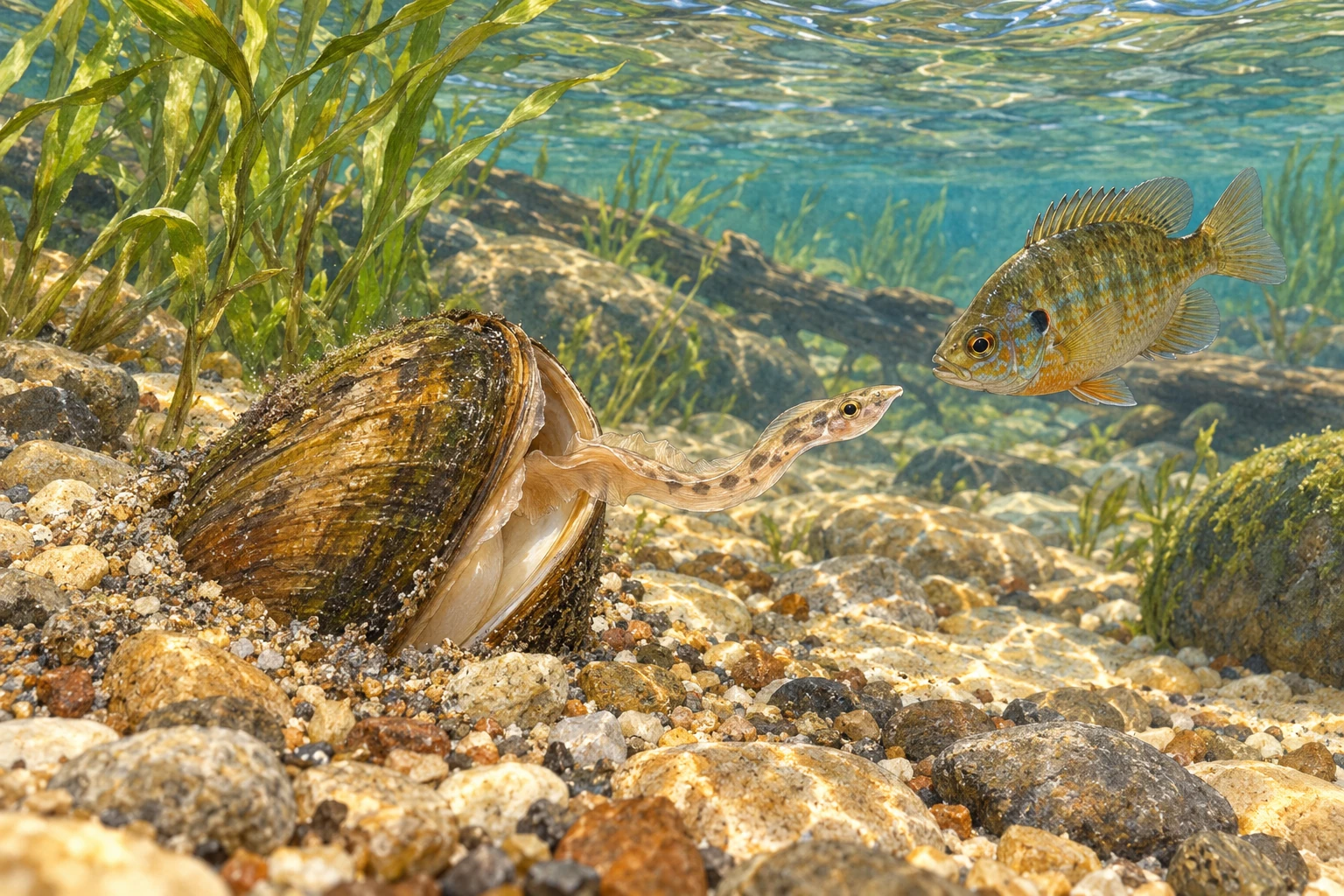
At the riverbed, a small fish-shaped movement appears beside a shell. A real fish approaches what looks like an opportunity to feed. The moving shape can be a mussel's mantle lure, part of a reproductive strategy whose next stage depends on contact with a suitable fish. The adult mussel's stationary life contains a mobile chapter.

Many native freshwater mussels in the unionid group produce larvae called glochidia. These larvae temporarily attach to a host fish and develop before leaving it as juveniles. That stage helps explain why conserving a mussel requires more than leaving adults undisturbed in apparently clean gravel. The life cycle connects the riverbed to animals moving through the water above it.

A partly buried freshwater mussel extends a fish-like mantle lure toward a small sunfish.
Conceptual host-attraction scene; no mussel or fish species, host compatibility, or larval scale can be inferred from it.

The host must be more than a passing ride

The USGS host-fish research program emphasizes specificity: larvae may complete their transformation on a particular host or a limited set of hosts. Finding glochidia attached to a fish does not necessarily prove that they will develop successfully there. Contact, attachment, and successful metamorphosis are distinct steps.

This is a subtle but consequential distinction. A fish might encounter larvae often because it occupies the right habitat, yet be physiologically unsuitable. Another fish might be an excellent host in a laboratory but rarely overlap with reproductive mussels in a river. A useful account combines compatibility with opportunity.

A USGS investigation in Texas joined field fish collection and laboratory recovery of larvae and juvenile mussels. Molecular identification can help connect the young stages with adult species that are hard to distinguish at such small sizes. An adult shell, a larva, and a fish carrying larvae are different parts of the evidence chain.

Not every mussel recruits its host in the same way

In a USGS public lecture with a full transcript, fisheries biologist Heather Galbraith explains a range of host-attraction strategies. Some mussels use mantle displays. Others release packages resembling food, and some make more direct contact with a fish. The fish-shaped lure is a striking example, not a universal organ on every freshwater mussel.

A lure does not need to fool a human observer perfectly. Its ecological effect depends on how a relevant fish responds in the water, under local light and movement conditions. An indistinct wriggle can be persuasive enough if it triggers investigation or a feeding strike. The resemblance is tested by the receiver's behavior, not by a photograph winning a human imitation contest.

That also explains why the details vary. A strategy involving one host's feeding behavior may be unsuitable for another. The mussel's reproductive timing, larval release, habitat, and display must fit the opportunities provided by its particular fish community.

A compatible host also has a history

A host-species list is useful, but the name of the fish need not describe every relevant property of an individual. Prior exposure can change the host's response. A fish capable of supporting a mussel's development may become less suitable after repeated encounters with its larvae.

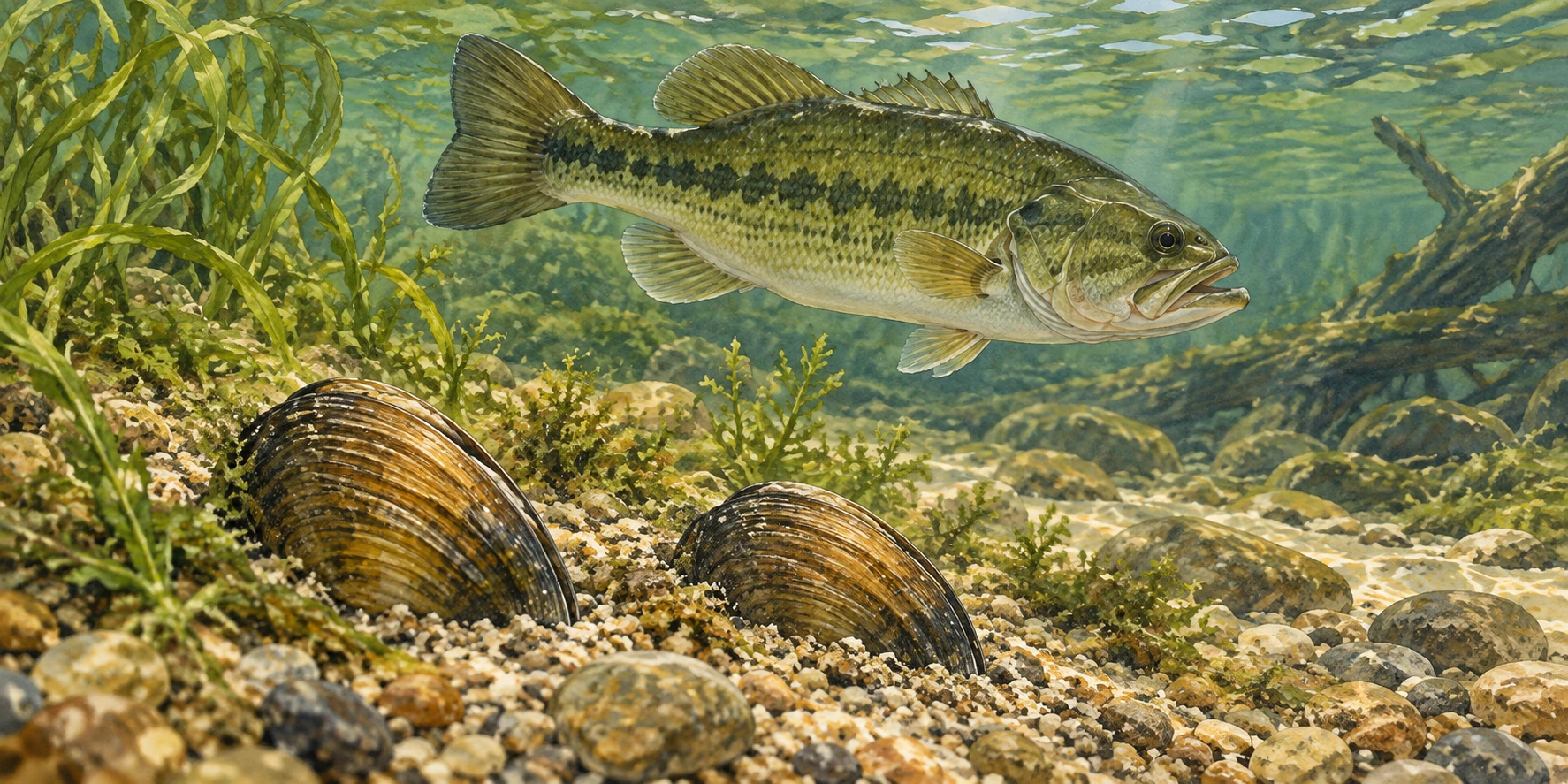
A 2006 experiment with largemouth bass investigated resistance after previous glochidial infections. The researchers measured successful metamorphosis among attached larvae and examined antibody responses. Primed fish supported lower transformation success than previously unexposed controls at the tested intervals. This is evidence for a changing host condition, not simply a failure of larvae to find the right fish species.

Largemouth bass passes above mussel shells in a gravel-bottomed river
A fish is a living developmental setting with its own history. This scene does not show infection or identify a current host relationship.

A related 2005 study tested whether acquired resistance extended to other mussel species. Some cross-resistance occurred, with evidence suggesting both specific and less specific components. The result should remain attached to the tested largemouth-bass/mussel comparisons. It does not establish one universal duration or immune response for every river fish.

Keep the denominator attached to the outcome

The worksheet has two fictional trials. Trial A begins with 30 attached larvae and yields 10 live juveniles. Trial B begins with 100 and yields 20. Trial A has a higher transformation proportion, about 33 percent rather than 20 percent. Trial B produces more juveniles overall.

Attachment is not transformation

A fictional two-trial ledger separates transformation percentage from juvenile yield and asks for appropriate controls.

Open this activity in its own window.

Both comparisons are correct. Neither identifies why the trials differ. Fish history, larval condition, species and recovery methods would need suitable controls before a cause could be assigned. “Better host” is too compressed unless the outcome and conditions are specified.

This is especially helpful when reading conservation propagation work. A successful attachment is an intermediate step. A percentage calculated from attached larvae asks a different question from the number of juveniles ultimately available. The two measures can rank trials differently without contradicting one another.

The moving fish in the illustration now carries another kind of history: its own previous biological encounters. The mussel's mobile chapter depends on an interaction with a living host, rather than a standard transport vehicle. Species compatibility opens the possibility; individual condition and the rest of the life cycle determine what follows.

The temporary association includes nutrition

Calling the fish merely a taxi can understate the relationship. A stable-isotope study investigated nutritional transfer during larval development. Changes in isotopic signatures supported a parasitic relationship rather than a completely passive ride. The host is part of the larva's developmental environment.

Parasitism does not automatically mean every natural attachment causes severe disease in a fish. The effects depend on species, exposure, and conditions. The important point is to identify the biological exchange accurately rather than making it sound either harmless by definition or catastrophic by definition.

Once young mussels leave the host, suitable habitat still matters. Successful transport cannot rescue a juvenile that lands in an unsuitable bed. Conversely, a good patch of substrate may fail to receive recruits if the appropriate host fish cannot reach it. A barrier's effect can therefore propagate through a life cycle without directly touching the adult mussels.

For conservation, that makes a practical difference. Restoring one species may require understanding another's movement, abundance, and compatibility. A hatchery can use host information to support propagation, while river restoration must also consider the conditions under which the whole sequence can occur naturally.

If you find a live mussel, observe it where it is and follow local rules rather than collecting or relocating it. The shell's identity and the river's host relationships are not obvious from appearance. The generated illustration shows a generic mantle-lure interaction, not a guide for identifying a particular species or choosing a fish host.

The adult seems anchored, but its offspring's history reaches into a moving animal. A river mussel's world includes a fish's senses, physiology, and route through the water. That hidden chapter is why a shell on the bottom can tell a larger story about whether a river remains connected.

Follow the evidence: USGS: life-history research and host-fish requirements; USGS: field and laboratory assessment of host relationships; USGS: stable-isotope evidence for larval parasitism; Heather Galbraith, USGS: audio lecture with transcript.

More curious connections, art and independent projects at Incoprea.

Periodical Cicadas: The Long Appointment Beneath the Trees

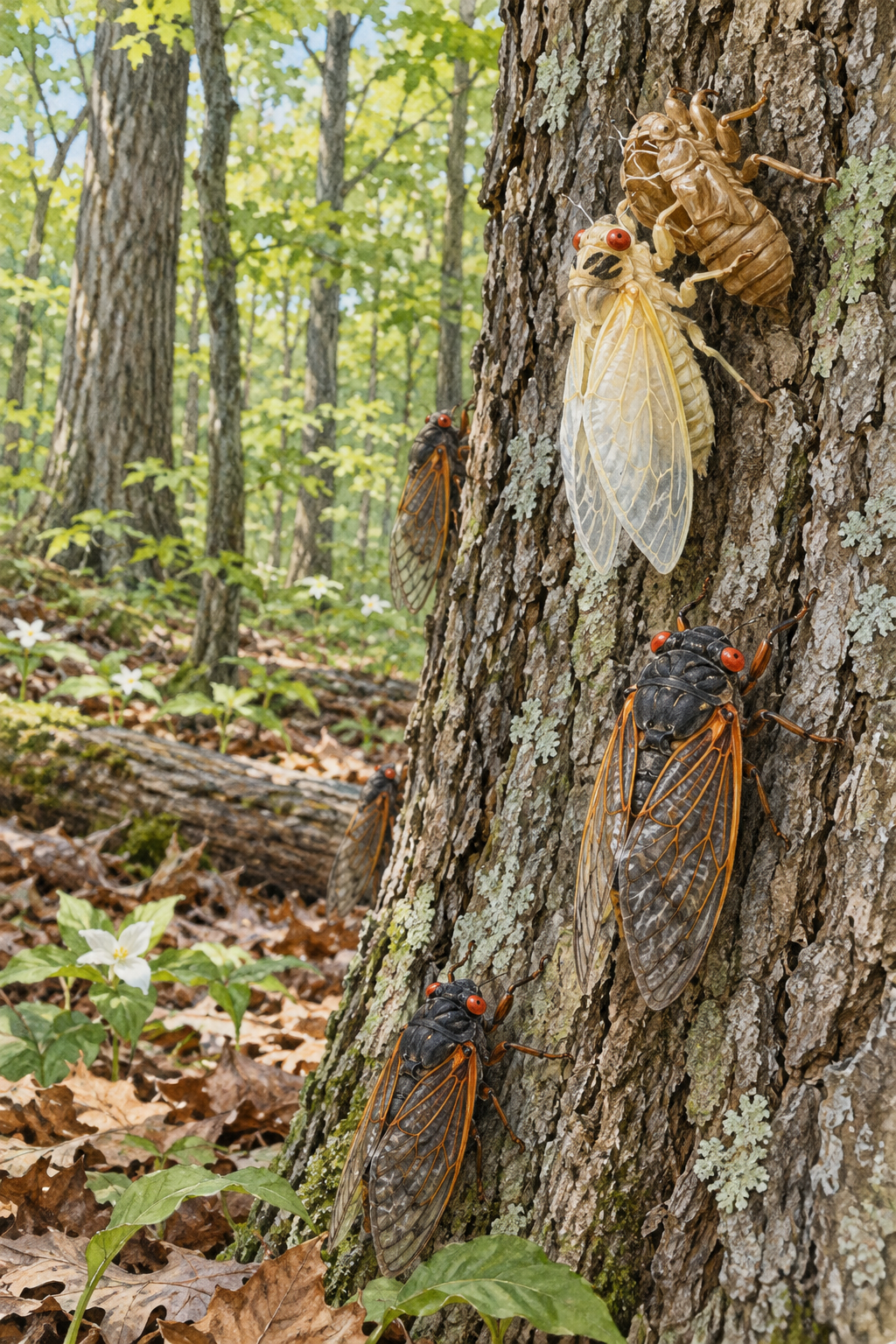
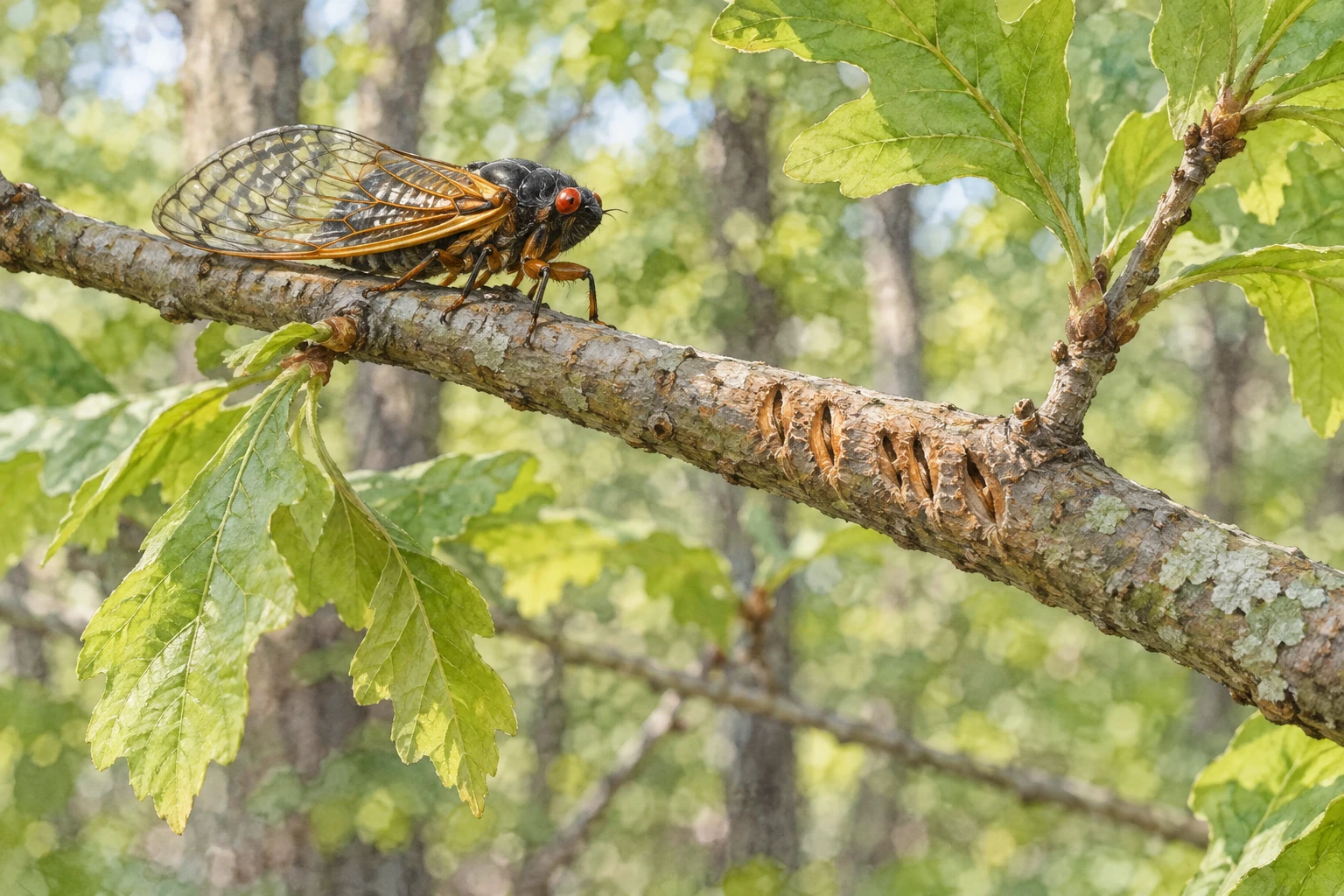
Red-eyed cicadas and a pale newly emerged adult on a woodland trunk beside an empty nymph shell.
Natural-history illustration of a periodical cicada emergence; an interpretive scene, not a field photograph.

Imagine keeping an appointment arranged before a child was born. The landscape has changed, trees have grown, and the child can now drive. Yet, beneath the same neighborhood, a generation of insects is approaching the surface together. The extraordinary feature of periodical cicadas is not simply that they wait. It is that so many arrive on a shared schedule.

That distinction changes the story. A cicada appearing each summer need not have lived for only one year. Many so-called annual cicadas also develop underground for several years; different age groups overlap. In periodical cicadas of the genus Magicicada, adult appearances are concentrated into particular years, separated by thirteen or seventeen years of underground development. A brood is a geographical year-class, not a single species. Several species can share its calendar. Penn State's illustrated account separates those easily confused categories.

The long part happens where we cannot watch

A periodical cicada does not spend all those years asleep. Nymphs feed on fluids from tree roots and grow through juvenile stages. Near emergence, they prepare exit tunnels. On a suitable spring evening, a nymph leaves the soil, climbs vegetation, and splits its old outer skeleton. A pale adult unfolds from it. The abandoned shell remains gripping the bark: a useful trace of an event that may have happened while the observer was indoors.

The visible adult period occupies weeks rather than years. Males produce calls with specialized vibrating structures, and females place eggs in slits in living twigs. Newly hatched nymphs later drop and enter the ground. The Smithsonian's life-cycle resources put those stages side by side. Looking at the sequence restores proportion: the spectacle is the brief reproductive opening of a much longer animal life.

Safety through a temporary excess

A slow, conspicuous insect sounds like an easy meal. In a mass emergence it often is. The survival advantage lies at population scale: predators cannot necessarily consume a matching fraction of an enormous, short-lived food pulse. This is called predator satiation. The National Park Service explanation describes how sufficient survivors can reproduce despite heavy feeding by birds and other animals.

A toy example makes the logic visible without pretending to measure a real forest. Suppose a group of predators eats 900 insects during an observation interval. If 1,000 insects emerge, only 100 remain. If 10,000 emerge and predator consumption rises to 1,800, 8,200 remain. More insects are eaten in the second case, but the proportion lost falls from 90 percent to 18 percent. Real predators, timescales, and densities complicate the calculation; the important distinction is between the number eaten and the risk faced by each insect.

This also explains why a few insects appearing off schedule might face a different situation. They do not automatically receive the protection associated with a dense emergence. A 2024 mathematical study explores how predation can help shape the geographical separation of broods. Its modeled outcomes are tests of a proposed mechanism, not proof that one force alone created the whole life history.

The quieter beneficiaries may be caterpillars

Not every beneficiary of a cicada emergence eats a cicada. A caterpillar can gain an advantage when a bird turns its attention elsewhere. That adds an indirect route from the underground appointment to the leaves above it.

A 2023 study of the Brood X emergence documented more than 80 bird species adding cicadas to their diets. At the studied forest sites, caterpillar densities and accumulated oak herbivory approximately doubled. The result concerned measured changes during that emergence; it is not a prediction that every oak in every brood region will lose the same amount of leaf area.

Cicada beside a twig bearing a short row of small egg-laying scars
A twig can record egg laying. That injury should be distinguished from leaf chewing by other insects during an emergence.

The research team's university account explains the complementary methods. Observers recorded bird feeding. Clay caterpillar decoys helped register bird attacks. Live caterpillars were counted, and leaf damage was measured. Together these observations connected a change in foraging with consequences elsewhere in the food web.

A clay caterpillar is especially useful to think about. It cannot hide, grow or move away. An attack mark measures an encounter with that model under its deployment conditions. It does not supply a complete census of caterpillar survival. The stronger account joins this indicator with independent observations, rather than asking one artificial prey item to stand in for an entire forest.

Follow two kinds of damage without mixing them

The twig detail shown here belongs to a separate part of the story: egg laying can leave small cuts in living twigs. Chewed leaf edges concern a different interaction. A tree could show both signs during an emergence, but pooling them as “cicada damage” would conceal who did what.

A food pulse travels through a forest

Printable evidence ledger separating three food-web links and their measurements.

Open this activity in its own window.

Use the reading sheet to build a three-link ledger: cicadas to birds, birds to caterpillars, caterpillars to leaves. For each link, name the observation and its limitation. Then imagine that only the final leaf measurements had been available. Could you identify the route from that endpoint alone? You would have several plausible explanations and much less leverage to choose among them.

This is a satisfying reason to look beyond the loudest animal. A brief abundance can reorganize attention. The event's ecological footprint may be visible in an insect that nobody watched eating a cicada, and in a leaf that no cicada chewed.

Thirteen and seventeen are clues, not a complete answer

Both intervals are prime numbers. That invites a memorable story about insects defeating predators through arithmetic. But a memorable calculation is not itself an evolutionary history. The University of Connecticut's research guide stresses the unusual combination of long development, periodicity, and synchronized abundance. It also discusses gaps in explanations based solely on predation or past glaciation. Many insects face predators and climatic shifts without evolving this schedule.

We can know that a pattern exists, demonstrate that a mechanism could favor it, and still lack a complete account of its origin. Keeping those levels separate makes the cicadas more interesting. There is room for field measurements, comparisons among species, and experiments about timing, rather than only a clever anecdote about primes.

The same caution helps with maps. A broad brood map identifies an expected region, not a promise for every yard. Changes in vegetation and land use can alter a very local experience. For practical tree protection, consult the extension guide's discussion of young trees and egg-laying injury rather than treating the emergence as a crop-devouring locust invasion. Cicadas and locusts are different insects.

When the chorus subsides, the neighborhood can seem to have returned to normal. A better description is that the visible phase has ended. The next generation has begun a long relationship with the ground and its roots. An empty shell on a fence is therefore more than the remains of an insect costume. It marks a meeting between two timescales: a few weeks loud enough to dominate a summer memory, and years of life that passed beneath notice.

Follow the evidence: University of Connecticut: periodical cicada biology; Smithsonian: life cycle and educational films; National Park Service: emerging cicadas; Penn State Extension: species, broods and tree care; Predation-driven geographical isolation of broods: a mathematical model.

More curious connections, art and independent projects at Incoprea.

publications

New this week Two novels in six stories each, from The Night Shift . New — a novel in six documents Small Print A Novel in Six Do...