Showing posts with label Spiders. Show all posts

Friday, October 23, 2026

The Spider That Takes a Room of Air Underwater

Picture a room with an open floor and a roof that holds back water. A diving-bell spider makes something like this among submerged plants. The room is filled with air carried down from the surface. Yet its most surprising feature is that the original supply is not the whole oxygen budget.
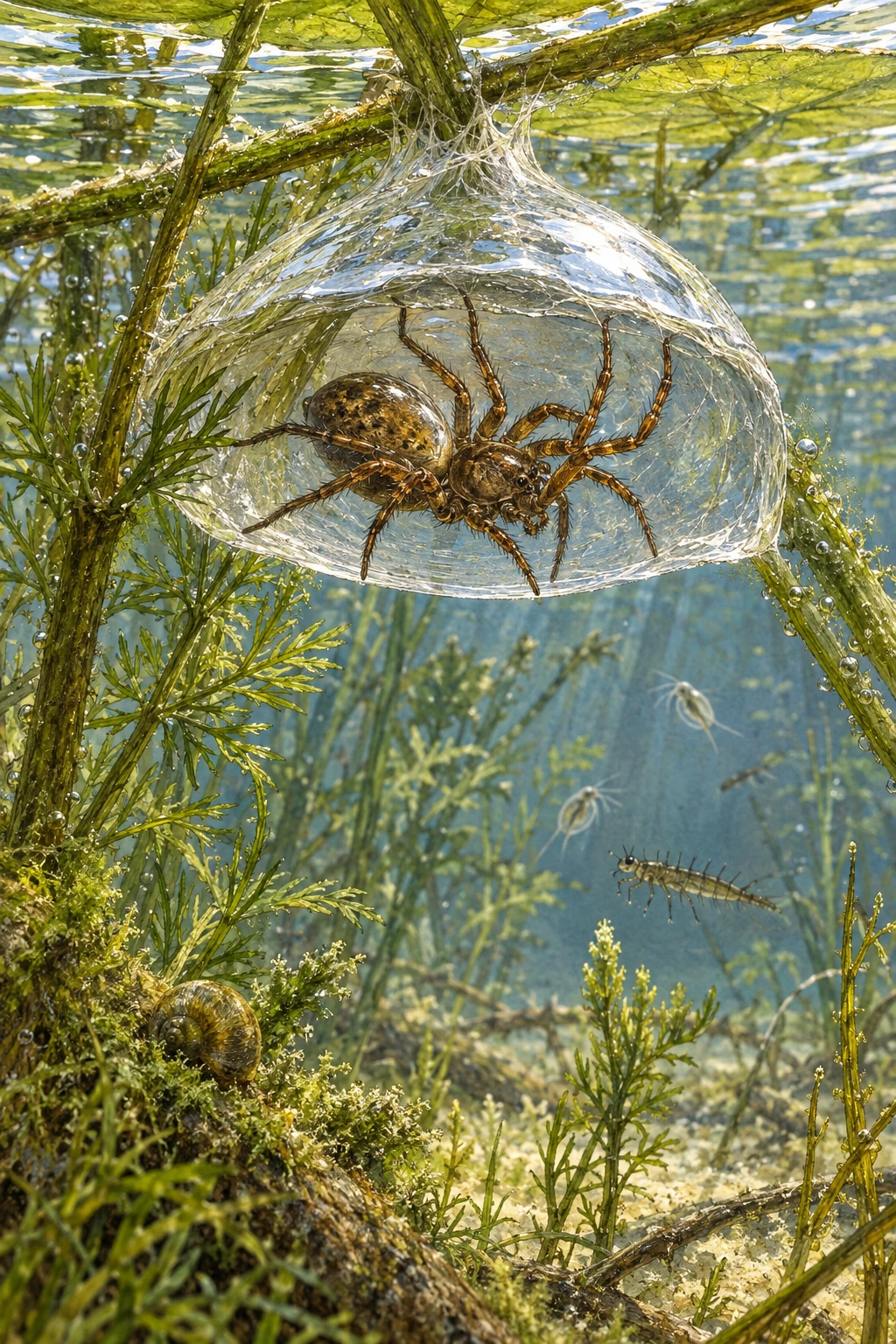
Diving-bell spider inside a silken underwater air space among plants
The bell is an underwater air space connected to its surroundings by gas exchange; the scene is interpretive.

Argyroneta aquatica breathes air while living largely underwater. Its bell provides an underwater air space, but calling it an oxygen tank misses an exchange across the boundary. Under suitable conditions, oxygen dissolved in the surrounding water diffuses into the bell as the spider uses oxygen inside.

What turns a bubble into a physical gill?

The direction of gas movement follows a difference in partial pressure. Consumption lowers the bell's oxygen partial pressure. Oxygen can then enter from the water. The term “physical gill” describes that gas-exchange function, without suggesting that the silk has become a fish's gill tissue. Theory and experiments connect the supply to the exposed area, the oxygen difference and the diffusion boundary layer.

A 2011 study put tiny oxygen-sensitive probes into bells. Measurements showed that uptake from the water could meet at least a resting spider's oxygen demand under the tested warm, stagnant conditions. The researchers also measured bell volume and oxygen conditions when spiders renewed their air. The result replaced a plausible story about bubbles with a measured exchange.

That finding is neither a promise of unlimited oxygen nor a timetable for every pond. Activity, bell size and the surrounding oxygen conditions matter. A well-supplied resting bell and a struggling bell in oxygen-poor water are different cases.

Change the budget, one variable at a time

The small explorer below uses a deliberately simplified relative supply index: area multiplied by the outside-to-inside oxygen difference, divided by boundary-layer thickness. It lets you compare supply with an arbitrary demand. These are teaching units. The result cannot estimate a spider's dive duration or tell you whether an actual pond is suitable habitat.

Explore a relative oxygen budget

Change relative area, oxygen difference, boundary thickness and demand in an explicitly simplified diffusion model.

Open explore a relative oxygen budget in its own window.

Start by doubling area while leaving everything else fixed. Next, return to the starting point and halve the oxygen difference. Those two changes act in opposite directions. Finally, raise demand without changing the bell. A respiratory structure can remain physically unchanged while the balance shifts against its occupant.

This comparison is useful far beyond one spider. Separate the size of a store from the rate at which a store is replenished. A large starting bubble and a high rate of oxygen entry answer different questions. Looking only at volume conceals that distinction.

Try naming the observation that would settle each question. A picture might help estimate volume. A changing oxygen reading could reveal a different part of the budget. Neither measurement should quietly acquire the other's meaning just because both concern the same bell.

The wall is stranger than a dry web

The bell's supporting material also repays a closer look. A microscopy study described silk threads associated with a proteinaceous hydrogel. Together they form a composite wall. The wet gel can make the thread arrangement difficult to see, while dehydration during preparation can crack and alter its appearance. A beautifully sharp dry micrograph need not show exactly what the material looks like in use.

The researchers did not fully resolve the gel's chemical constitution or glandular origin. Nor should the presence of gel be treated as a measurement of its contribution to oxygen exchange. Structure, gas permeability and the living spider's performance require connected but distinct tests.

Why the surface still matters

Oxygen is only one gas in the bell. Nitrogen can diffuse out, and the gas space shrinks over time. The physical-gill account therefore does not eliminate trips to the surface. It explains why a bubble's useful life can exceed what its original oxygen contents alone would suggest.

A good way to reread the opening scene is to ask three questions. How much gas is there now? How quickly is oxygen entering? How quickly is the animal consuming it? Those questions turn the submerged “room” into a living balance of supply, demand and maintenance. Its roof is impressive, but the invisible traffic through its boundary is the deeper story.

Sources and further reading: The diving bell and the spider: the physical gill of Argyroneta aquatica (2011); Physical gills in diving insects and spiders: theory and experiment (2013); Composite structure of the diving bell wall (2013).

Explore all 80 new articles · Browse the complete illustrated collection

Explore more art, ideas, and independent projects at Incoprea.

Wednesday, October 14, 2026

Peacock Spider Courtship Has a Soundtrack You May Miss

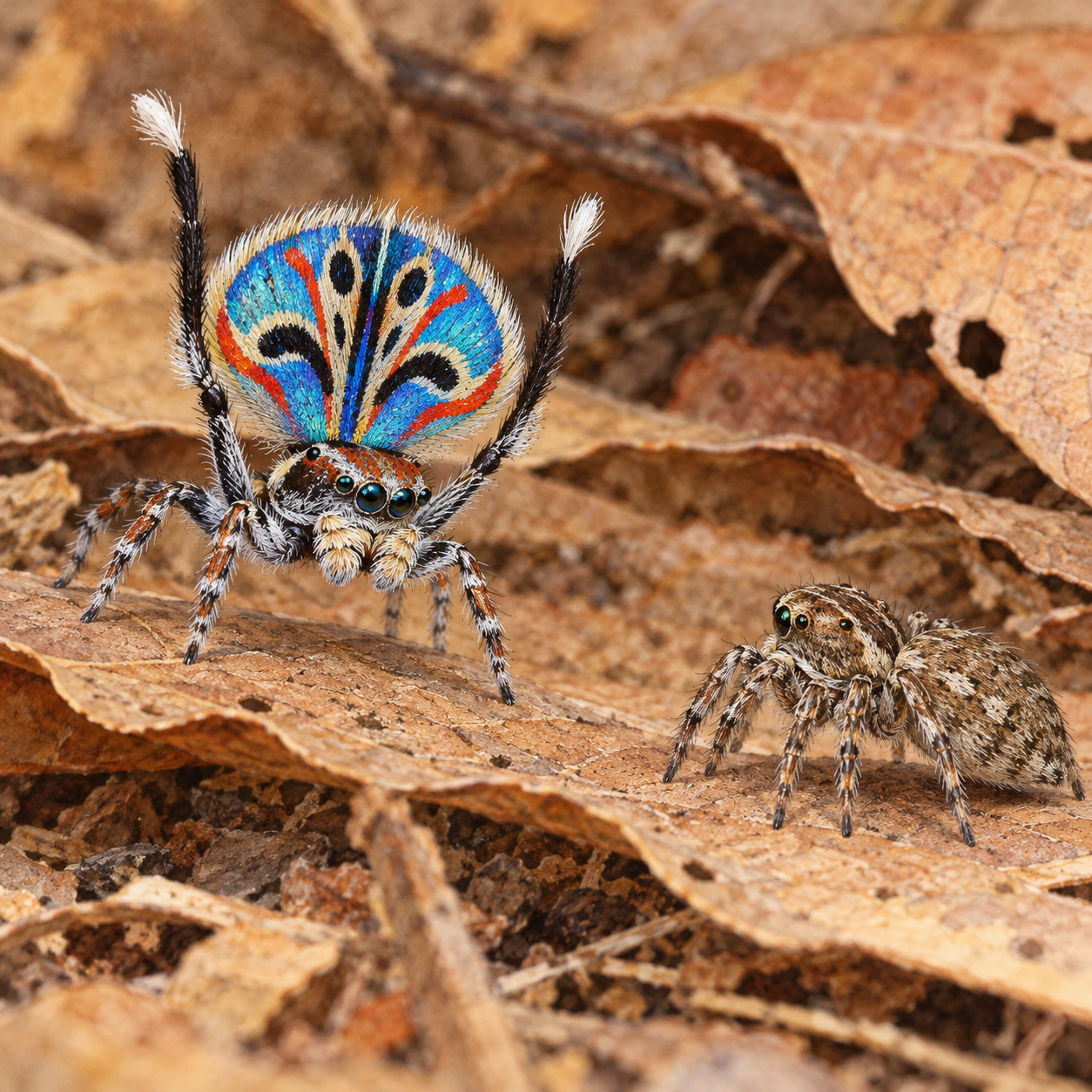
A male peacock spider raises a colorful fan and legs toward a smaller plain female on leaf litter.
A conceptual peacock-spider courtship scene at enlarged scale, with an artistic pattern rather than an identified specimen.

A male peacock spider raises a colorful abdominal fan, waves his legs, and shuffles in front of a female. Magnified video makes the display look like a miniature stage performance. Much of the exchange, however, happens through a channel that a silent clip can leave out.

In Maratus volans, researchers have measured vibrations accompanying the visible display. The animal's performance is multimodal: movement and color work alongside signals transmitted through the surface beneath it.

The fan is an abdomen, rather than feathers

Peacock spiders are small Australian jumping spiders. In displaying males, folded flaps associated with the abdomen open into a fan-like shape. A raised third pair of legs helps frame and accompany the movement.

The resemblance to a peacock gives the spiders their common name, but their apparatus is an arachnid's body. Their colors, proportions, and display details vary among species. A striking male in one photograph should not stand in for every member of the group.

Museums Victoria's account of peacock-spider research emphasizes how much observers have learned by paying close attention to these tiny animals. A spectacle can be common at its own scale and still remain easy for a much larger viewer to overlook.

Vibrations add another channel

In a 2011 study, scientists combined ordinary and high-speed video with laser vibrometry, a method for measuring tiny movements. They documented vibrational signals as well as visual behavior during courtship in M. volans.

A vibration through a leaf or other substrate is different from airborne sound recorded by a nearby microphone. To understand what the female receives, researchers need measurements suited to the medium carrying the signal.

The study also distinguishes describing a signal from demonstrating its exact function. Several ideas can explain multimodal communication: different components might convey different information, reinforce one another, or become useful under different conditions. Identifying the display's parts is a foundation for testing those alternatives.

Follow one display through three channels

The study's supporting movies are a better place to begin than an edited compilation with music. On the first viewing, watch the abdominal fan and the raised legs. Record the sequence of changes you can actually see. On the second, watch the female rather than the male: her position and responses are part of the interaction, even when the male occupies most of the frame.

For the vibration record, check how the researchers measured and presented the signal. Laser vibrometry detects motion of the substrate. If that measurement is made audible for a recording, the speaker is rendering a measured vibration for human listening. It does not mean a tiny airborne song would sound equally loud to a person standing beside the spider.

Keep the recording's timescale in mind as well. High-speed footage can reveal movements hidden in ordinary video, but slowing it changes the experience of timing. The scientific question concerns how components occur relative to one another during a real display. A slow-motion flourish is useful evidence about motion, not a new normal pace for the animal.

A simple observation sheet can have three columns: visible action, substrate vibration and receiver response. Leave a cell empty when the clip or measurement does not show that channel. The exercise makes the missing information visible instead of unconsciously supplying it from a human idea of dancing.

A performance for the intended audience

Human viewers tend to notice saturated colors and movements that resemble dancing. A female spider may attend to combinations of timing, motion, and vibration that our first impression does not capture.

The same caution applies when we call a performance successful. A conspicuous display is an attempt to communicate, not a guarantee of mating. Studying the receiver's behavior is as important as admiring the sender's ornaments.

See or hear more: Explore the study's supporting courtship videos.

Describing a signal is different from proving its job

Suppose a vibration and a fan movement repeatedly occur together. That establishes a relationship worth investigating. To find what the vibration contributes, researchers need comparisons that alter access to the signal while preserving other relevant parts of the display. The receiver's response then helps test a proposed function.

Different components could reinforce a common message, convey partly different information or remain useful under different viewing conditions. A description of a complex sequence is a foundation for those alternatives, not evidence that one must already be correct. The 2011 paper explicitly treats its detailed account as a basis for investigating multimodal communication.

The species label matters because the striking family resemblance can hide diversity. A film of one Maratus species cannot establish an identical choreography or vibration repertoire in another. Museums and taxonomic researchers combine close observation with the work of distinguishing species, making a spectacle legible as biology.

This changes the question a viewer brings to the performance. Instead of asking whether the spider dances well by human standards, ask what information reaches the intended receiver, through which medium and at what moment. The fan remains beautiful, but the behavior becomes richer when the female and the vibrating stage receive as much attention as the ornamented male.

Sources and further reading: Girard and colleagues: Multi-Modal Courtship in Maratus volans · Museums Victoria: Peacock-spider research · Australian Museum: Peacock-spider natural history

The Hawaiian Happy-Face Spider's Smile Is Only One Pattern

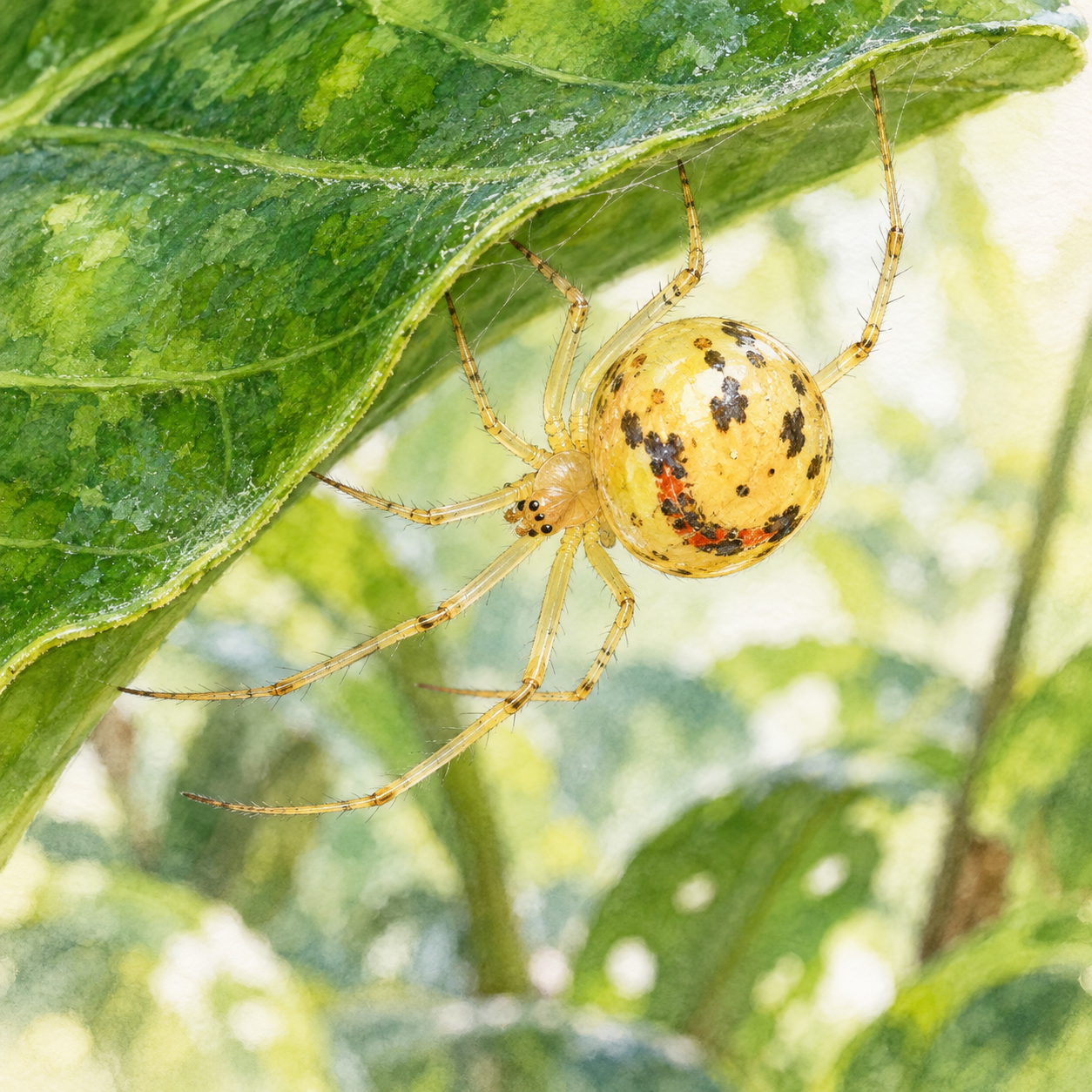
Two dark marks and a curved line can be enough for a human to see a face. On the abdomen of a tiny Hawaiian spider, that resemblance has become a famous name. The happy-face spider appears to smile in some photographs. Other members of the same species look quite different, and some have no celebrated face-like marking at all.

A pale-yellow spider with irregular face-like red and black abdomen markings hangs beneath a green leaf.
One artistic possible happy-face-spider pattern at enlarged scale; real individuals vary substantially.

Theridion grallator is a small spider of Hawaiian wet and mesic forests. Its popular portrait is an invitation to look, but it can also narrow what we notice. The full story includes inheritance, development, feeding and a delicate way of living beneath leaves. The supposed smile is one possible visual outcome within that larger biology.

Look at the spider before the face

Haleakala National Park describes a spider less than five millimeters long that occupies thin webs beneath leaves. It spends the day near this shelter and catches small prey mainly at night, either dangling near the web or searching neighboring foliage. The enlarged abdomen in a portrait belongs to a very small animal in a visually crowded environment.

Females guard their eggs and care for young after hatching. That behavior changes the image of a novelty spider into an animal investing in offspring. A leaf underside can be a resting place, a hunting location and a nursery. The biological importance of the site is easy to miss when the photograph crops away everything except the pattern.

Try describing the main illustration without using any face words. Record the position, color and shape of each mark. “A dark curved band near one end” is a different description from “a smile.” Both may point to the same feature, but the first is easier to compare across animals whose markings do not fit a recognizable expression.

Variation belongs to the species

The species shows color polymorphism: multiple visible forms occur within it. Pale translucent yellow forms and patterns involving red, dark or white areas can all belong to happy-face spiders. Bishop Museum describes many patterns. One dramatic individual therefore cannot stand in for the entire population, even when it becomes the photograph most often shared.

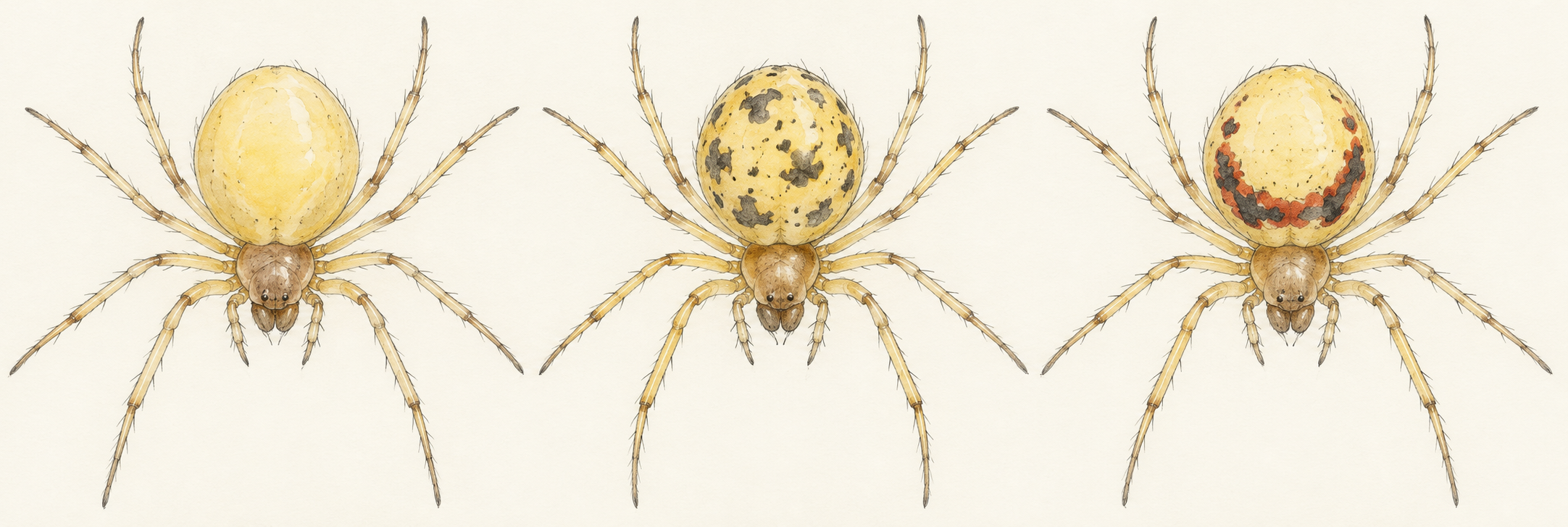
Three artistic happy-face-spider studies compare plain yellow, scattered dark marks, and a curved red-dark pattern.
A conceptual comparison of possible pattern variation, rather than exact named genetic morphs or identified specimens.

The supporting comparison is an illustrative introduction to variation, not a set of named genetic morphs copied from identified specimens. In actual research, categories need consistent definitions. Whether two markings belong to the same category depends on the question being asked and the features used to classify them, rather than on how similar their expressions seem to us.

Imagine a gallery containing ten especially cheerful-looking spiders. Would it tell you the proportion of cheerful-looking individuals in a forest? Only if the method of selecting photographs supplied that information. A gallery chosen for memorable patterns is useful for showing possibilities. A population survey needs a sampling method that also records the less spectacular animals.

The pattern is built during development

Rosemary Gillespie and Bruce Tabashnik investigated color-pattern inheritance in a 1989 study. Their family observations were consistent with Mendelian inheritance involving a locus with patterned forms dominant to the unpatterned form in the material examined. That finding links visible variation to inherited differences rather than treating each abdomen as an independently painted accident.

Their observations also showed that spiderlings began unpatterned and acquired markings over time. Some patterns took much longer to develop than others. A photograph of a young animal therefore supplies different information from a photograph of an adult. Age can affect what is visible without meaning the individual belongs to a permanently unpatterned category.

That is a valuable distinction whenever appearance is used to infer inheritance. Ask whether a trait is expressed at the life stage being examined. The absence of a visible adult feature in an immature animal does not automatically establish the absence of the inherited capacity to produce it. Development connects genetic possibilities with the form a camera records today.

Base color can change for another reason

Gillespie also studied diet-induced color changes. The spider's translucent abdomen can change its background appearance after certain prey are consumed. In laboratory observations, these changes could be rapid and reversible. They add another dimension to color variation, distinct from the inherited superimposed markings examined in the pattern study.

This does not mean a spider chooses a cheerful expression after a meal, or that feeding explains every difference among morphs. It means that a visible color can have more than one source. Pigmentation, translucency and contents seen through tissue can all contribute to what appears in a photograph.

For a simple reading exercise, separate the abdomen into a background and marks placed over it. Then ask which kind of change a report describes. A shift in the background tint is not necessarily the same event as the developmental appearance of a dark band. That distinction makes apparently conflicting descriptions of spider color easier to understand.

Whose eyes would explain the pattern?

Predator avoidance and concealment have been proposed as explanations for the spider's coloration. Bishop Museum describes the suggestion that patterns may help prevent bird predation. A proposed advantage must be assessed in the environment and visual system of the relevant predator. Human recognition of a smile does not by itself identify the evolutionary function of the marks.

Nor must every color difference have one simple cause. Inherited variation can be maintained within a population while development and feeding alter an individual's appearance. Looking for those overlapping processes is more rewarding than trying to translate the abdomen into an emotion. A spider beneath a leaf has no obligation to resemble the nickname humans gave it.

The apparent smile can remain delightful. It becomes a starting point for a more attentive view: a tiny hunter, a guarded brood, an unfolding pattern and a population containing many different forms. The wonder is not lost when the face dissolves into markings. It expands into the biological reasons that no single portrait is the whole species.

Explore more creative curiosity at Incoprea.

Famous Last Meals is now in paperback — stories, history and 25 recipes

Famous Last Meals: Stories, History, and Recipes is now available in paperback on Amazon. The illustrated collection brings together 23 his...