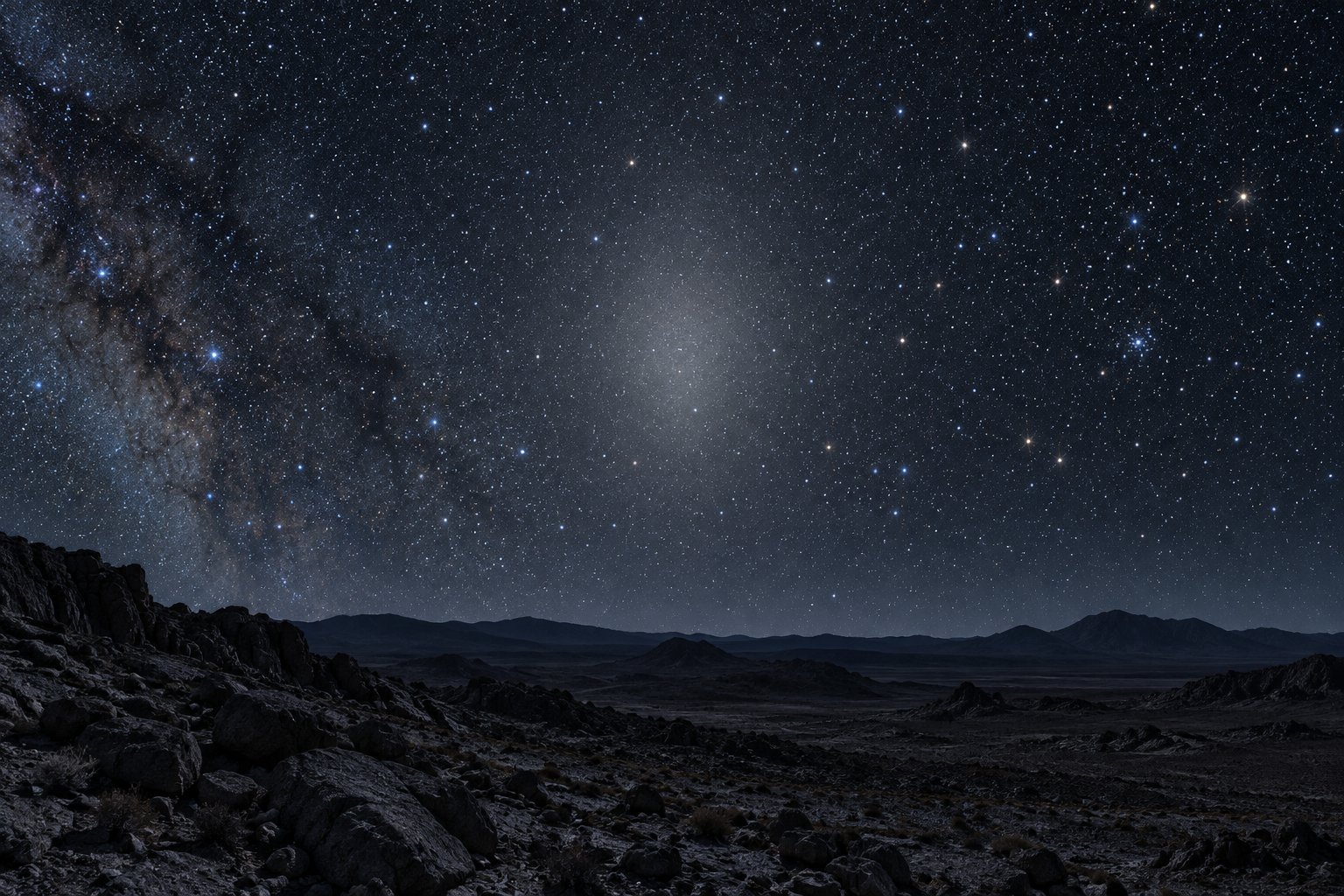
Most celestial sights announce themselves with a bright point or a recognizable shape. The gegenschein does almost the opposite. Under a very dark sky, it is a broad, faint brightening that can look like a patch you are not quite sure you saw. Its name means “counter-shine,” and its position supplies the clue: it appears in the direction directly opposite the Sun.
That might sound impossible during the night. Yet sunlight continues to illuminate space beyond Earth, including the fine dust scattered through the inner Solar System. Some of that light returns toward us. The gegenschein is a subtle reminder that darkness above our heads is still crossed by sunlight.
A glow made from scattered sunlight
The particles responsible belong to the interplanetary dust cloud, fed by material from sources including comets and asteroids. They do not need to generate their own light. Their surfaces scatter the sunlight that reaches them, and we see the combined contribution of many grains along a line of sight.
The geometry differs from the brighter cone of zodiacal light often photographed after twilight. The gegenschein lies at the antisolar point, within the much fainter zodiacal band that follows the plane of the Solar System. It is therefore a particular feature of the same dusty environment, rather than an unrelated luminous object.
Locate a direction before searching for a glow
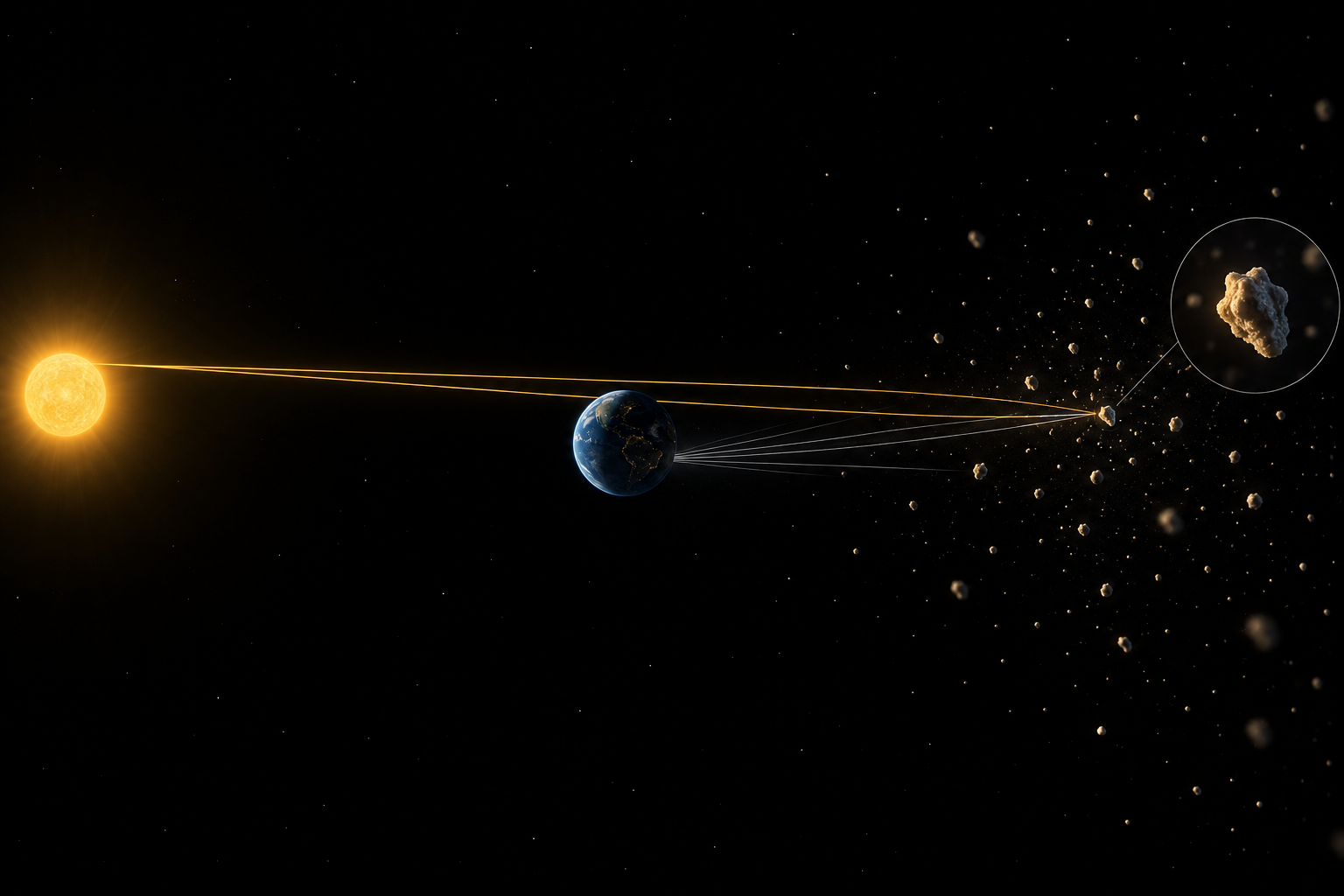
A simple sketch helps more than searching randomly through a dark sky. Put the Sun on one side of Earth, then extend the Sun–Earth line outward through the nighttime side. The outward direction is antisolar. It is a direction on the sky, not a nearby physical object parked permanently behind the planet.
As Earth travels around its orbit, that direction moves against the background stars. A feature whose brightest point remains tied to it is therefore offering a clue about scattering geometry. In the 2013 imaging study, researchers found a narrow enhancement centered at the antisolar direction across their observations. They compared the broader shape with dust-distribution models rather than treating the glow as a uniformly illuminated cloud.
The drawing in this article compresses many grains and light paths into a few visible elements. It should not suggest that there is a single reflecting sheet at a fixed distance. Light arriving from dust along a line of sight contributes to the view. The image we see combines information about where grains are with information about the directions in which they scatter light.
Why the opposite direction matters
Looking almost directly back along the incoming sunlight produces a brightness enhancement known as an opposition effect. At this angle, the shadowed parts of an irregular grain can be hidden behind its illuminated parts. Light-wave effects can also enhance backscattering. Researchers study the narrow brightening around the exact antisolar point to learn about the dust's optical properties.
A useful comparison with a flashlight and a rough surface
Imagine a rough illuminated object whose tiny recesses cast shadows. Viewed from one direction, those shadows are exposed. Viewed nearly along the direction from which the illumination arrives, more of the shadows can hide behind the illuminated parts themselves. That change can increase the apparent brightness without increasing the lamp's power.
This is an aid to visualizing shadow hiding, one proposed contributor to the opposition effect. It does not demonstrate the whole physics of interplanetary dust. The research also considers coherent backscattering, involving light-wave interactions. A tabletop analogy can clarify one mechanism while remaining insufficient to identify which processes dominate in distant grains.
The distinction is useful whenever an astronomical explanation uses a familiar object. Ask which relationship the analogy captures, and which measurements are still needed. Here, the direction of enhanced brightness is observable; the detailed optical behavior of the dust must be inferred through models and careful imaging.
If you attempt an observation, treat a non-detection as a result with conditions attached. Record whether the Moon was present, whether haze or nearby lights brightened the sky, and whether the target direction overlapped a bright Milky Way region. A processed photograph can help document faint structure, but its contrast is also a choice made during capture and processing. Compare it with the published observational images without expecting the eye to reproduce the camera. The search becomes more rewarding when you know what might hide the phenomenon and what a successful identification would need to establish.
A reward for a truly dark night
Moonlight, artificial lighting, haze and the bright background of the Milky Way can overwhelm the gegenschein. A photograph may reveal it more strongly than the eye, especially after long exposure and processing. A dramatic image should not be taken as a promise of an equally dramatic naked-eye view.
To understand where to look, picture a line running from the Sun through Earth and onward into the night sky. Around local midnight, that opposite direction is highest. A moonless night at a dark location gives the subtle patch its best chance to stand apart. Even if it remains elusive, the idea changes the sky: empty-looking space is full of dust, and dust can return a little daylight to the night.
Sources and further reading: NASA: The Gegenschein · High-resolution imaging of the gegenschein · ESO: Gegenschein over the VLT




