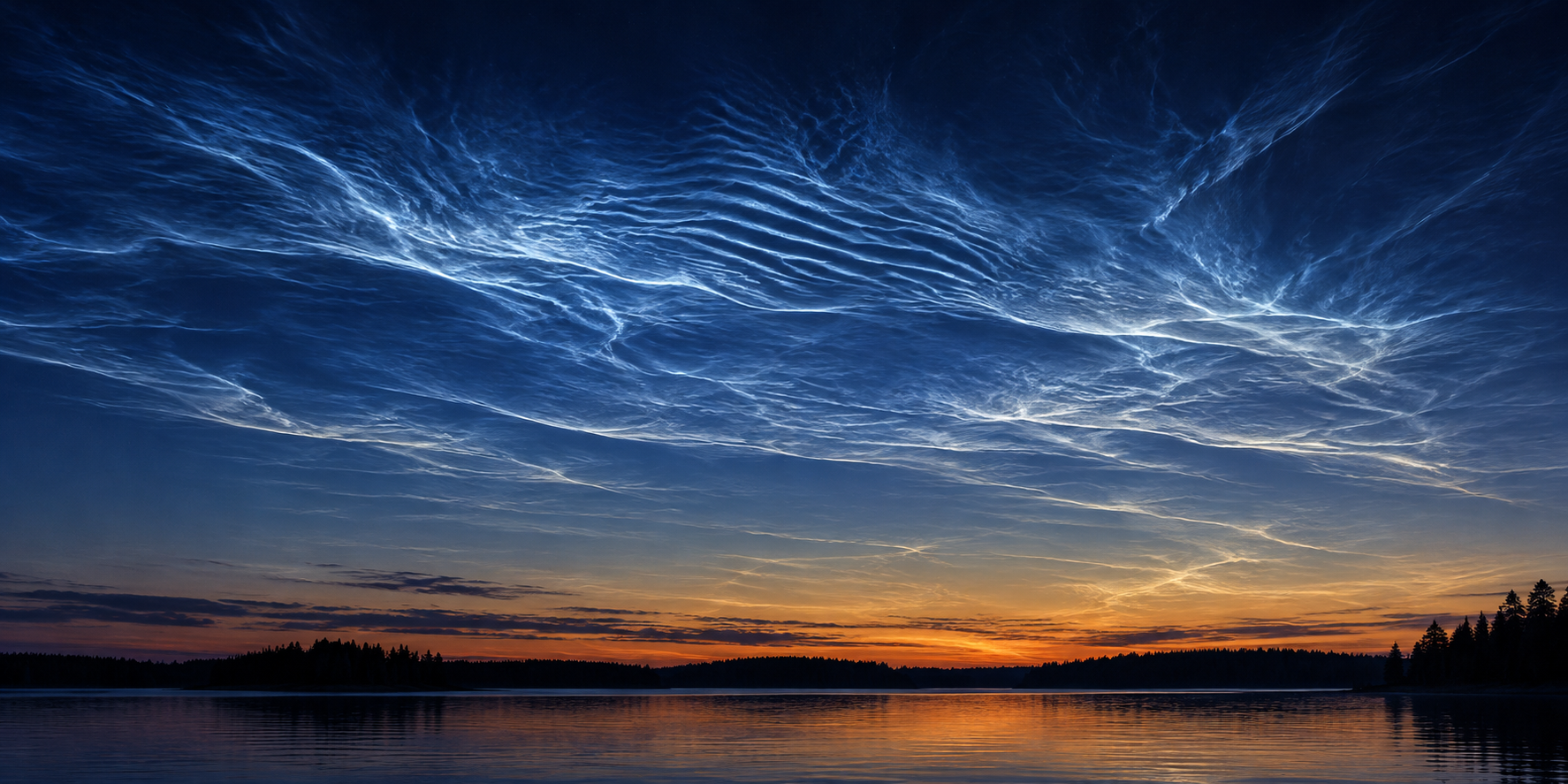
The landscape has darkened, ordinary clouds have turned grey, and then a fine blue-white lattice appears high in the twilight sky. Noctilucent clouds can look as if they produce their own light. Their name means night-shining, but their brightness comes from sunlight that still reaches their extraordinary altitude.
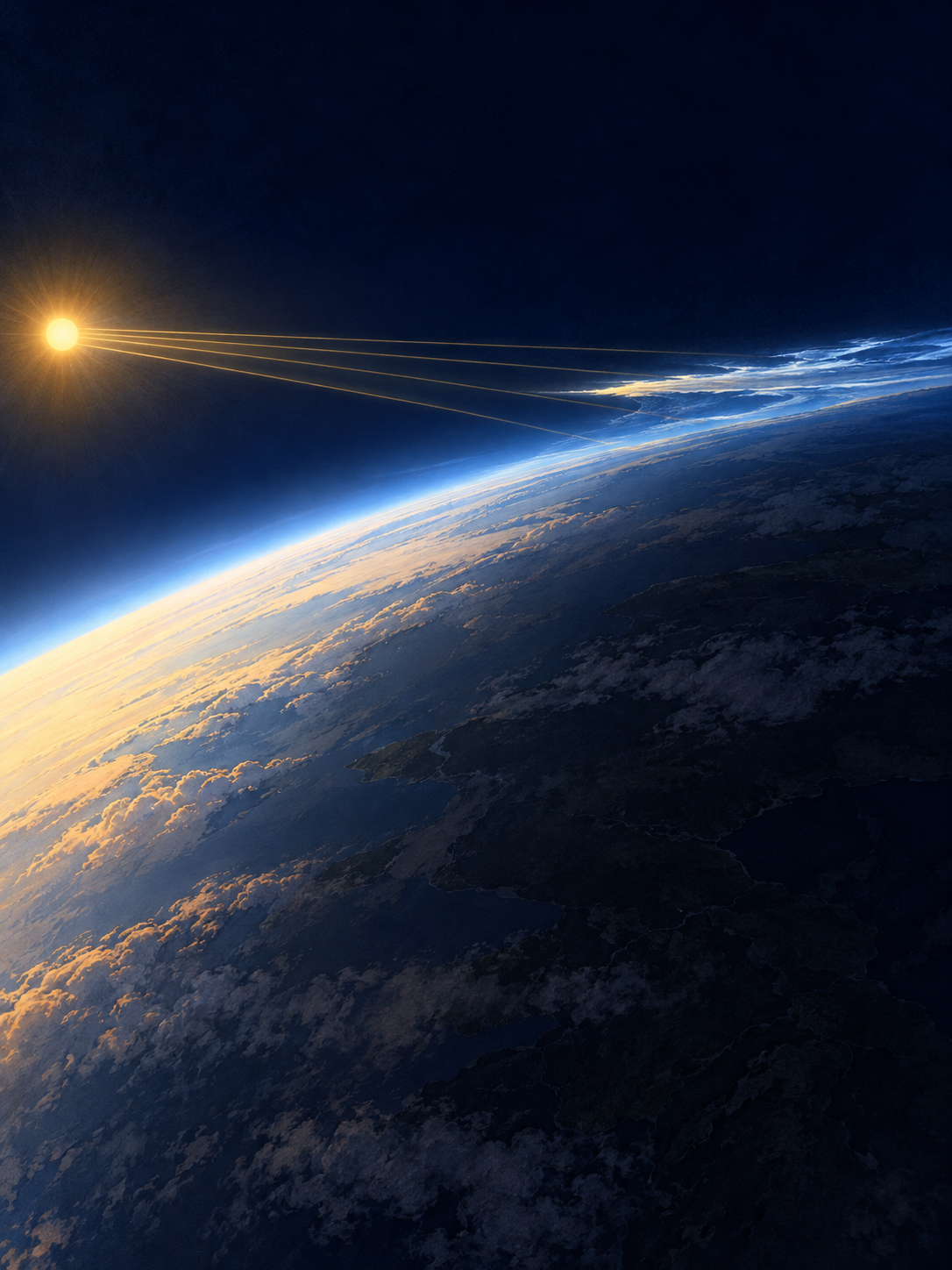
They occupy a different atmospheric neighborhood from the clouds that deliver rain. Understanding their height changes the apparent paradox: the observer can be in Earth's shadow while a thin cloud far above remains illuminated.
An unusually high place for water ice
Noctilucent clouds, also called polar mesospheric clouds, form near the top of the mesosphere. NASA places them roughly 76 to 85 kilometers above Earth's surface. That is far above the ordinary weather-cloud layer.
At those heights, the air is extremely thin and water is scarce. Under sufficiently cold conditions, tiny ice crystals can form. Sunlight reflected by the crystals gives the clouds their pale blue and silvery appearance.
The clouds are often associated with high latitudes during late spring and summer. That can seem backward: why would an ice cloud favor summer? The upper atmosphere has its own circulation and temperature behavior. The mesosphere can be particularly cold during the local summer, even while the surface is enjoying long, warmer days.
A little material from space
Ice needs suitable starting material on which to form. NASA's AIM mission helped establish the role of very small particles called meteoric smoke, produced as material from space burns up in the atmosphere.
The term “smoke” does not mean a visible plume hanging above a meteor. It refers to tiny residual particles that become part of the upper atmosphere's chemistry and cloud formation. A familiar-looking ripple of ice can therefore include a connection to incoming extraterrestrial material.
This is one reason the clouds interest researchers beyond their beauty. Their formation depends on temperature, water vapor, particles, and atmospheric motion acting together.
The sky is a connected system
AIM observations revealed relationships between different layers of the atmosphere and helped scientists study waves and circulation. Conditions lower down can influence events much higher up, and changes in one polar region can be linked with changes in the other.
Researchers also examine how cloud occurrence relates to long-term changes in water vapor and temperature. A single striking evening is an observation, however, not a diagnosis of the entire climate system. Establishing a trend requires consistent measurements over time.
For a viewer, the essential geometry is enough to make the scene memorable. Low land lies in shadow; very high ice still meets the Sun. Fine textures that would be hard to notice in daylight stand out against a darkening background.
Noctilucent clouds show that sunset does not happen everywhere above you at once. Their delicate light marks the intersection of Earth's curved shadow with one of the coldest and highest cloud-making regions in the atmosphere.
See or hear more: See NASA's noctilucent-cloud animation.
Sources and further reading: NASA: Polar Mesospheric Clouds; NASA: Meteor Smoke Makes Strange Clouds; NASA: Taking AIM—10 science highlights.
Explore more creative work at Incoprea.