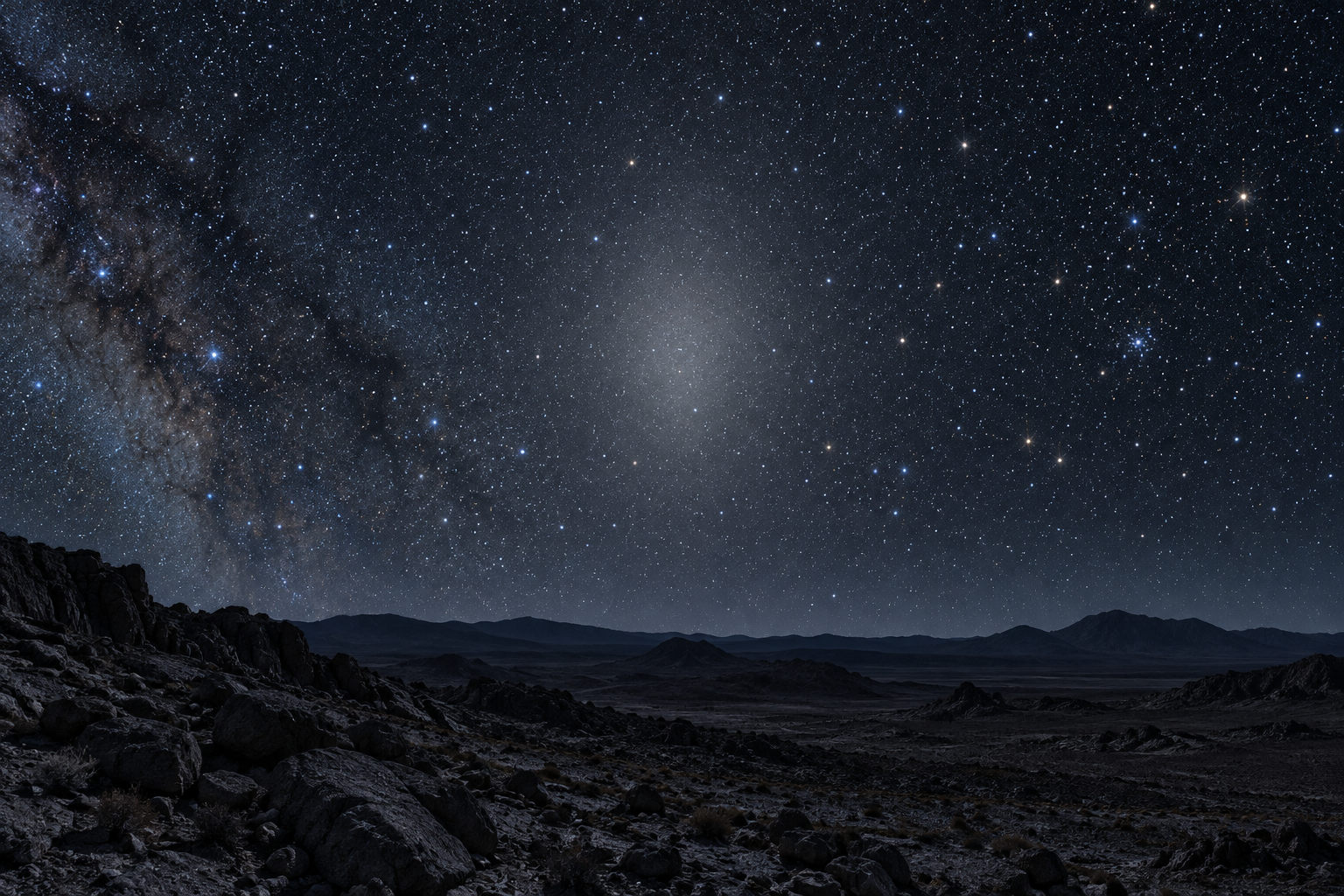
Most celestial sights announce themselves with a bright point or a recognizable shape. The gegenschein does almost the opposite. Under a very dark sky, it is a broad, faint brightening that can look like a patch you are not quite sure you saw. Its name means “counter-shine,” and its position supplies the clue: it appears in the direction directly opposite the Sun.
That might sound impossible during the night. Yet sunlight continues to illuminate space beyond Earth, including the fine dust scattered through the inner Solar System. Some of that light returns toward us. The gegenschein is a subtle reminder that darkness above our heads is still crossed by sunlight.
A glow made from scattered sunlight
The particles responsible belong to the interplanetary dust cloud, fed by material from sources including comets and asteroids. They do not need to generate their own light. Their surfaces scatter the sunlight that reaches them, and we see the combined contribution of many grains along a line of sight.
The geometry differs from the brighter cone of zodiacal light often photographed after twilight. The gegenschein lies at the antisolar point, within the much fainter zodiacal band that follows the plane of the Solar System. It is therefore a particular feature of the same dusty environment, rather than an unrelated luminous object.
Why the opposite direction matters
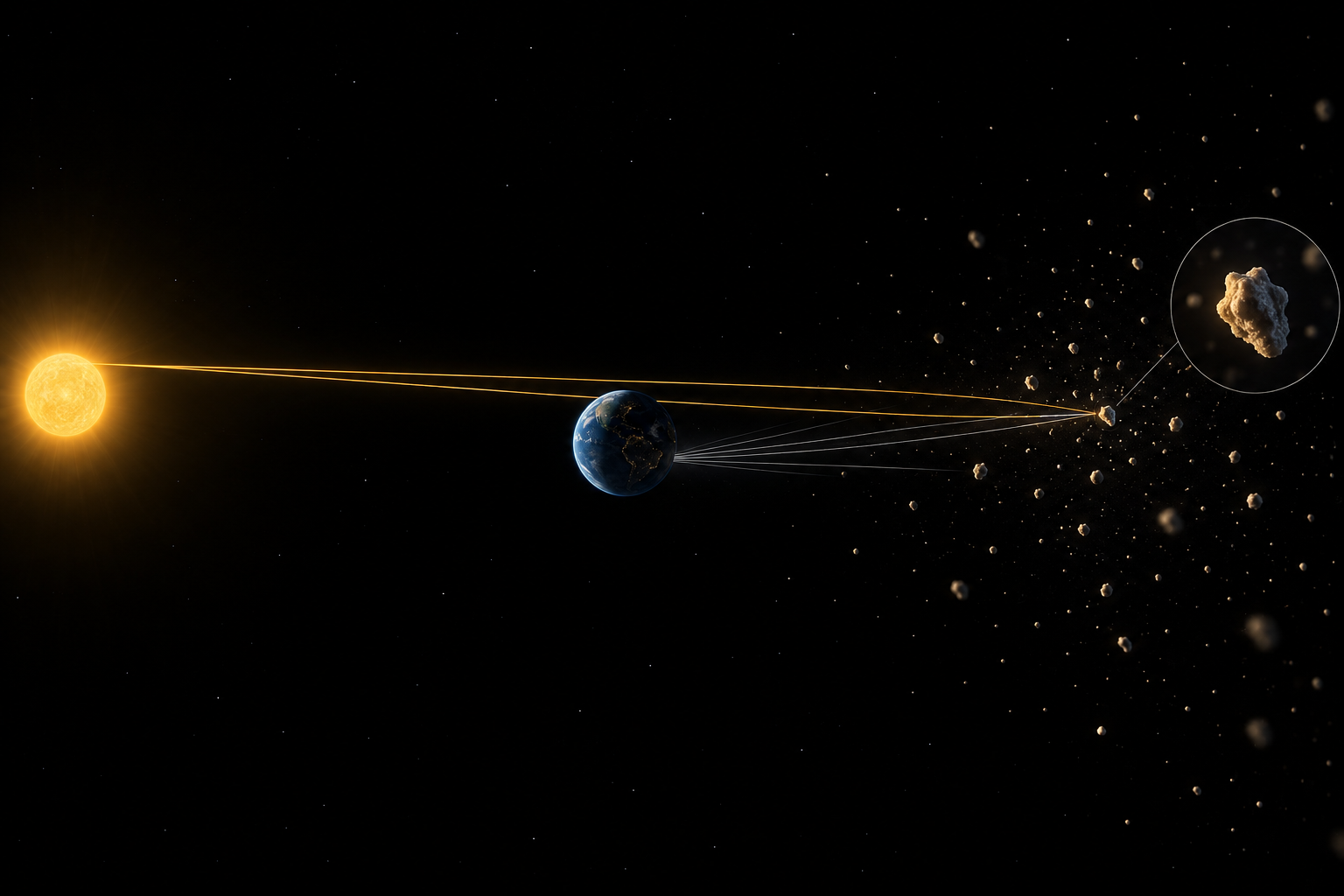
Looking almost directly back along the incoming sunlight produces a brightness enhancement known as an opposition effect. At this angle, the shadowed parts of an irregular grain can be hidden behind its illuminated parts. Light-wave effects can also enhance backscattering. Researchers study the narrow brightening around the exact antisolar point to learn about the dust's optical properties.
The illustration's neat rays simplify a messy reality. There is no single solid reflector, and the grains are distributed over a large volume. The glow's brightness and shape contain information about both that distribution and how individual particles scatter light. Something barely visible becomes a way of investigating material far too small and distant to pick out directly.
A reward for a truly dark night
Moonlight, artificial lighting, haze and the bright background of the Milky Way can overwhelm the gegenschein. A photograph may reveal it more strongly than the eye, especially after long exposure and processing. A dramatic image should not be taken as a promise of an equally dramatic naked-eye view.
To understand where to look, picture a line running from the Sun through Earth and onward into the night sky. Around local midnight, that opposite direction is highest. A moonless night at a dark location gives the subtle patch its best chance to stand apart. Even if it remains elusive, the idea changes the sky: empty-looking space is full of dust, and dust can return a little daylight to the night.
Sources and further reading: NASA: The Gegenschein; High-resolution imaging of the gegenschein; ESO: Gegenschein over the VLT.
Explore more creative discoveries at Incoprea.




