Showing posts with label Genetics. Show all posts

Thursday, October 22, 2026

The Fish Embryo That Waits for Its Pond to Return

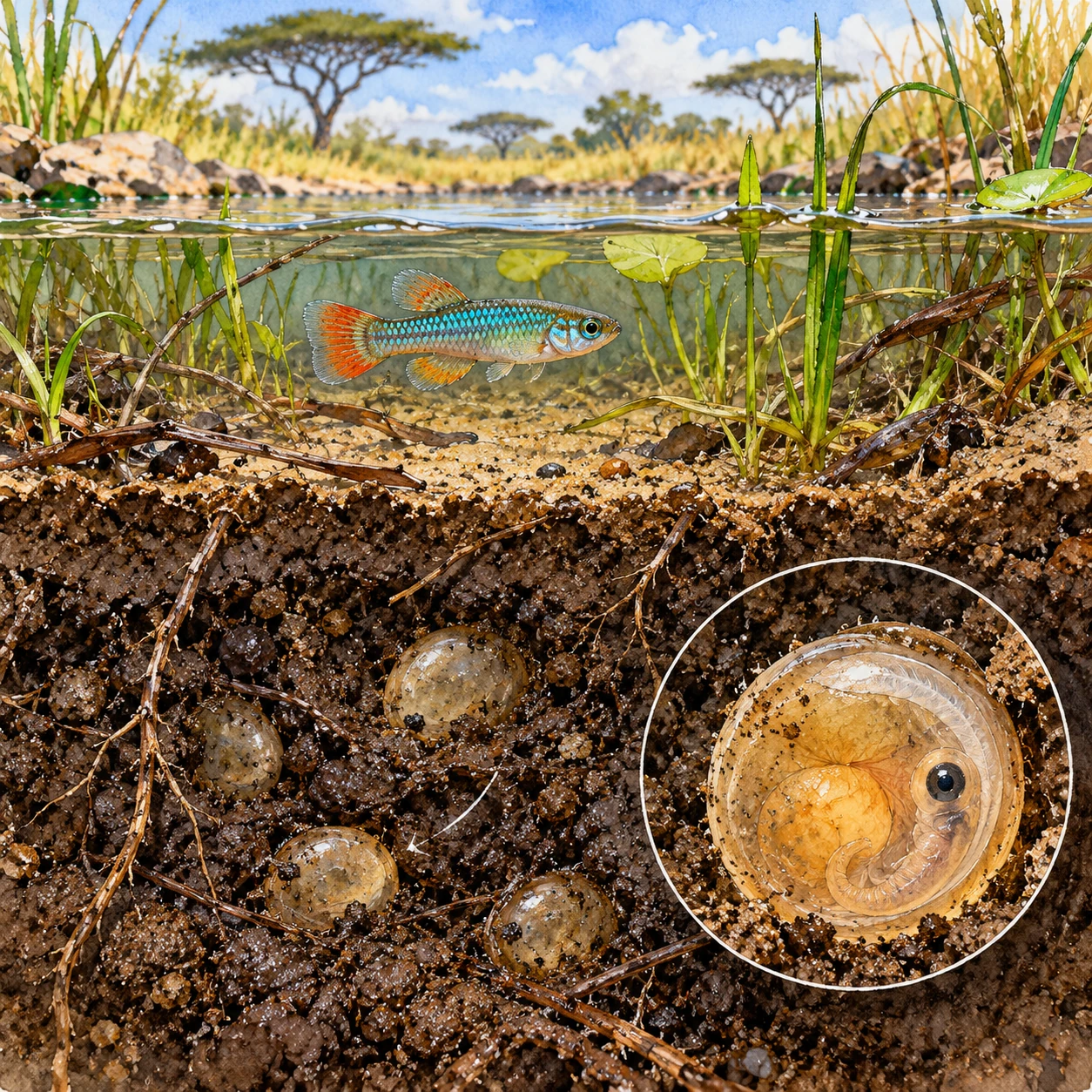
Conceptual cutaway of a temporary savanna pond with a turquoise killifish above eggs in the underlying soil.
Conceptual cutaway combining rainy-season habitat and an enlarged embryo; life stages and scales are combined for explanation.

A pond can disappear without the local fish lineage disappearing with it. The apparent contradiction is resolved below the mud's surface. For the African turquoise killifish, Nothobranchius furzeri, the dry season can be crossed as an embryo inside an egg, with development held in a regulated pause. The adult is adapted to an urgent season. The embryo is adapted to waiting.

This is not a story of a fish flopping out of water and surviving until rain returns. The life stage matters. Adults inhabit temporary pools; embryos can remain when the adult habitat is gone. Calling the fish “drought proof” would blur the very division of labor that makes its life cycle understandable. One stage grows and reproduces within a limited opportunity, while another carries the lineage through its absence.

Paused development is still a biological activity

The term for this state is diapause. It is a programmed interruption of development, not simply a dead embryo that later becomes alive. The Brunet Lab's research overview identifies killifish as a model for studying both vertebrate aging and this unusual preservation state. Those subjects meet in a basic question: what must a living body keep doing when ordinary growth is stopped?

The useful image is not a film frozen at a frame. A film frame requires no maintenance. Cells still have structures and molecules that must remain functional if development is to resume. A pause must therefore include a strategy for preserving what already exists, not only an instruction to make fewer new parts.

In a 2020 study in Science, researchers followed gene activity during diapause and tested genes involved in chromatin regulation. Chromatin is the molecular organization of DNA and its associated proteins; changes in that organization help control which genes are used. The study identified members of the Polycomb system, including CBX7, as important for maintaining diapause and preserving muscle. Disrupting a regulator did more than change a molecular label: it altered the maintained state.

That moves the explanation from “the embryo slows down” toward a testable mechanism. A preservation program has components. If changing a component damages preservation or changes the timing of exit, researchers can begin to distinguish causal work from molecular changes that merely accompany the pause.

How do you test whether waiting has a cost?

The same 2020 research compared later outcomes in fish that had experienced diapause. Within the durations and conditions studied, the pause did not produce an apparent penalty in subsequent growth, fertility, or adult lifespan. This is striking, but its boundaries are essential: an observed absence of a cost in these measures is not proof that every possible cost is absent under every environmental condition.

The small fish is useful partly because its adult life is short enough for researchers to follow whole lifetimes within a practical study. Stanford's account of building the research model describes the development of genetic tools and shared resources. A compelling organism becomes much more informative when different laboratories can measure comparable traits and test the same biological components.

The first rain can be an unreliable invitation

A waiting embryo faces two uncertainties: when water will arrive and whether the water will last. A shower can wet a basin without providing enough time for a new fish generation to reproduce. Developmental delay can therefore have a role beyond simply bridging the predictable dry interval.

A 2015 experiment with Nothobranchius furzeri found variation in whether embryos entered diapause, how long they remained there and when they hatched. Some variation persisted after genetic and environmental sources were controlled. The authors interpreted that pattern in terms of diversified bet hedging: spreading risk across offspring rather than sending every embryo through one identical schedule.
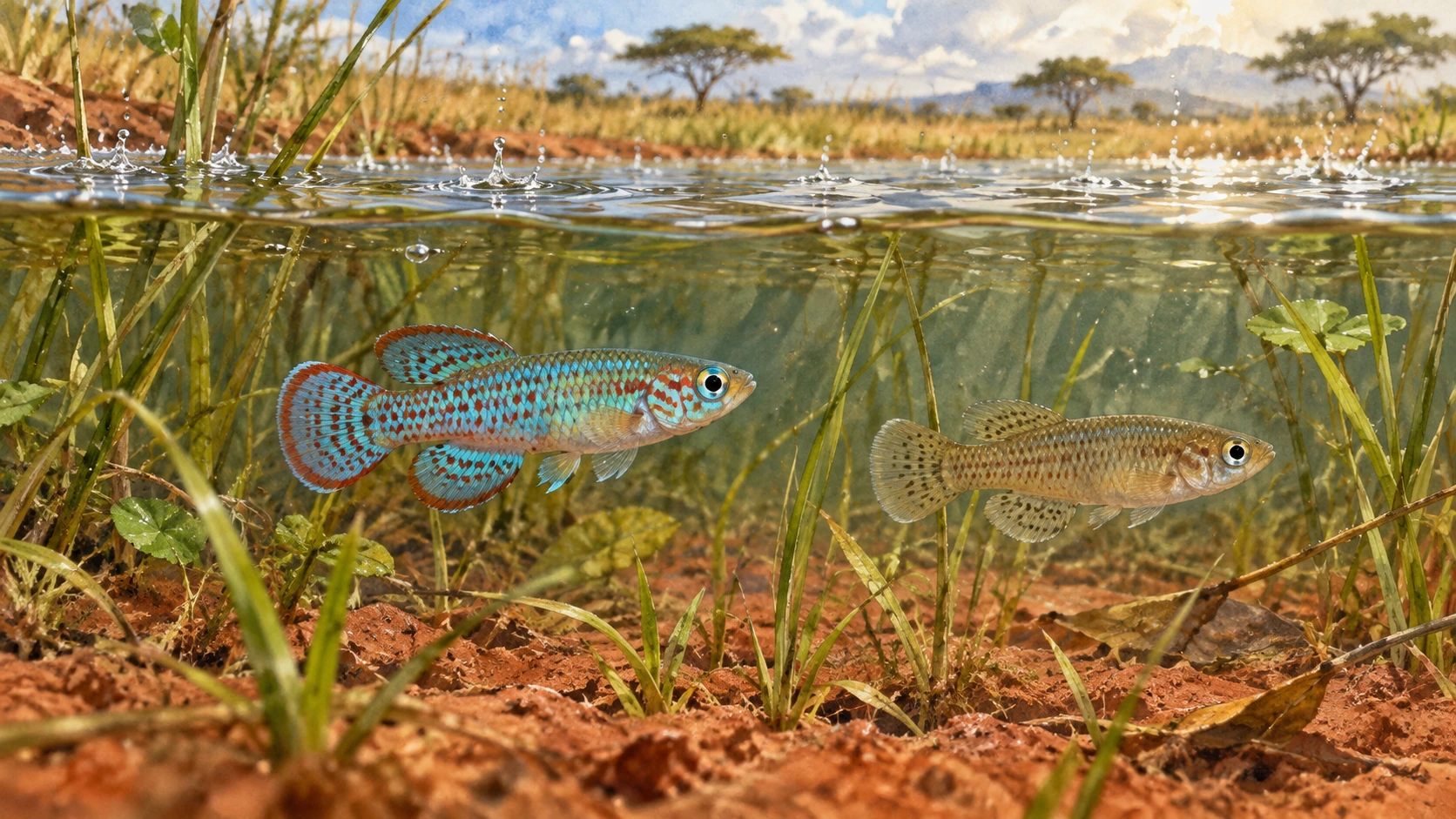
Turquoise killifish swimming above sediment in a shallow temporary pool
The wet phase is an opportunity with a deadline. A return of water does not guarantee a complete growing season.

Field research on 13 egg banks representing seven Nothobranchius species added natural conditions to that account. Development could be synchronized during major habitat phases and more variable during transitions. The authors discussed how environmental guidance and intrinsic variation can work together. This was a multispecies comparison, not proof that every population of the turquoise killifish follows one fixed rule.

The useful distinction is between responding to information and spreading risk because information is incomplete. A reliable cue could synchronize development. If a cue sometimes gives a false start, variation among offspring can leave part of a lineage exposed to a different opportunity.

A ledger with two possible pools

The worksheet begins with 100 fictional eggs. In one scenario all hatch at the first rain. In another, half remain. Suppose the first pool fails,90 percent of the reserve survives waiting and 60 percent then produces surviving fish. The second scenario retains 27 survivors while the first retains none.

One rain is not a whole growing season

Two invented hatching schedules, two rainfall outcomes and a revealable arithmetic check.

Open this activity in its own window.

Now change the sequence. If the first pool offers 80 percent survival, committing everything yields 80. The split strategy yields 40 from the first pool and 27 from the second: 67. The same arrangement that softened a catastrophe has sacrificed some return during a good early opportunity.

These invented values do not establish an optimal hatching fraction. They show why a strategy cannot be judged from one favorable season. To evaluate it, researchers need the sequence of conditions, the cost of waiting and the reproduction achieved by survivors. The tiny fish's extraordinary pause belongs to a larger problem: how a lineage persists when a useful signal is never a perfect promise.

Evolution can rewire existing tools

A 2024 Cell study investigated how the diapause program evolved. It compared regulatory activity and gene expression across relevant species and developmental states. Its central finding concerned the reuse of ancient genes through changes in their regulatory landscape. Evolution did not need to invent every preservation-related molecule from nothing; changes in when and where existing genes were used could help build a new life-history program.

That is a different kind of ingenuity from the usual picture of evolution producing a novel anatomical gadget. A shift in coordination can change an organism's possibilities. The same general principle is familiar in making things: possessing a set of materials is different from organizing them into a working process. The analogy helps with the distinction, but the research concerns inherited biological regulation, not a designer making a deliberate plan.

Natural populations also prevent the species from becoming a simple symbol of one fixed lifespan. Max Planck research compared wild populations and linked differences in lifespan to population history and the accumulation of harmful mutations. Ecology, demography, genetic background, and laboratory conditions all matter when interpreting an aging result.

None of this establishes a method for placing a person in suspended animation. It does establish a vertebrate system in which long preservation, resumed development, and molecular regulation can be investigated together. The difference is substantial: one is a dramatic application we can imagine; the other is an experimental opportunity researchers actually have.

When the rains return, the pool looks like a place newly ready for life. The eggs tell a longer story. Life was already present, organized to wait through the period when its adult form could not live there. The most remarkable part is not that time was defeated. It is that evolution produced a way to spend one kind of time very differently from another.

Follow the evidence: Hu and colleagues: vertebrate diapause and Polycomb regulators; Singh and colleagues: evolution of the diapause regulatory program; Brunet Lab: aging and diapause research; Stanford: establishing the killifish research model; Max Planck Institute: lifespan differences in wild populations.

More curious connections, art and independent projects at Incoprea.

Pando: Where Does One Tree End?

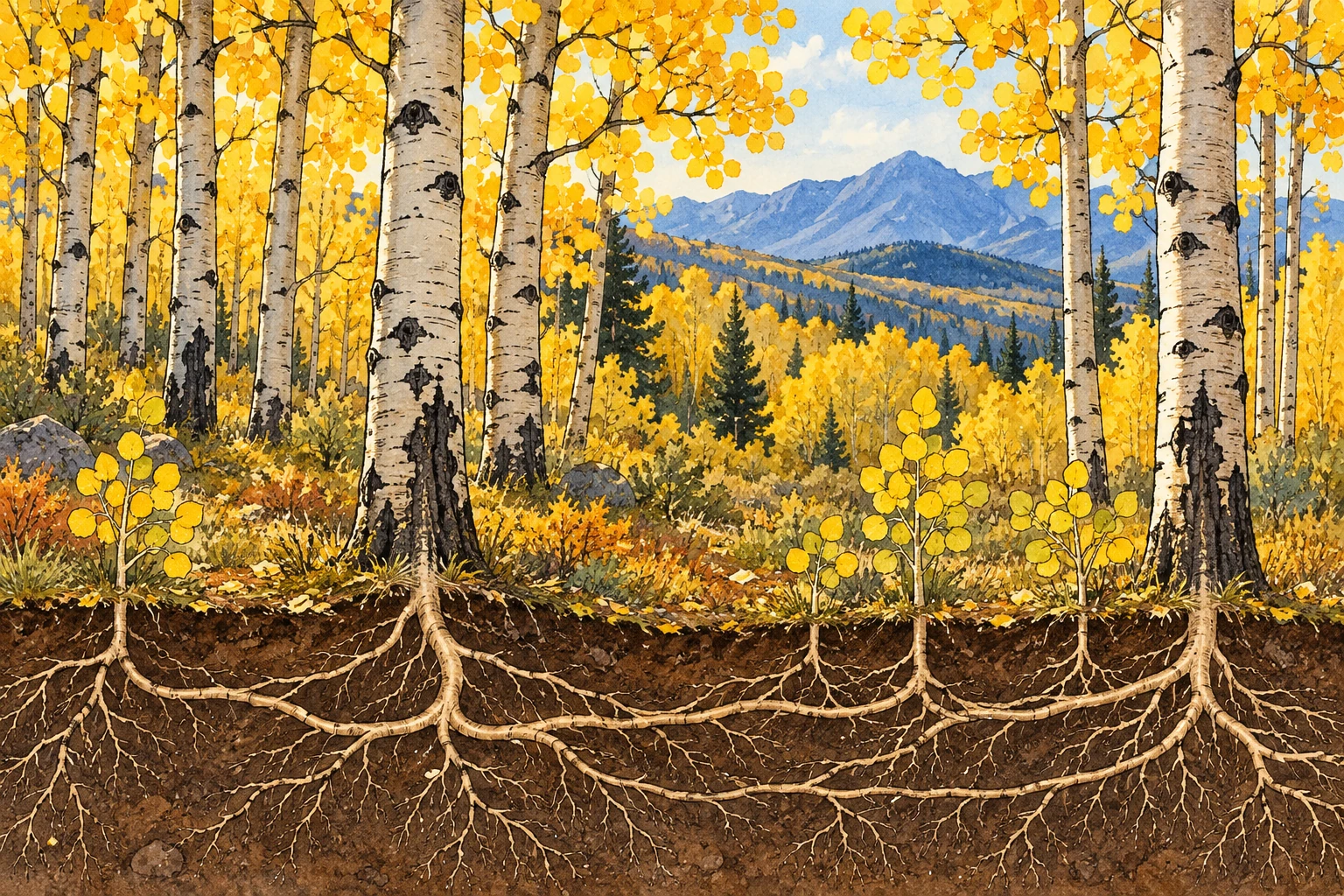
Stand among the white trunks of an aspen grove and the ordinary counting rule seems obvious: one trunk, one tree. Pando, the large quaking-aspen clone in Utah, makes that rule inadequate. Many visible stems belong to a lineage that began from one seed and spread vegetatively. The forest-like scene asks us to distinguish a trunk from a genetic individual.

An autumn aspen grove with a schematic soil cutaway showing roots and young suckers.
Conceptual aspen cutaway; root connections are schematic, not a map or reconstruction of Pando.

The distinction is not mystical. A ramet is a module produced through clonal growth; a genet is the genetic individual originating from a seed or other founding reproductive event. Multiple ramets can belong to one genet. The terms help describe a plant whose body is assembled and renewed across space.

How can we know that the stems belong together?

The Western Aspen Alliance's genetics account describes DNA-fingerprinting work that confirmed Pando's clonal identity in 2008. It also notes other, smaller clones within the broader aspen stand. A grove's visual boundary and a clone's genetic boundary are not automatically the same line.

This is a good example of evidence changing an everyday category. Similar leaf shape or simultaneous autumn color can suggest a connection, but genetic markers can test whether sampled stems share clonal identity. Conversely, a genetically identified clone does not give us a photograph of every living root connection at every moment.

The US Forest Service account of quaking aspen explains how root suckering contributes to regeneration. New stems can arise from an existing root system. A stem can die while clonal growth continues elsewhere. The longevity of a lineage therefore need not mean that one ancient trunk or one unchanged piece of original tissue remains alive.

Which age are we asking about?

Counting rings in a trunk estimates the age of that stem. Estimating the time since the clone's founding seed requires a different method. Neither the number of stems nor the width of the grove supplies a direct clock unless assumptions about past growth are added.

A 2026 eLife reviewed preprint analyzed somatic mutations across more than 500 samples, including different tissues and neighboring clones. Its authors used phylogenetic analyses to estimate a clone age of roughly 12,000–37,000 years. Crucially, the accompanying editorial assessment judged evidence for several central conclusions, including age, incomplete because the genomic data were relatively low-coverage and sampled only part of the genome.

The right way to report that result is as a model-based estimate with explicit evidential limits. It is not a certified birthday. Older articles and earlier preprint versions can give different ranges; that movement is a reason to identify the version and method rather than selecting the most dramatic number.

One genotype can become several ecological neighborhoods

Sharing a clonal identity does not make every part of a grove experience the same conditions. A fence, a browsing route or a patch of dense young stems can create a different developmental history without creating a new founding genotype.

The 2022 Pando reassessment returned to 64 plots and followed a set of vital indicators. It described contrasting trajectories among management areas, including stronger regeneration in protected parts and continuing problems elsewhere. The account concerns the conditions measured then; it should not be read as a fresh 2026 census.

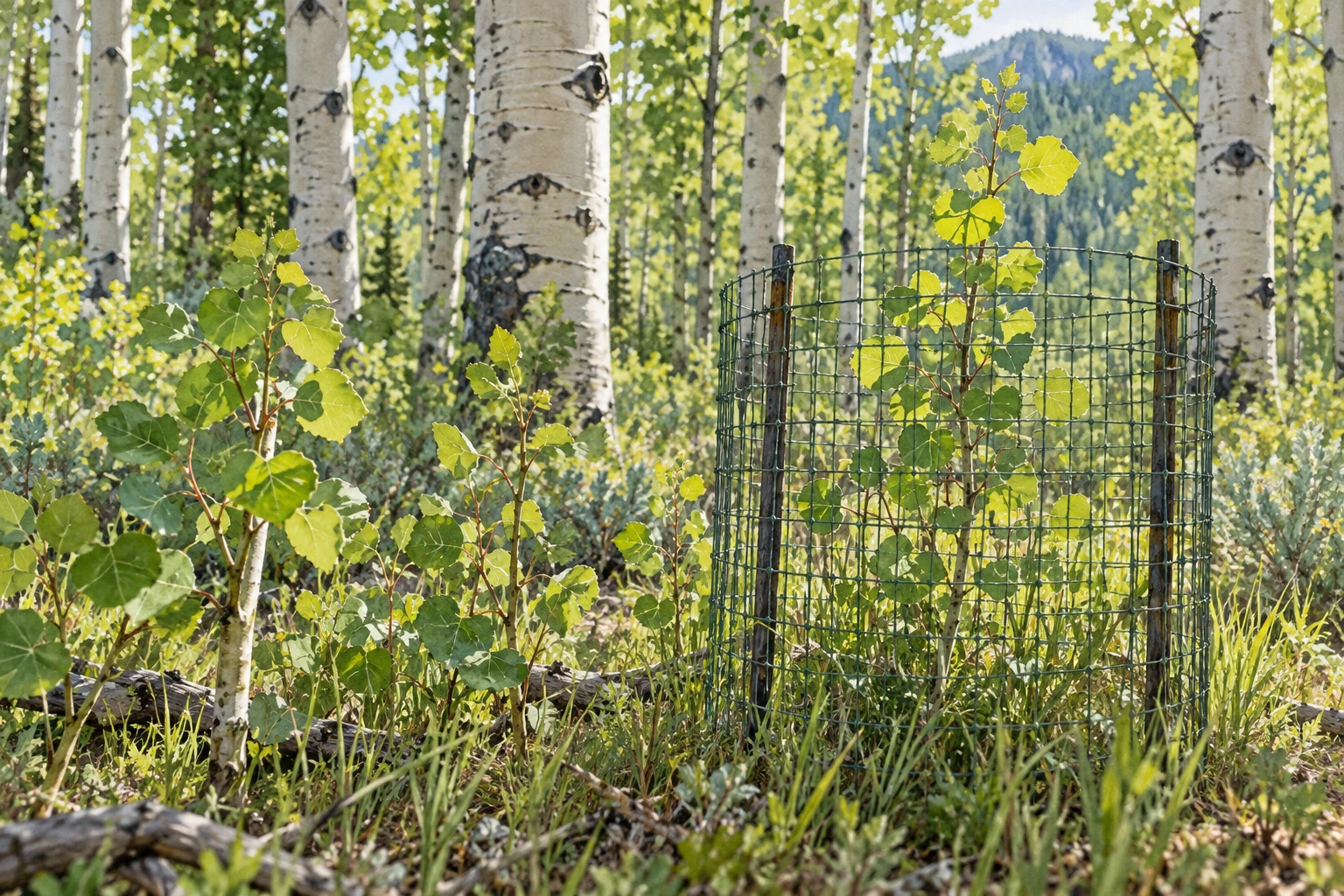
Young aspen suckers and a small sapling near a conservation fence beneath mature trunks
Genetic continuity still depends on successful stem replacement. This scene is not a monitored Pando plot.

The associated Utah State dataset and methods record explain why remeasurement matters. Repeatedly returning to defined plots can connect changes in mature stems, young stems and browsing. A new photograph from an attractive part of the grove cannot replace that comparison.

The study also distinguished regeneration from recruitment. Producing low suckers is not enough if they remain trapped in a vulnerable stage and fail to grow beyond browsing height. A count of new shoots can look encouraging while the transition needed for canopy replacement remains weak.

A small demographic check

Imagine a fictional stand with 100 mature stems. During one interval, ten die,50 low suckers appear and only two young stems reach the class needed to replace mature stems. Reporting “50 new shoots” alone sounds like rapid renewal. Recording the transitions shows a different balance:92 mature or replacement-class stems after the losses and gains, under these simplified rules.

What should be followed next?

The fate of those 50 suckers. How many survive, how many are repeatedly browsed and how many enter the next size class? The numbers are invented; the exercise explains why stages and transitions can matter more than a single total.

A clone can therefore persist genetically while its visible structure changes. Its conservation problem is not solved by confirming identity again, and its identity does not cease merely because management produces a patchwork of conditions.

When looking from an established path, let the smallest stems have as much attention as the canopy. Then return to the measured study for the population-level inference. The young shoot is an opportunity; successful passage through several stages is the process that makes that opportunity count.

The practical problem is the next generation of stems

Whatever the precise age, persistence depends on replacement. A 2018 study by Rogers and McAvoy examined 65 monitoring plots under different management regimes. It measured mature trees, regeneration, browsing, and signs of ungulate presence, and used historical aerial photographs to examine change. Successful recruitment of young stems was central to assessing condition.

The study linked mule-deer browsing with poor regeneration and found stronger recruitment under effective protective treatments. A fence that animals could penetrate did not provide the same protection as an effective barrier. That detail matters: the presence of a management structure on a map is not evidence that it achieved its ecological function.

A stand full of large trunks can therefore conceal a demographic problem. If old stems continue to die while few young stems escape browsing and reach maturity, the current canopy does not guarantee a future canopy. Looking only upward can miss the process that determines whether the clone persists.

The Friends of Pando–Forest Service partnership describes a framework for research, public education, and stewardship. Such work turns a record-breaking organism into a place with ongoing practical needs. The relevant conservation outcome is not preserving a headline about size; it is sustaining the living processes that replace tissue and maintain a functioning community.

If visiting an aspen grove, look for several sizes of stems, including young suckers and saplings, from established routes. Do not dig to expose connections or move through protected regeneration areas. The contrast between a mature canopy and the smallest stems can be more informative than another photograph of impressive trunks.

The generated cutaway above is schematic. Its roots explain the possibility of clonal growth; they are not a mapped reconstruction of Pando's underground body. The genetic and monitoring studies are the evidence.

Pando expands the meaning of a tree without erasing the usefulness of individual stems. Each trunk has a history; the lineage has another. Its future depends on renewal at the scale of small shoots. A very old organism can be sustained by tissue that is young, and an apparently full forest can need help making what comes next.

Follow the evidence: Utah State Western Aspen Alliance: genetic identity; US Forest Service: quaking-aspen biology; Rogers and McAvoy: regeneration and browsing at Pando; Pineau and colleagues: 2026 reviewed preprint and assessment; Friends of Pando: stewardship partnership with Forest Service.

More curious connections, art and independent projects at Incoprea.
Wednesday, October 14, 2026

Horizontal Gene Transfer: When Evolution Moves Sideways

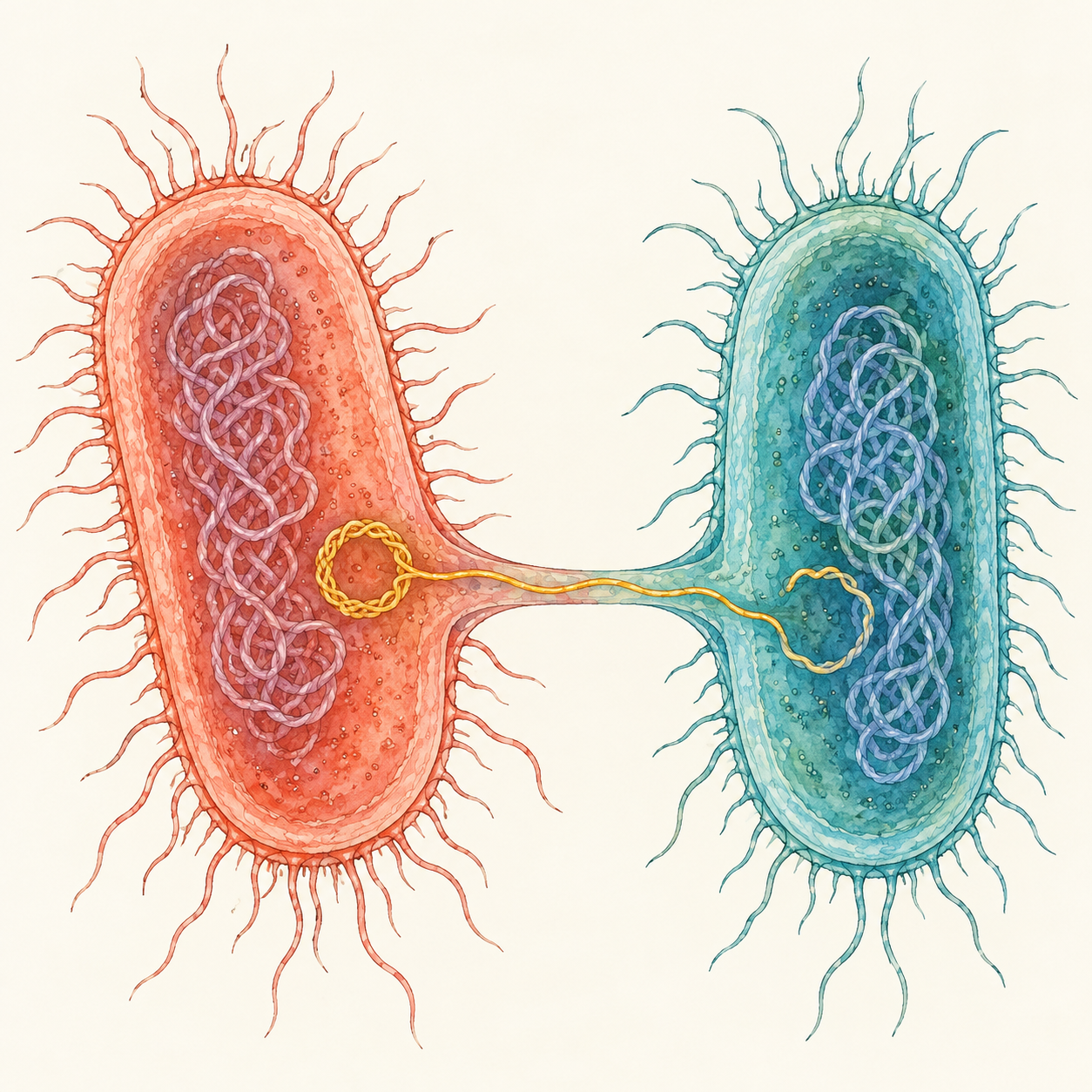
Two conceptually colored bacteria are connected by a bridge carrying a strand associated with a plasmid.
Conceptual illustration of conjugation, one route of horizontal gene transfer. Cellular structures and DNA are simplified and not to scale.

We usually picture inheritance as a family tree: parents pass genes to offspring, and branches divide over generations. In the microbial world, another route can cross those branches. Horizontal gene transfer moves genetic material between organisms outside ordinary parent-to-offspring inheritance.

A bacterium may acquire useful DNA from another cell or from material in its surroundings. This does not make every species freely interchangeable. It does mean that the history of a particular gene can differ from the history of the organism carrying it.

Three routes through the microbial world

In transformation, a cell takes up DNA from its environment. Some bacteria become competent to do this under suitable conditions. DNA released by dead organisms can therefore remain biologically relevant after the organisms themselves are gone.

In conjugation, DNA is transferred through direct contact between cells using specialized molecular machinery. Plasmids, separate DNA elements that can replicate in a host, are important participants. Some other mobile elements can integrate into a chromosome and also transfer between cells.

In transduction, a bacteriophage participates in moving bacterial DNA to another cell. The details depend on the phage and the transfer mechanism. Viruses can thus be involved in genetic exchange as well as in infections that kill their hosts.

RouteHow DNA travels
TransformationUptake of environmental DNA
ConjugationTransfer through cell contact
TransductionTransfer associated with a phage

A gene’s journey needs several pieces of evidence

Imagine finding a very similar gene in two bacteria whose other genes suggest a more distant relationship. A sideways journey is one possible explanation. It is not the only question to investigate. Could the gene have been present in a shared ancestor and then lost from other descendants? Could a mixed sample or an identification error have produced the apparent result? A surprising match is a starting clue, not a complete travel history.

Researchers therefore compare several kinds of information: the relationships among organisms, the relationships among copies of a gene, and the DNA surrounding that gene. A sequence sitting beside recognizable mobile-element machinery tells a different story from a match examined in isolation. Evidence of actual transfer adds another layer. Each observation narrows the possibilities while answering a slightly different question.

The distinction becomes especially important when a useful trait appears quickly in a population. The population might contain more descendants of cells that already had the trait. Cells might acquire new DNA. Both processes might occur together. Knowing that resistant cells became common would not, on its own, tell you which process produced that change.

Try identifying the route from the clue

Consider three fictional observations. In the first, a bacterium acquires a DNA fragment that was freely present in its surroundings. In the second, a transferable DNA element moves during direct contact between cells. In the third, the delivery involves a bacterial virus. Match these descriptions with transformation, conjugation, and transduction before reopening the route table above.

Compare the three routes

The first description points to transformation, the second to conjugation, and the third to transduction. These clues identify the delivery route. They do not establish that the new sequence persisted, produced a useful trait, or spread through later generations.

Now add one extra observation: descendants several generations later still carry the acquired sequence. This helps address persistence, but you would still need another comparison to establish its effect on growth or survival. The exercise separates arrival, inheritance, and function instead of allowing the word “transfer” to stand for all three.

Arrival is only the beginning

For acquired DNA to have a lasting effect, it must persist and function. It may need to replicate as a plasmid or become incorporated into existing genetic material. A recipient's defenses, compatible sequences and cellular machinery influence whether that happens.

The added material can also impose costs. A gene useful in one environment may be unnecessary or disadvantageous in another. Selection then affects whether cells carrying it multiply successfully. Horizontal transfer provides variation; it does not guarantee that every transferred sequence becomes an adaptation.

These constraints make the process scientifically interesting. Researchers can investigate not just whether a gene is present, but how it arrived, whether it is active and what ecological conditions favor its retention. Similar sequences alone do not settle every possible history.

Why extra DNA can be a mixed bargain

Carrying and expressing a plasmid can use cellular resources. Its effects also depend on the host and the environment. The American Society for Microbiology describes how plasmids may persist despite costs, with subsequent evolution changing their transfer or their burden on a host. This does not turn every costly element into a benefit; it makes persistence a question about interacting processes. Read the plasmid overview.

A useful everyday comparison is an extra set of instructions carried to a new workshop. It may describe a valuable task, yet still require compatible tools, materials, and time. The analogy has limits: cells do not read deliberately or choose what to keep. It does capture why possession of information is different from being able to use it effectively.

The lateral-transduction study linked below adds a further surprise. In the bacterial systems it examined, phages moved some chromosomal genes more efficiently than familiar mobile elements moved through comparison routes. That is a result tied to particular organisms and mechanisms. Its value lies in showing how a measurement can overturn a convenient general assumption about what kinds of DNA are mobile.

New abilities can cross lineage boundaries

Horizontal transfer can spread genes for using particular nutrients, resisting environmental stresses or interacting with other organisms. Antibiotic-resistance genes are an especially consequential example. Their movement helps explain why a capability can appear in different bacterial lineages rather than remaining confined to descendants of one original cell.

A family tree still matters, but for microbes it may be crossed by connections between branches. Evolution is shaped by reproduction, mutation and selection, while some genetic information also travels sideways. Following those connections reveals a dynamic community behind what might look like separate, isolated cells.

Explore more creative curiosity at Incoprea.

Before Gene Editing, CRISPR Was a Bacterial Defense System

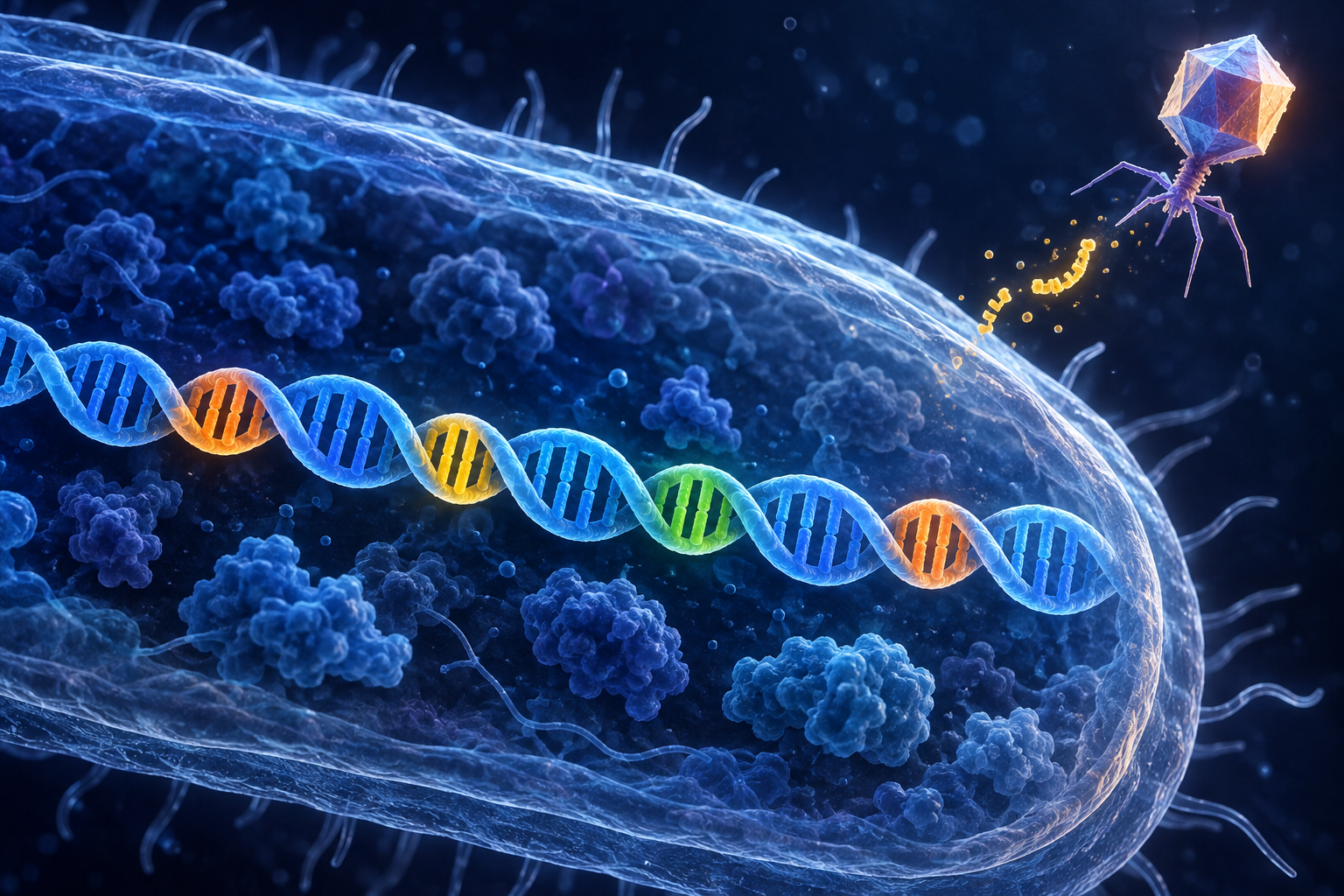
A conceptual bacterial DNA ribbon contains repeating blue sections and differently colored spacers beside a phage.
Conceptual illustration of a CRISPR array. Colors represent repeats and varied spacers, not actual DNA sequences or a measured molecular structure.

CRISPR is widely associated with editing genes, but its story begins in the ongoing struggle between microbes and the viruses that infect them. Certain bacteria and archaea keep short sequences of foreign genetic material in their own genomes. Those sequences can help them recognize a later encounter.

This is a molecular form of acquired defense. The organism is not consciously remembering an event. Instead, a record in DNA can provide the sequence information needed to direct protective machinery toward an invading target.

Repeated sequences with meaningful gaps

CRISPR stands for clustered regularly interspaced short palindromic repeats. A CRISPR array contains repeated stretches separated by sequences called spacers. Researchers noticed that some spacers matched genetic material from viruses and other foreign elements.

That match was a clue, but an explanation needed experiments. In 2007, researchers working with Streptococcus thermophilus showed that bacteria challenged by phages acquired new spacers derived from the viral genomes. Adding or removing particular spacers changed resistance to the corresponding phages.

The result linked a specific sequence record to a specific protective effect. It helped establish that CRISPR arrays and associated genes could provide acquired resistance. Not every bacterium has such a system, and bacteria possess many other defenses as well.

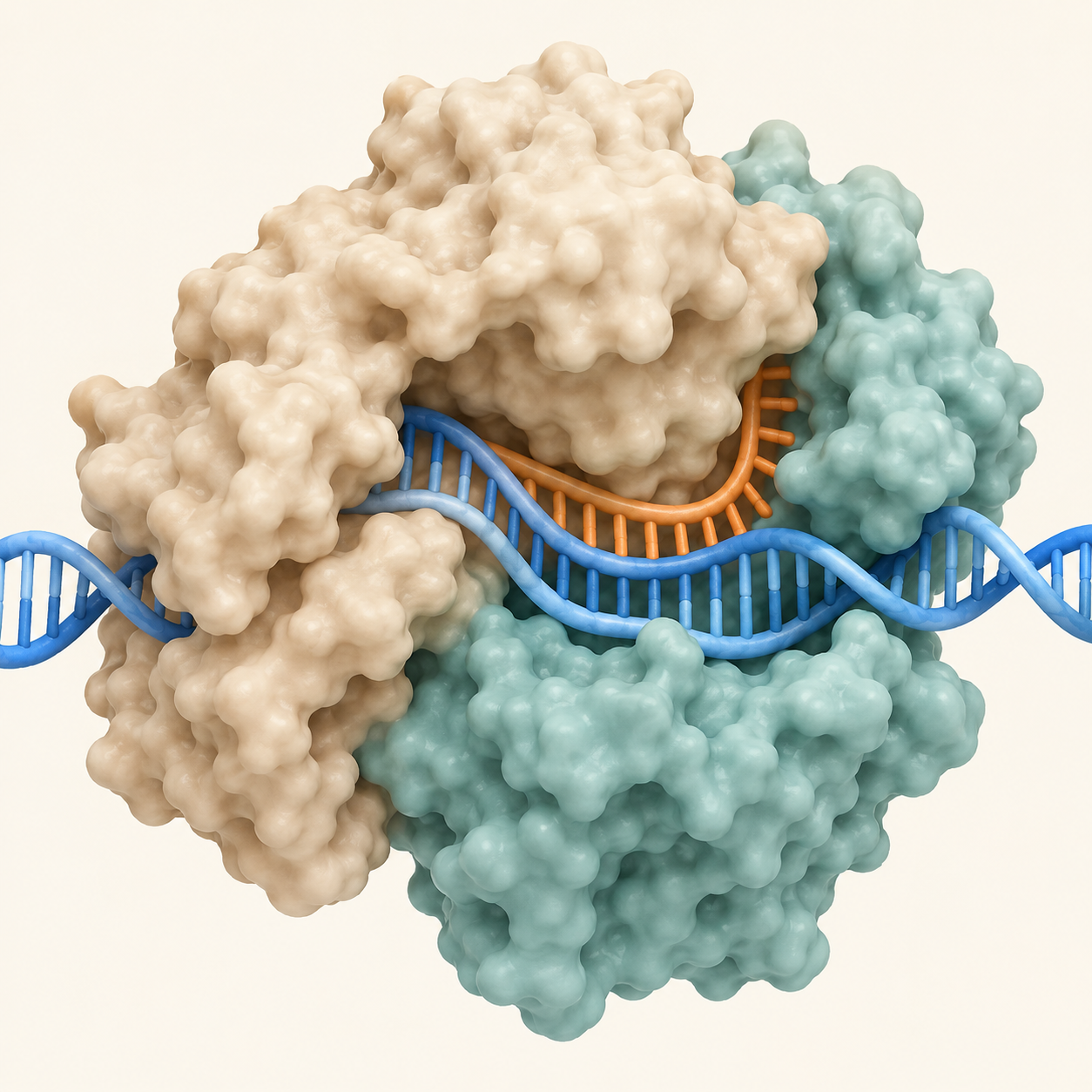
A conceptual protein surrounds a DNA strand alongside an orange RNA guide.
Conceptual illustration of RNA-guided DNA recognition. Protein and nucleic-acid shapes are approximate, not a solved Cas9 structure.

What made the resistance experiment convincing?

A matching sequence could have been an interesting coincidence. The stronger question was whether changing the sequence record changed what happened during a viral encounter. Barrangou and colleagues connected those levels: the bacterial record acquired new spacers, and adding or removing particular spacers changed resistance to corresponding phages. A record and a protective effect were tested together.

That distinction is useful far beyond CRISPR. Finding a feature in successful survivors establishes an association. Altering that feature and comparing the outcome can help establish a causal role. It still matters which organism, virus, and conditions were tested. One controlled result should not silently become a claim that every microbial immune system works identically.

Read a molecular memory without treating it as a mind

Imagine a row of identical dividers with different small tokens between them. The repeated dividers represent repeats; the varied tokens represent spacers. Suppose one token corresponds to part of a virus encountered earlier. The row is a stored pattern. By itself, it is not yet the mechanism that recognizes or stops anything.

Now ask what else must be present. The sequence has to be expressed in a usable form. A guide needs molecular partners, and those partners must recognize an appropriate target in the right context. Finally, a protective event has to follow recognition. The comparison helps prevent a common shortcut: treating an informative DNA pattern as if it were a complete, self-operating memory.

In the illustration above, look separately for the repeated features and the differences between them. Its colours are visual aids rather than a sequence you could use in an experiment. They help show organization; they cannot show whether a particular spacer provides protection against a particular virus.

A sequence becomes a guide

CRISPR-associated proteins are called Cas proteins. In many systems, the stored sequence information is transcribed and processed into RNA guides. A guide can direct a protein or protein complex toward complementary foreign genetic material. The details differ among CRISPR system types.

Cas9 is one famous example of an RNA-guided enzyme that can cut DNA. Other systems use different proteins, and some target RNA. It would therefore be misleading to describe all natural CRISPR defense as the same pair of molecular scissors.

Successful recognition is also more demanding than simply finding a short matching string somewhere in a cell. The system must distinguish an appropriate target and operate in its molecular context. Viruses can change, and some have evolved mechanisms that interfere with CRISPR defenses. The interaction remains an evolutionary contest.

The invader can interfere with the defence

There is another reason to avoid treating the stored record as a guarantee. Bondy-Denomy and colleagues identified phage genes that inhibited a CRISPR–Cas defence in Pseudomonas aeruginosa. Their 2013 paper established examples of what became known as anti-CRISPR genes. The finding concerns molecular countermeasures, rather than a virus making a conscious tactical decision. Read the original anti-CRISPR study.

This adds an important dimension to the story. A bacterium may have a recognizable sequence record while another part of the encounter prevents effective defence. A failed defence is therefore not automatically evidence that the record was absent or that matching never occurred. Biology often requires a sequence of working steps, with more than one place where the outcome can change.

Targeting and editing are different achievements

The 2012 Cas9 study examined a particular molecular system and showed that its RNA guidance could be reconfigured. It did not show that a chosen DNA cut automatically produces every desired final genome. That later task brings repair, delivery, and the condition of the recipient cells into the explanation. The distinction is central to understanding why an elegant molecular result can open a field of research without completing it.

When you encounter a CRISPR headline, try locating its actual achievement. Is it about a natural defence, a protein recognizing a target, a change measured in cells, or an application tested in an organism? All are interesting. Naming the level makes the evidence easier to assess and restores the microbial discovery story behind the famous tool.

The origins remain as interesting as the applications. A biological system shaped by viral encounters became a research tool because scientists asked what its unusual DNA pattern was doing. CRISPR's history shows how careful work on microbial life can uncover mechanisms with uses that were never apparent from the first observation.

Explore more creative curiosity at Incoprea.

Famous Last Meals is now in paperback — stories, history and 25 recipes

Famous Last Meals: Stories, History, and Recipes is now available in paperback on Amazon. The illustrated collection brings together 23 his...