Showing posts with label Books. Show all posts

Sunday, October 25, 2026

Volvelles: When a Book Asked the Reader to Turn the Page’s Machinery

Some books ask more of a reader than turning pages. A circular disc attached to a page can rotate over another disc, bringing marks, windows or pointers into a new relationship. The movement is small, but its effect is substantial: the reader operates part of the book. Devices of this kind are called volvelles.

Illustration of layered rotating paper wheels attached to an open book page.
An imagined paper instrument shows how a page can become movable.

A page that contains an instrument

The History of Science Museum in Oxford places volvelles within a larger tradition of paper instruments. Books and loose sheets could contain sundials, quadrants, astrolabes and other devices. Some were intended to be cut out and mounted. Others were meant to remain attached to a page, where moving components made a diagram usable.

A printed circle is not automatically a volvelle. The important difference is the designed movement of one part relative to another. A fixed diagram shows a relationship chosen by its maker. A movable diagram can present a range of relationships chosen by its user, within the rules built into the device. The page becomes something to manipulate as well as something to inspect.

Paper also changes the economics of an instrument. Oxford’s museum notes that printed devices could be disseminated more widely and cheaply than expensive brass examples. That did not make every paper instrument simple or inexpensive. An elaborate book could require substantial printing, hand assembly and careful finishing. The material allowed a range of possibilities, from affordable teaching tools to exceptional display objects.

Not every wheel did the same job

In Paper machines, Royal Society librarian Louisiane Ferlier introduces astronomical devices in the Society’s collections. A calendar published by Regiomontanus in 1474 includes a lunar volvelle. The article also discusses Johannes Schoener’s 1521 Aequatorium astronomicum, whose sequences of moving parts relate to the positions of celestial bodies. These are specific books with specific devices, not evidence for one universal paper calculator.

The Royal Society page includes a demonstration film. If the player does not appear, the article’s photographs and descriptions provide a useful fallback. Watch for the order of operations rather than trying to extract a scientific result from a brief view. Which wheel moves first? Which component stays fixed? Where does a reader obtain an input, and where would an output be read?

Those questions expose the work that a static photograph leaves hidden. An instrument may look crowded because several scales have to share the same surface. Motion can make that density manageable by aligning only the parts relevant to a chosen setting. A beautiful wheel is therefore also an interface, with assumptions about what its reader already understands.

Movement leaves a problem for preservation

A conservation study at France’s Institut national du patrimoine examines two editions of Jacques Bassantin’s astronomical work, dated 1599 and 1613. The study treats the volvelles as paper instruments mounted within books. It raises an especially revealing conservation question: how much movement should be preserved or permitted when movement itself can stress an old object?

A functioning replica can show an operation while protecting a fragile original. A digitized page can make small marks easier to read. Neither experience is identical to turning the historical device. Each preserves different kinds of access. The distinction matters because an object designed for use may have reached a point at which unrestricted use would damage the evidence of its own making.

Missing pieces create another difficulty. A book might retain the printed base of a wheel while losing a pointer, thread or rotating layer. It may still look complete to a reader who expects illustrations to be flat. Looking for attachment points and separate edges can therefore change an ordinary page into evidence of a lost mechanism.

The idea continued beyond early printed books

The Johns Hopkins Libraries hold the Barritt-Serviss Star and Planet Finder, published in 1906. Its board contains a central volvelle intended to relate a view of the sky to dates and times. The finding aid describes the claims of the object; it does not verify a particular present-day reading from it. The example shows that rotating paper devices were not confined to Renaissance volumes.

Calling a volvelle an “early computer” can be suggestive, but it may hide more than it explains. Some wheels perform a calculation; others organize information, illustrate a model or coordinate tables. It is better to ask what a particular device does than to award every moving circle the same technological ancestry.

Make a movement model without pretending to calculate the sky

Place one scrap-paper circle on a larger one and mark a triangle on the top disc. Turn it by hand while leaving the lower circle still. Notice how a fixed pointer would make one alignment easy to read. This is only a model of relative movement: it has no astronomical scale, prediction or historical claim.

The enduring surprise of a volvelle is that reading can involve an action with a material consequence. The reader sets something, compares something and observes what changes. A page need not contain electronics to respond to a hand. Its responsiveness can be built from cut edges, a central attachment and an arrangement of marks.

Explore more art, ideas and independent projects at Incoprea.

The Peutinger Table: A Long, Thin World Built Around Journeys

Imagine trying to fit a world onto a strip little more than a forearm high and several metres long. Coastlines would have to stretch, seas would narrow and familiar landforms would become difficult to recognize. The Peutinger Table does exactly this. Its distorted geography becomes more intelligible when you stop asking it to resemble a modern atlas and start following the roads.

Imagined folded route map with red roads, towns, mountains and seas, examined through a magnifying glass.
An imagined route map; the historical manuscript is linked below.

The object is medieval; its contents reach further back

The surviving Tabula Peutingeriana is a parchment manuscript made around 1200, now held by the Austrian National Library as Codex 324. Eleven sections survive. The UNESCO record places it in the Memory of the World register, which recognizes documentary heritage. It is not a Roman scroll that somehow avoided two thousand years of damage.

The distinction between object and information is crucial. A recent copy can preserve older material, while introducing alterations of its own. The KU Eichstätt research project treats the map as the outcome of successive copying and revision. Its possible ancient stages, sources and purposes remain subjects of investigation. A single confident caption such as “a map made in AD 400” erases that problem.

The research project describes a scroll nearly 6.8 metres long and roughly a third of a metre high. Its western beginning has not survived. The remaining world extends through the Mediterranean and onward towards India. These dimensions produce an extraordinary viewing experience: a territory too large to take in at once, yet so compressed vertically that broad seas become narrow intervals between bands of land.

A journey supplies another kind of order

The eye can travel along routes, encounter settlements and consider the distances written between them. City symbols and road connections give the sheet an internal logic even where its outline feels unfamiliar. UNESCO emphasizes the road system associated with the Roman imperial transport and communications service, the cursus publicus. This is a useful starting point for reading the network, but it does not settle every question about the map’s original audience or use.

A route diagram selects relationships. It can preserve the order of stops without preserving the angle of every road. This is why comparisons with a transit diagram are helpful up to a point. On a subway map, the next station can matter more than the shape of the river. The comparison becomes misleading if it encourages us to imagine ancient travellers unfolding this exact medieval object at a roadside junction.

We can distinguish three questions. What does the manuscript show? What earlier information did its makers inherit? What did particular owners actually do with it? The first can be investigated through close looking. The second requires comparison and historical argument. The third may remain difficult even when the first two are better understood. A map’s possible usefulness does not by itself prove its intended use.

Copying can preserve and transform

The Austrian library’s UNESCO nomination describes the medieval scroll format as an imitation of an ancient book form. It also traces later ownership through Prince Eugene of Savoy and into the imperial library. The map’s survival is therefore a history of custody as well as a history of geographical knowledge. Its modern name comes from the early modern collector Konrad Peutinger, not its original maker.

KU’s project proposes paying attention to changing layers rather than looking only for one foundational moment. That approach makes the map more interesting. A copied document can contain information of different ages, because a copyist may update one feature while retaining another. The result need not be a consistent snapshot of a single year. It can be a record of what successive people considered worth carrying forward.

That possibility also changes how we read apparent mistakes. An unfamiliar place name could reflect copying, an earlier tradition or a modern failure of identification. Calling every awkward feature an error assumes we already know which world the map was meant to represent. Careful scholarship keeps several explanations in view until the evidence can discriminate between them.

A small reading exercise

Open the Austrian National Library’s record for segment VI, which covers the Adriatic and neighbouring regions. Follow its link to the digitized image; if the viewer does not respond, the record’s description provides a location anchor. KU’s project page also links to map editions and interactive tools. You do not need to identify every Latin name to begin.

Choose two connected settlements and trace only the route between them. Next, look away from the road and inspect the nearest sea or mountain. Notice how differently connection and landscape are handled. Finally, compare the space given to a prominent city with the space given to surrounding territory. This tests the map’s visual priorities without pretending to reconstruct a journey.

The long strip teaches an important habit of map reading: ask what a representation has chosen to make easy. Accurate shape is one possible goal. Preserving names, connections and remembered places is another. The Peutinger Table is compelling because those goals have been compressed into an object whose history remains layered, incomplete and open to argument.

Explore more art, ideas and independent projects at Incoprea.

Thursday, October 22, 2026

The Covers Around the Texts: What the Nag Hammadi Books Can Tell Us

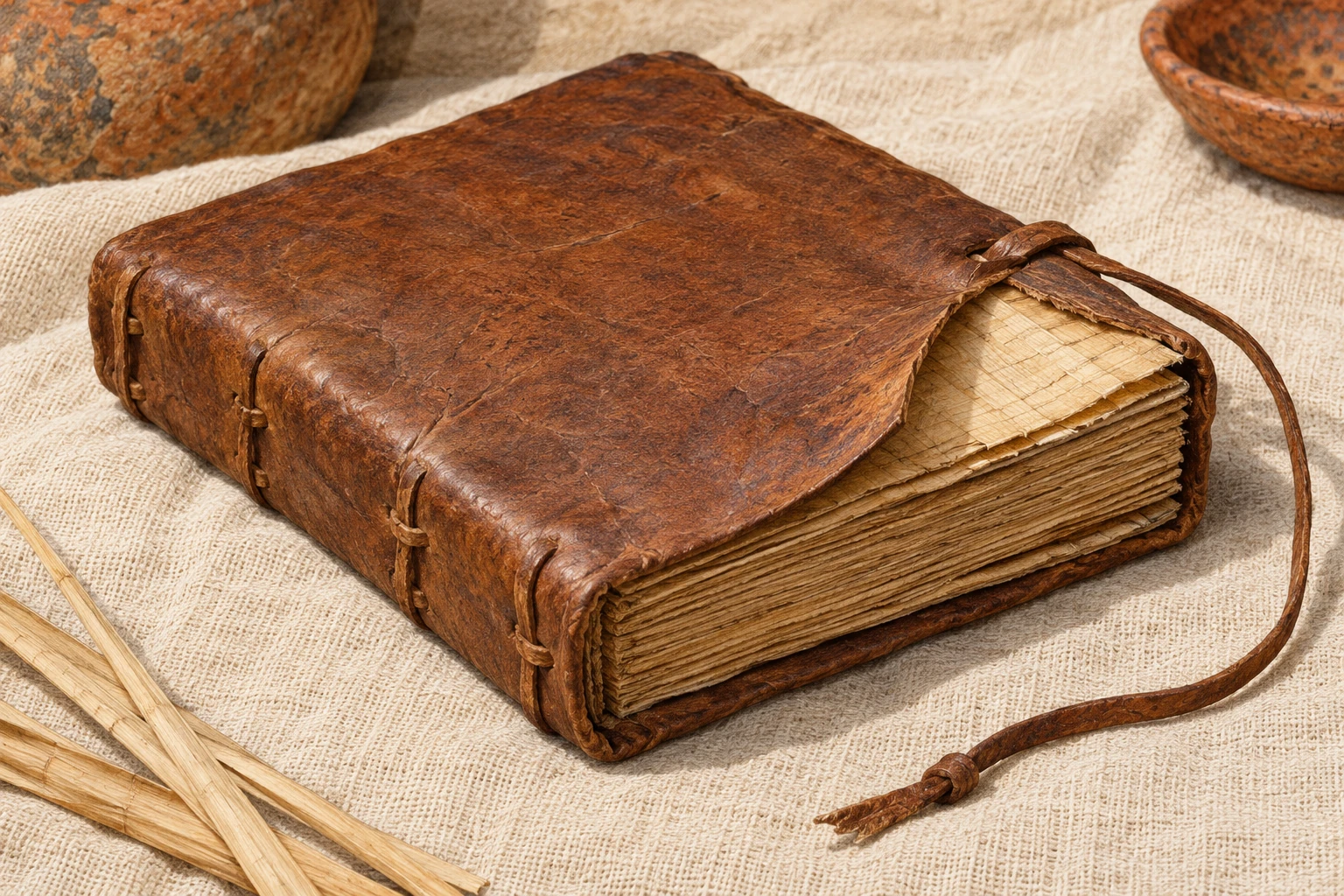
Conceptual leather codex with layered papyrus page edges on an archival surface.
Conceptual late antique binding study, not a replica of a Nag Hammadi manuscript or its original condition.

When an ancient manuscript is translated, the cover can disappear from the reader’s attention. The words become a clean column of modern print; the leather, sewing, page edges, and reused scraps around them become background. At Nag Hammadi, those supposedly peripheral materials are part of the evidence for how books were made and used.

The manuscripts discovered in Egypt in 1945 are famous for their religious texts. They are also objects assembled from materials, handled by readers, and interpreted by scholars whose conclusions do not all agree. A cover does not solve every mystery. It gives us a different set of questions.

A text, a manuscript, and a binding have different dates

The Coptic Museum’s manuscript overview identifies the Nag Hammadi codices among its important papyrus groups and places them in the study of fourth-century Egypt. A codex is a book of leaves joined along one side, rather than a continuous roll. “Codex” describes a physical format, not a particular religious position.

Three dates can matter at once: the composition of a work, the copying of this surviving version, and the manufacture or repair of its cover. They need not coincide. A later copy of an older text is still a physical object made at a particular moment.

A discarded document reused inside a cover introduces another date. It can establish that the cover was not made before the document, while leaving open how much time passed before reuse. This kind of reasoning is called a terminus post quem: a boundary after which something must have happened, rather than an exact birthday.

Why writing can survive inside a cover

The catalog of the surviving binding associated with Codex I describes leather lined with layers of papyrus used as cartonnage, or stiffening. The catalog locates the codex’s papyrus text block in Cairo and identifies the binding separately. Keeping the physical components distinct matters when following an object’s later history.

Reusing a written sheet as construction material changes its job. The words that once carried a message become part of a board or lining. Centuries later, the same words can help a researcher investigate the people and materials around book production. Their survival can be accidental from the original writer’s point of view, even if the reuse itself was entirely practical.

It would be a mistake to say that every person named on a reused scrap therefore owned the finished book. A letter can move, be discarded, be collected, and be reused elsewhere. A plausible connection needs several kinds of evidence rather than a single suggestive name.

The scholarly argument stays open

In The Nag Hammadi Codices and their Ancient Readers, Paul Linjamaa examines material features, scribal marks, and reading practices and supports a monastic setting for the books. He also discusses disagreement over what the documentary material and other clues can establish. This is a developed scholarly interpretation, not a label that every observer can apply with equal certainty.

The same study notes letters dated 341, 346, and 348 reused in the cover of Codex VII. Their dates provide a lower boundary for that cover’s manufacture. Notice what the evidence does not say: it does not make every text in the collection a work composed in 348, and it does not date the eventual burial to that year.

A doctoral study of late antique and medieval Egyptian bindings makes another helpful distinction: a fragment reused as part of a binding is not necessarily the whole binding. Precise descriptions prevent a construction component from taking on more explanatory weight than it can carry.

Make a harmless model of a chronological boundary

Take a discarded envelope or a scrap of printed paper with a clearly visible recent date. Fold it inside a plain paper cover for a small notebook. Write today’s date on a separate sheet explaining what you did. You now have three different pieces of temporal information:

  • the date printed on the reused scrap;
  • the date the new cover was assembled;
  • any later date when someone reads or stores the notebook.

Imagine the explanatory sheet is lost. A future observer who finds only the dated scrap inside the cover could infer that the cover came afterward. They could not recover the exact day of assembly from that clue alone. That narrow result is still useful.

The model is an exercise in reasoning, not a replica of a Nag Hammadi binding. Do not dismantle an old book to find hidden papers. Trained conservators have to balance access to information against preserving the construction that is itself evidence.

Draw a small diagram with separate boxes for text block, cover, and reused lining. Add a line only where a source establishes a connection. This makes it harder for the date or location of one component to migrate unnoticed into another. The diagram can stay simple while preserving a surprisingly important piece of the book’s history.

One book can contain more than one construction decision

The phrase “a codex” can hide internal differences. Paul Linjamaa’s study of the construction of Codex I describes three quires, or groups of folded sheets. They are unequal: the first contains twenty-two sheets, the second eight, and the third six. Codex I is exceptional within the Nag Hammadi group in being assembled from multiple quires. The author argues that its unusual arrangement is connected with the work of copying; that explanation is an interpretation of material and textual clues, not a note left by the binder.

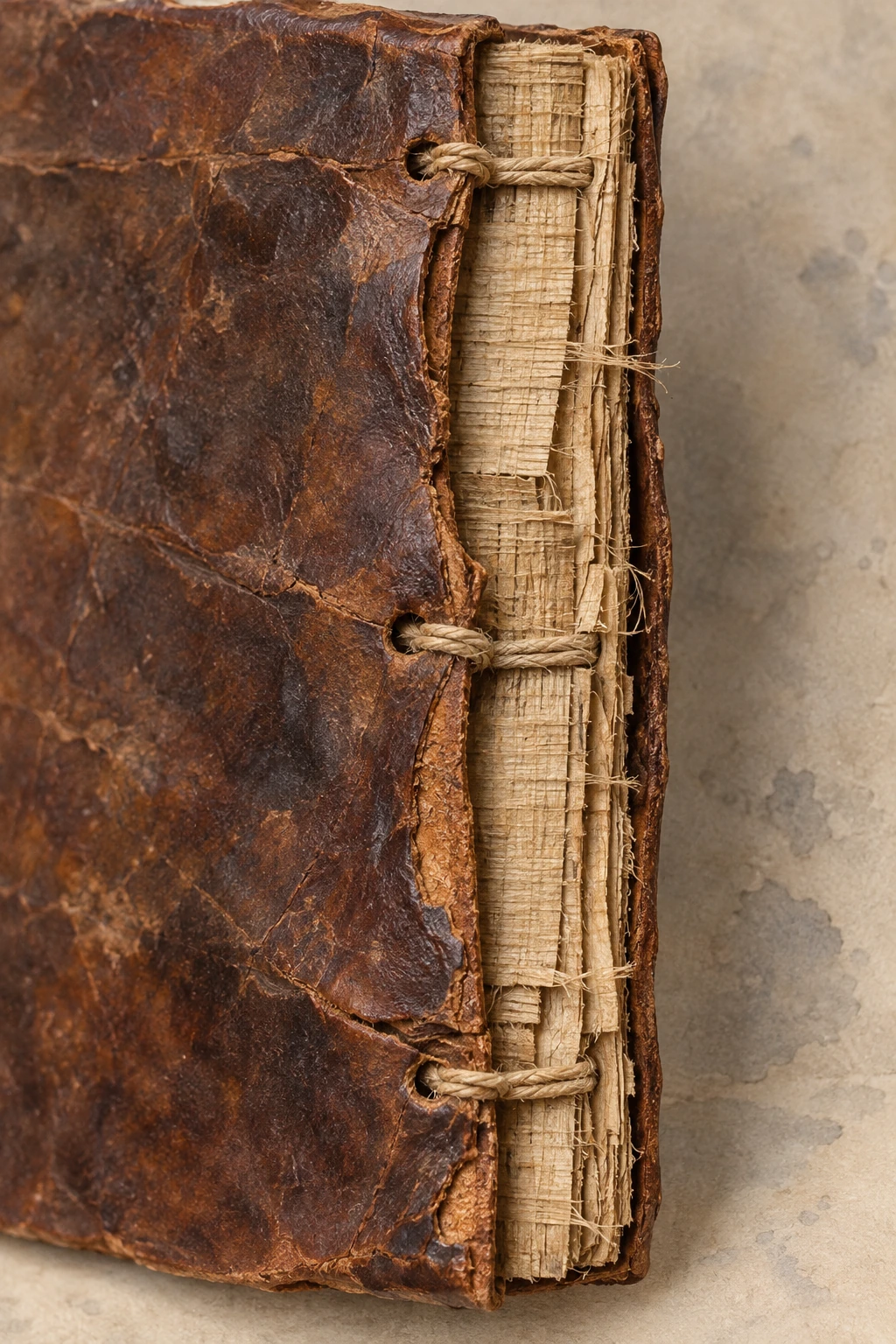
Leather binding edge exposes layered papyrus and sewing in a generic construction study.
Hypothetical binding study, not a facsimile of a Nag Hammadi codex.

Try stacking three small groups of ordinary folded scrap paper: one noticeably thick and two thinner. Without sewing or pretending to reproduce the ancient binding, observe how “one book” can consist of several internally distinct packets. A photograph of an outer cover may conceal that organization. A catalog’s construction description restores a relationship that the front view cannot show.

The relationship between age and appearance becomes clearer through a separate comparison. Conservator Flavio Marzo’s Codex Sinaiticus structural report explains that the British Library portions’ current binding reflects work carried out by Douglas Cockerell and his son in 1935. Sinaiticus is a different manuscript, on parchment, with a different history. Its modern binding is not evidence for Nag Hammadi construction. It demonstrates why “ancient book” does not guarantee that every visible structural feature is ancient.

The chronology exercise below presents four fictional dated components. Choose the latest reused document and ask what it can establish about the cover. Then add a dated later repair. The resulting boundaries move independently. None of the dates supplies the composition date of the text simply by being near it.

Which date belongs to which part?

Fictional document and repair dates demonstrate lower boundaries without assigning a text’s birthday.

Open this activity in its own window.

This is a way of reading relationships rather than accumulating numbers. A date can belong to a sheet, a copying act, a cover, a repair, an acquisition, or an image made yesterday. Before adding it to a timeline, write the noun beside it. That small habit prevents a precise piece of evidence from becoming an imprecise story.

When you return to a real codex, choose one construction detail and trace it through the institution’s documentation. The cover need not disclose a dramatic secret to be informative. Its thickness, sewing, reused materials, and later interventions can reveal a book whose physical organization changed as people continued to make use of it.

Read the page around the words

When viewing a manuscript image, make a second reading after the translation. Look at the margin, the edge of the writing block, spacing, corrections, and any sign that seems separate from the main text. Describe the mark before assigning it a purpose. A stroke might direct attention, divide a passage, or belong to a later intervention; those possibilities require comparison and context.

The pleasure of this approach is that it restores books to human use without inventing a dramatic owner. A copied error, an added mark, or a reused scrap can reveal work in progress. The manuscript becomes an event in material history as well as a carrier of ideas.

The cover is therefore neither a mere wrapper nor a secret key that explains everything. It is a second archive, one whose clues often answer more modest questions than a sensational discovery story promises. Modest answers can be the ones that make the past feel most real.

Sources and a closer look

Coptic Museum: manuscripts; Schøyen Collection: Nag Hammadi binding MS 1804/1; Paul Linjamaa: The Nag Hammadi Codices and their Ancient Readers; Dal Sasso: late antique and medieval Egyptian bindings.

Find more art, ideas, and unexpected connections at Incoprea.

The Diamond Sutra’s Last Line: What a Dated Printed Book Lets Us Know

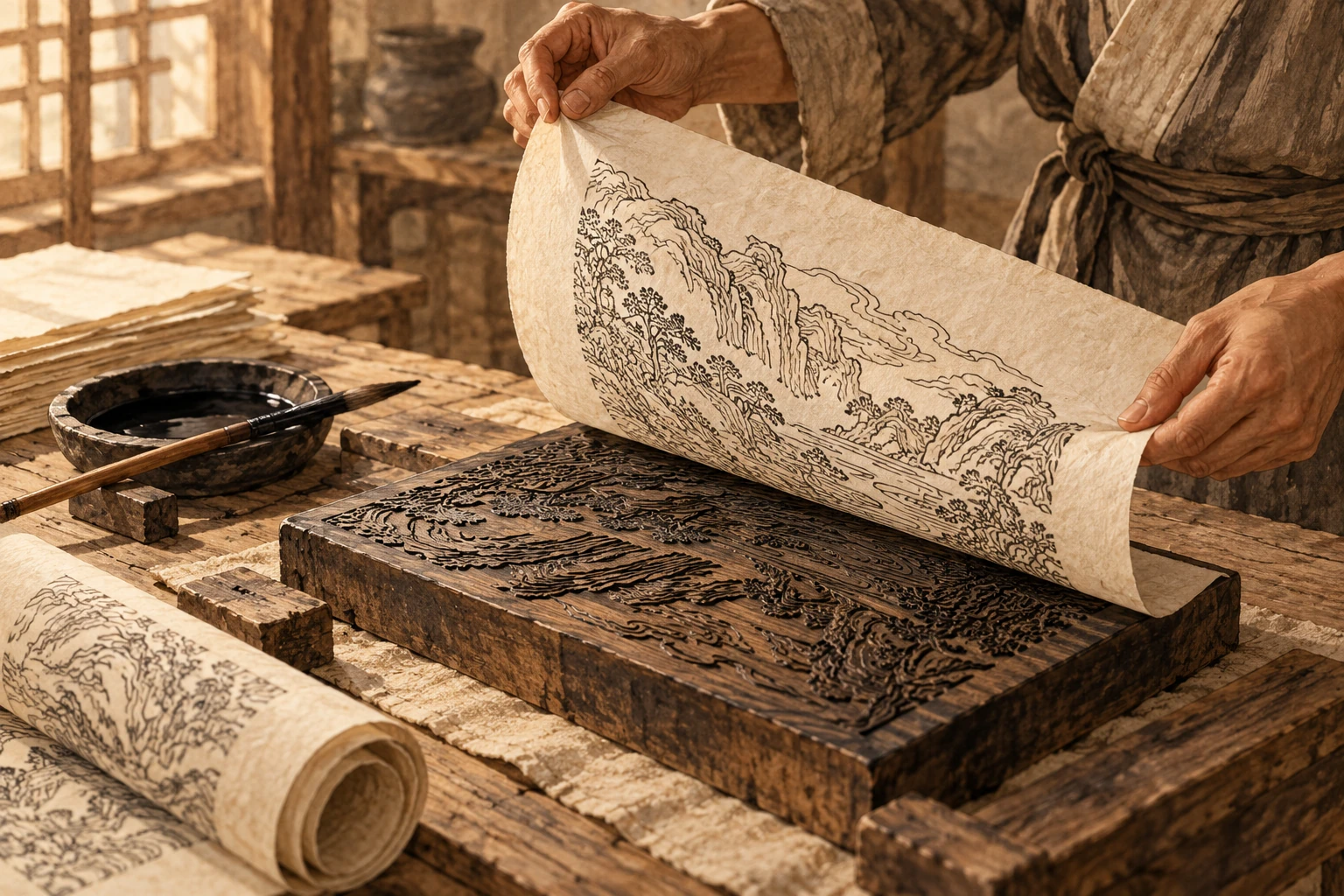
Illustrative hands lift thin paper from a wooden relief-printing block beside a roll of paper and an ink brush.
Conceptual woodblock-printing scene. It depicts no named printer and reproduces no Diamond Sutra text.

At the end of a five-metre printed scroll, a short note changes the history of the whole object. It identifies a sponsor, an intention, and a date equivalent to 11 May 868. The final lines let us make a much more precise claim than the appearance of old paper alone would allow.

The Diamond Sutra in the British Library is often introduced as the world’s oldest printed book. The careful wording is more interesting: it is the earliest surviving complete printed text with a date. Earlier printing exists. This scroll’s special power comes from the particular evidence that survives with it.

The last line is part of the work

The International Dunhuang Programme’s guide explains that the copy was sponsored by Wang Jie and woodblock printed onto seven joined sheets. The colophon records the date and dedicates the production to his parents, for distribution. It is a Buddhist act as well as an achievement of printing.

That distinction prevents a common substitution. The sponsor is not automatically the block-cutter, printer, translator, or author of the ancient teaching. A single surviving name can tempt a modern account to assign all the work to one person. The object itself supports a more limited, and more socially interesting, attribution.

The scroll format matters too. A “book” need not consist of leaves turning around a spine. Here, text and image unfold horizontally. The reader’s sequence of encounter differs from flipping through a modern bound volume, even if both objects carry a sustained text.

Printing multiplies a surface; it does not remove labor

In woodblock printing, a prepared relief surface carries the design that transfers to paper. The IDP account identifies the scroll’s separate printed sections and the joining that made the long format. Once a block exists, repeated impressions become possible; preparing it still requires skilled work.

Think about the difference between writing a message once and making a tool that can reproduce it. The second task can be worthwhile because of the copies it permits. It also requires decisions about layout, line width, ink, paper, and handling. A printing history focused only on the first surviving date can miss those practical choices.

The University of Oxford’s object resource emphasizes the colophon’s devotional purpose. This is a useful corrective to treating the scroll as if it were produced solely to mark a stage on a modern technological timeline. Its makers and sponsor had reasons that belonged to their own religious world.

A text people used, not only an object people display

An IDP newsletter devoted to the Diamond Sutra discusses the text’s place within Mahayana Buddhism and its transmission, alongside research into the scroll’s paper and conservation. The connection is important: the printed object carried a teaching that could be read, copied, recited, and understood within a living practice.

An introductory article cannot replace that tradition’s interpretation. It can avoid turning the sutra into an exotic prop. If you follow the text further, choose a clearly identified translation and commentary and distinguish a religious explanation from a simplified museum label.

The printed frontispiece adds another form of encounter before the main text. Rather than treating it as an optional illustration, ask how an image prepares the reader for what follows. Where are the figures looking? What arrangement makes the act of teaching visible? The answers begin with the picture, while identifying every figure requires the accompanying scholarship.

Conservation changes what access means

The IDP’s film resources connect the scroll’s story with science and conservation. Its later conservation and digitization newsletter explains that the scroll remained in separate panels after extensive treatment, enabling the panels to be displayed in turn. A digitized long view can therefore give an impression of continuous access that differs from the object’s physical conservation arrangement.

A British Library collection-care paper by Helen Shenton discusses virtual reunification and preservation through dispersed collections, including Dunhuang material. Digital access can reunite information for study without undoing the physical histories of collection, dispersal, and treatment.

This is a useful distinction for any online museum visit. Ask whether you are seeing one photograph, several images joined digitally, a reconstruction, or a moving view of the physical object. Each can be helpful; each makes different things visible.

Compare the first and last portions of the scroll as distinct encounters. The opening can invite attention through an image; the ending supplies a dated statement. Between them lies the physical labor of reading a long format. An online image that puts everything on one screen changes that sequence, so try examining the sections individually before viewing the whole.

The image you can read depends on the support you cannot see

Conservation can change the information available in a digital encounter. Wood and Barnard’s account of the Diamond Sutra treatment in IDP News 38 describes old linings and adhesive residues that placed stress on the paper. Removing them required investigation and careful treatment, and exposed creases and variations that had been obscured. This was work on the named scroll, not a general instruction for treating old paper at home.

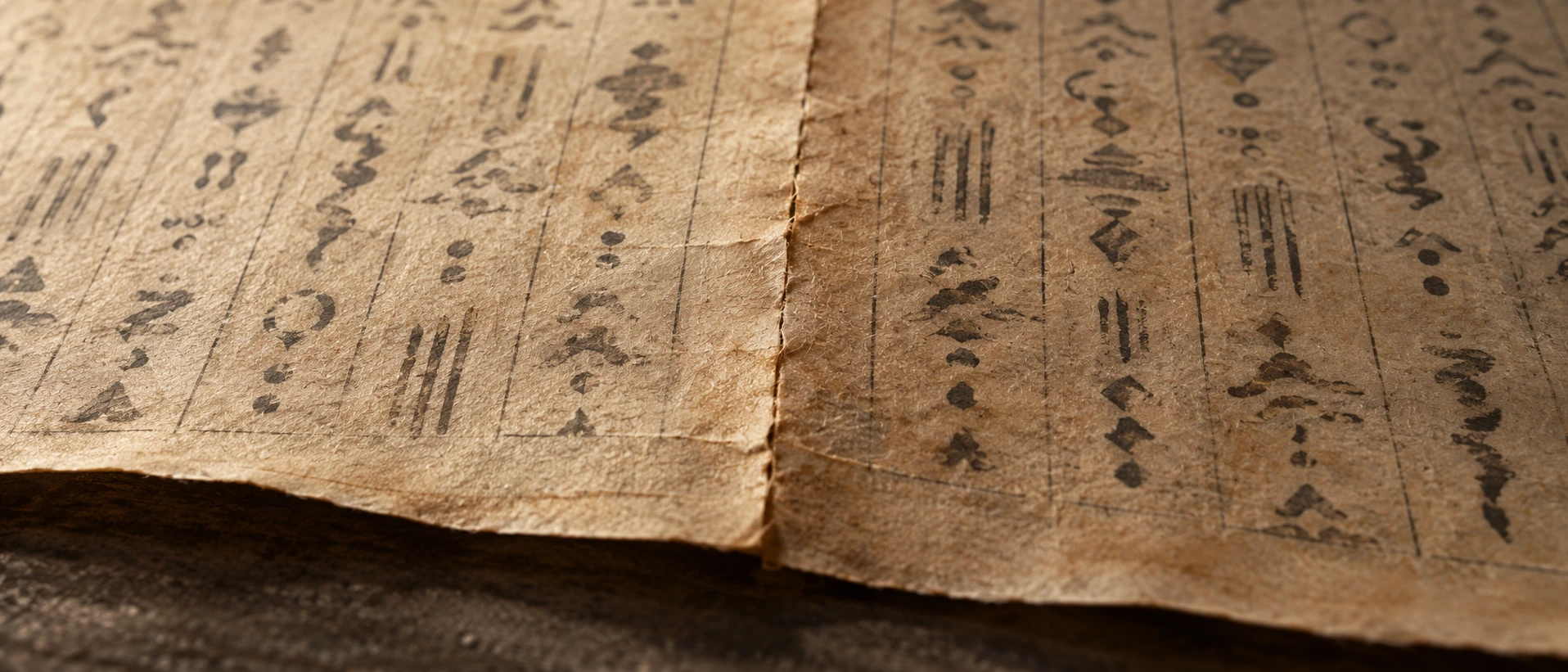
Close paper scroll join and fibers with faint nonlinguistic ink columns.
Conceptual paper-and-join study. No Diamond Sutra text is reproduced.

A separate project makes the access problem visible at another scale. IDP’s Lotus Sutra project report describes conserving and photographing 790 scrolls and three booklets, completed in 2022. Those are manuscripts of a different sutra. They are useful comparisons for how fragile scrolls become available online; they should not be described as extra sections of the Diamond Sutra.

Look at the report’s before-and-after views of Lotus Sutra scroll Or.8210/S.3796. Choose one tear or edge that appears in both. Ask what the later view makes easier to follow, and what part of the appearance is now a support or repair. The point is not to score the object for looking “new.” A successful intervention can preserve access while allowing the older material and later work to remain distinguishable.

Next compare a whole-scroll digital image with a close image of a join. The first helps establish sequence and scale. The second makes fibers, overlaps, and local damage more accessible. Neither view supplies everything the other provides. A long object reduced to a narrow strip on a phone can look continuous while hiding the labor required to make its parts safely readable.

For a two-minute viewing task, write down three nouns before zooming: paper, ink, support. Under each, note one feature you can actually see and one question you need the conservation record to answer. Resist assigning every pale area to missing ink or every straight boundary to an original sheet edge. Photography, mounting, repair, and digital stitching can introduce other boundaries.

The same exercise changes the famous final line. Its date remains remarkable, but our ability to encounter that line today depends on acts of care, imaging, cataloging, and interpretation. The surviving words and their present accessibility belong to connected histories. Reading both brings unnamed later work into the story without confusing it with the act of printing in 868.

Read the evidence in reverse order

Try a five-minute visit to the institutional images. Start at the end, where the colophon appears. Then move to the joins between sheets, the main text, and finally the frontispiece. This reverses the dramatic museum habit of beginning with the most beautiful picture.

  1. Write down what the dated note actually establishes.
  2. Find one material feature that a transcription of the words would omit.
  3. Identify one person or task that must have existed but is not individually named in the surviving note.
  4. Write a caption that preserves the word “dated” in the claim about early printing.

For an optional paper model, join several ordinary scrap sheets end to end and lay them on a table. Put a short original dedication at the end. Roll and unroll the strip gently. Notice how the dedication becomes information encountered after a physical journey through the object. This models format, not Buddhist practice or historical printing.

The Diamond Sutra’s date is a remarkable anchor, but the scroll is richer than a world-record label. It joins devotion, sponsorship, repeated images and words, delicate paper, and centuries of preservation. A small final note opens that larger world because it tells us exactly enough—and leaves the unnamed work around it available for thoughtful attention.

Sources and a closer look

IDP: Diamond Sutra learning guide; Oxford Cabinet: earliest dated printed book; IDP News 38: text, paper and conservation; IDP: Diamond Sutra film resources; IDP News 43: conservation and digitization; Helen Shenton: virtual reunification and conservation.

Find more art, ideas, and unexpected connections at Incoprea.

Wednesday, October 14, 2026

Why Some Libraries Chained Their Books

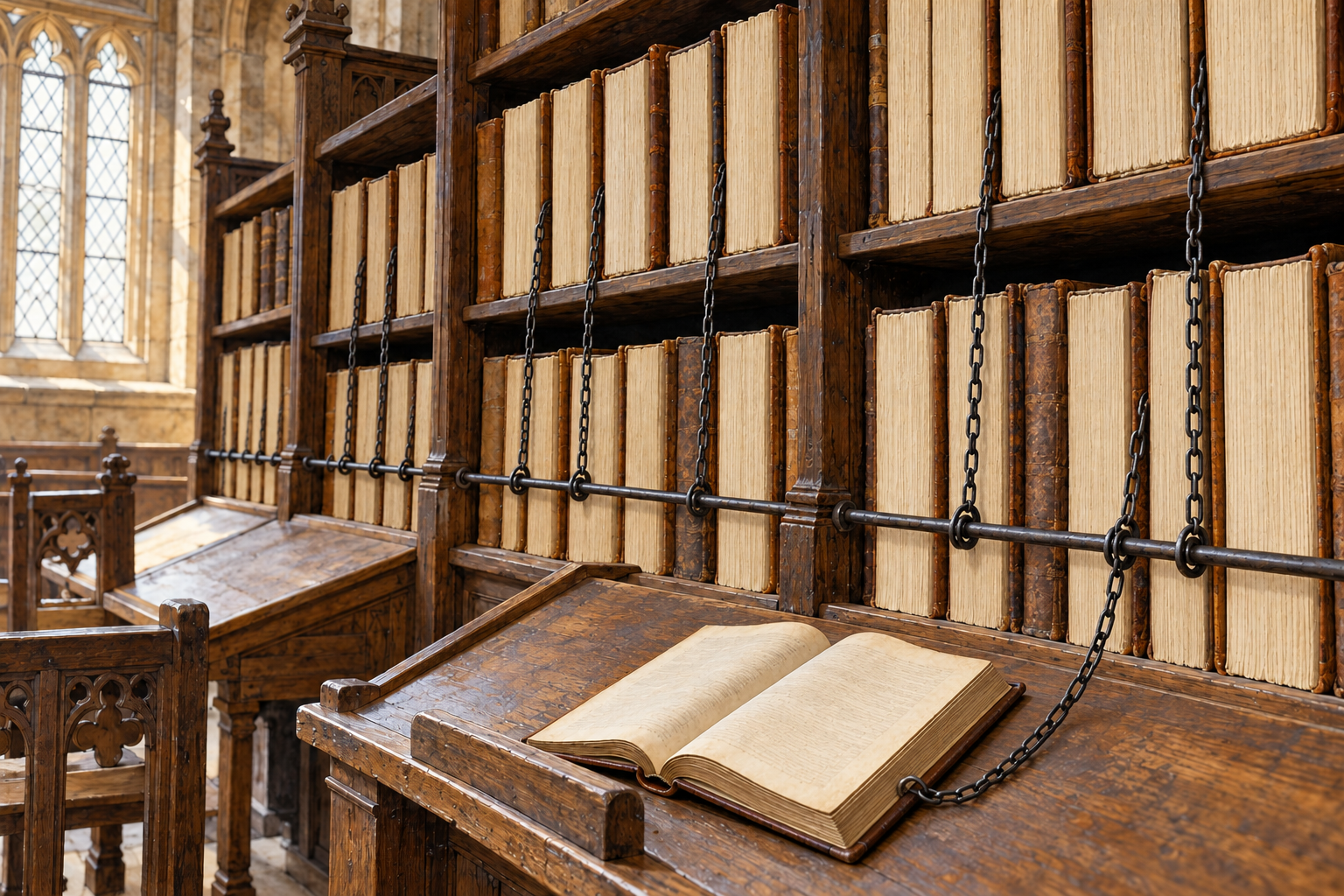
Stand in front of a shelf and imagine choosing a book by its page edges. The spines face away from you. A chain runs from each cover to a metal rod, and the desk is close enough for a volume to reach it. The arrangement looks unfamiliar until you follow the movement of a reader’s hands.

A chained library was a physical answer to a practical question: how could a valuable, portable book remain available for consultation without leaving the collection? The chain joined the object to a place. Furniture, book orientation and rules of admission determined what reading in that place could mean.

Books with their page edges facing outward are tethered to a shelf rod above a reading desk.
Fore-edge-out shelving places the book, tether and reading surface in one arrangement. This imagined bay follows the principle without reproducing a surveyed Hereford interior.

Read the mechanism from the cover to the desk

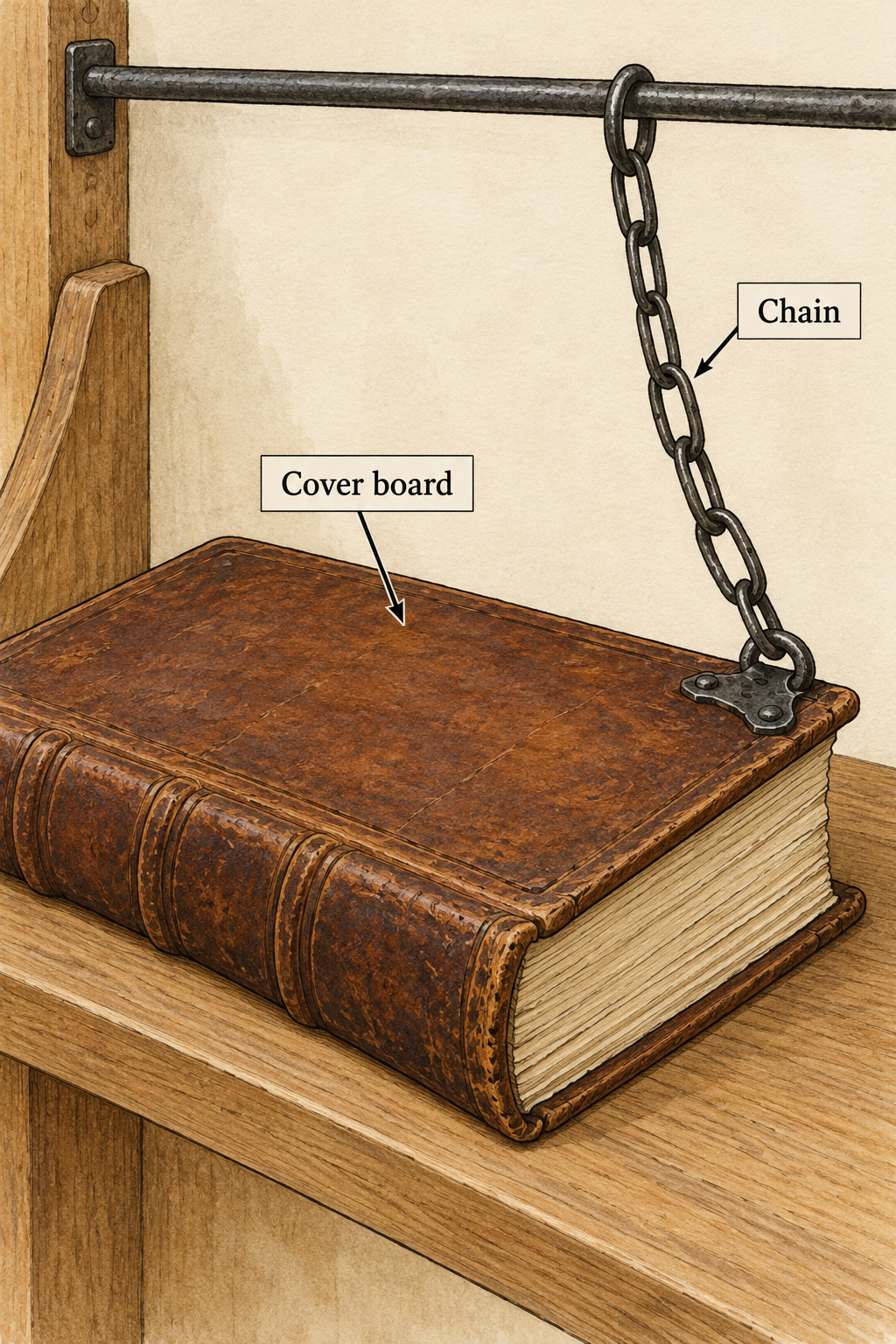
Hereford Cathedral’s account describes a chain attached to a book’s front cover, with its other end slotted onto a rod along the bottom of the shelf. A reader could lift the volume down and open it at the desk while the tether remained attached. The pages were available to turn; the hardware did not have to fasten the text shut.

The fore-edge is the edge opposite the spine. At Hereford it faces the reader, which avoids turning the volume around before opening it and tangling the chain. This is a small detail with a large explanatory role. A shelf arranged for untethered books is not automatically convenient for books that remain connected to a rail.

Try the movement with an ordinary modern book on your own table, without attaching anything to it. First place its spine toward you, lift it, and turn it into a comfortable reading position. Then place the page edge toward you and repeat. Imagine a tether fixed to the front cover throughout. The orientation that felt merely odd becomes a response to a sequence of movements.

A simplified close view of a leather book cover connected by a chain to a metal shelf rod.
The tether meets the cover rather than passing through the pages. The simplified detail invites you to trace the connection, not measure historic hardware.

A room can preserve several different historical times

Hereford’s surviving seventeenth-century library retains its chains, rods and locks. The cathedral describes the displayed arrangement as the one used from 1611 to 1841. Its collection also includes much older material, among it the eighth-century Hereford Gospels. The date of a book, the date of its furniture and the date of its current protective room need not match.

That distinction prevents a common visual shortcut. A medieval manuscript sitting in an early-modern chained bookcase does not make every visible component medieval. A surviving library can bring together objects acquired, arranged and conserved over many generations. Looking carefully means keeping those layers in view rather than assigning the whole room a single birthday.

Consider what a photograph cannot settle. It may show a cover fitting and a chain very clearly. It cannot, by itself, tell you when the fitting was added, whether it was moved or repaired, or which regulations applied to a particular reader. The physical clue is valuable precisely because it gives you a focused question to take to a catalogue or institutional history.

Some books traveled while others stayed

Oriel College’s library history records both a lending collection and a chained collection. Its statutes envisaged books being returned each year on 2 November, when fellows made new selections. References to the chained library appear by 1409, and Oriel’s books remained chained until 1755.

Oriel also distinguishes probable arrangements from firmly dated records. Marks on manuscripts suggest that some volumes lay flat at lecterns, while a later shelf-based system changed the room’s organization. This is useful evidence of reading practice. The surviving object can retain traces of how people once approached it, even when the furniture or routine has changed.

The two collections complicate the idea that a chain expresses a blanket hostility to readers. An institution could lend some material and retain other material for consultation in place. That did not make admission universal. It means that the question “Could someone take this book away?” needs to be kept separate from “Who was allowed to read here?”

A promise of access could include a social boundary

The history supplied by Wimborne Minster makes that boundary unusually visible. The library was founded in 1686. An initial gift of theological works was not chained. When Roger Gillingham added ninety books in 1695, he required the new gift to be chained and the library to open free to townspeople of a specified social standing.

The donor’s wording included “shopkeepers or the better class of person.” That restriction matters. The same arrangement could increase access beyond a private owner’s shelves while still drawing a line around the intended public. Calling it open without discussing that line would lose part of its history.

Wimborne’s recorded subject range includes gardening, medicine, law and building as well as theology. Imagine the different questions those books could bring into the room. The chain tells us where consultation occurred. The collection’s subjects and the admission rules help reveal whose practical or scholarly questions the institution expected to serve.

Look at a library photograph as evidence

Find a page edge, a spine, a cover attachment, a rod and a reading surface. Trace a possible route from shelf to desk. Then make two lists: things the image shows directly, and things you would need a catalogue or rule book to establish. A visible tether belongs on the first list. A claim that everyone in the town could read the collection belongs on the second.

A chain cannot keep the climate out

Keeping a book in the building addresses only one kind of loss. In its 2023 account of environmental-system works, Hereford described separate temperature and humidity needs in the Chained Library, archives, reading room and Mappa Mundi chamber. The modern protective system has to care for materials and spaces with different requirements.

The Library of Congress guide to storing books likewise emphasizes the environment and good storage as ways to extend a book’s useful life. Restricting movement does not prevent deterioration caused by unsuitable conditions. A dramatic security fitting and a quiet environmental system protect against different threats.

Return to the first imagined movement: lifting a volume down, opening it, and reading while its chain rests nearby. The library is more than a row of restricted objects. It is a set of decisions about keeping knowledge available, managing scarce copies, admitting readers and preserving the material long enough for the next generation to ask its own questions.

Sources and further exploration: Hereford Cathedral: mechanism and surviving arrangement; Oriel College: lending and chained collections; Wimborne Minster: donors and access; Hereford’s 2023 environmental works; Library of Congress: storing books.

Jikji: The Korean Book That Changes the Printing Timeline

Open a history of printing at Jikji and the usual sequence changes. This Buddhist book was printed with movable metal type in Korea in 1377, decades before the Gutenberg Bible. Its importance is not only that it makes a familiar timeline longer. It lets us ask how a particular community turned a teaching into a reproducible book.

The surviving metal-type edition is incomplete: the second volume is held by the Bibliothèque nationale de France, while its first leaf is missing. That is enough to preserve a remarkable witness to production, and enough to encourage a closer look at the people and processes behind it.

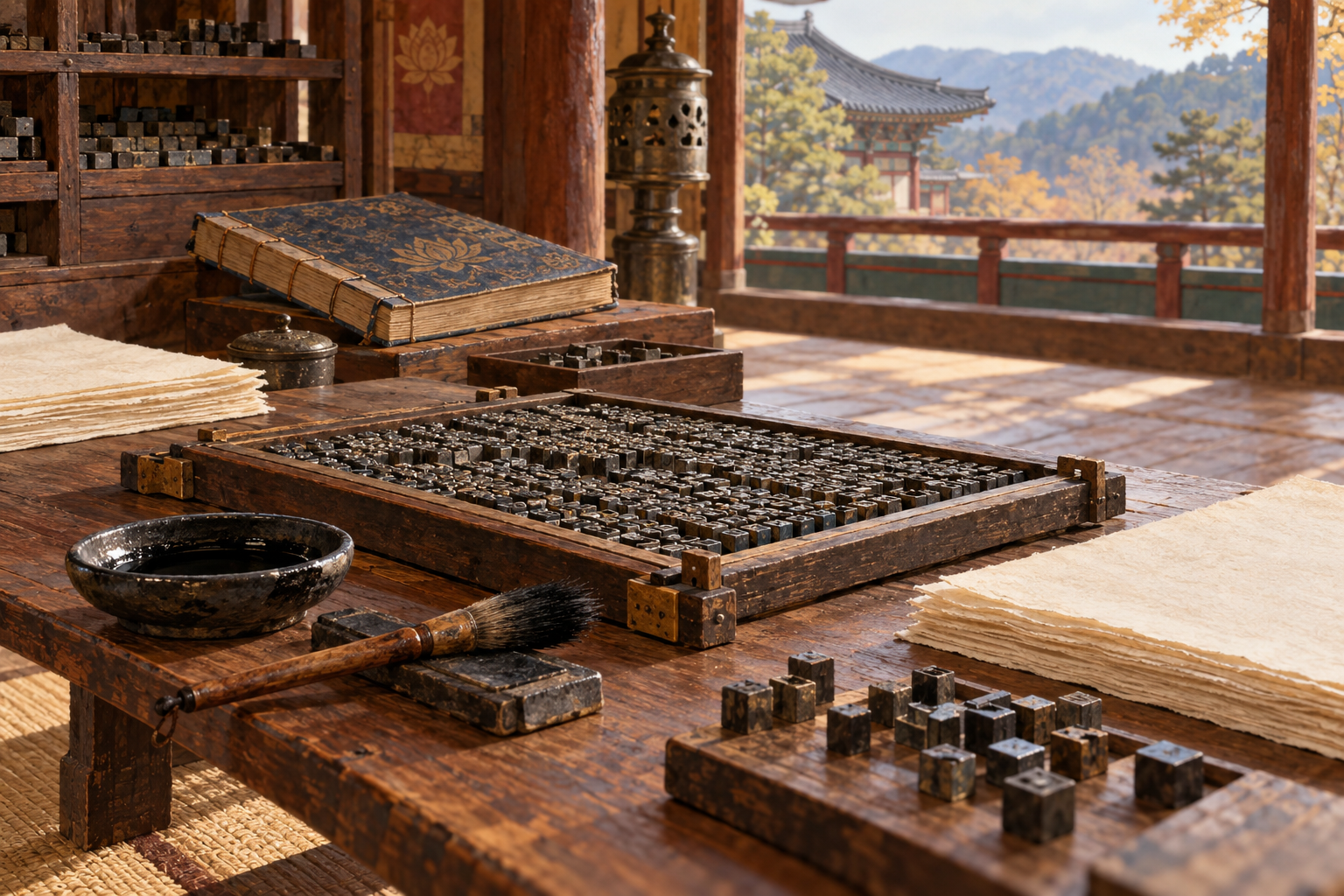
Illustration of an imagined Korean temple workspace with movable metal type and paper.
An imagined printing workspace suggests the materials behind a metal-type book; it is not a reconstruction of a documented workshop.

A book intended to be used

Jikji brings together Buddhist teachings compiled by the monk Baegun. The BnF describes its educational purpose in the tradition known in Korea as Seon. Its makers were preparing a religious text for readers and students, rather than an exhibit demonstrating a step towards a future European press.

The publication took place at Heungdeok-sa temple in Cheongju. The Republic of Korea's UNESCO nomination names the monks Seokcan and Daldam in connection with the work, and records a donation by the Buddhist nun Myodeok. Production required more than an inventor's idea: compilation, support, skilled making and an intended audience had to come together.

Those names also change the scale of the story. A book called the oldest of its kind can seem to belong mainly to a global competition. A book compiled, funded and printed by particular people belongs to a network of teaching and commitment. Both histories matter, but the latter explains why a book was made at all.

What movable type makes possible

Movable type separates the reusable character from the finished page. Individual pieces are arranged to form text, ink is applied and an impression is transferred to paper. The pieces can then be rearranged. A woodblock instead carries an entire carved page that can be retained for further impressions.

The difference creates practical choices. Type offers reuse across different pages, but a printer needs a stock of characters, a way to find them and an arrangement that prints consistently. A block requires the page to be carved, but can preserve that page for later reprinting. The better choice depends on the book, the workshop and the expected use.

Jikji itself makes coexistence visible. The BnF notes a woodblock edition of the complete text dated to 1378, surviving in Korea. Metal type did not arrive and immediately make every other method pointless. Different printing arrangements could serve the circulation of the same teaching.

Choose a printing method for a real task

Imagine that you run a small historical workshop. You have three commissions: a short text that will never change and needs repeated reprints, many different new pages, and a revised edition with frequent corrections. There is no single correct answer without knowing costs, tools and labour, but the comparison makes the tradeoffs easier to see.

Questions a workshop has to answer
NeedWoodblock questionMovable-type question
Repeat an unchanged pageCan its block be stored and used again?Should the setting stay assembled, or be reset later?
Prepare many different pagesHow much carving does each new page require?Are the needed characters available and easy to select?
Correct a passageCan the block be altered, or must it be replaced?Which pieces and spacing need to change?

Notice that storage belongs on both sides. Reusable pieces have to be organised, while retained blocks take space. A technique's advantage is meaningful only when it is connected to a particular production problem.

Look at the surviving pages

The BnF's Jikji feature links to the digitised book in Gallica and includes a video introduction. Begin with a whole spread or page. Follow the columns and the relation between text and margin before concentrating on a single character.

Next choose a character shape that appears more than once. Compare the impressions without assuming that every difference must come from a different piece of type. Ink, paper, pressure, wear and image quality can all affect what is visible. The useful first step is a description of the difference, rather than a diagnosis.

Finally examine the publication information discussed in the catalogue. It connects the object to a place, a date and a method. The historical argument grows stronger when those details remain attached to an identifiable copy rather than circulating as a claim beside a generic printing image.

What the earlier date establishes

The BnF calls Jikji the oldest currently known surviving book printed with movable metal type. The wording leaves room for the earlier Korean printing recorded in written sources. The oldest surviving witness and the first use of a technique are different questions.

Jikji precedes the Gutenberg Bible by roughly eight decades. That comparison corrects a narrow history, but does not by itself prove a direct path of transmission from Korea to Gutenberg. The University of Utah's “From Jikji to Gutenberg” project studies early printed material and the technical questions behind it. Comparison can be valuable without presupposing its conclusion.

Return to the book's purpose after considering the machinery. Movable pieces mattered because they helped make a text available in repeatable form. Jikji is a technological landmark, and it is also a religious book produced by people who wanted readers to encounter its teachings. Seeing both makes the timeline more human and the achievement more complete.

Sources and further reading

Explore more art, stories and discoveries at Incoprea.

Famous Last Meals is now in paperback — stories, history and 25 recipes

Famous Last Meals: Stories, History, and Recipes is now available in paperback on Amazon. The illustrated collection brings together 23 his...