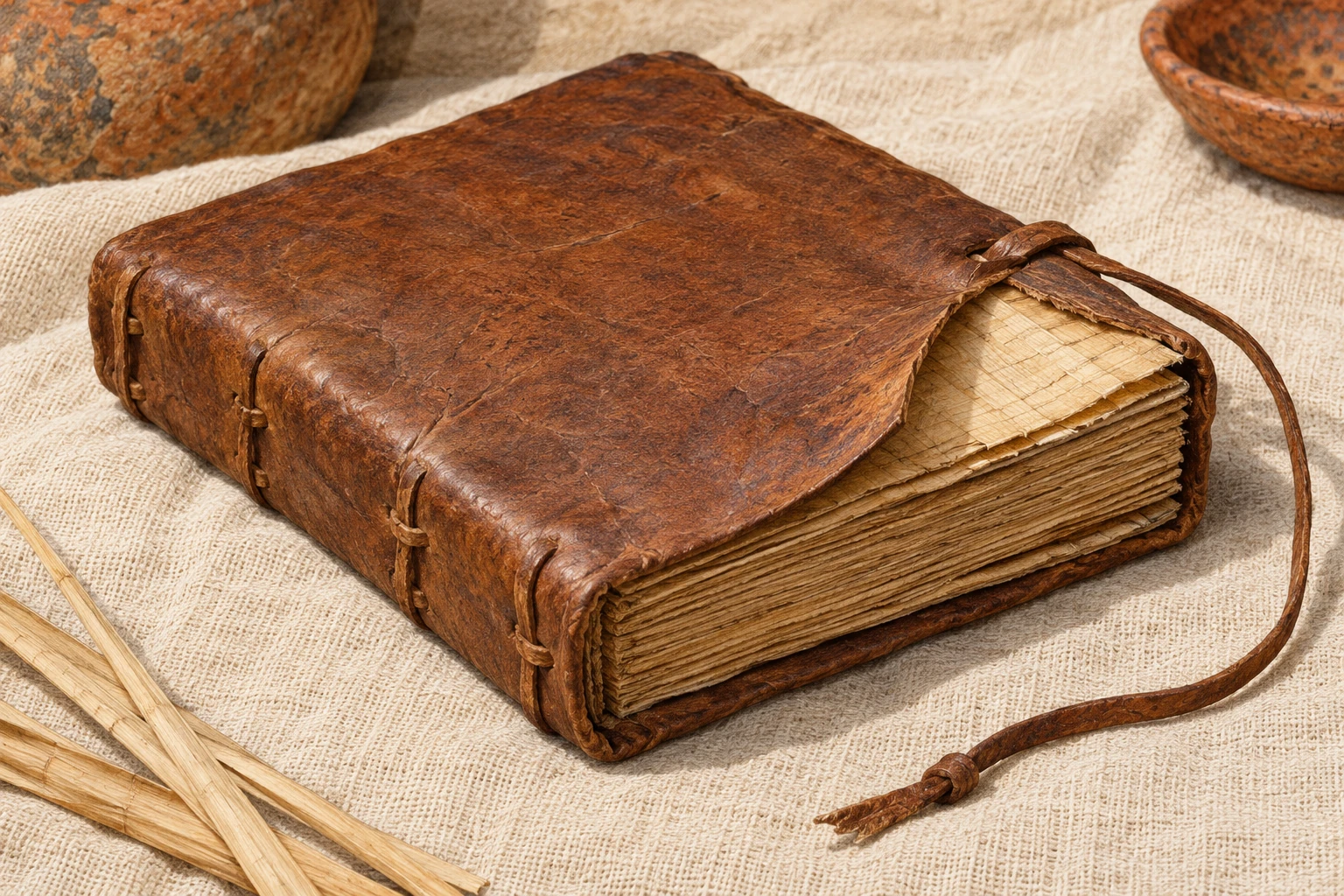
When an ancient manuscript is translated, the cover can disappear from the reader’s attention. The words become a clean column of modern print; the leather, sewing, page edges, and reused scraps around them become background. At Nag Hammadi, those supposedly peripheral materials are part of the evidence for how books were made and used.
The manuscripts discovered in Egypt in 1945 are famous for their religious texts. They are also objects assembled from materials, handled by readers, and interpreted by scholars whose conclusions do not all agree. A cover does not solve every mystery. It gives us a different set of questions.
A text, a manuscript, and a binding have different dates
The Coptic Museum’s manuscript overview identifies the Nag Hammadi codices among its important papyrus groups and places them in the study of fourth-century Egypt. A codex is a book of leaves joined along one side, rather than a continuous roll. “Codex” describes a physical format, not a particular religious position.
Three dates can matter at once: the composition of a work, the copying of this surviving version, and the manufacture or repair of its cover. They need not coincide. A later copy of an older text is still a physical object made at a particular moment.
A discarded document reused inside a cover introduces another date. It can establish that the cover was not made before the document, while leaving open how much time passed before reuse. This kind of reasoning is called a terminus post quem: a boundary after which something must have happened, rather than an exact birthday.
Why writing can survive inside a cover
The catalog of the surviving binding associated with Codex I describes leather lined with layers of papyrus used as cartonnage, or stiffening. The catalog locates the codex’s papyrus text block in Cairo and identifies the binding separately. Keeping the physical components distinct matters when following an object’s later history.
Reusing a written sheet as construction material changes its job. The words that once carried a message become part of a board or lining. Centuries later, the same words can help a researcher investigate the people and materials around book production. Their survival can be accidental from the original writer’s point of view, even if the reuse itself was entirely practical.
It would be a mistake to say that every person named on a reused scrap therefore owned the finished book. A letter can move, be discarded, be collected, and be reused elsewhere. A plausible connection needs several kinds of evidence rather than a single suggestive name.
The scholarly argument stays open
In The Nag Hammadi Codices and their Ancient Readers, Paul Linjamaa examines material features, scribal marks, and reading practices and supports a monastic setting for the books. He also discusses disagreement over what the documentary material and other clues can establish. This is a developed scholarly interpretation, not a label that every observer can apply with equal certainty.
The same study notes letters dated 341, 346, and 348 reused in the cover of Codex VII. Their dates provide a lower boundary for that cover’s manufacture. Notice what the evidence does not say: it does not make every text in the collection a work composed in 348, and it does not date the eventual burial to that year.
A doctoral study of late antique and medieval Egyptian bindings makes another helpful distinction: a fragment reused as part of a binding is not necessarily the whole binding. Precise descriptions prevent a construction component from taking on more explanatory weight than it can carry.
Make a harmless model of a chronological boundary
Take a discarded envelope or a scrap of printed paper with a clearly visible recent date. Fold it inside a plain paper cover for a small notebook. Write today’s date on a separate sheet explaining what you did. You now have three different pieces of temporal information:
- the date printed on the reused scrap;
- the date the new cover was assembled;
- any later date when someone reads or stores the notebook.
Imagine the explanatory sheet is lost. A future observer who finds only the dated scrap inside the cover could infer that the cover came afterward. They could not recover the exact day of assembly from that clue alone. That narrow result is still useful.
The model is an exercise in reasoning, not a replica of a Nag Hammadi binding. Do not dismantle an old book to find hidden papers. Trained conservators have to balance access to information against preserving the construction that is itself evidence.
Draw a small diagram with separate boxes for text block, cover, and reused lining. Add a line only where a source establishes a connection. This makes it harder for the date or location of one component to migrate unnoticed into another. The diagram can stay simple while preserving a surprisingly important piece of the book’s history.
Read the page around the words
When viewing a manuscript image, make a second reading after the translation. Look at the margin, the edge of the writing block, spacing, corrections, and any sign that seems separate from the main text. Describe the mark before assigning it a purpose. A stroke might direct attention, divide a passage, or belong to a later intervention; those possibilities require comparison and context.
The pleasure of this approach is that it restores books to human use without inventing a dramatic owner. A copied error, an added mark, or a reused scrap can reveal work in progress. The manuscript becomes an event in material history as well as a carrier of ideas.
The cover is therefore neither a mere wrapper nor a secret key that explains everything. It is a second archive, one whose clues often answer more modest questions than a sensational discovery story promises. Modest answers can be the ones that make the past feel most real.
Sources and a closer look
Coptic Museum: manuscripts; Schøyen Collection: Nag Hammadi binding MS 1804/1; Paul Linjamaa: The Nag Hammadi Codices and their Ancient Readers; Dal Sasso: late antique and medieval Egyptian bindings.
Find more art, ideas, and unexpected connections at Incoprea.