A carbonised Herculaneum scroll can resemble a piece of charcoal, yet its interior may still contain pages of writing. The eruption of Vesuvius in 79 CE transformed papyrus into an object too fragile to open in the ordinary way. Physical access and intellectual access became painfully difficult to reconcile.
Virtual unwrapping changes that relationship. The scroll can stay closed while researchers scan it, identify its internal surfaces and construct flattened views. Reading is no longer dependent on pulling the original layers apart. But the journey from a scan to a philosophical argument still has several distinct stages.
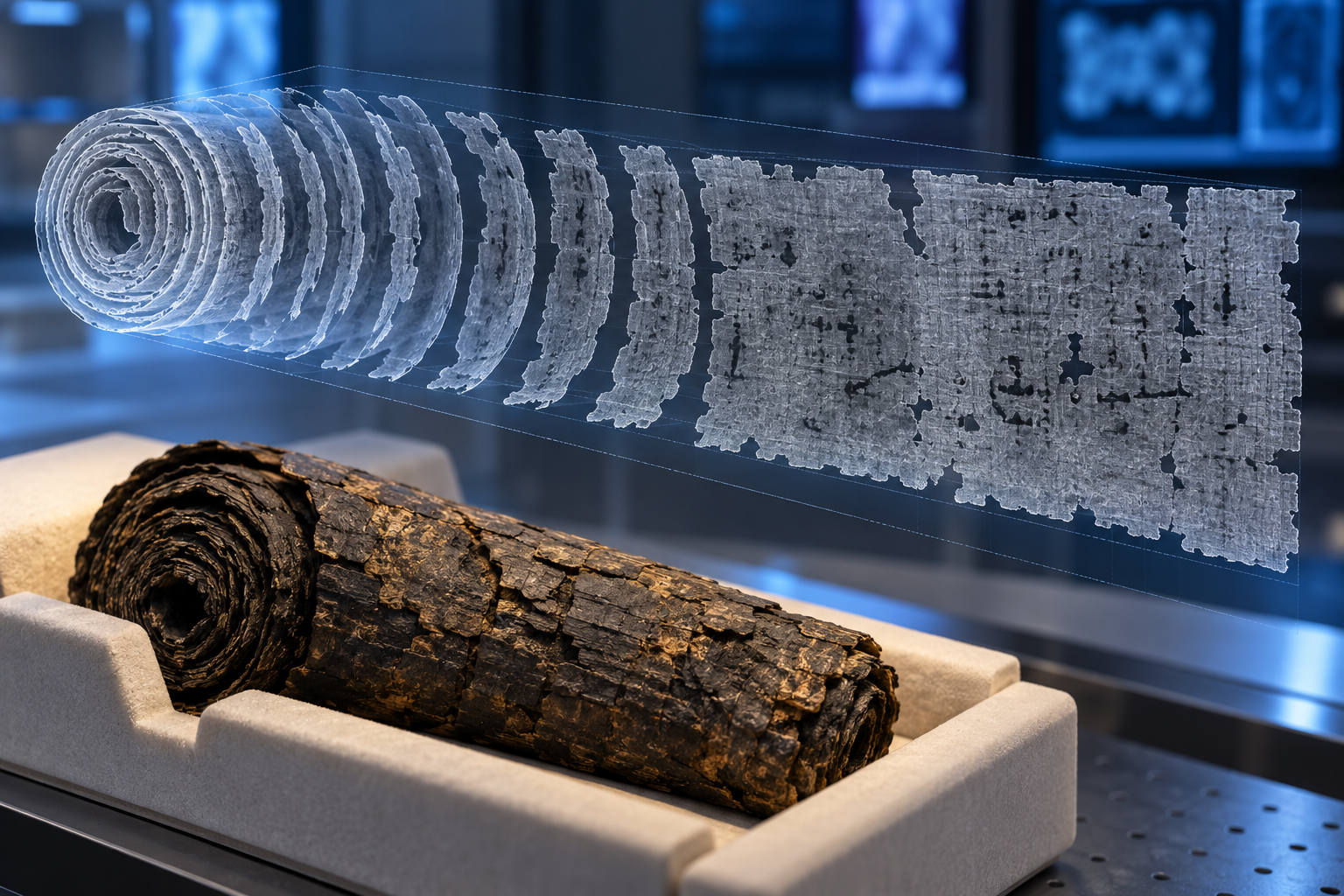
First find the page inside the object
X-ray computed tomography combines many projections into a three-dimensional representation. For a damaged roll, the result is not automatically a set of readable pages. Researchers first have to identify surfaces within a compressed and distorted volume.
That task is called segmentation. Think of following one crumpled sheet through a dense stack without accidentally crossing into a neighbouring sheet. Breaks, folds and close contacts complicate the route. An error can affect how marks relate to one another in the flattened view.
The EduceLab-Scrolls methodology makes verification central to this work. The aim is to preserve a traceable relationship between a recovered surface and the scan data. A compelling image is useful only if researchers can investigate how it was obtained.
Then distinguish the writing
The ink presents another difficulty. Carbon-based ink and carbonised papyrus can be hard to separate in X-ray data. Machine-learning methods can identify subtle evidence associated with writing, but they must remain connected to measured features.
A model producing a plausible ancient-looking sentence would not solve the problem. The task is to recover evidence of marks that were on the object. Language knowledge can help assess a reading, but cannot replace the material basis for the letters being proposed.
This is why a flattened image, a transcription and a translation should be distinguished. The first presents a recovered surface. The second identifies letters and gaps. The third interprets the words. Progress at one stage enables the next without making its judgements automatic.
Follow the change from a first image to sustained text
The Vesuvius Challenge began in 2023, helping accelerate work through shared data and collaborative problem-solving. In February 2025, the Bodleian Libraries announced an image of the interior of PHerc. 172, one of its Herculaneum scrolls. The announcement described both the technological achievement and the continuing work of reading.
A June 2026 University of Kentucky report documented a further scale of recovery. Researchers had virtually unwrapped the surviving portion of PHerc. 1667, yielding nearly one and a half metres of text across approximately twenty columns. It also reported more than seventy recovered columns from PHerc. 172.
The phrase surviving portion matters. Recovering all of a present fragment is not necessarily recovering an entire ancient book. A count of columns is meaningful when attached to a particular scroll and state of preservation, rather than used as a total for an imagined complete library.
What a title can change
The 2026 report included identified titles associated with Philodemus, including “On Gods, Book 8.” Other recovered material raised a possible Stoic attribution, with the scholars explicitly treating authorship as an open question. The source contains both firm identifications and proposals, and they should be read differently.
A title can connect a recovered passage with a work known incompletely or not otherwise surviving. A continuous stretch of text can reveal how an argument develops across columns. Those gains are different from the excitement of recognising one isolated word.
The new material therefore returns attention to scholarship: the ordering of claims, the meaning of terms, relationships with other writings and the reconstruction of damaged passages. Technical recovery opens a door; trained readers still have to work through what is behind it.
Watch a surface become legible
The University of Kentucky's June 2026 feature includes a film of the virtual unwrapping. Watch once for the geometry: volume, surface and flattened view. Then watch again for the distinction between seeing the surface and recognising its writing.
- Where does the presentation show the physical roll or scan volume?
- How is a particular internal surface selected and followed?
- When do marks appear in an image that a reader could begin to inspect?
- Which later steps—transcription, restoration and translation—are not settled by the animation alone?
This viewing task is more useful than imagining an invisible hand peeling the scroll open. The digital method creates a representation; the original remains physically closed. Its success depends on relating the representation back to the measured object.
Preservation and access can support one another
A digital surface can be shared and revisited without repeatedly handling the fragile original. Researchers can compare readings, improve algorithms and return to difficult areas. The stored scan also gives later methods something to reconsider.
Yet a scan does not eliminate conservation. The object remains the source of the evidence, and its condition matters for both present and future examination. Nor is a first successful reading a final edition. Better documentation can improve access while making disagreements more precise.
The Herculaneum scrolls change the meaning of a surviving library. These books had endured physically while remaining largely inaccessible as texts. Virtual unwrapping lets preservation and reading meet again, one documented surface and carefully examined passage at a time. The achievement is not simply that a machine sees through charcoal. It is that a community of researchers can recover evidence without sacrificing the pages it hopes to understand.