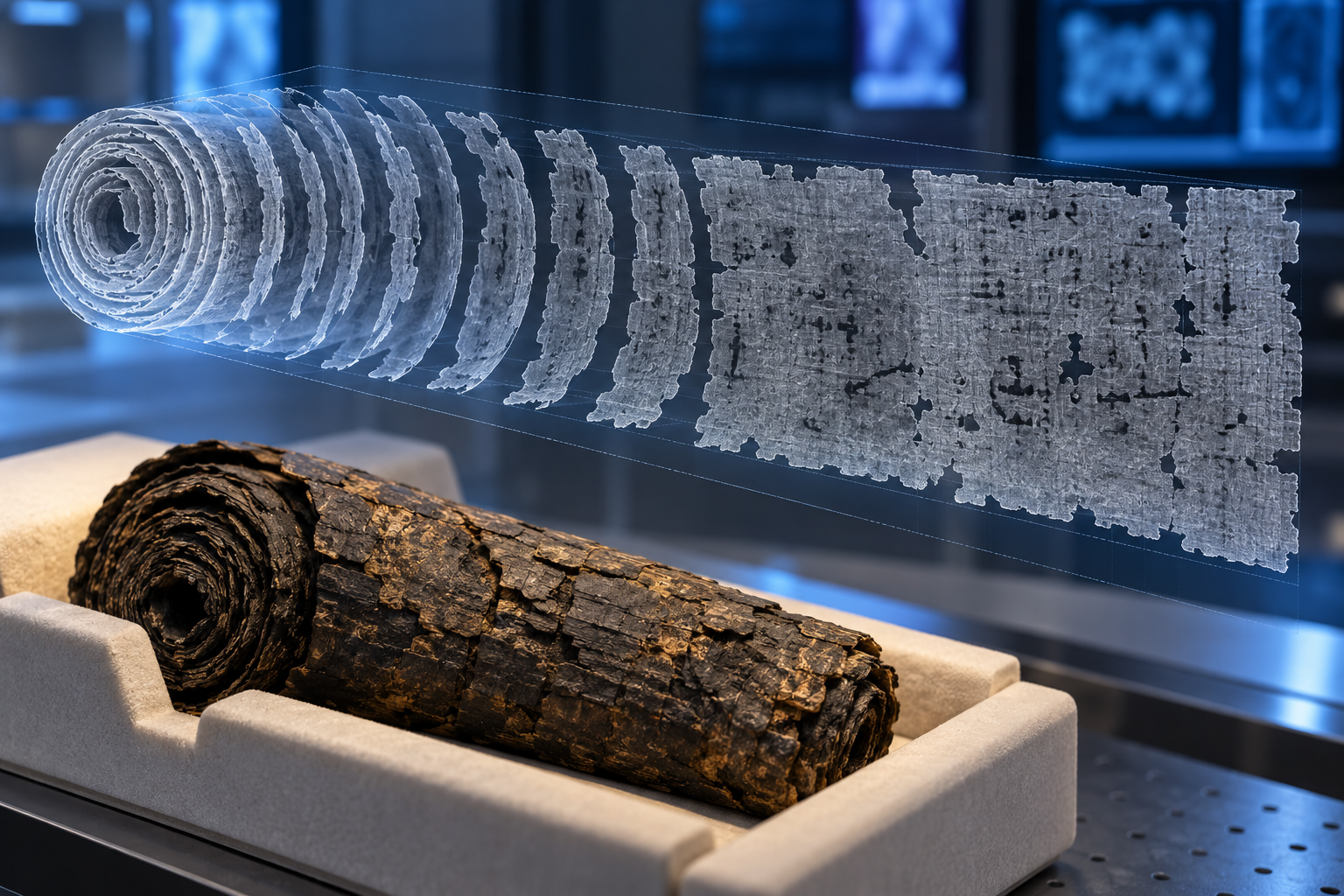
At first glance, a carbonized Herculaneum scroll can resemble a lump of charcoal. It is actually a fragile rolled document, transformed by the eruption of Mount Vesuvius in 79 CE. Its text may survive inside, but physically separating the layers can destroy the very evidence a reader hopes to recover.
Virtual unwrapping tackles that contradiction. Researchers scan the object, trace its internal surfaces digitally and produce flattened views of the papyrus. The physical scroll can remain closed while a representation of its pages becomes available for study.
Find the surface before reading the ink
High-resolution X-ray tomography creates a three-dimensional record of internal structure. It is not an ordinary photograph that sees directly through the outer layers. Many projections are combined to reconstruct a volume, within which researchers identify the papyrus surfaces.
Tracing those surfaces is called segmentation. The layers can be compressed, distorted or broken, making it a difficult geometrical problem. Once a surface has been identified, software can flatten its representation. The resulting image needs to preserve the relationship between marks and the actual scanned material.
Ink introduces another challenge. Carbon-based ink on carbonized papyrus can be hard to distinguish. Machine-learning methods help detect subtle evidence associated with ink in the scan data. They are tools for interpreting measured features, not a legitimate way to invent plausible ancient sentences where evidence is missing.
Progress from individual words to sustained text
The Vesuvius Challenge, launched in 2023, accelerated work by sharing scan data and encouraging researchers to improve the methods. Early milestones demonstrated that writing could be detected inside still-rolled Herculaneum material.
A February 2025 Bodleian announcement described successful imaging inside PHerc. 172, one of its scrolls. Further progress was reported by the University of Kentucky in June 2026: the surviving portion of PHerc. 1667 had been virtually unwrapped, yielding nearly 1.5 meters of text across approximately 20 columns. The announcement also reported more than 70 recovered columns from PHerc. 172.
“Surviving portion” is a meaningful qualification. A damaged fragment of a roll is not necessarily a complete ancient book. Likewise, recovering an image, reading letters and establishing the identity of a work are separate stages, each requiring its own evidence.
Some newly recovered material has supplied book titles associated with the Epicurean philosopher Philodemus. Other authorship questions remain open. The 2026 researchers treated a possible Stoic attribution cautiously rather than presenting an attractive candidate as a certainty.
Imaging becomes scholarship
Papyrologists and other specialists assess handwriting, reconstruct damaged words and interpret the results in their historical and philosophical setting. A technological breakthrough makes that scholarship possible; it does not replace it.
At the same time, conservation remains central. A digital representation can let many researchers examine evidence without repeatedly handling a vulnerable artifact. Better methods may also help revisit images whose first readings were incomplete.
Kentucky's 2026 research page includes a film of the virtual unwrapping. Watching the layers become a surface helps explain the process far better than imagining an invisible hand pulling a scroll open.
The achievement is a new relationship between preservation and access. A library that survived physically but was largely unreadable can gradually become legible, one measured surface and carefully interpreted passage at a time.
Sources and further reading: Bodleian: Inside PHerc. 172, February 2025; University of Kentucky: June 2026 recovery announcement; EduceLab: Verifiable recovery methodology.
Explore more creative discoveries at Incoprea.




