An old manuscript can contain more than one book on the same piece of parchment. Its most visible writing may be the youngest layer. Underneath, faint traces of an earlier text remain, like a conversation someone tried to erase but never quite silenced. Such a reused manuscript is called a palimpsest.
Recycling that accidentally preserved history
Parchment, prepared from animal skin, was durable enough to be scraped and written on again. Reusing it could remove the old writing from ordinary view without eliminating every trace of ink or every change to the surface.
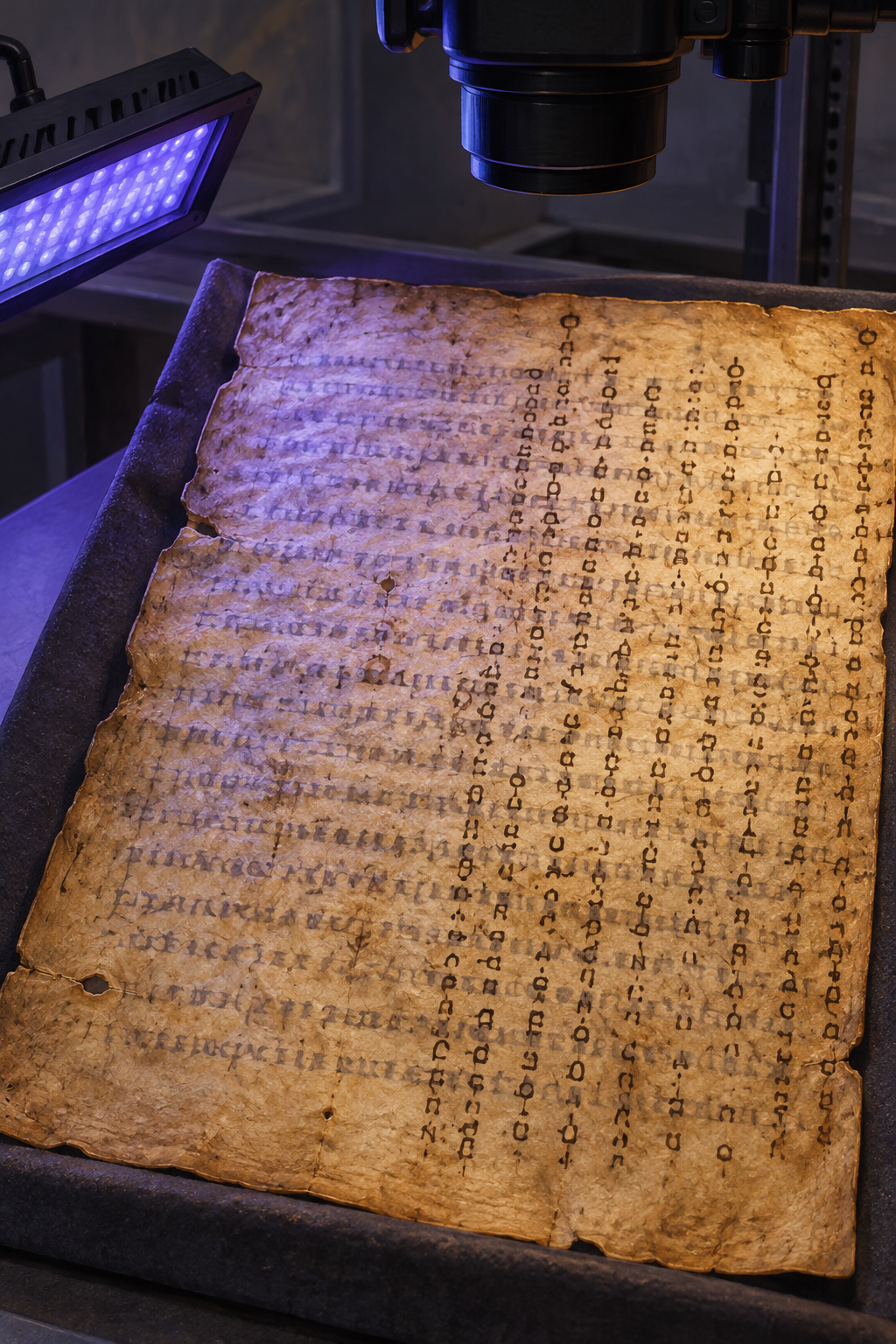
The Archimedes Palimpsest is a famous example. Its visible form is a Greek prayer book completed in the thirteenth century. To make it, scribes reused leaves from earlier manuscripts, including a tenth-century copy containing works of Archimedes. The leaves were divided, rotated and refolded; the new writing crosses the older text at right angles.
That physical rearrangement creates a demanding puzzle. A reader must distinguish two histories of writing while also reconstructing how the pages once fitted together. The prayer book is itself a historical object, rather than merely an obstacle in front of the mathematical text.
Looking beyond ordinary light
Multispectral imaging records the same area under different wavelengths of illumination. Ink and parchment do not respond identically across those wavelengths. Images can therefore reveal differences that are difficult to see with the naked eye.
The Archimedes project combined careful photography with processing intended to improve the visibility of the undertext. In its 2007 imaging session, each leaf was photographed across twelve wavelengths from ultraviolet through infrared. The project account makes a useful distinction: collecting the photographs did not automatically make the writing readable. Processing was another stage.
The result may be displayed in unusual colors that emphasize differences between materials. Such an image is a tool for reading evidence, not a picture of how a medieval reader would have seen the page. Its colors need an explanation just as a map's colors do.
The computer still needs the scholar
A striking enhancement can look like a finished discovery, but investigators must examine whether a faint mark is a letter, damage, interference from the later writing or an artifact of processing. The early Archimedes experiments encountered problems with aligning images and with unwanted visual noise.
That is why conservation, imaging science and knowledge of scripts work together. An imaging specialist can improve contrast. A reader trained in the language and handwriting can judge what the marks mean. A conservator protects the fragile source that allows either kind of work.
Palimpsests offer an unusually literal reminder that knowledge has layers. A practical decision to reuse material could obscure a text, while the material itself kept enough traces to let another age recover parts of it. The exciting moment is not a machine inventing missing words. It is a surviving mark becoming visible enough to read again.
Sources and further reading: The manuscript and its contents; The project's multispectral imaging account; How the images were captured.
Explore creative connections at Incoprea.