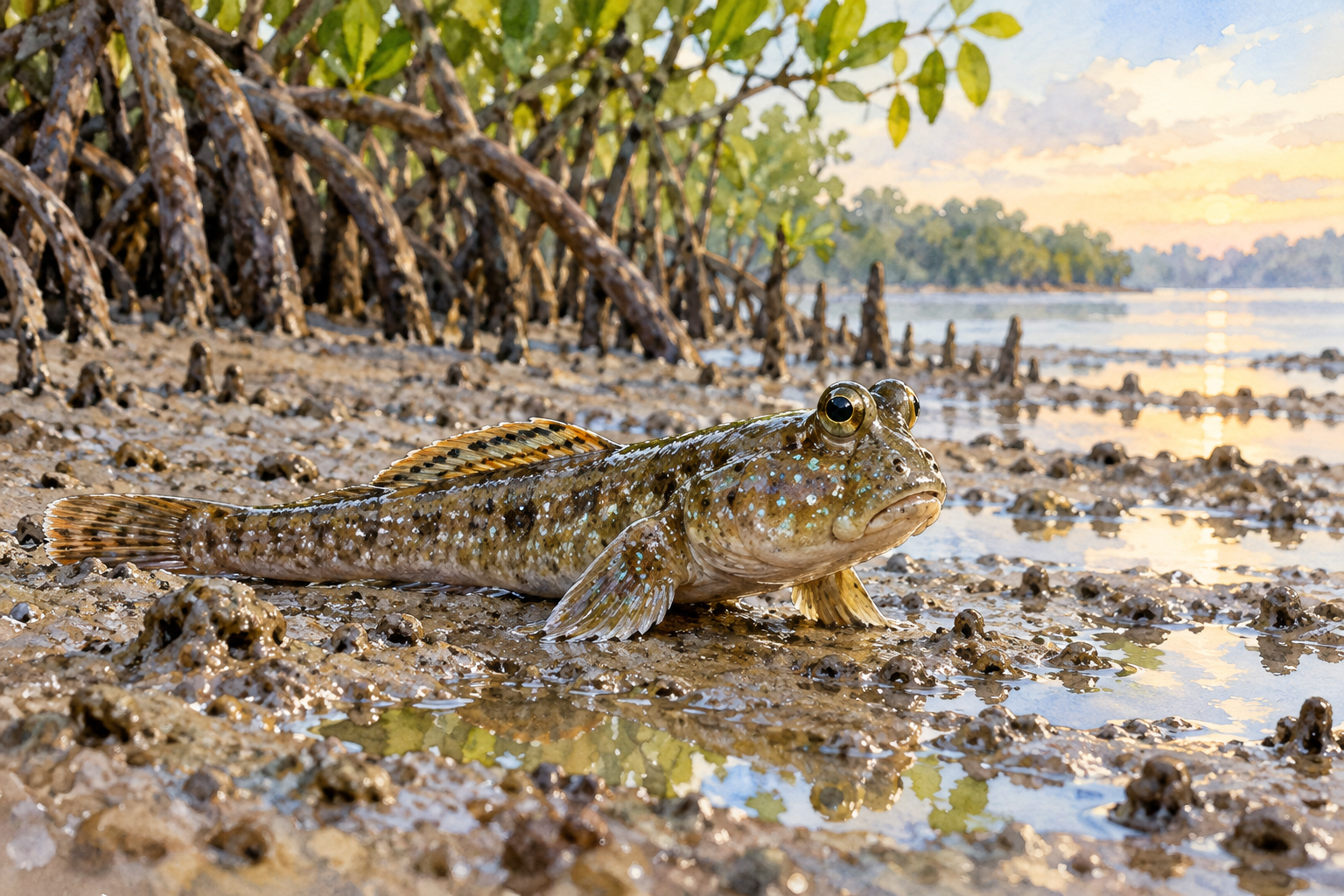
Watch a mudskipper for a little longer than seems necessary. At first you notice the obvious surprise: a fish is sitting above the water. Then its paired fins brace against the surface. Its raised eyes move. One eye briefly sinks into its head and comes back out. The more closely you look, the less this seems like a fish making a single daring excursion. It is an animal managing several ordinary problems in an extraordinary setting.
A tidal flat is never permanently one thing. A place exposed to air can later be underwater. For a mudskipper, the boundary offers opportunities, but it also changes how breathing, movement, and exposed tissues work. Understanding the animal becomes more satisfying when we ask what each small action accomplishes.
The shore presents a bundle of problems
Mudskippers are amphibious gobies. “Amphibious” describes their use of both aquatic and exposed environments; it does not place them in the amphibian group that includes frogs. Patricia Wright and Andy Turko’s review of amphibious fishes shows how many different challenges accompany life outside water. Support, hydration, gas exchange, and waste handling all change at the boundary. A solution to one challenge does not automatically solve the rest.
Think first about support. Water supports much of a fish’s weight; on an exposed surface that help disappears. Mudskippers use their fins and body movements to travel over the substrate. They also need moist surfaces for effective gas exchange. The useful question is therefore more precise than “Can this fish breathe air?” We need to ask where oxygen enters, under which conditions, and how the animal keeps the relevant tissues functioning.
These answers vary among species. Research on mudskipper reproduction describes contributions from the gills, the lining of the mouth and branchial cavity, and the skin, in different proportions. There is no single universal mudskipper breathing diagram that explains every species equally well. That variation is part of the interest: related animals can use a shared shoreline lifestyle while differing in how they handle its demands.
A blink built in a different way
The eyes offer an especially good close-up. In a 2023 study, Brett Aiello, Thomas Stewart, and colleagues examined blinking anatomy and behaviour in mudskippers. A mudskipper does not simply close a pair of eyelids like ours. The eye retracts into its socket, where a flexible covering called a dermal cup passes over its surface. Existing eye muscles help produce the movement, alongside this specialized tissue. The original paper connects the origin and function of blinking with life on land.
What would count as evidence that a blink is useful? A neat-looking movement alone would not answer that question. The team tested functions: wetting the eye, removing material, and protecting it. As Penn State’s research account explains, blinking increased when the eyes were dry. Blinks also cleaned the eye and responded to potential injury. The fish lack our tear glands and ducts; water from the surroundings and skin mucus appear to supply a wetting film instead.
That is a valuable distinction between resemblance and mechanism. Both you and the fish can maintain a moist eye by blinking, yet the moving parts and source of the film differ. The resemblance gives researchers a question to test. It does not entitle us to assume that every anatomical detail, or every step of evolutionary history, must match.
Watch the blink, then watch the animal
Watch the research footage linked by Penn State. First follow one eye, rather than the whole fish. Look for its downward movement and the return to a raised position. On a second viewing, widen your attention: is the animal supported above the water, and what can you actually see of the surface around it? Keep the observation separate from the explanation you have just read.
Try making two short notes: “I saw…” and “This could help because…”. The first should contain a visible event. The second is an interpretation informed by research. For example, seeing an eye retract is different from proving that it became wetter. Scientists needed controlled comparisons to investigate that function. A video is a useful invitation to notice, but it does not contain every measurement behind a conclusion.
If your first viewing misses the blink, that is useful information too. A conspicuous evolutionary story can depend on an inconspicuous behaviour. The habit of watching again often reveals more than a new list of surprising facts would.
The nursery with a supply of air
There is another shoreline problem hidden below the mud. A burrow may protect eggs, yet its water can contain very little oxygen. In 1998, Atsushi Ishimatsu and colleagues reported that the giant mudskipper Periophthalmodon schlosseri accumulated air inside its burrows. Their study of stored burrow air identified a way an animal could bring a useful environment into a difficult one.
A later field and laboratory study followed the Japanese mudskipper Periophthalmus modestus. Males added mouthfuls of air to the egg chamber, helping maintain oxygen for developing eggs. When development was complete, the male removed air, allowing the eggs to become submerged and hatch. The authors combined observations with measurements rather than inferring the process from the shape of an empty burrow. Read the egg-incubation and hatching study.
Notice the reversal. Air is useful during incubation; water becomes necessary at hatching. It would be easy to tell this as a story of a fish “escaping water,” but its life depends on controlling when the two environments meet. A burrow can be a refuge, a nursery, and a managed boundary. Findings from a named species deserve that name, rather than being silently turned into a rule for all mudskippers.
A living comparison, not a preserved ancestor
Mudskippers are modern fishes with their own evolutionary history. Their amphibious life and blinking evolved independently of the lineage that produced our four-limbed ancestors. This makes them useful comparisons: researchers can observe how a living animal handles exposed eyes and movement between media. It does not make them a film recording of a transition hundreds of millions of years ago.
The shoreline becomes more interesting when we leave that shortcut behind. A blink, a pause on the mud, and a mouthful of air carried into a burrow are separate actions with separate consequences. Together they show why adapting to a boundary is more than acquiring one spectacular trait. The next time a fish appears to be doing nothing above the waterline, give it another minute. There may be a great deal of work in that small interval.




