The river needs to carry ships. The towns on either bank need to carry people across. A conventional road bridge can solve both by climbing high enough, but its approaches need room to rise. A movable bridge can open, but that introduces a different sequence of movement and waiting.
A transporter bridge offers a wonderfully direct rearrangement: keep the supporting span high, then hang a moving passenger platform down near the banks. People cross on the platform while the structure above provides its route.
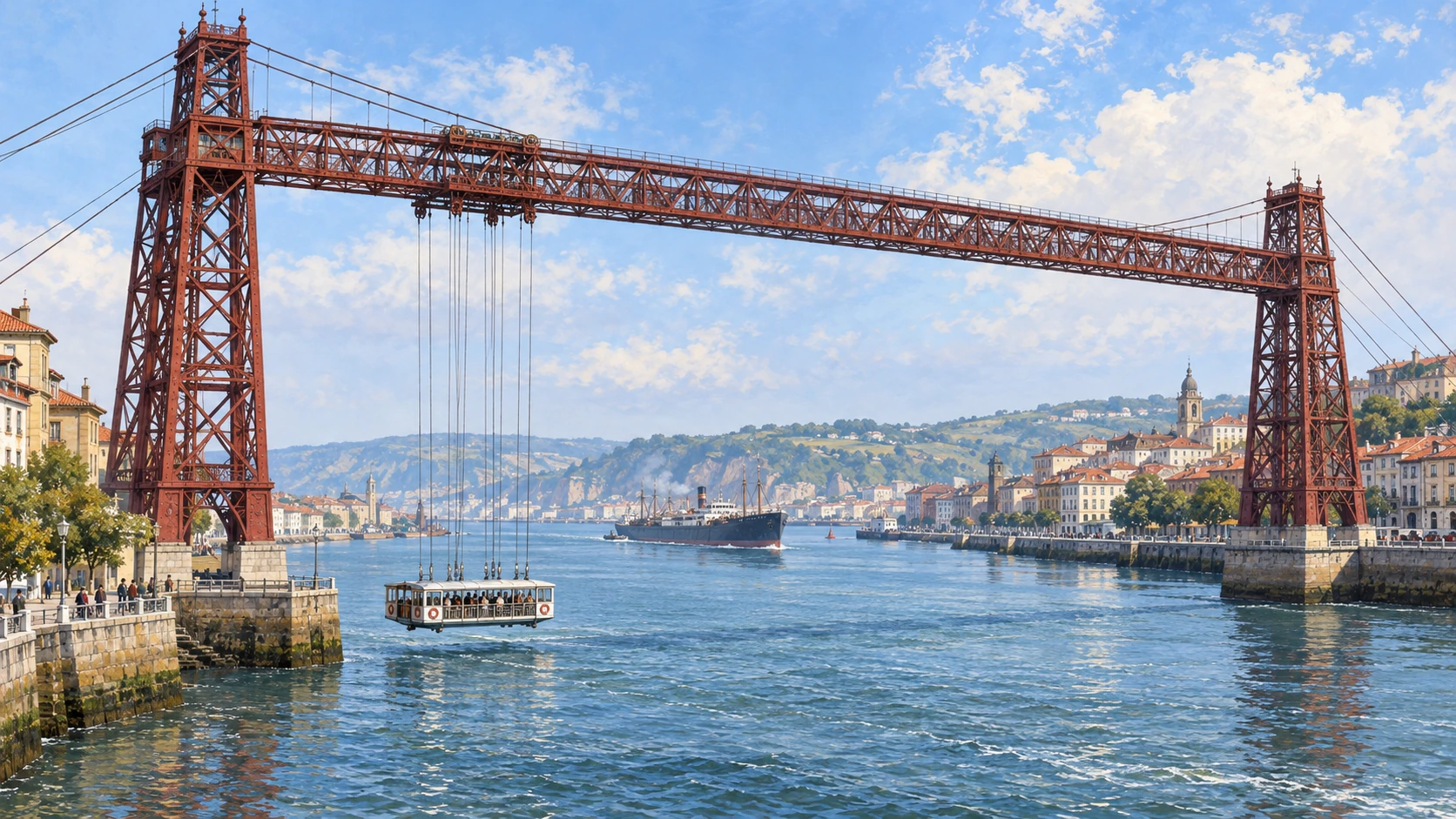
Trace the load upward
Start at the gondola, the low platform that carries passengers and vehicles. Follow its suspension members upward to the trolley. The trolley travels across the high-level structure. Continue through the main span and towers to the ground. The passengers travel low, but their weight is carried along a route far above them.
UNESCO’s Vizcaya Bridge account describes the pioneering example completed in 1893, connecting Portugalete and Getxo at the estuary west of Bilbao. Alberto de Palacio’s design combined ironworking traditions with twisted steel cables and a suspended transporter. The high crossing structure preserved navigation without requiring a high road approach on each bank.
The gondola is not a boat floating independently on the water. That distinction helps explain why its path and support belong to the bridge even though the experience at bank level resembles boarding a ferry.
One crossing becomes a cycle
Imagine a fictional platform with room for ten vehicles. It takes one minute to unload and load at each bank, and two minutes to travel each way. A complete return cycle lasts six minutes. If both directions are full, it carries twenty vehicles per cycle, or an idealized 200 vehicle crossings per hour.
Now give the same platform a busy direction and an empty return. Only ten vehicles are carried per cycle, or 100 per hour in the busy direction. Faster travel helps, but loading time remains. These invented figures are a scheduling exercise, not the capacity or timetable of Vizcaya or any other bridge.
Change the bottleneck on paper
Keep the ten-vehicle platform but halve each crossing time to one minute. The cycle becomes four minutes. With full loads both ways, idealized throughput becomes 300 crossings per hour. Next keep two-minute travel but halve each bank stop. The cycle becomes five minutes, yielding 240 crossings per hour.
Both interventions save time, but not the same amount. Neither calculation includes queues that do not fit on the platform, navigation coordination, interruptions, safety margins or uneven vehicle sizes. A moving structure’s speed alone does not describe its whole service.
Compare the parts that move
In a lift bridge, a large section of roadway rises. In a swing bridge, a span rotates. In a transporter bridge, the high supporting crossing can stay in place while a small suspended platform moves below it. Each solution organizes space and time differently.
The Getxo municipal description directs attention to the gondola’s carriage on the high rails. Try using its photographs to distinguish carriage, suspension and gondola. They are easy to compress into one mental object, but they have different mechanical roles.
Then imagine drawing a line for a tall ship’s passage. The full structure must provide sufficient clearance, while the low moving platform needs operating coordination. “Ships can pass” does not mean that every part of the river is unobstructed at every instant regardless of where the gondola is.
The engineering includes maintenance
Newport Transporter Bridge’s history and restoration account describes the continuing work needed on its gondola, motor house and main structure. This is a useful reminder that a transport invention survives through inspection and repair as well as its original concept.
A heritage photograph may emphasize a sweeping lattice silhouette. Operation also depends on smaller moving and electrical parts, loading arrangements and the condition of the structure carrying them. Preserving a working machine is a different challenge from preserving only its outline.
For a final close-looking exercise, divide a bridge photograph into three layers: fixed structure, moving equipment and people’s access route. Give each a different color in a sketch. Then ask which layer a proposed change would affect. Enlarging a gondola, for example, is also a question about loads, supports and the rest of the system.
The transporter bridge is memorable because it makes a clever separation visible. The route that supports a crossing can be high while the place where people board stays low. A familiar river problem becomes a different machine when its jobs are assigned to different heights.
Sources and further exploration: UNESCO: Vizcaya Bridge; Getxo municipality: visit the Bizkaia Bridge; Newport Transporter Bridge: history and restoration.
Explore all 50 new articles · Browse the complete illustrated collection
Explore more art, ideas, and independent projects at Incoprea.


