Showing posts with label India. Show all posts

Friday, October 23, 2026

Soapstone and Shadow: Reading a Hoysala Temple Wall

A heavily carved temple wall can defeat the eye through abundance. You notice a face, then a necklace, then an animal, and lose the architecture holding them together. At the Hoysala temples of Karnataka, a better beginning is to step back. Look for the shape of the wall before trying to identify every figure on it.

The three ensembles inscribed together by UNESCO are Channakeshava at Belur, Hoysalesvara at Halebidu, and Keshava at Somanathapura. Dating to the twelfth and thirteenth centuries, they share an architectural language without being identical buildings. Their projecting and receding plans create surfaces that turn, catch light, and present different views as a person moves.
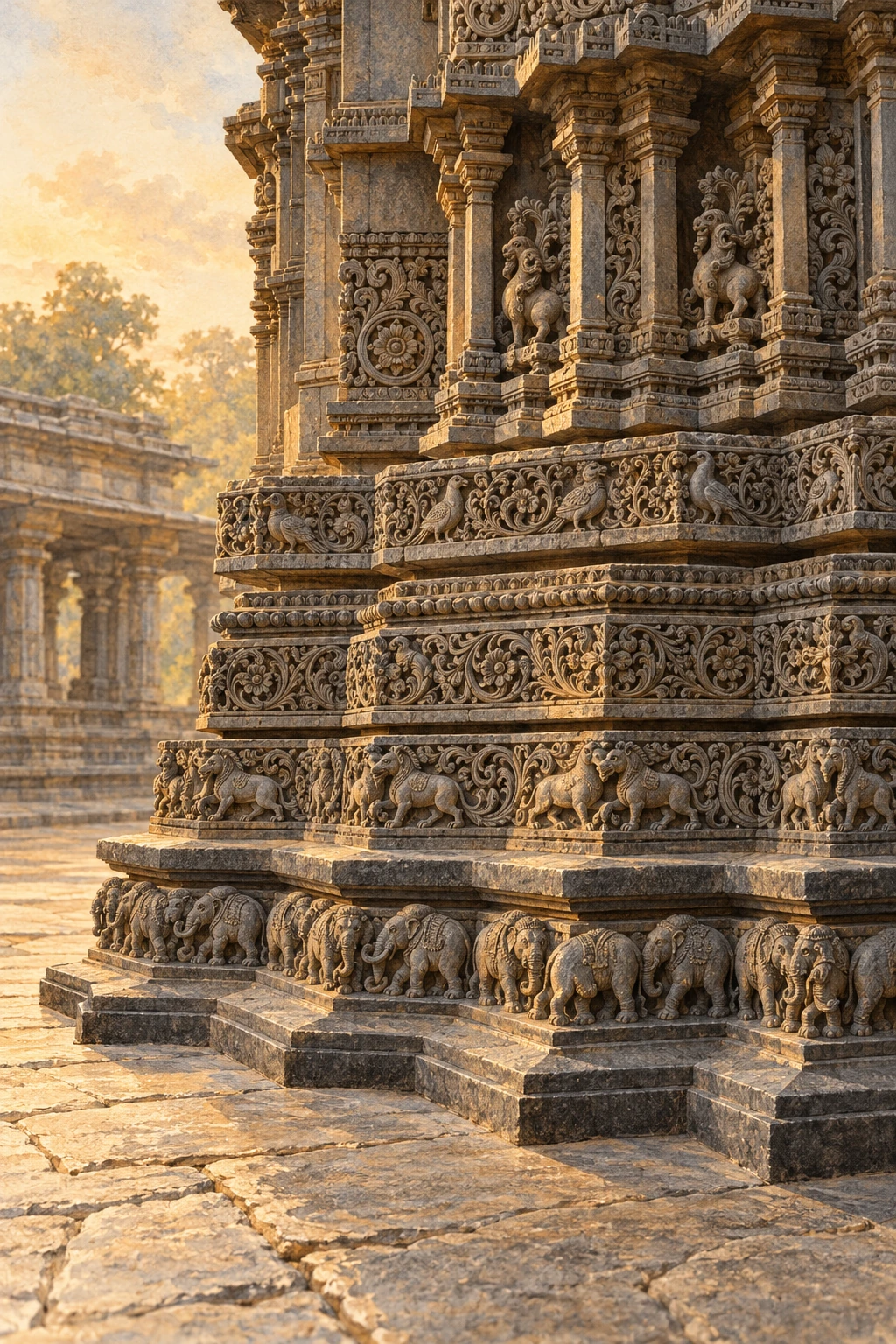
An original architectural study inspired by Hoysala soapstone carving: a generic fluted star-plan base and stacked carved horizontal friezes, dense small floral and animal ornament, deep recesses with raking warm light, no identifiable deity, no exact Belur temple sculpture, no inscription or modern tourist..
Recesses, projecting bands, and repeated details organize light across an imagined Hoysala-inspired wall.

Read with your feet, even from a photograph

A stellate plan is a plan with star-like projections. On a flat diagram, it can seem primarily geometric. In a building, every change of direction also changes what you can see. A shallow relief and a deep recess behave differently under the same light. The architecture provides repeated changes of viewpoint rather than one ideal front.

The raised circumambulatory platform follows the shrine's form and provides a route around it. Moving around a sacred building is therefore connected to its sculptural arrangement. This is a religious setting, not a collection of decorations assembled for a modern camera. Its images belong to worship, narrative, patronage, and skilled making.

When you have only photographs, seek a plan and a wider elevation as well as close-ups. Try to locate each detail on the larger building. An isolated image can make a small figure seem monumental or a large panel seem miniature. Reattaching it to the wall restores some of the choices a sculptor had to make.

Soapstone is an opportunity, not an explanation by itself

Karnataka's official account draws attention to the use of soapstone and the dense carving at Belur and Halebidu. Knowing the material helps explain how fine detail was possible. It does not explain why a particular story, gesture, ornament, or sequence was chosen.

A material allows possibilities; a workshop selects among them. Describing the whole achievement as “soft stone made it easy” would erase the judgment required to organize a difficult surface. Notice where a border separates scenes, where a figure projects beyond its background, and where a repeated band gives your eye a stable line to follow.

Nor should detail be treated as a contest in which more always means better. A large quiet form and a small busy one perform different jobs. Ask how their contrast works. The useful unit of attention may be a whole bay or horizontal band rather than the most spectacular isolated ornament.

The makers sometimes have names

The 2023 ICOMOS evaluation notes inscriptions naming sculptors and their home towns at Belur. It also identifies sculptors' names at Halebidu, including overlaps with Belur. This is firmer evidence for makers and connections between sites than an impression that two carvings merely “look alike.”

A signature does not provide a complete biography. It does, however, interrupt the idea of a vast anonymous decorative machine. The surface records choices made by people whose work circulated through particular places. A name, an inscription's location, and a comparison with another site can begin a more precise history of a workshop.

Finish by comparing plans. Belur's main shrine and Halebidu's paired sanctums do not organize space in the same way, despite their shared Hoysala context. Similar carving does not make the buildings interchangeable. The reward for slower looking is that the wall stops being a blur of virtuosity and becomes an arrangement you can begin to follow.

Sources and further exploration

Explore all 80 new articles · Browse the complete illustrated collection

Continue exploring art, ideas, and unexpected connections at Incoprea.

Wednesday, October 14, 2026

Rani-ki-Vav: The Well You Descend Through Like a Monument

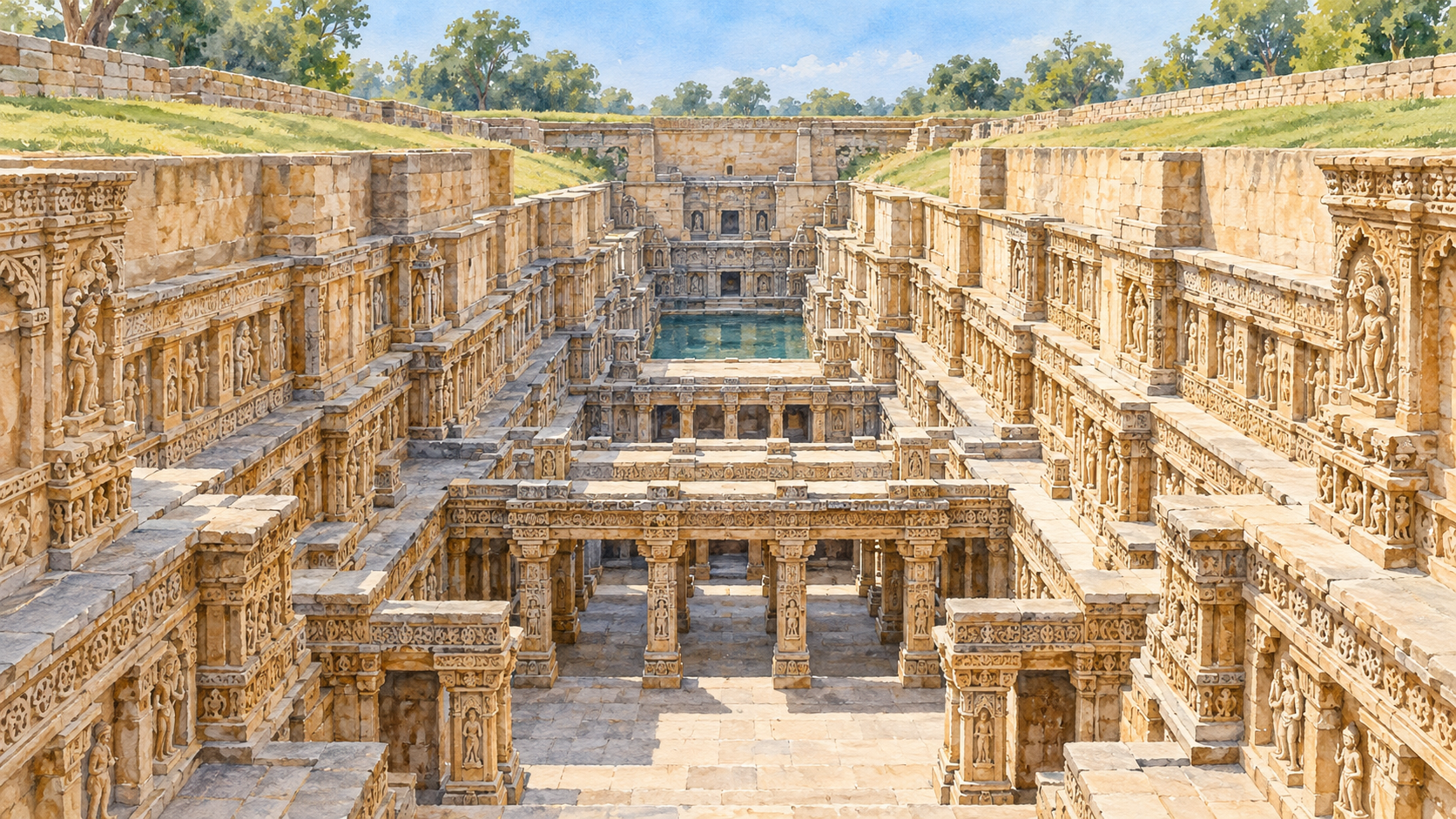
At street level, a well can seem like a small opening in the ground. Rani-ki-Vav asks you to imagine the opposite: a long architectural interior descending towards water, its walls and pavilions filled with sculpture. The space that might have remained hidden becomes the monument.

The Queen's Stepwell stands at Patan in Gujarat, India. Its most revealing feature is not any single carving. It is the relationship between movement, water and attention: the route down organises what a person encounters, while the carved surfaces make that practical journey richly meaningful.

Painted long view into an ornate rectangular stepwell with descending levels and carved sandstone pavilions.
An architectural interpretation inspired by Rani-ki-Vav; carving, layout and the suggested water level are illustrative rather than a survey or present-day record.

Read the building along its length

UNESCO describes an eleventh-century memorial in the Maru-Gurjara architectural tradition. Stairs, pavilions, a tank and the well shaft form an east-to-west sequence. Rather than treating the monument as a pit decorated around its edge, picture a building whose principal direction is both forward and downward.

The seven levels give that descent a structure. Covered or framed spaces interrupt the stairs and create changes in perspective. A wide view helps establish the route, but it cannot communicate every detail a person would encounter along it. This is architecture organised through successive positions, rather than one ideal viewpoint.

It also differs from the compact, repeated zigzag stair patterns that circulate in photographs of other Indian stepwells. Those images can be beautiful, but allowing one famous visual formula to stand for every stepwell makes this building harder to understand. At Patan, begin with the long corridor and its sequence of spaces.

The practical reason to go below ground

The water source lay below ground, so access was a practical design problem. The Indira Gandhi National Centre for the Arts attributes the monument to Queen Udayamati and describes its long stepped corridor. An essential route became the organising feature of the building.

This basic task has several dimensions. A well needs a source; people need a route to it; the surrounding structure has to remain stable; and the route has to be understood by the people using it. The achievement lies in bringing these requirements into one built arrangement. Decoration did not have to be added as an afterthought to an otherwise complete idea.

For a useful comparison, think of a staircase in a public building you know. Its steps connect floors, but its width, landings, light and entrances also shape how people move. Rani-ki-Vav works on a much grander and more richly carved scale, yet it rewards the same question: what happens to the experience when a route is treated as a place?

Why the phrase “inverted temple” matters

UNESCO uses the idea of an inverted temple to describe the monument's celebration of water's sanctity. The phrase does more than remark that the building goes down. It draws together the resource being reached, the imagery around it and the carefully composed approach.

The sculptures include religious, mythological and secular subjects. In the UNESCO description, more than five hundred principal sculptures are accompanied by many smaller figures. A numerical total conveys abundance, but it cannot replace looking at how figures occupy niches, borders and architectural frames.

The UNESCO New Delhi feature also draws attention to floral and geometric designs and to a visual relationship with Patan's Patola textile traditions. Its comparison is an invitation to examine shared forms. A resemblance alone does not establish that one specific pattern was copied directly from a particular fabric.

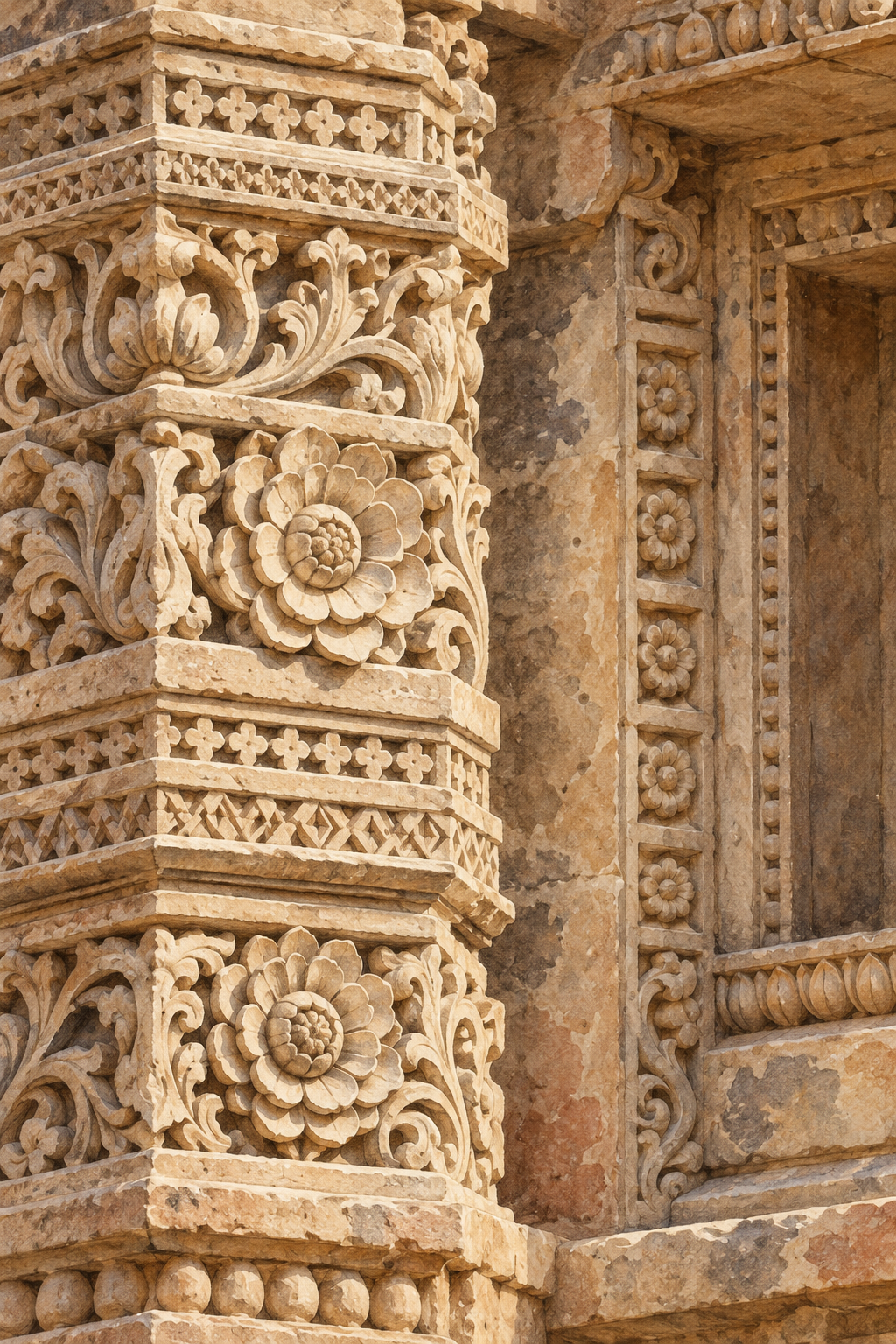
Close-up painted study of floral carving, a niche edge and a carved pillar on warm sandstone.
An interpretive study of the floral carving and layered stone detail associated with stepwell architecture; it does not reproduce a specific Rani-ki-Vav sculpture.

Use the smaller illustration as a reminder to change scale, then return to photographs of the actual monument. A flower, an ornament and an architectural edge can become a coherent composition when viewed together. The challenge is to keep the detail connected to its location rather than collecting isolated decorative fragments.

A virtual visit with three stops

The UNESCO New Delhi feature provides photographs and linked films credited to cultural organisations. The Indira Gandhi National Centre for the Arts provides another architectural account. Choose these records for a short visual journey rather than relying on an attractive reconstruction's suggested water level.

  1. Establish the route. In a wide photograph, identify the stairs, a pavilion and the direction of the well. Follow the sequence with your eyes.
  2. Find a pause. Choose a framed or covered space. How does it interrupt the long descent? What can be seen through it?
  3. Choose one carved surface. Notice its scale in relation to the surrounding stonework. What does a close view reveal that disappeared in the first photograph?

Now describe the building in three sentences, one for each stop. If all three describe only sculpture, return to the route. If all three describe only engineering, return to the carved surface. The exercise helps bring use and meaning into the same account.

Burial, recovery and the monument we see

UNESCO explains that flooding and silt helped preserve the stepwell for centuries. Its account distinguishes surviving fabric from limited reconstructions needed for stability. Burial protected important surfaces, but the monument still has a history of damage, excavation and conservation.

A view today therefore includes surviving material and the effects of excavation, conservation and loss. The monument's present appearance is evidence to examine, not a complete return to an eleventh-century moment. The same care applies to water: a painted or illustrated pool cannot establish a historical or current water level.

After following the route, the stepwell's central idea becomes clearer. A community's access to an essential resource was given monumental form. The descent does not lead away from architecture towards a hidden utility. The descent is the architecture, and reaching water supplies the reason for its extraordinary sequence.

Sources and further reading

Explore more art, stories and discoveries at Incoprea.

Famous Last Meals is now in paperback — stories, history and 25 recipes

Famous Last Meals: Stories, History, and Recipes is now available in paperback on Amazon. The illustrated collection brings together 23 his...