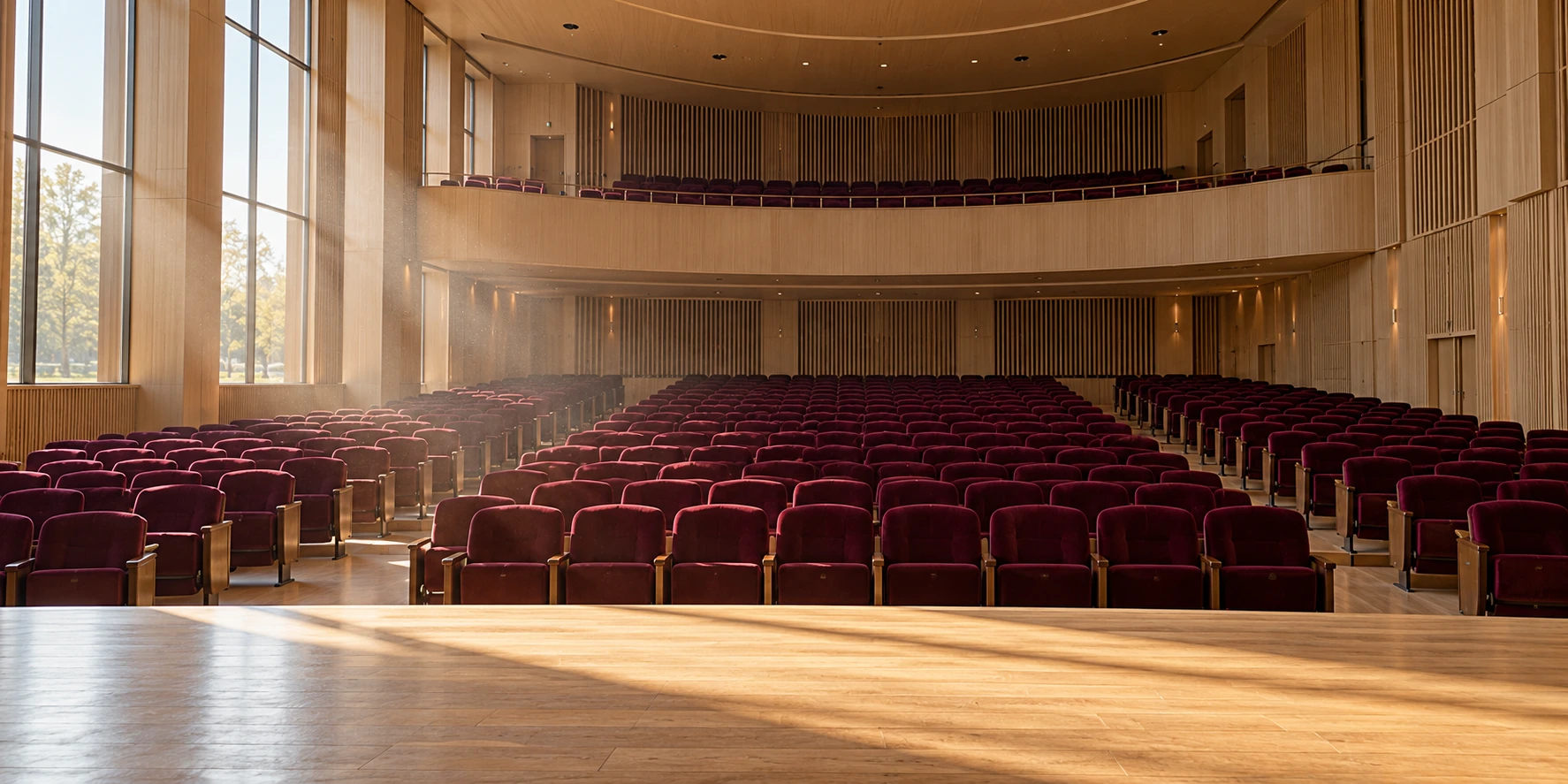
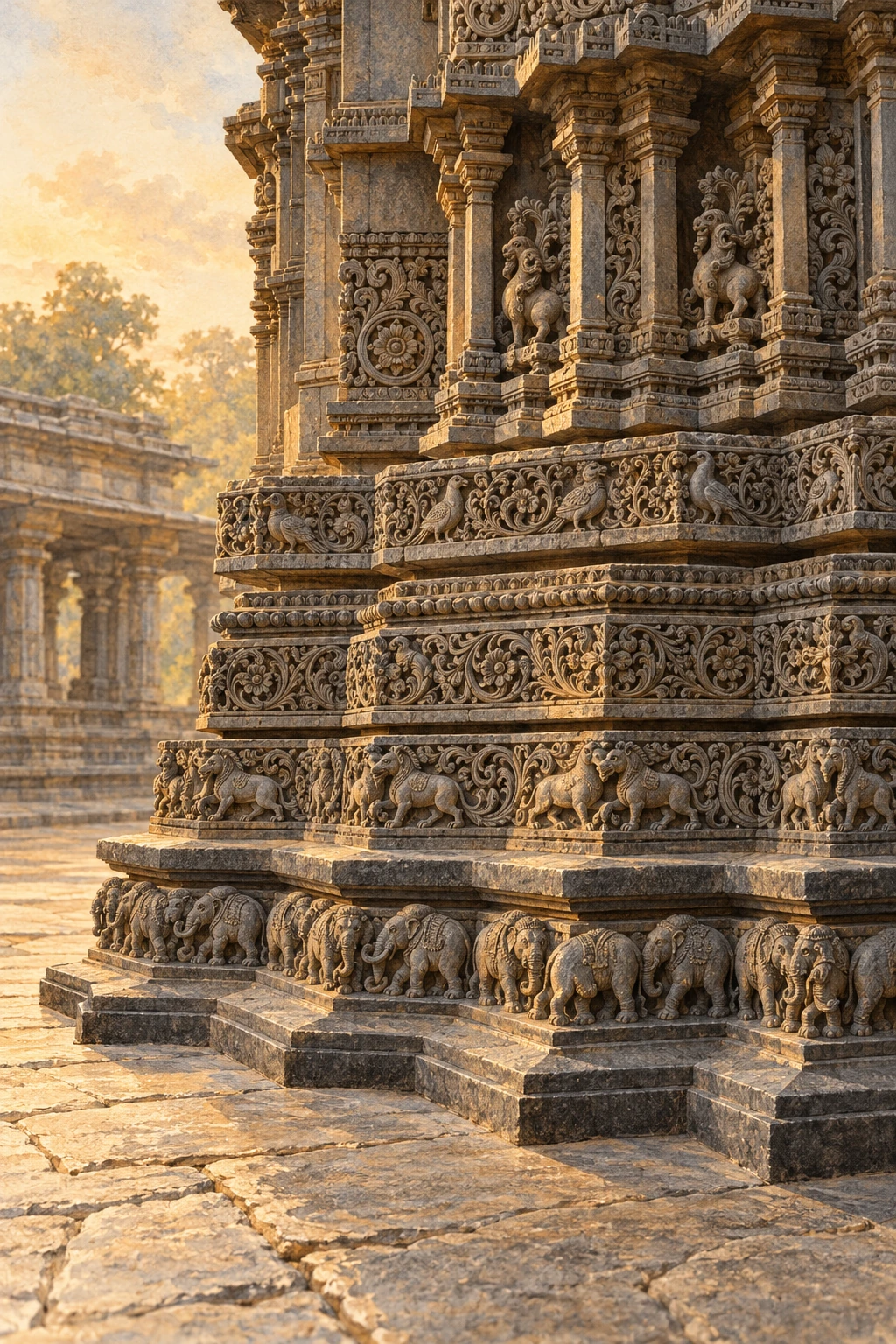
A heavily carved temple wall can defeat the eye through abundance. You notice a face, then a necklace, then an animal, and lose the architecture holding them together. At the Hoysala temples of Karnataka, a better beginning is to step back. Look for the shape of the wall before trying to identify every figure on it.
The three ensembles inscribed together by UNESCO are Channakeshava at Belur, Hoysalesvara at Halebidu, and Keshava at Somanathapura. Dating to the twelfth and thirteenth centuries, they share an architectural language without being identical buildings. Their projecting and receding plans create surfaces that turn, catch light, and present different views as a person moves.
Read with your feet, even from a photograph
A stellate plan is a plan with star-like projections. On a flat diagram, it can seem primarily geometric. In a building, every change of direction also changes what you can see. A shallow relief and a deep recess behave differently under the same light. The architecture provides repeated changes of viewpoint rather than one ideal front.
The raised circumambulatory platform follows the shrine's form and provides a route around it. Moving around a sacred building is therefore connected to its sculptural arrangement. This is a religious setting, not a collection of decorations assembled for a modern camera. Its images belong to worship, narrative, patronage, and skilled making.
When you have only photographs, seek a plan and a wider elevation as well as close-ups. Try to locate each detail on the larger building. An isolated image can make a small figure seem monumental or a large panel seem miniature. Reattaching it to the wall restores some of the choices a sculptor had to make.
Soapstone is an opportunity, not an explanation by itself
Karnataka's official account draws attention to the use of soapstone and the dense carving at Belur and Halebidu. Knowing the material helps explain how fine detail was possible. It does not explain why a particular story, gesture, ornament, or sequence was chosen.
A material allows possibilities; a workshop selects among them. Describing the whole achievement as “soft stone made it easy” would erase the judgment required to organize a difficult surface. Notice where a border separates scenes, where a figure projects beyond its background, and where a repeated band gives your eye a stable line to follow.
Nor should detail be treated as a contest in which more always means better. A large quiet form and a small busy one perform different jobs. Ask how their contrast works. The useful unit of attention may be a whole bay or horizontal band rather than the most spectacular isolated ornament.
The makers sometimes have names
The 2023 ICOMOS evaluation notes inscriptions naming sculptors and their home towns at Belur. It also identifies sculptors' names at Halebidu, including overlaps with Belur. This is firmer evidence for makers and connections between sites than an impression that two carvings merely “look alike.”
A signature does not provide a complete biography. It does, however, interrupt the idea of a vast anonymous decorative machine. The surface records choices made by people whose work circulated through particular places. A name, an inscription's location, and a comparison with another site can begin a more precise history of a workshop.
Finish by comparing plans. Belur's main shrine and Halebidu's paired sanctums do not organize space in the same way, despite their shared Hoysala context. Similar carving does not make the buildings interchangeable. The reward for slower looking is that the wall stops being a blur of virtuosity and becomes an arrangement you can begin to follow.
Sources and further exploration
- UNESCO: Sacred Ensembles of the Hoysalas
- Karnataka Tourism: Halebeedu and Belur
- ICOMOS evaluation of the Hoysala ensembles, 2023
Explore all 80 new articles · Browse the complete illustrated collection
Continue exploring art, ideas, and unexpected connections at Incoprea.