The colorful gables at Bergen's Bryggen make a memorable waterfront. But a row of facades is a poor diagram of a trading town. The useful question is what happened behind them. A dried fish could pass through spaces for storage, assessment, bargaining, and dispatch. People had to sleep, cook, keep accounts, and reduce the chance that one fire would destroy their working world.
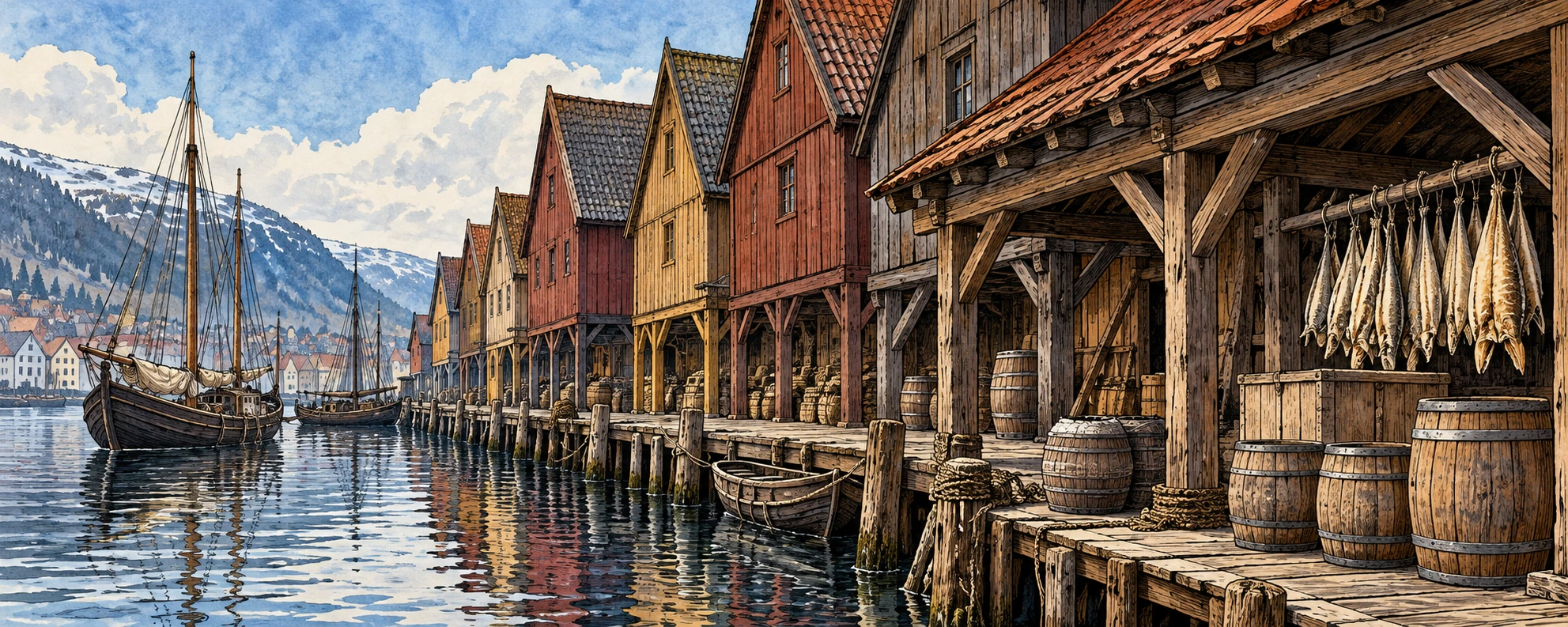
Read Bryggen from the water toward the back, then downward into the ground. This is an interpretive walk through its documented organization, rather than a claim that every surviving doorway performed one fixed task for centuries. The district changed. Its layout nevertheless preserves unusually clear relationships between commerce, domestic life, and shared space.
Begin with the cargo
Stockfish is fish preserved by drying, usually cod and sometimes coley. The European Hansemuseum's Bergen audio stop follows the exchange of this northern Norwegian product for goods such as grain. It explains why keeping qualities mattered to long journeys and why grading fish was expert work. Much of the supply came from the Lofoten fishery.
That turns a seemingly simple object into a coordination problem. A dried fish in a warehouse is also the result of catching, processing, transport, and agreements between people who may never share a meal. Its usefulness at the destination depends on what happened before it arrived. Looking at the final commodity alone hides those dependencies.
Try describing the trade without using the word “merchant.” You need a fisher, someone handling the catch, people moving cargo, an assessor, and a buyer. You also need provisions moving in the other direction. The exercise makes the waterfront less like a collection of picturesque houses and more like a junction between livelihoods.
At the front: where a transaction acquired a record
Norway's heritage directorate describes offices and dwellings at the front of the building rows, warehouses farther in, and assembly rooms, kitchens, and fireproof stone cellars toward the back. The Hanseatic office was established in the fourteenth century. Trade in stockfish from northern Norway was central to its influence.
Put the account beside the cargo in your imagination. A pile of fish is physical; a claim to payment is an agreement. Trading requires the two to remain connected. That observation does not identify the contents of a particular lost account book. It explains why an office belongs in the same architectural story as a storeroom.
From the front, the buildings can look independent. Follow the narrow spaces inward and the length of a property becomes more apparent. A useful photograph therefore includes the passages and the rear as well as the gables. A waterfront panorama answers “what did the town show?” A view into a row begins to answer “how did it work?”
In the middle: value was something people judged
Storage is easy to overlook because it looks like waiting. Yet keeping goods between arrival and departure is part of trade, not an interruption to it. A warehouse allows a product to be separated in time from the ship that delivered it. It also concentrates the consequences of mistakes.
Expert grading adds another layer. “Dried fish” names a broad category. A transaction needs distinctions within that category. When you read the museum's account, notice that the assessment belongs to people with learned judgment. A quantity and a quality are different kinds of information. Counting one cannot substitute for understanding the other.
This is a good place to resist an attractive fictional detail. We can imagine a noisy argument over a bundle, but an imagined argument is not evidence of a recorded event. The stronger reconstruction explains the decisions the setting required without inventing named participants, dialogue, prices, or one typical day that supposedly represents several centuries.
At the back: the working community
Assembly rooms and cooking facilities bring collective life into the picture. They remind us that a trading establishment had to organize people as well as goods. The 2024 Climate Vulnerability Index report treats these relationships, along with the less visible archaeological deposits, as parts of one heritage property.
The distinction matters when judging what should survive. If only the waterfront silhouettes remained, a recognizable image might endure while much of the evidence for how the place functioned disappeared. Preserving a relationship between spaces can be as significant as preserving an attractive surface.
Below the floor: water can protect wood
The buildings now visible largely follow rebuilding after the fire of 1702, within older property boundaries. Under them are deep cultural deposits containing earlier structures and traces of work. Riksantikvaren's monitoring account explains that drainage, drying, and compression can damage both the deposits and the buildings above them. Stable groundwater is therefore part of caring for the district.
“Keep a wooden building dry” and “keep buried wooden remains waterlogged” can both be sensible aims in different conditions. They concern different environments. The apparent contradiction disappears when we ask which material, in which location, under which conditions. Conservation cannot be reduced to one slogan about water.
NIKU's project description records archaeological mapping, test investigations, and advice about where interventions could occur without disturbing intact deposits. A modern drainage decision therefore requires knowledge of a buried town. The ground is an archive and a support, not simply empty space beneath the visible attraction.
Return mentally to the waterfront. The gables now stand at the end of a longer chain: fisheries, assessments, stores, shared rooms, fires, rebuilding, and carefully managed ground. Bryggen becomes more interesting when its beauty is allowed to include the practical arrangements that made the town possible.
Sources and further exploration
- Riksantikvaren: Bryggen in Bergen
- European Hansemuseum: Stockfish from Bergen, audio and transcript
- Riksantikvaren: climate adaptation and monitoring at Bryggen
- Day and colleagues: Bryggen Climate Vulnerability Index, 2024
- NIKU: the Bryggen groundwater project
Explore all 80 new articles · Browse the complete illustrated collection
Continue exploring art, ideas, and unexpected connections at Incoprea.