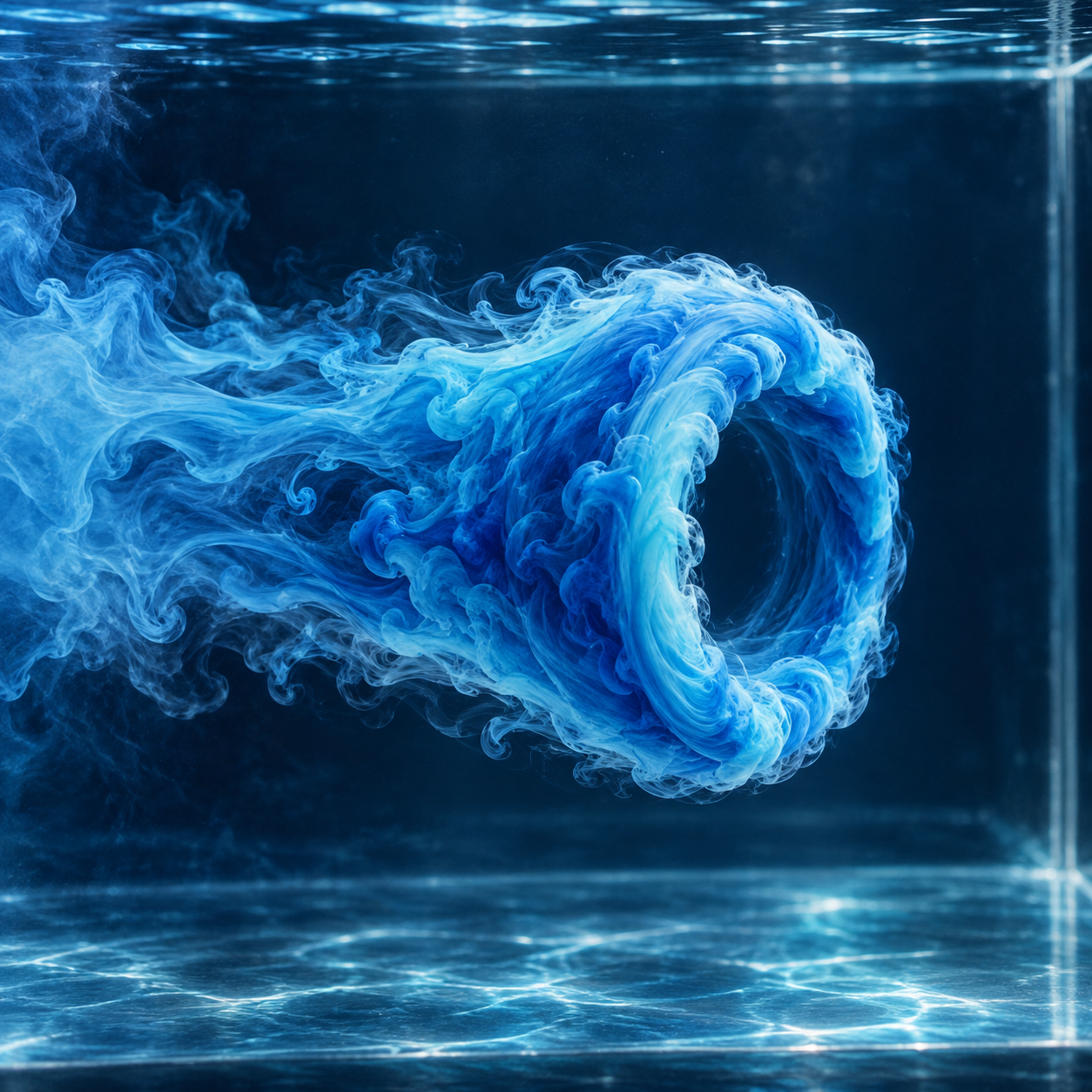
A blue loop moves through clear water. Its outline is recognizable, but there is no skin holding it together and no solid object hidden inside. The shape persists because water circulates in an organized way around a curved core. What travels is a pattern of motion carried by moving fluid.
A vortex ring invites two different kinds of looking. From the side, follow its progress through the tank. Then imagine a slice through its core and follow the circulation. The forward journey and the curling motion happen together. Missing either one turns the ring into a misleading picture of a soft object being pushed along.
Follow the little circles around the large circle
The Feynman Lectures describe a smoke ring as a torus-shaped bundle of vortex lines. A torus has the familiar overall shape of a doughnut. The fluid’s circulation around the core helps the ring move forward: the flow associated with one part of the structure influences the other parts.
Keep those two geometries separate. The large circle is the ring’s overall path around its hole. A small loop around a section of its core represents the local circulating flow. The description is not that every dyed particle races around the large circle like a car on a circular track.
Try this without drawing a finished diagram. Curl one hand into a loose ring and use a finger of the other hand to trace a small loop around one part of it. Move the ring-shaped hand forward while continuing that small loop. Your hands cannot reproduce a fluid flow field, but the gesture distinguishes travel of the whole pattern from circulation around its core.
The visible color is a tracer, not a complete map of every moving parcel. Clear fluid can move while remaining difficult to see. Conversely, a streak of dye tells us where the tracer has gone, not automatically the exact velocity or vorticity everywhere nearby. A beautiful image is the beginning of a measurement question.
A longer push does not simply make the same ring larger forever
A classic 1998 experiment by Morteza Gharib, Edmond Rambod and Karim Shariff generated rings with a piston and cylinder in a water tank. The researchers compared piston travel, L, with the outlet diameter, D. For shorter strokes they observed a single ring; longer strokes produced a leading ring followed by a trailing jet.
Across a broad set of the conditions they tested, the transition occurred at L/D values around 3.6 to 4.5. They called this a formation number. It describes a limit in those ring-forming flows, rather than a universal rule that any circular puff in any fluid must obey the same number.
Imagine two otherwise comparable piston strokes through the same outlet. One has L/D equal to 2, the other equal to 6. Before looking at the result, predict which one is more likely to leave a trailing jet. The question makes the ratio useful: extending the supply of moving fluid can change the kind of flow produced, not merely the size of an isolated ring.
Check the piston-stroke prediction
The L/D=6 case is above the reported transition range, so the experiment suggests a leading ring with a trailing jet. The L/D=2 case is below it. These are comparisons with the named experiment, not a guarantee for every nozzle shape, discharge history or fluid condition.
Watch a controlled collision lose its simple outline
Harvard’s 2020 account of a vortex-collision experiment introduces a deliberately clean starting point: two rings approaching one another head-on. A synchronized scanning light sheet and high-speed camera helped reconstruct their rapidly changing geometry. Numerical simulations gave the researchers another way to examine the interaction.
First watch the overall motion. As the rings approach and interact, their cores stretch outward. Then watch again for departures from an even circular outline. Waves develop along the cores, followed by slender structures between them. A change that first looks like an untidy edge becomes part of an organized sequence at a smaller scale.
In the original Science Advances paper, Ryan McKeown and colleagues explain a cascade involving the elliptical instability. The growing disturbances produce secondary filaments; interactions among those filaments can produce still smaller ones. The authors distinguish two iterations observed experimentally from three in simulations. That distinction matters when a striking sequence is summarized in a few sentences.
The experiment does not settle every turbulence problem. It isolates an interaction through which energy can pass toward smaller scales. The strength of the setup is that its simple beginning makes the developing complexity easier to investigate than a whole river or aircraft wake at once.
Make three passes through the film
On the first pass, describe only what happens to the large outlines: approach, expansion, distortion, loss of recognizable rings. On the second, choose one emerging filament and follow it for as long as it stays visible. On the third, notice which images are experimental views and which are reconstructions or simulations. Avoid treating every colored rendering as the same kind of evidence.
Now compare your notes with the paper’s figure captions. A useful discrepancy may be a feature your eye missed rather than an error in the footage. Slow motion and reconstruction make a short event inspectable, but the observer still has to decide what is being represented.
Similar loops can contain different ingredients
Caltech’s work on simulated bubble rings follows underwater air rings that merge and separate. Its account emphasizes geometric comparison between simulations and real footage. Those rings introduce an air–water interface, while a dyed water vortex uses color to reveal motion within water. The family resemblance is informative without making the cases identical.
A clear loop is a particularly generous starting point for the eye. You can recognize it before knowing the equations, then discover that recognition is only the first step. Follow its circulation, its formation and its interaction with another ring, and a small traveling shape becomes a route into the much larger question of how organized flow develops complexity.
Sources and further exploration: Feynman Lectures, Chapter 40; Gharib, Rambod and Shariff: vortex-ring formation; Harvard SEAS: Unraveling turbulence; McKeown and colleagues: the 2020 paper; Caltech: bubble-ring simulations.