Warm, salty water can lie above cold, fresher water without immediately overturning. Warmth tends to make the upper water lighter; salt tends to make it heavier. If the thermal effect wins, the arrangement is stable when considered as two bulk layers.
Yet a small displaced parcel can tell a different story. It may exchange heat with its surroundings faster than it exchanges salt. Cooling can remove the buoyancy that kept a warm, salty parcel aloft while leaving much of its extra salt behind.
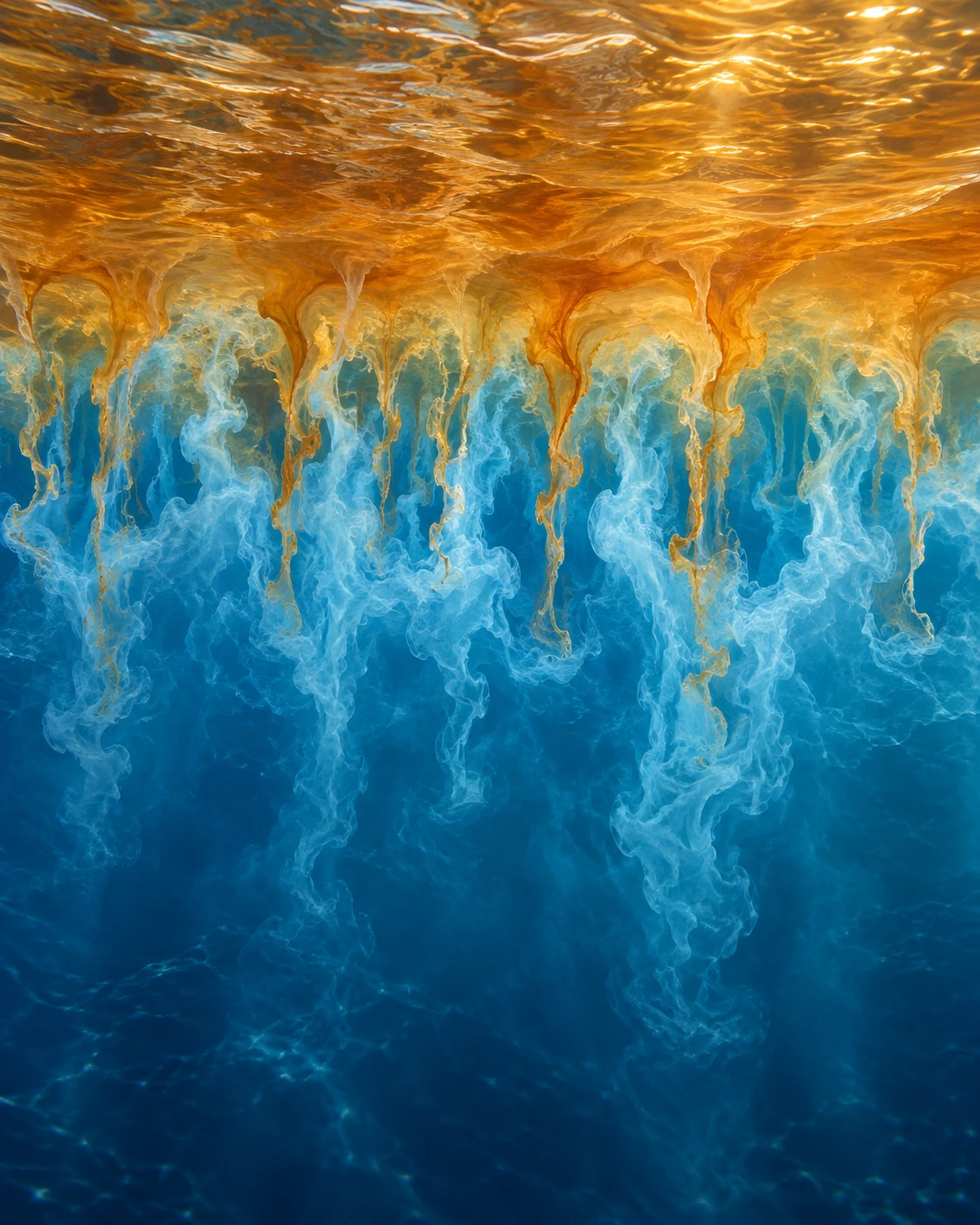
Stability depends on which exchange you allow
This is the core of salt fingering, one form of double-diffusive convection. “Double” refers to two contributors to density that spread at different molecular rates. Heat diffuses much faster than salt in water, so an initially stable arrangement can develop smaller-scale motions.
A descending warm, salty parcel can lose heat and become denser than nearby water. A rising cold, fresh parcel can gain heat while retaining a relative lack of salt. Narrow interleaving motions can grow under suitable conditions. The colors in the illustration make those processes legible; ocean water does not separate into amber and blue substances.
A WHOI account of its Atlantic tracer experiment explains the large contrast between heat and salt diffusion and connects the small structures to measurable mixing. The important statement is about rates of exchange, not salt sinking independently as little solid threads.
Give a parcel a simpler ocean
The model below calculates only a parcel’s approximate density contrast. It is not a simulation of fingers. Start with a parcel 4°C warmer and 0.5 practical-salinity units saltier than the reference water. In the chosen linear approximation, that parcel is about 0.43 kilogram per cubic metre lighter.
Change a parcel’s buoyancy
Adjust temperature, salinity and heat exchange; inspect a linear density budget without pretending to calculate a mixing flux.
Now remove three quarters of its temperature excess while holding its salt contrast fixed. The example becomes about 0.18 kilogram per cubic metre denser than the reference. Nothing magical happened to the salt. The two competing contributions to density changed unequally.
These are original illustrative inputs with constant coefficients. Real seawater’s expansion and salinity effects vary with temperature and pressure, and salt also diffuses. The calculation cannot predict the growth rate, size or mixing efficiency of a real finger. It isolates one step in the mechanism so that the sign change is easy to inspect.
A staircase in a profile
Some ocean regions contain a thermohaline staircase: relatively well-mixed layers separated by sharp interfaces in temperature and salinity. Salt-finger activity can be concentrated at those interfaces. It is a structure in a vertical water profile, not a staircase on the seafloor.
The WHOI experiment near Barbados released tracer around 400 metres deep and revisited it nine months later. Its vertical spreading, considered with microstructure measurements, supported substantial mixing associated with salt fingers. The interpretation drew on several observations rather than on the visual appearance of a layered profile alone.
The original review by oceanographer Raymond Schmitt gives the wider physical framework for double diffusion. It helps distinguish salt fingering from the other common arrangement, in which colder, fresher water overlies warmer, saltier water and a different type of double-diffusive behavior may occur.
Do not make every small staircase into the same result
Observations of a daytime thermocline in the northeastern Arabian Sea examine salt-finger conditions in a much shallower and more rapidly changing setting. Such work extends the question beyond a permanent deep staircase. It does not mean that the Barbados flux estimate can be applied unchanged to the upper ocean everywhere.
Shear, ordinary turbulence, rainfall, solar heating and changing currents can alter or erase the conditions that fingers need. Recognizing a possible instability is therefore different from measuring its contribution to the local heat or salt budget.
Three checks for a double-diffusion claim
- Find which layer is warmer and which is saltier. A density profile by itself hides that competition.
- Ask whether the proposed mechanism is salt fingering or another double-diffusive arrangement.
- Look for a flux estimate, tracer result or microstructure evidence before translating a pattern into a mixing rate.
The fascination lies in the scale change. A water column can resist bulk overturning while permitting small parcels to exploit unequal exchanges. A seemingly stable arrangement can therefore contain an active, carefully constrained route to mixing.
Sources and further exploration
- WHOI: Salty Staircase in the Atlantic
- Schmitt: Double Diffusion in Oceanography
- Scientific Reports: Salt fingers in a diurnal thermocline
Explore all 80 new articles · Browse the complete illustrated collection
Keep exploring at Incoprea.