The white material looks like ice, yet its identity depends on a guest. Water molecules form a crystalline cage structure that can host gas molecules, commonly methane. Change the conditions enough, and the same location may no longer support that solid.
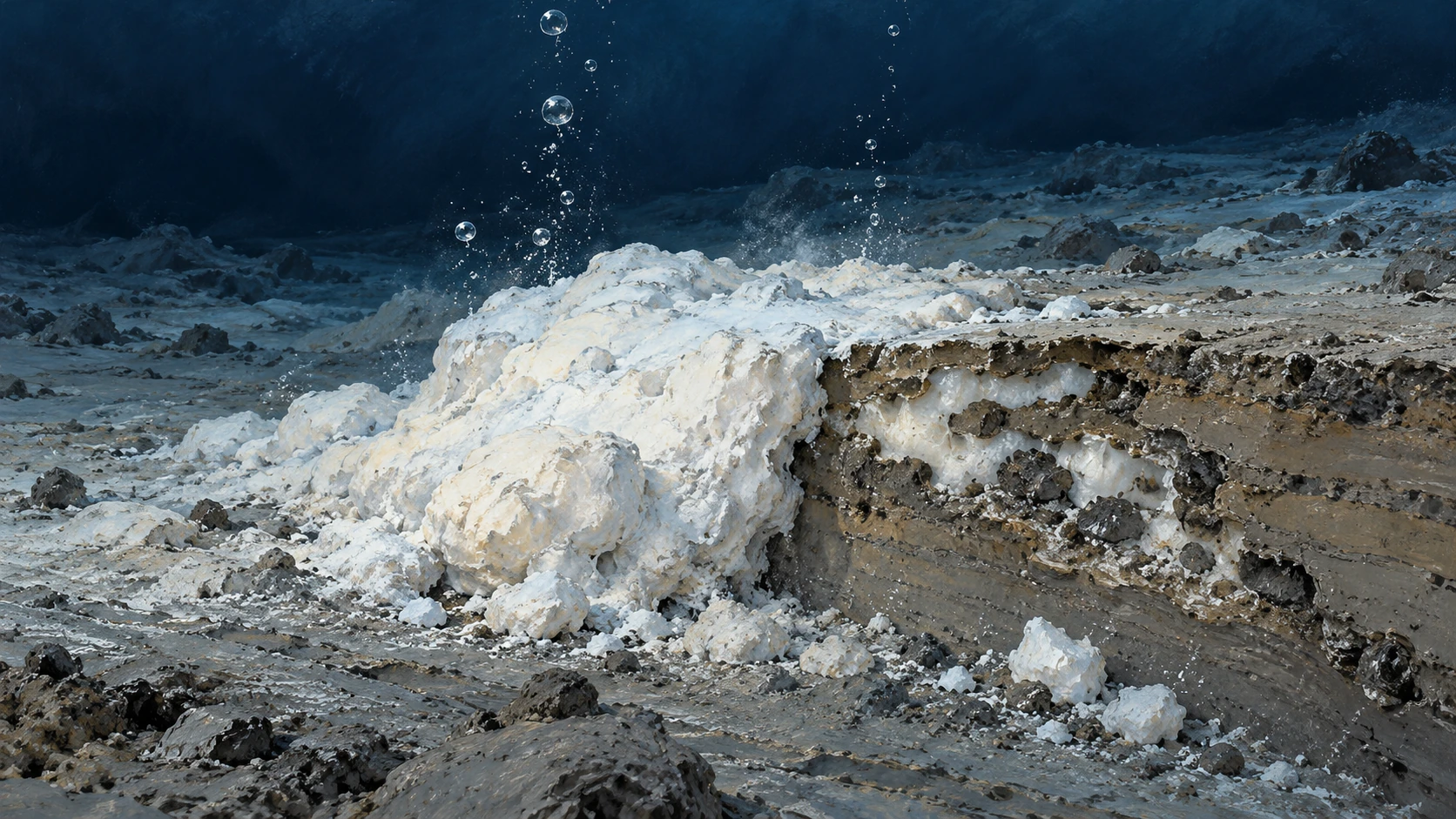
Methane hydrate is often introduced as “burning ice.” The nickname captures the gas content but skips the part that makes it geologically interesting: its stability occupies a particular region of pressure, temperature and composition. Its address is conditional.
A suitable address is not proof of a resident
The USGS gas-hydrate primer describes methane molecules occupying sites within a water-molecule lattice. Much of Earth’s hydrate occurs within marine sediments near continental margins, with additional settings associated with permafrost. It is generally not a giant exposed slab across the deep seafloor.
Depth affects pressure, and sediment temperature tends to increase downward. Their combination can define an interval where hydrate is stable. The interval shifts with water temperature, geothermal conditions, pore-water salinity and the gas mixture.
Even inside that interval, sufficient methane and water must be available. Stability tells us a phase could persist under specified conditions. It does not tell us that the required material supply exists, nor that every pore is filled.
Why “warming makes it vanish” is an incomplete model
A review of formation and breakdown timescales by Ruppel and Waite separates thermodynamic stability from the rates of heat transfer, mass transfer and reaction. A phase boundary can move while a deposit responds more slowly or unevenly.
Hydrate can dissociate into gas and water, but dissolution into surrounding water is also important. Transport can move methane elsewhere, where new hydrate may become possible. A realistic story therefore follows material and energy through the sediment instead of erasing all solid instantly when a threshold is crossed.
Consider an original analogy: a map shading where snow can survive is not a map of snowfall, snow depth or melt rate. The analogy is limited, but it exposes three distinct questions that a single “hydrate stability” map cannot answer by itself.
Follow the methane through four boundaries
The most consequential confusion is between methane leaving hydrate and methane entering the atmosphere. Those events can be separated by sediment, a water column and multiple chemical pathways.
| Observation | What it supports | What remains open |
|---|---|---|
| Hydrate recovered in a core | Solid hydrate at that sample location | Its regional abundance and future response |
| Bubbles above the seabed | Gas crosses the sediment–water boundary | Its source and the fraction reaching air |
| Dissolved methane in water | Methane is present in the sampled water | Transport, oxidation and gas exchange |
| Sea–air methane flux | Transfer across the measured sea surface | How much originated from hydrate |
The table is a reading aid, not a ranking of instruments. Each measurement addresses a different boundary. Combining them can close an argument that none could settle alone.
Missing the atmosphere does not mean having no effect
The USGS environmental research overview emphasizes methane dissolution and transformation in the water column. Microbial oxidation can convert methane to carbon dioxide and affect oxygen and acidity. Those processes change the environmental consequences even when the original methane does not reach the air directly.
A Cascadia-margin research expedition combined bubble measurements, water chemistry, pore-water observations and oxidation-related work. That mixture of methods is revealing: attributing a seep to hydrate breakdown requires more than locating a bubble plume near a theoretical stability boundary.
There is real uncertainty about hydrate inventories, local sediment properties, future warming and the pathways methane takes. Uncertainty is not a reason to replace a budget with either a catastrophe story or a dismissal. It is a reason to specify which reservoir, timescale and boundary a claim concerns.
One question that improves a headline
When an article says “methane was released,” ask: released from what, into what, and measured over which interval? A solid-to-pore-water transfer, a seabed seep and an atmospheric emission are not interchangeable quantities.
The cages are only the beginning. Understanding hydrate means following the conditions that permit it, the supplies that build it, and the routes taken by its methane when those conditions change. The interesting science is the journey between those stages.
Sources and further exploration
- USGS: Gas Hydrates Primer
- Ruppel and Waite: Hydrate formation and breakdown timescales
- USGS: Gas Hydrate and the Environment
- USGS: Seafloor Methane Seeps at the Edge of Hydrate Stability
Explore all 80 new articles · Browse the complete illustrated collection
Keep exploring at Incoprea.