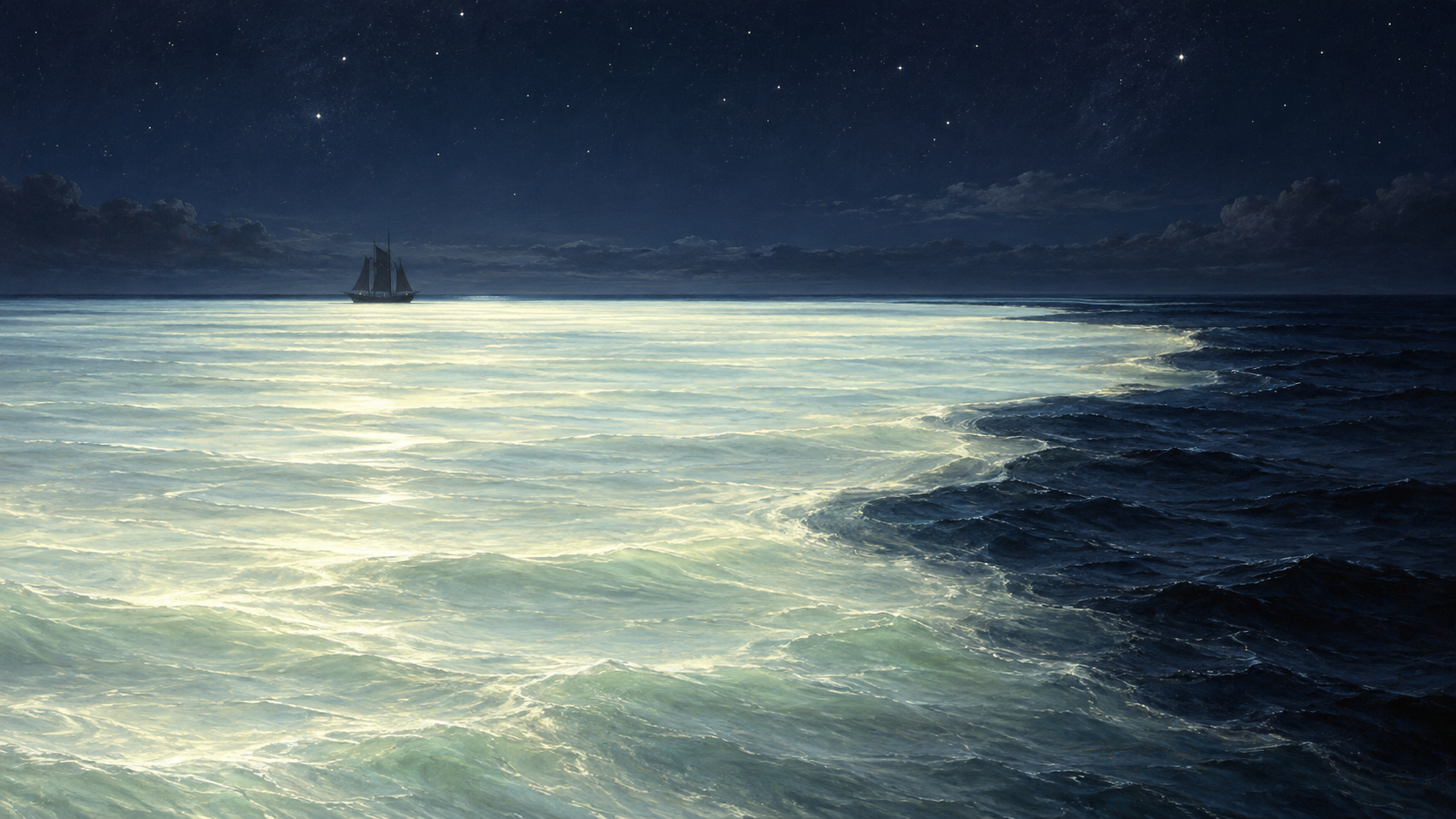
A sailor expects darkness beyond a ship's lights. Occasionally, the sea supplies its own illumination: a vast, pale surface glowing steadily toward the horizon. These rare displays are called milky seas. They can make the ocean appear white or softly greenish, as though an enormous light were hidden beneath it.
The effect differs from the brief blue flashes stirred up in many bioluminescent waves. A milky sea is reported as broad and comparatively uniform, persisting without needing every patch of water to be disturbed. That difference suggests a different biological mechanism.
A bacterial explanation with open questions
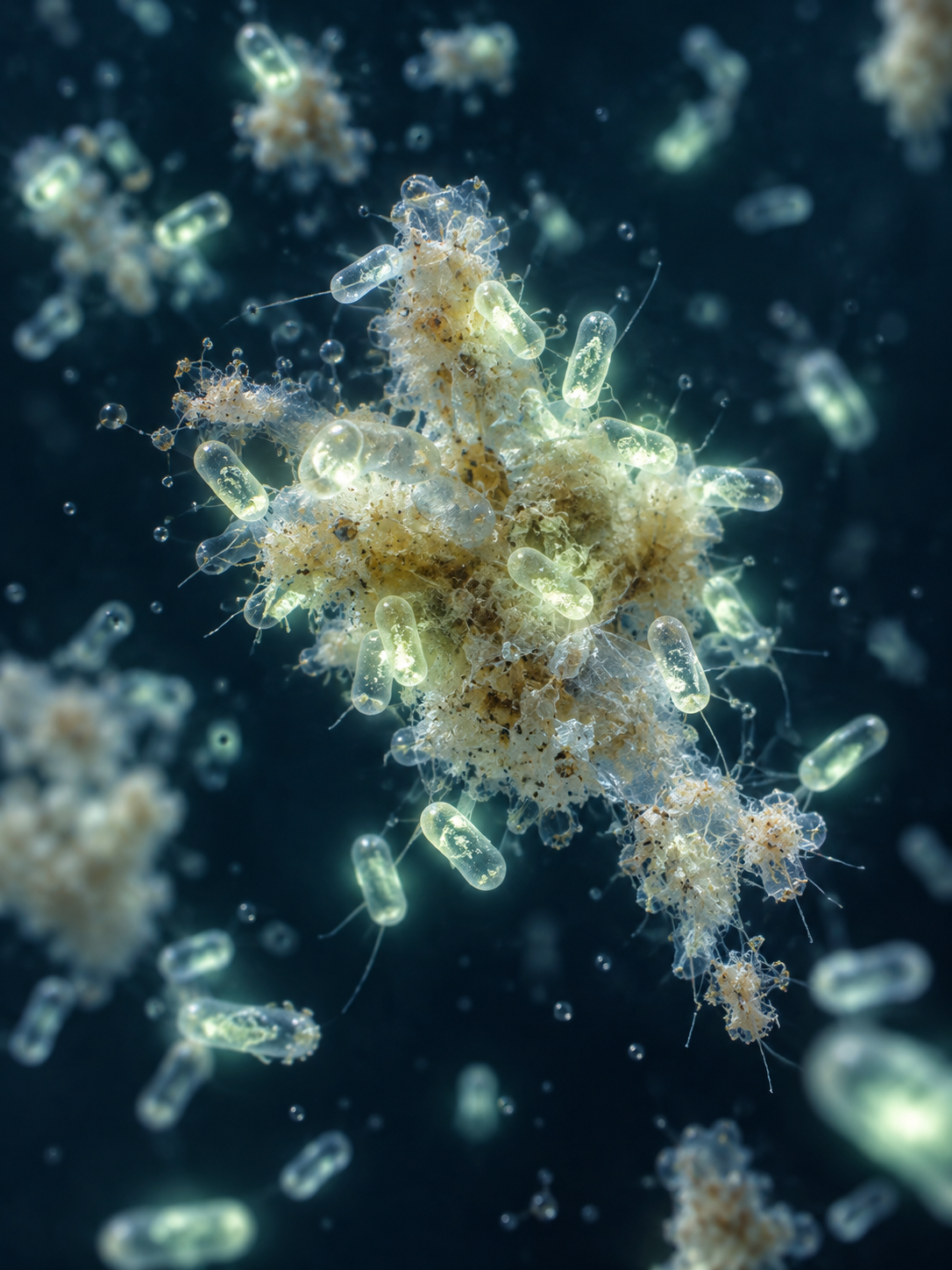
Luminous bacteria are the leading explanation. Unlike dinoflagellates that commonly flash in response to motion, some bacteria can produce a sustained glow. Their light production can depend on population density and chemical signaling, a process known as quorum sensing.
Researchers have proposed that bacteria associated with concentrated organic material, including algal blooms, could supply enough light collectively to create a milky sea. Limited historical sampling supports the bacterial idea. But the exact organisms, structure and conditions of most events remain uncertain.
A steady glow is a clue about time
Imagine watching the same small patch of water for a minute. Does it brighten only after a ripple or splash, then fade? Or does the background remain luminous between disturbances? Both observations concern marine light, but their timing gives investigators a way to distinguish processes that a single photograph may make look similar.
The bacterial explanation involves coordinated biological activity, rather than millions of cells receiving a simultaneous command from a ship. Chemical signals can accumulate within dense bacterial populations and affect light production. Scaling that process from a colonized particle to a large, persistent ocean region is the unresolved ecological problem. Knowing how a cell can glow is not enough to explain why a whole water mass does so.
The researchers' proposed “natural flask” offers a useful image. Relatively isolated water with suitable conditions might maintain a luminous community, as a vessel maintains a laboratory culture. It remains a hypothesis about organization in the sea, not a literal membrane surrounding the observed patch. Currents, nutrients and the vertical structure of the water all become relevant to testing it.
A sailor's story meets a satellite
Specialized low-light satellite instruments have changed the investigation. A 2021 study used a sensor known as the Day/Night Band to locate twelve candidate events between 2012 and 2021. The observations let researchers follow bright regions across successive nights and compare them with currents and other environmental information.
One striking event south of Java in 2019 covered more than 100,000 square kilometers in satellite observations. Researchers later learned that the yacht Ganesha had crossed the glowing water. Its crew supplied recollections, navigation information and photographs that could be compared with the satellite record.
Their report described a mostly steady glow and a dark bow wave, rather than a brighter splash at the bow. That contrast helped distinguish the encounter from the familiar disturbance-triggered light of many dinoflagellate displays.
Build the case from three records
Start with the yacht's reported course. A vessel encounters one route through an event, with a time, position and limited horizon. Satellite images add the broader luminous shape on nights when the sensor and viewing conditions permit it. Comparing the two can establish whether the crew's experience and the remote signal belong to the same region.
Then add photographs carefully. A camera's exposure and processing affect how strongly a soft glow appears. The images can preserve valuable features and provide corroboration without being a direct copy of the crew's night vision. Reports that the bow wave appeared darker than the surrounding water are especially interesting because they concern a relationship within the scene, rather than a single claimed brightness.
The third record would be a deliberately collected biological sample. Which organisms are present? Does a sample glow steadily when left undisturbed? How does its behavior change with depth, time or position near the region's edge? These questions connect the luminous pattern to the living system producing it. The satellite cannot answer them simply by resolving the shape more sharply.
Use those three records as a checklist while reading the linked studies. Identify what was actually available for each event and which conclusions rely on an explanation transferred from earlier sampling. The investigation is strongest when a missing observation remains visibly missing. That gap is also the reason improved detection from space matters: locating an event while it persists could make the much harder work of sampling it possible.
The missing laboratory is the ocean
Matching a vessel's experience to a satellite signal is a valuable step. It gives investigators greater confidence that they are recognizing the same phenomenon across very different scales. The next challenge is to connect that recognition with timely sampling of living communities.
Milky seas are hard to study because research ships cannot simply summon one. A satellite can help identify where to look, but a detailed biological explanation still requires measurements in the water, with attention to how conditions change.
Sources and further reading: Miller et al.: Honing in on milky seas from space · Miller: The 2019 Java boat encounter · Colorado State University: Satellite investigation of milky seas · Miller and colleagues: Full open text of the satellite investigation