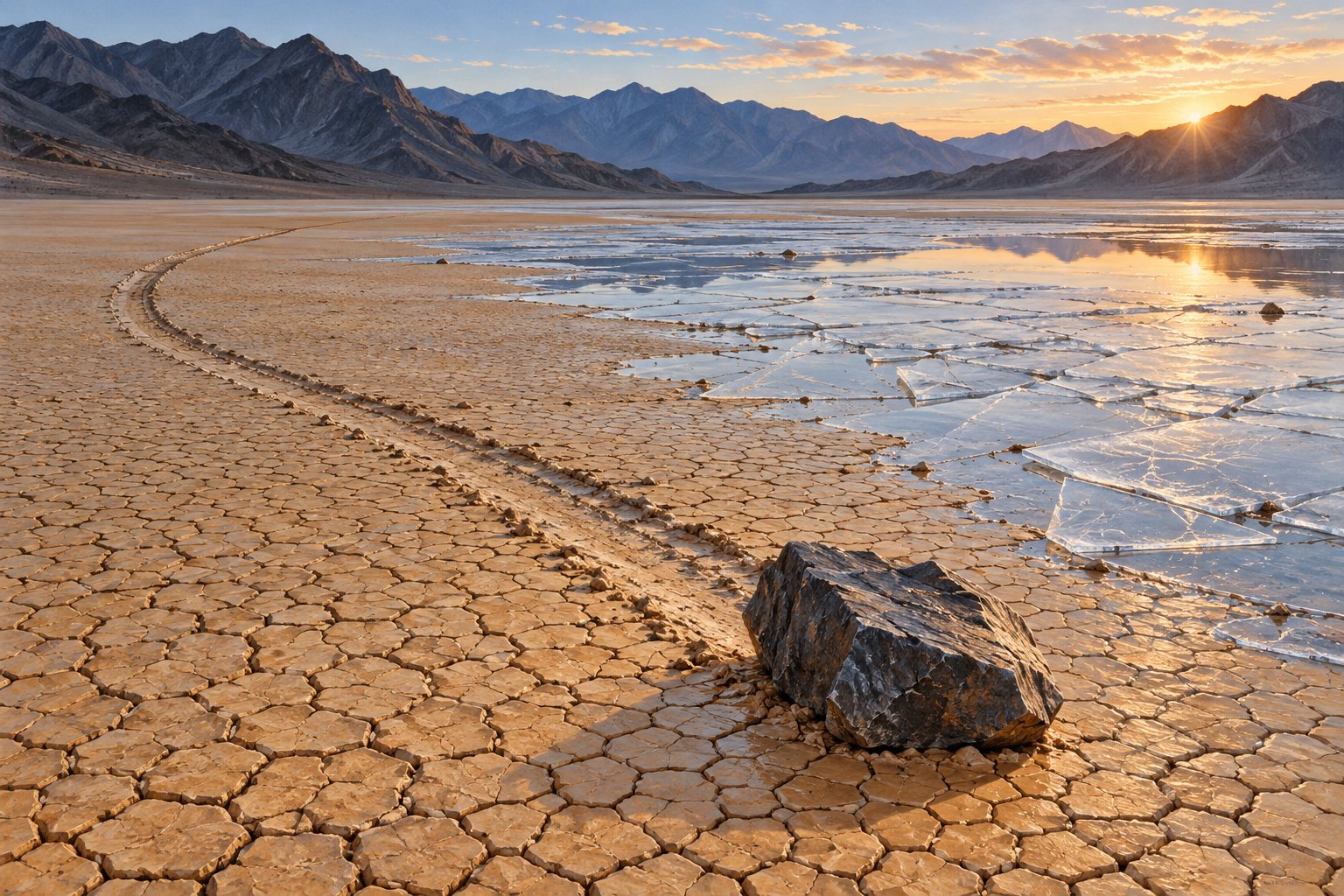
A rock rests on a cracked desert lakebed. Behind it stretches a long groove, sometimes straight, sometimes turning as if the stone had changed its mind. There are no footprints and no obvious hill. At Racetrack Playa in Death Valley National Park, the scenery seems to have misplaced one of the basic rules of geology: rocks are supposed to stay where you leave them.
The stones really do move. The interesting part is that their journeys depend on conditions almost opposite to the blazing heat most people associate with Death Valley. A rare winter arrangement of water, ice and modest wind can turn an apparently motionless desert into a slow conveyor.
A desert with a temporary winter skin
In December 2013, researchers Richard and James Norris witnessed rocks moving across a shallow pond on the playa. Their experiment used weather instruments, time-lapse cameras and stones fitted with GPS equipment. The research, published in 2014, replaced a collection of plausible stories with direct measurements.
First, rain must leave water deep enough for floating ice to form, yet shallow enough for stones to protrude above the surface. A cold night freezes a thin sheet. Sunshine then weakens and fractures that sheet into broad panels. Wind pushes the floating panels, which can press against rocks and slide them through the soft mud.
The ice was only a few millimeters thick. The observed winds were roughly 3–5 meters per second, a breeze rather than a hurricane. A large panel spreads that gentle push over a substantial area. It need not lift a stone or wrap it in a thick icy jacket to help move it.
A journey too slow to notice
During the recorded events, rocks typically traveled at only a few meters per minute. Some movement episodes lasted seconds; others continued for several minutes. Several stones could move together, leaving roughly parallel tracks, while changing ice conditions could produce turns and differences in direction.
That creates an unusual problem for an observer: the evidence can be obvious afterward, while the event itself is easy to overlook. If surrounding rocks are also moving, there may be little visual reference for judging the motion. A dramatic-looking trail can record an undramatic afternoon.
The tracks deserve to stay mysterious-looking
The observations explain how many trails form, while leaving room to investigate different rocks and different winters. An explanation does not make the scene ordinary. It reveals an unexpectedly delicate mechanism, in which a tiny thickness of ice helps rearrange substantial pieces of landscape.
The playa is also fragile. Footprints and vehicle marks can persist, and moving stones erases the very evidence visitors come to see. The best encounter is a patient one: look at the trail, imagine the vanished pond and ice, and let the rock keep its place until the next brief winter journey.
Sources and further reading: National Park Service: The Racetrack; Norris et al., PLOS ONE: First observation of rocks in motion.
Explore more creative curiosities at Incoprea.