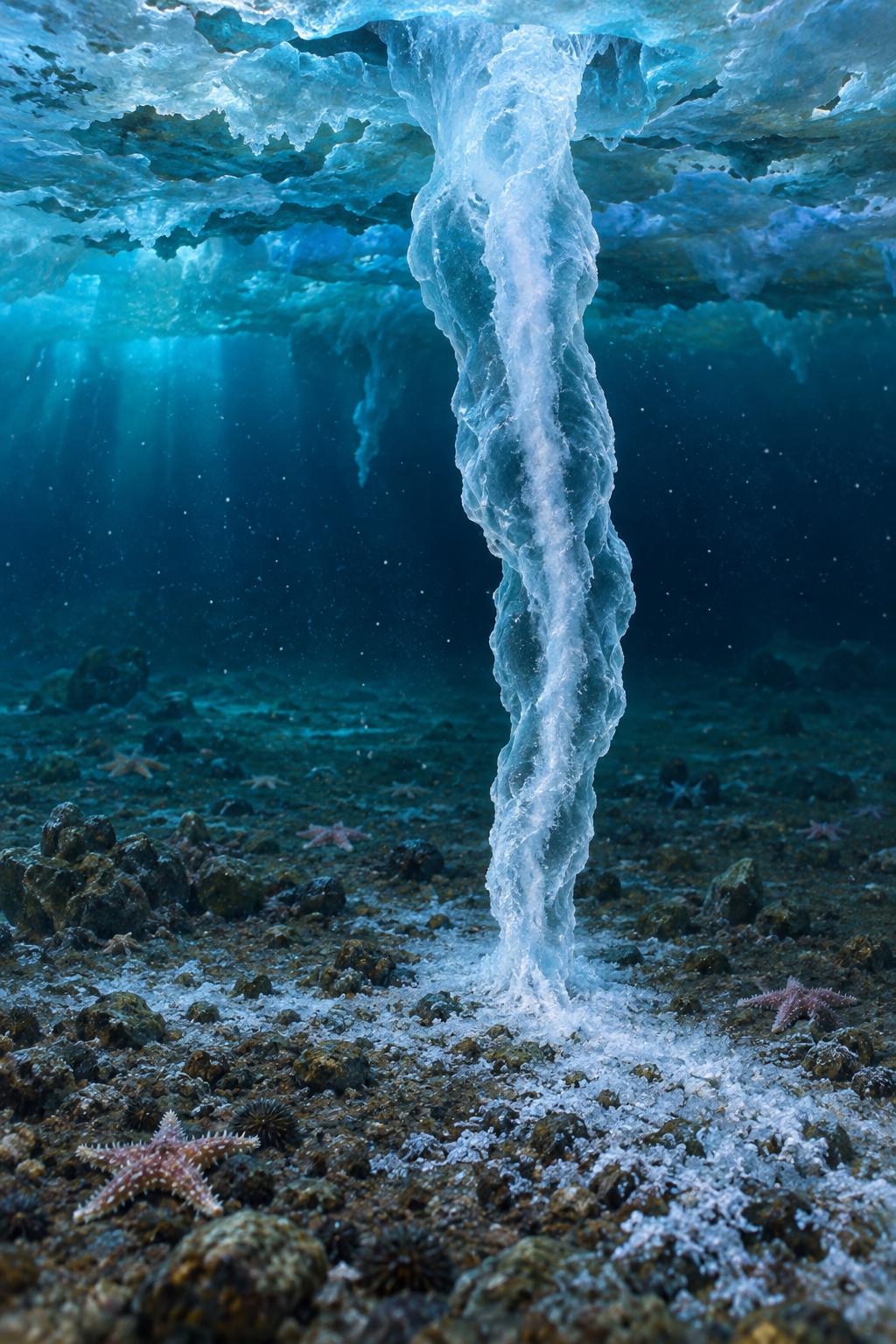
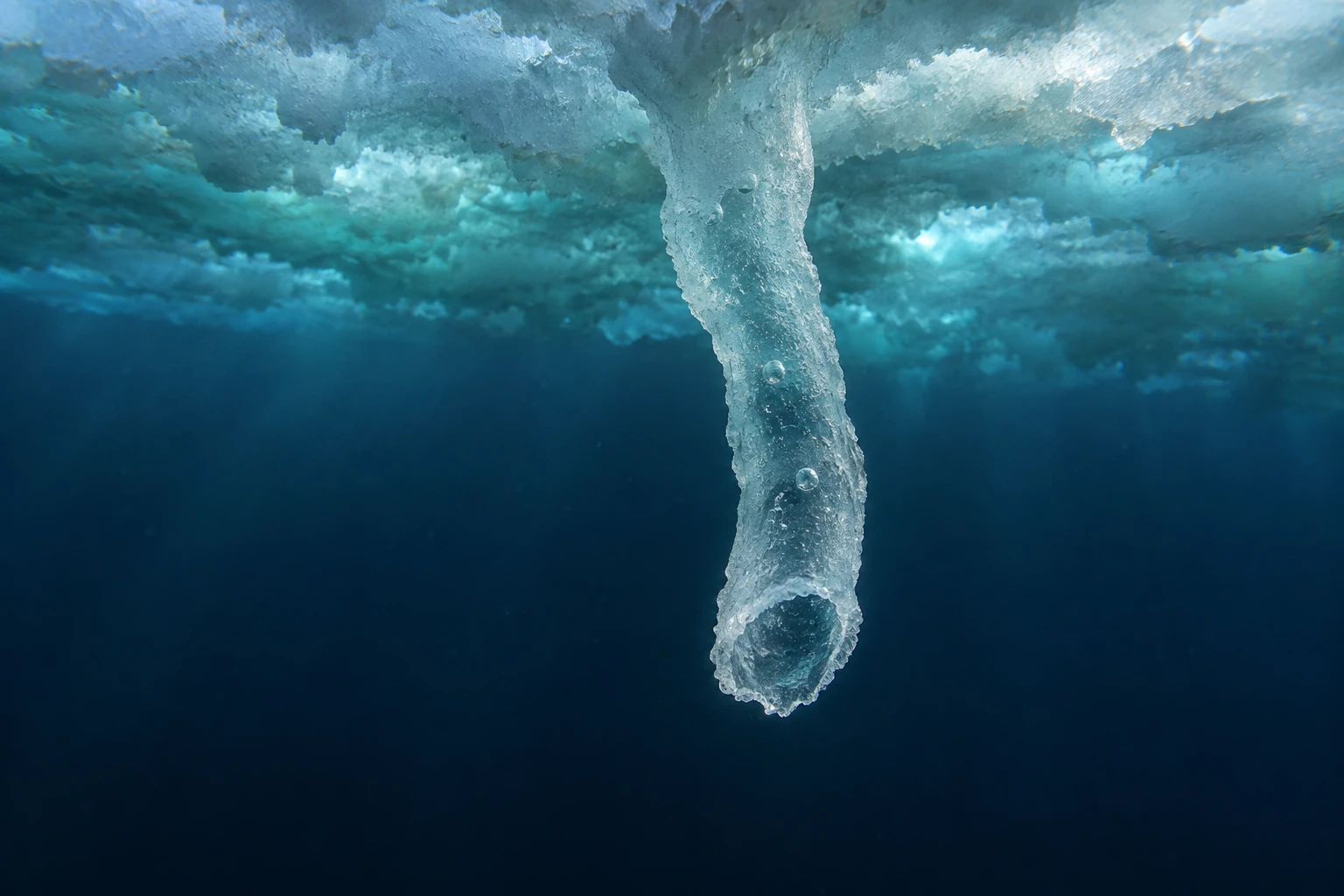
Imagine an icicle growing underwater. It hangs from the underside of sea ice and reaches down into seawater, forming a pale tube around an invisible descending stream. This structure is a brinicle, and it is one of the stranger architectural tricks that salt and cold can perform together.
Its familiar nickname, an underwater “ice finger,” captures the shape. More dramatic names can make it sound like a creature hunting the seabed. The real process is physical rather than purposeful: water freezes around concentrated brine draining from the ice overhead.
Freezing makes a salty problem
As seawater freezes, the developing ice excludes much of its salt. The remaining liquid becomes a concentrated brine threaded through channels and pockets in the ice. That brine can be colder than the surrounding seawater while remaining liquid, because dissolved salt lowers its freezing temperature.
It is also denser, so when it escapes from the underside of the sea ice it sinks. The extremely cold plume can freeze the less salty seawater touching it. An icy sleeve develops around the flow, extending downward as more brine passes through. The result is a hollow tube, not a solid spear falling through the ocean.
Why colder liquid can remain liquid
The brinicle's apparent contradiction comes from comparing two different solutions as though their freezing conditions were identical. Concentrated brine can remain liquid at a temperature where less salty surrounding water can freeze. The cold stream therefore need not freeze first merely because it is colder.
As the two meet, heat flows from the relatively warmer seawater toward the colder brine. Under suitable conditions, surrounding water freezes into a wall. The brine continues through the channel it helps produce. A hollow tube is the visible record of this heat exchange and of the continuing supply from above.
Imagine interrupting that supply. The existing tube does not contain a secret engine that must keep lengthening. Its growth depends on the thermal and flow conditions at the advancing end and along its walls. The structure is better understood as an evolving boundary around a flow than as an ordinary icicle that happens to point down underwater.
Salinity, temperature and flow have different roles in this explanation. Salt changes freezing behavior and contributes to the brine's density; the temperature difference makes freezing of surrounding water possible; the flow carries the cold solution through the structure. Removing any one from the description can make the remaining process sound mysterious again.
A garden growing upside down
Researchers have compared this process with “chemical gardens,” laboratory structures in which mineral tubes build themselves around flowing solutions. Ordinary chemical gardens often grow upward because the internal solution is lighter than the surrounding liquid. In a brinicle, dense brine goes downward and the wall is ice, making it an inverted cousin of that phenomenon.
The comparison is useful because it connects a striking polar scene with broader questions about self-organization. Nature can build a narrow channel without a designer, mold or excavator. A difference in composition and temperature provides the machinery.
Watch a laboratory analogue with the variables in view
The 2024 experimental paper includes video material and compares several ways of growing analogous tubes. Before watching, make a short list of what the experiment can control: the solutions supplied, their temperatures, the point where a flow enters and its rate. In the field, these conditions can vary beneath an irregular ice sheet and are harder to measure continuously.
Choose one feature to follow, such as the position of the lower tip. Then notice whether the wall stays continuous and whether branching or irregular growth appears. A time-lapse can make a slow process look decisive, so check the accompanying timing before inferring how fast the natural structure would develop.
An analogue is valuable because it lets researchers test relationships repeatedly. It is not a complete polar ocean reduced to a glass container. Differences in scale, boundaries and supply conditions remain part of the interpretation. Compare the stated experimental method with the natural mechanism rather than judging realism only from a similar silhouette.
The same discipline applies when the discussion moves to icy moons. An Earth experiment can show how a particular brine and temperature arrangement builds a membrane. Extending it to another world requires information about that world's ice, ocean composition and conditions. A plausible chemical setting can motivate a search without establishing that the structure or a living community is actually present there.
An earthly clue for distant oceans
A brine flow that reaches the seafloor can freeze water along its path, affecting small animals unable to move away quickly. That local impact is real, but it does not turn every brinicle into a sweeping underwater catastrophe. Its scale and fate depend on the surrounding environment.
Brinicles have also attracted researchers studying icy moons. Scientists have considered whether comparable ice membranes could form where an ice shell meets a salty ocean, and whether their chemical gradients might matter for possible habitats. Those are hypotheses, not evidence that brinicles or life have been discovered on Europa or Enceladus.
Sources and further reading: Cartwright et al.: Brinicles as inverse chemical gardens · Vance et al.: Brinicle properties and icy ocean worlds · Testón-Martínez et al.: Experimental modelling of brinicle growth




