Wednesday, October 14, 2026

Silbo Gomero: A Sentence Whistled Across a Valley

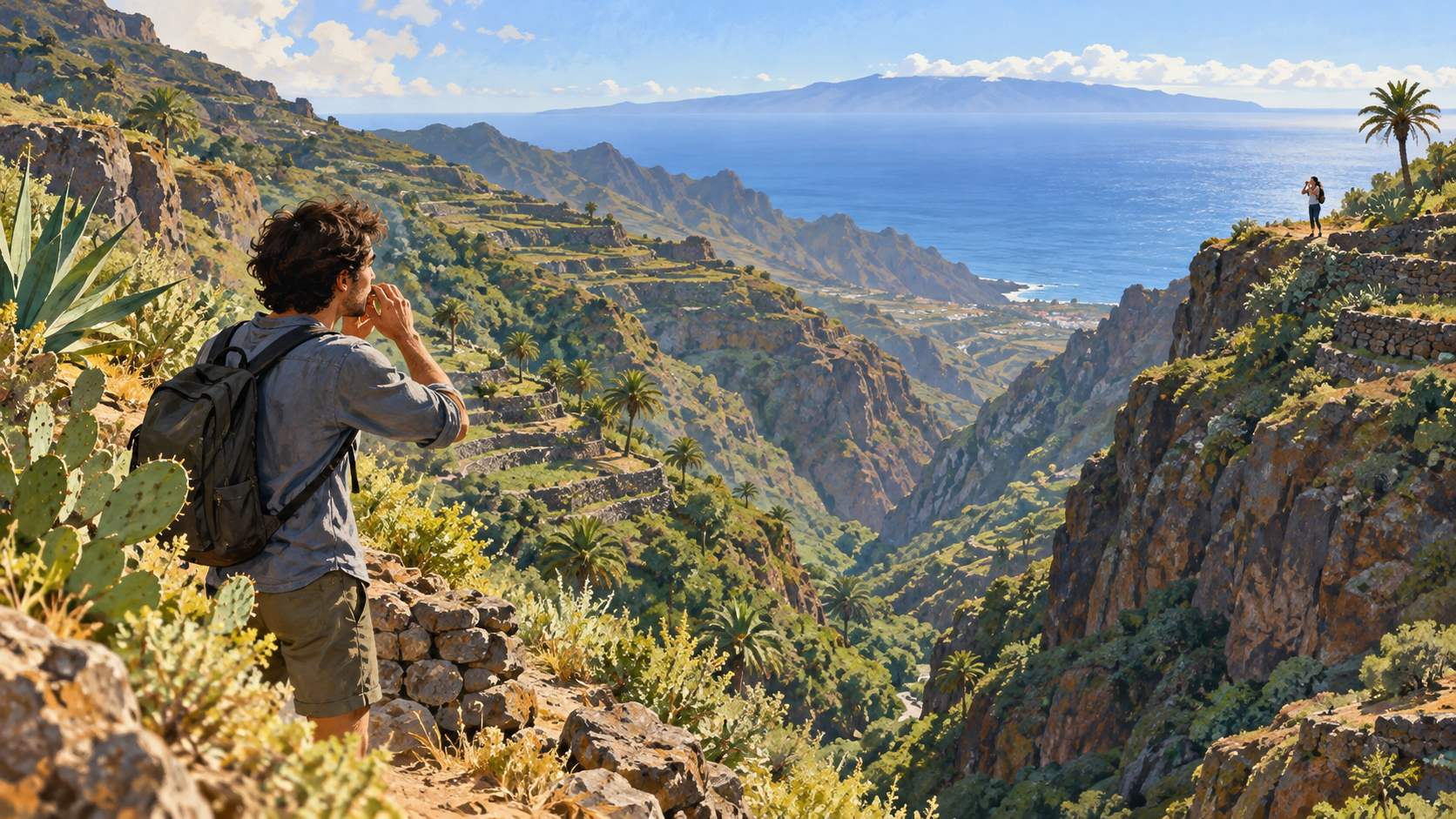
Two people communicate across a deep green ravine in a Canary Islands landscape.
A conceptual scene of whistled communication across La Gomera's terrain, with unnamed figures. Generated illustration.

A whistle can mean “come here,” or it can carry an entire sentence. On La Gomera, one of Spain's Canary Islands, Silbo Gomero turns spoken language into an acoustic form that can travel across steep ravines. What first sounds like a bird call may be someone asking a perfectly ordinary question.

The island's terrain gives the practice a practical setting. A person visible across a valley can still be a long walk away. A clear, carrying whistle creates a connection across that gap, without requiring the speaker and listener to meet.

Speech, compressed into another sound

Silbo Gomero represents the Spanish spoken by islanders through whistled sound. The tongue, lips, and sometimes fingers help shape a tone whose changes carry distinctions from speech. The listener follows patterns and context, rather than translating a separate secret vocabulary.

A whistled signal cannot preserve all the acoustic detail of ordinary speech. Several spoken sounds can converge on a similar whistled form. Work discussed by the Canarian Academy of Language emphasizes this ambiguity: recognition depends partly on what a sentence is likely to mean in its situation.

That is less alien than it sounds. Ordinary conversation also relies on context when a word is muffled, a sentence is interrupted, or several meanings are possible. Silbo makes the listener's interpretive contribution especially apparent.
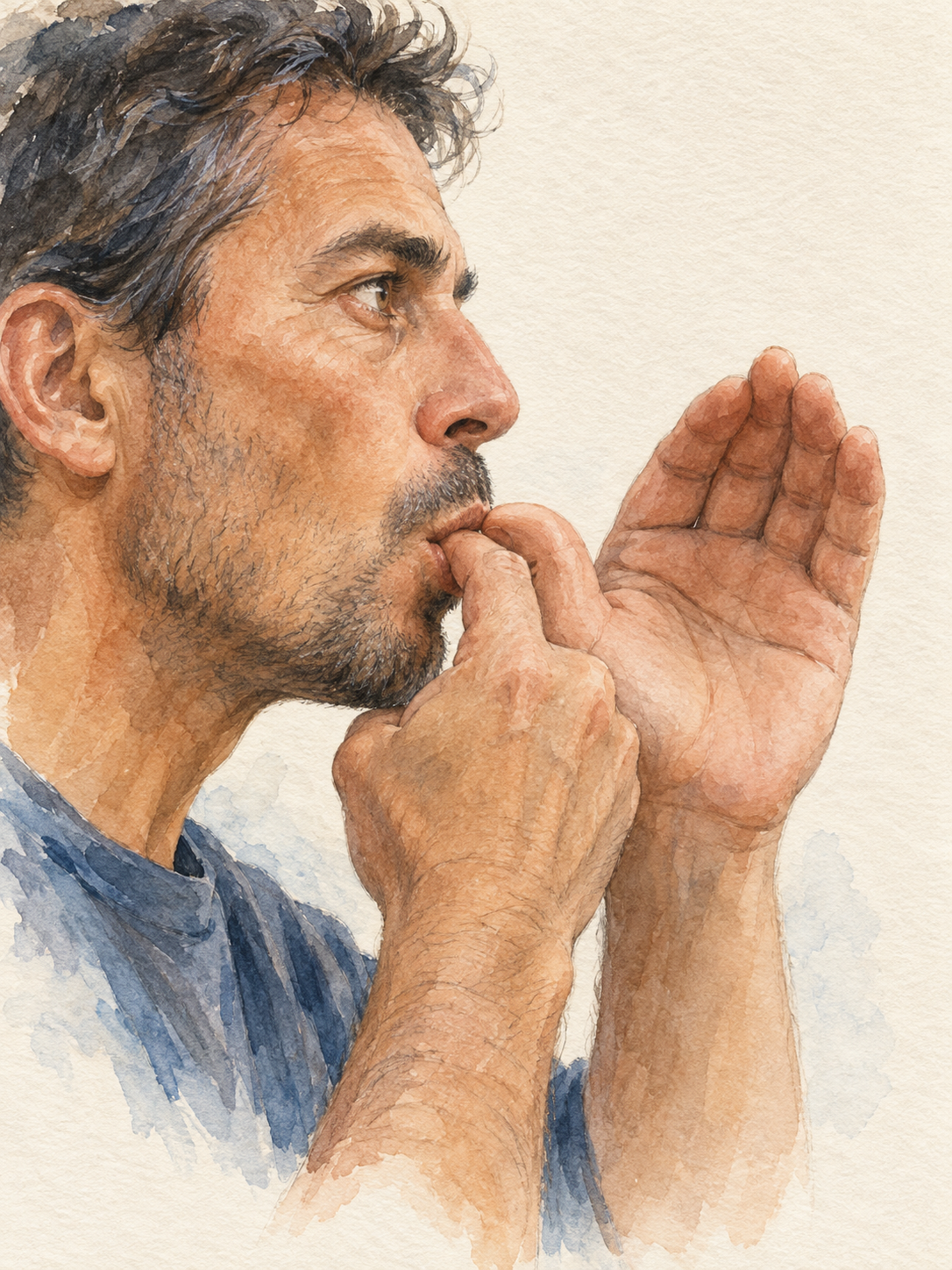
A close artistic study of a whistler's lips and hands.
A conceptual study of a whistling gesture, rather than an exact technique guide or named person's portrait. Generated illustration.

The brain hears more than a noise

A 2005 Nature study examined how proficient users processed Silbo Gomero. Listening to the whistled language activated brain areas normally associated with spoken-language function. The same response was not found in control participants who did not understand the system.

The result illustrates the role of learning. A tone that is merely an intriguing sound to one listener carries linguistic structure for another. Recognizing speech depends on what the brain has learned to extract from a signal, as well as on the signal's physical form.

This does not mean that any whistle is automatically language. The skill belongs to a practiced system shared between communicators. An impressive loud whistle and a fluent Silbo sentence are different achievements.

A tradition needs new speakers

UNESCO inscribed Silbo Gomero on its Representative List of the Intangible Cultural Heritage of Humanity in 2009. Its account highlights school teaching, introduced in 1999, as part of transmitting the practice to younger generations.

A living communication tradition cannot be preserved solely by recording its sounds. People need to learn how to make distinctions, interpret ambiguous messages, and use the skill with others. Teaching creates another setting for a practice whose everyday surroundings have changed.

Silbo is compelling because it asks us to separate language from our usual idea of a voice. The words remain a social exchange, even when their carrier becomes a narrow stream of sound crossing open air. The ravine, the whistle, and the trained listener all take part in making the sentence arrive.

See or hear more: Hear Silbo Gomero in UNESCO's film.

Sources and further reading: UNESCO: Silbo Gomero; Nature: Neural processing of a whistled language; Canarian Academy of Language: Study of Silbo Gomero.

Explore more creative work at Incoprea.

The Persian Qanat: Water Engineering Hidden Under the Desert

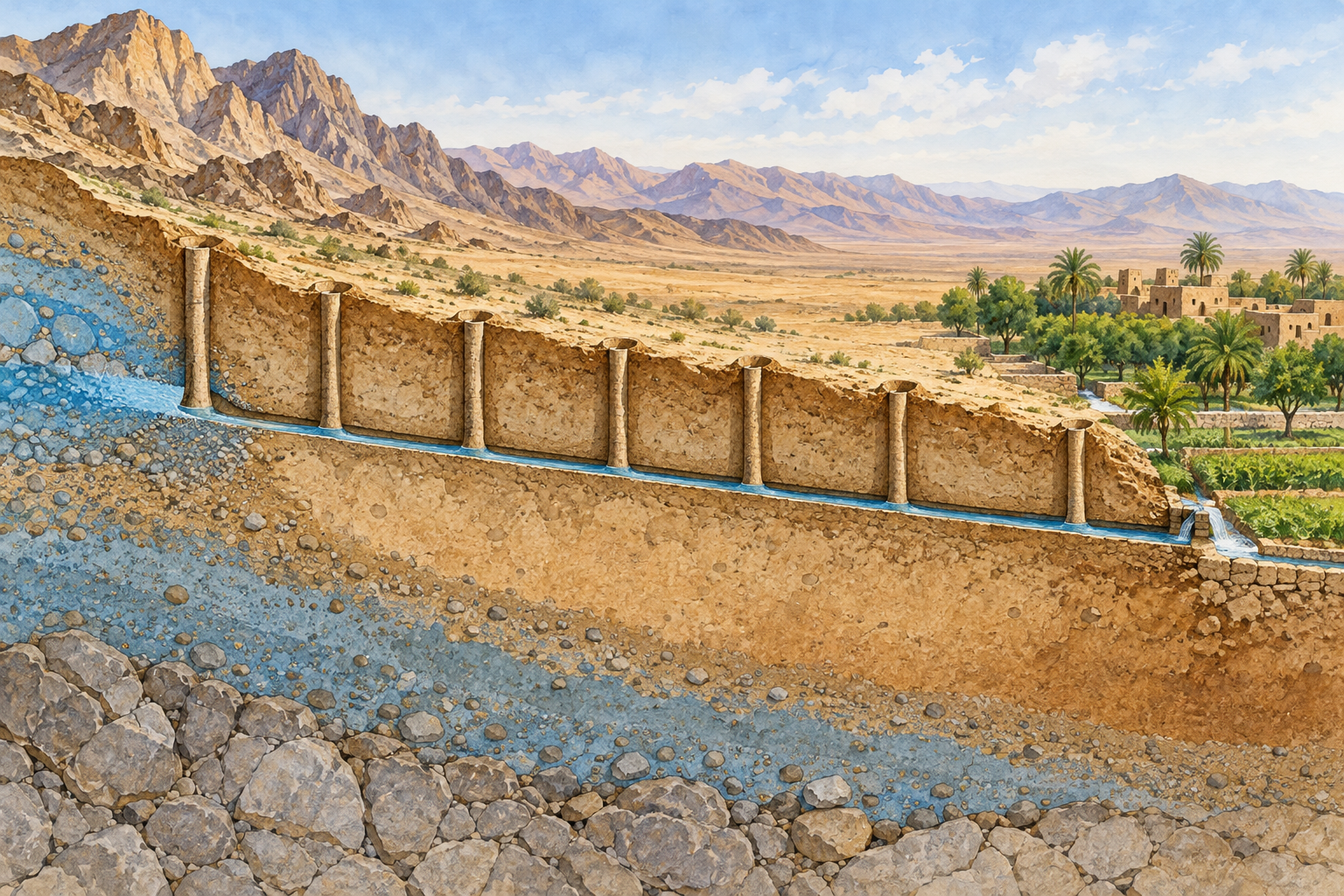
A conceptual underground qanat tunnel and vertical access shafts carry water from high ground to a village garden.
A conceptual qanat cutaway with simplified geology and proportions, rather than an exact site reconstruction. Generated illustration.

From above, a qanat can look like a line of small craters crossing dry land. Beneath those openings lies a carefully graded tunnel, carrying groundwater toward a settlement. The visible holes are only the access points of an engineering system whose essential work happens underground.

Qanats have helped support agriculture and communities in arid parts of Iran for centuries. Their central idea is beautifully economical: reach water in higher ground and arrange a route that allows gravity to deliver it where people need it.

A slope gentle enough to work

A qanat begins by tapping a suitable underground water source, often in an alluvial area near the head of a valley. A deep “mother well” helps establish the source, and a nearly horizontal tunnel leads toward a lower outlet.

“Nearly horizontal” is the important phrase. The tunnel needs a controlled downward gradient. Its level, length, and slope must be calculated in relation to the aquifer and the land surface. A channel that fails to meet those conditions cannot simply wish water uphill.

Vertical shafts along the route allow workers to remove excavated material and provide ventilation and access. Constructing and maintaining the system requires experienced workers and knowledge handed down through practice. The apparent simplicity of the finished flow conceals considerable skill.

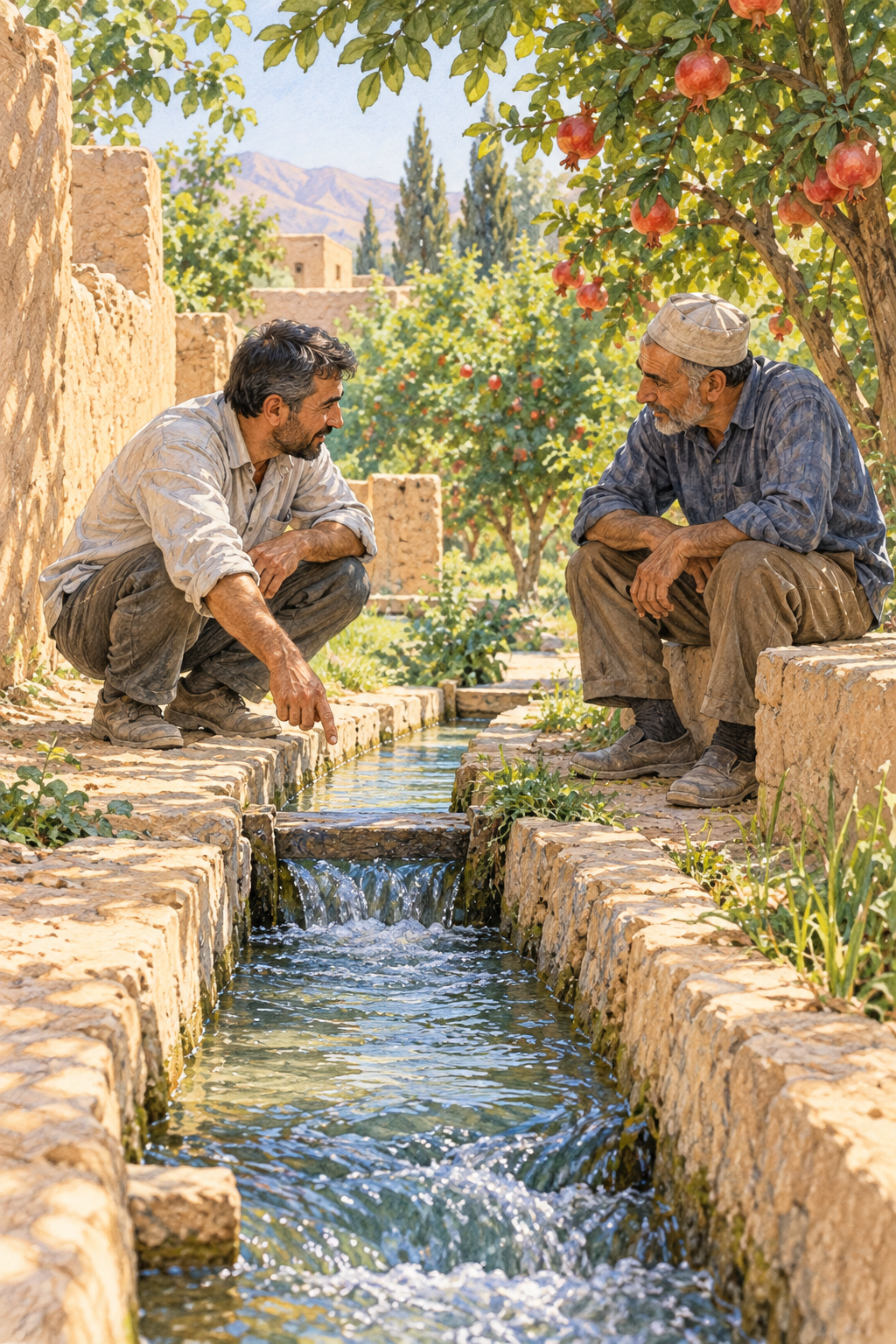
Two farmers discuss water beside an irrigation channel in a pomegranate garden.
An imagined everyday scene of discussion around shared irrigation water, illustrating the social side of qanats. Generated illustration.

The water system includes people

Once water reaches the outlet, channels distribute it to fields and gardens. The supply has to be shared. UNESCO's account of the Persian Qanat emphasizes traditional communal management alongside the physical structures: owners, users, and local councils coordinate the resource.

That social arrangement is part of the technology. A tunnel may transport water successfully while its benefits are distributed badly. A working agricultural system depends on rules, maintenance, trusted measurements, and cooperation as well as on a correctly dug channel.

FAO's account of qanat-irrigated farming around Kashan connects the water supply with crop diversity, livelihoods, and a landscape of gardens. The infrastructure influences what can grow, where people can settle, and how agricultural work is organized.

An old solution with continuing conditions

Underground transport limits the exposure that would allow water to evaporate from an open channel in a hot, dry environment. Gravity also supplies the movement without a pump lifting each volume along the tunnel. These qualities help explain the system's endurance.

They do not make its water supply unlimited. A qanat still depends on its source and catchment, its physical condition, and continued maintenance. UNESCO includes the protection of water catchment areas among the needs of the eleven qanats in the World Heritage property.

The most useful way to appreciate a qanat is as a connection among geology, geometry, and community. Its makers turn knowledge of an aquifer into a flowing line, then turn that line into shared food and settlement. The desert's small openings mark a much larger achievement beneath your feet.

Sources and further reading: UNESCO World Heritage: The Persian Qanat; FAO: Qanat Irrigated Agricultural Heritage Systems; ICOMOS: Persian Qanat World Heritage evaluation.

Explore more creative work at Incoprea.
Marshallese Stick Charts: Learning the Shape of the Sea

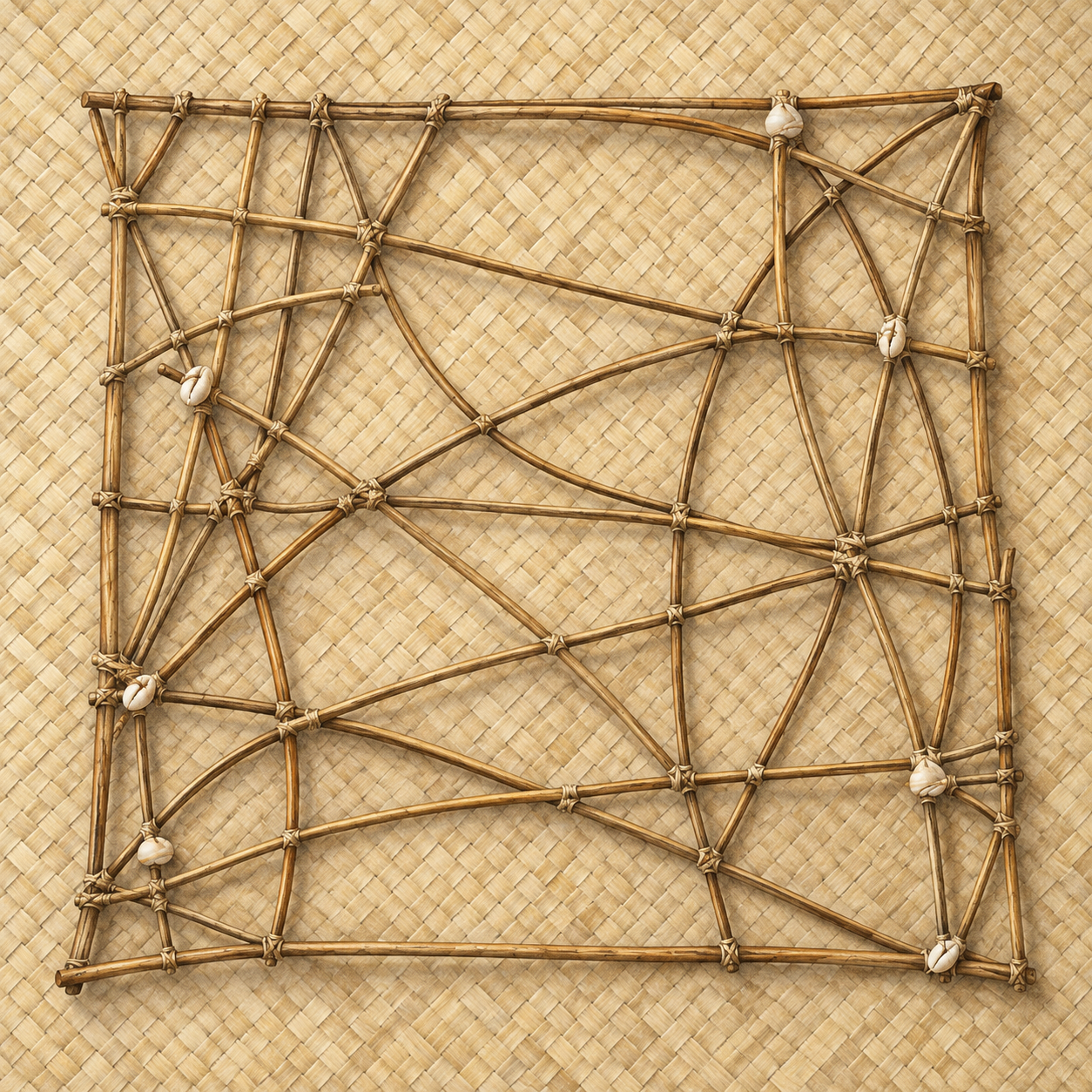
A handmade lattice of curved and straight plant strips with tied shells rests on a woven mat.
An artistic interpretation of a Marshallese stick chart, not a copy of a particular museum object. Generated illustration.

A Marshallese stick chart can look like a delicate piece of abstract art: narrow strips bound together, curves crossing straight lines, and small shells attached at selected points. It becomes more intriguing when you learn that many of its lines concern waves, rather than coastlines.

These objects belong specifically to the navigation traditions of the Marshall Islands in Micronesia. Describing them as generic “Polynesian maps” erases both their geographic setting and the particular expertise that made them useful.

An ocean represented through relationships

The materials commonly include coconut-palm ribs or other plant strips, fiber bindings, and shells. Depending on the chart, shells can mark islands or atolls, while curved and diagonal pieces represent swell relationships and wave behavior. Other strips support the object physically.

Reading it like a modern road atlas misses its purpose. The positions and curves can express information important to a navigator without providing a uniformly scaled picture of every distance and direction. Some charts teach general principles; others help record relationships around particular islands.

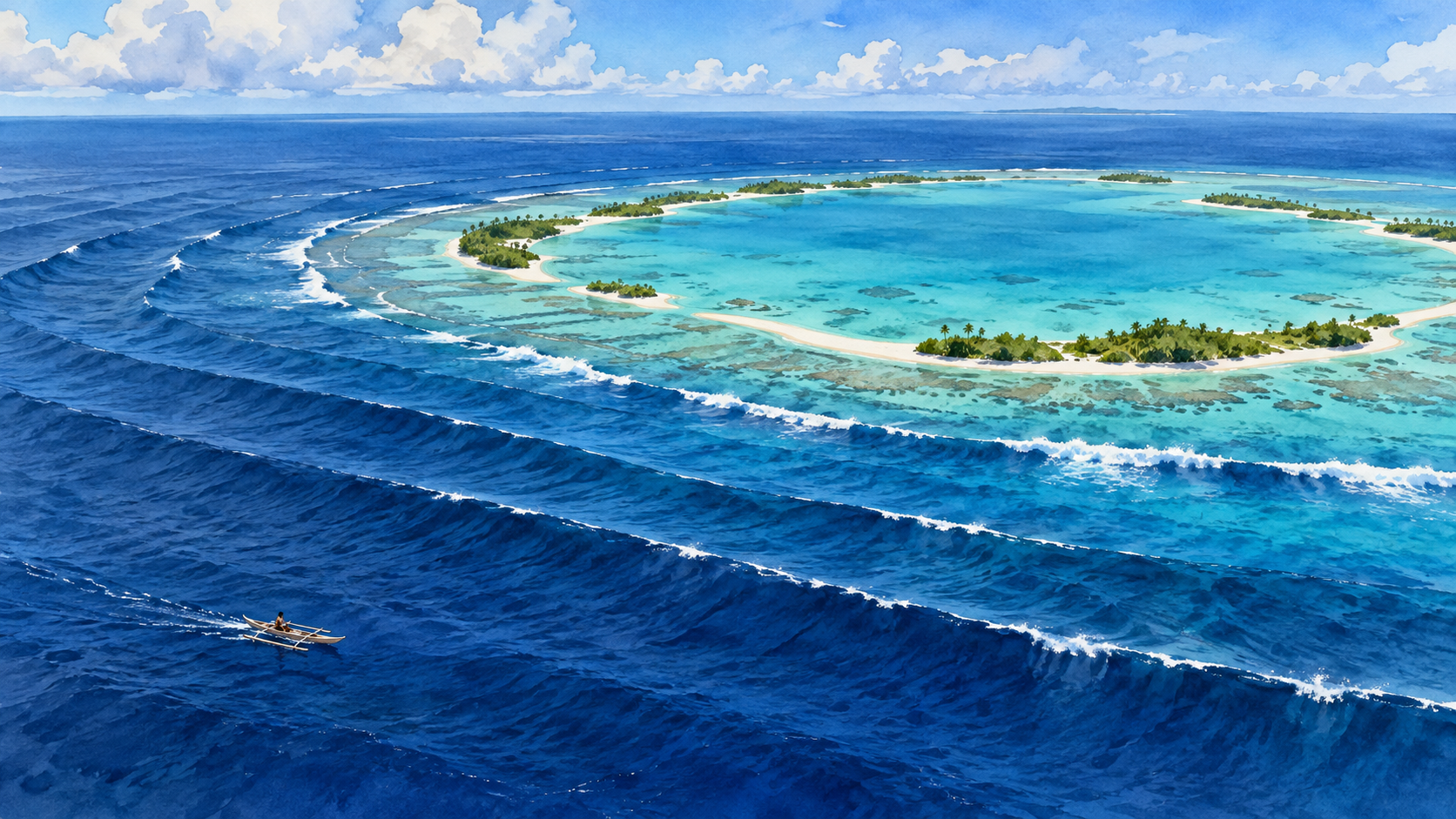
For example, a teaching chart called a mattang can represent how waves behave around land. Reflection and refraction change wave directions, creating patterns that an experienced observer can learn to recognize. The sea contains information beyond the outline of a shore.

Long ocean swells curve around a low coral atoll while a small canoe crosses the foreground.
A simplified atoll-and-swell scene, illustrating relationships rather than providing navigational measurements. Generated illustration.

The chart prepares the navigator

The Smithsonian and British Museum describe these charts as learning and memory aids. They were studied before a voyage, rather than carried as instruments to consult aboard a canoe. The navigator needed to internalize the relevant relationships and interpret the moving environment.

That distinction gives the object a different kind of power. It is part of training perception. A learner can examine a model, discuss it with someone experienced, and then connect its structure with actual wave motion.

Charts could also be personal and difficult for someone else to interpret. Understanding the maker's conventions and the associated instruction matters. A museum can preserve the material object without automatically preserving every piece of knowledge needed to read it.

A different idea of useful accuracy

A familiar map encourages us to ask where a point sits on a flat surface. Marshallese wave knowledge also asks how the ocean behaves around that point, and what a traveler can sense before land becomes visible.

That is a demanding observational skill. Waves overlap, conditions vary, and the chart cannot perform the interpretation on the navigator's behalf. The handmade lattice works within a larger system of teaching, memory, vessels, and experience.

Its elegance comes from representing the relationships that matter for a particular task. A chart need not resemble the world visually to describe something useful about it. Here, plant strips and shells help organize a trained person's understanding of moving water.

Looking again at the curves, the apparent abstraction becomes practical. The object is a reminder that a navigable landscape can include patterns of motion, and that learning to notice those patterns is itself a form of technology.

Sources and further reading: Smithsonian: Navigating with Micronesian Stick Charts; British Museum: Marshall Islands rebbelib; Open University: Voyages of discovery and settlement.

Explore more creative work at Incoprea.
How an Axolotl Rebuilds a Limb, and What Can Stop It

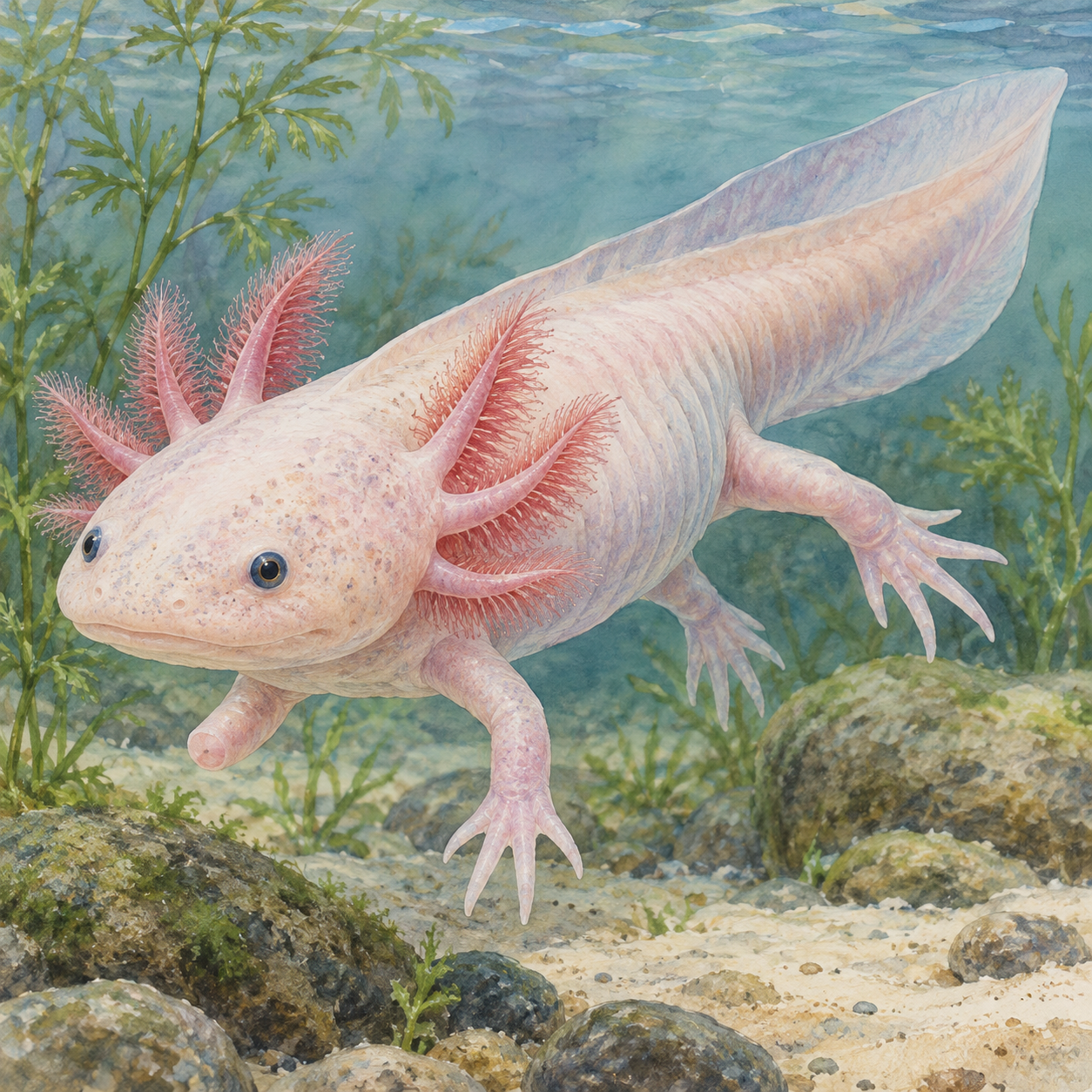
A pale axolotl with rose-colored external gills and a small forelimb bud swims in clear water.
An illustrative axolotl with a smooth limb bud suggesting regeneration, rather than a documented experimental specimen. Generated illustration.

An axolotl can replace a lost limb with another limb containing bones, muscles, nerves, skin, and properly arranged digits. The result is far more organized than simply sealing a wound. The animal has to rebuild a structure and reconnect it with the rest of its body.

This aquatic salamander has become a major research organism because it makes that problem experimentally approachable. Its abilities are remarkable, but they are not unlimited or automatic. The conditions that interrupt regeneration can be as informative as the successful examples.

A repair site becomes a building site

After a limb is lost, cells cover the wound with a specialized layer called the wound epithelium. Beneath it, cells accumulate in a structure called a blastema. Those cells proliferate and respond to signals that guide growth and patterning.

The blastema is sometimes pictured as a heap of cells that can become absolutely anything. The reality is more constrained: it contains progenitor cells whose histories and identities matter. Rebuilding involves coordinated contributions, rather than every cell freely choosing any role.

As the new structure develops, it first resembles a small limb and then grows. The challenge includes placing different tissues in the right relationship. Making bone is one task; making the correct arrangement of bones inside a functioning limb is another.

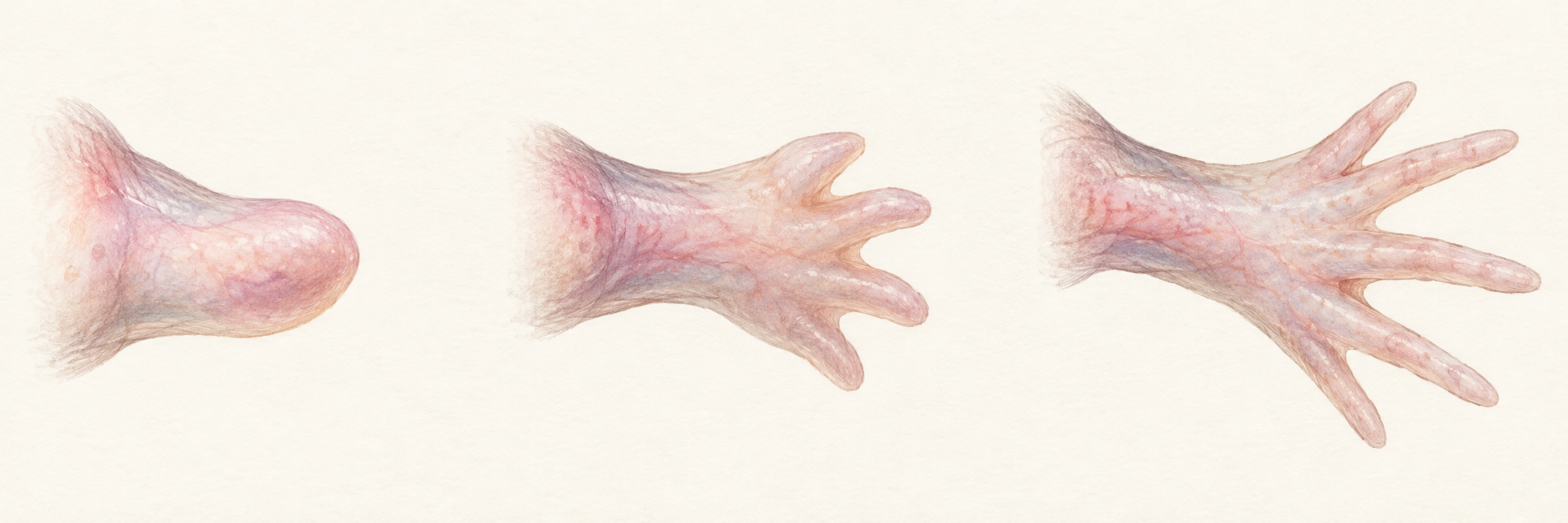
Three conceptual limb studies show a rounded bud, emerging digits, and a developed five-digit hindlimb form.
Conceptual studies of axolotl limb regrowth using a five-digit hindlimb form. The sequence is illustrative, with no exact timing or specimen scale. Generated illustration.

The immune system helps set the conditions

A 2013 study demonstrated the importance of macrophages, immune cells often associated with clearing debris and responding to infection. When researchers depleted them during a critical period in axolotls, wounds could close but limb regeneration failed, with substantial scarring.

That finding separates wound closure from regeneration. A surface can heal without the missing structure being restored. It also shows that immune activity is part of the constructive process, rather than merely an obstacle that a regenerating animal must suppress.

Researchers investigate such disruptions to identify the signals and cellular relationships that make a repair site permissive for rebuilding.

Even this specialist has limits

Axolotls normally retain several juvenile features as adults, including external gills. In a 2014 experiment, researchers induced metamorphosis and compared regeneration with age-matched animals that retained the usual form. Metamorphosed animals regenerated more slowly and showed reduced accuracy in the resulting limb structures.

The result concerns a specific experiment; it does not mean every change in size, age, or developmental state has the same effect. It shows why the state of the whole animal belongs in the explanation.

According to NIH, researchers also study axolotl regeneration in other damaged tissues, hoping to understand principles relevant to human healing. Discovering a useful mechanism in a salamander, however, is several steps away from reproducing complete limb regeneration in a person.

The axolotl offers something more valuable than a promise of instant repair: a living system in which scientists can ask what rebuilding requires. Its success and its failures reveal how cells, signals, and tissue organization work together to reconstruct a complicated body part.

Sources and further reading: NIH: Research Organism Superheroes—Axolotls; Godwin and colleagues: Macrophages and limb regeneration; Induced metamorphosis reduces regenerative rate and fidelity.

Explore more creative work at Incoprea.
The Resurrection Fern's Brown-to-Green Transformation

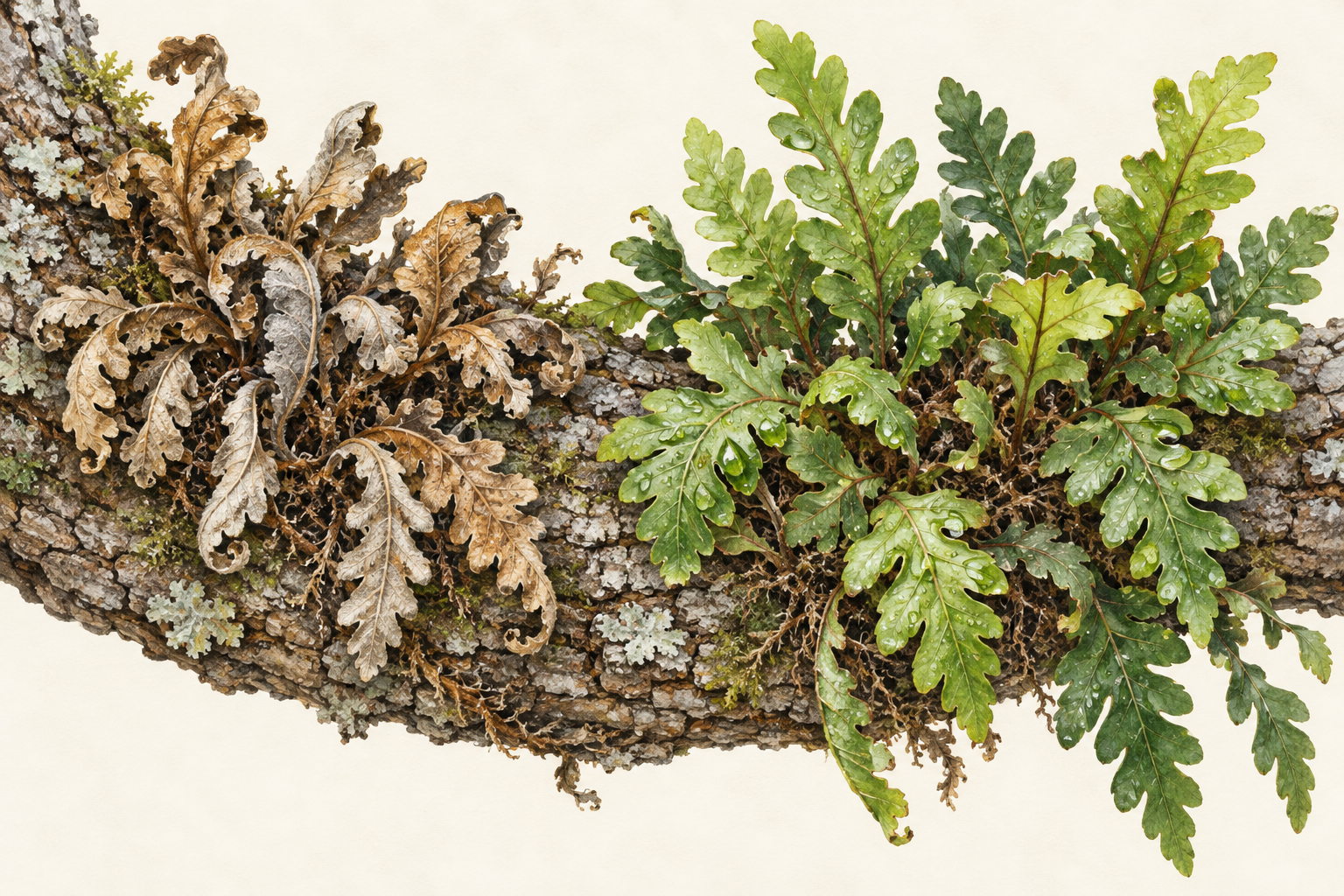
Dry curled fern fronds and reopened green fronds are compared on an oak branch.
An artistic comparison of dry and hydrated resurrection-fern fronds; this is not a photographic time sequence. Generated illustration.

A small fern on an oak branch can seem to disappear into dead bark during a dry spell. Its fronds curl, fade, and look thoroughly finished. After rain, the same patch can open into fresh-looking green foliage within hours. The change is dramatic enough to have earned it the name resurrection fern.

The name describes an appearance, not a return from death. The living tissues have survived dehydration and resume activity when water becomes available. That distinction is the real biological achievement.

A plant living above the soil

The resurrection fern familiar in the southeastern United States commonly grows on tree branches. It is an epiphyte: a plant using another plant as a place to live. It still performs its own photosynthesis, rather than drawing its food from the tree as a parasite would.

Bark offers a surface to occupy, but it provides a precarious water supply. Rain comes and goes, and an exposed branch can dry rapidly. A fern living there benefits from being able to withstand a loss of water that would severely damage many other plants.

University of Florida accounts also describe resurrection ferns growing on rocks, bricks, and fallen wood. A tree is a useful support, rather than an indispensable source of nourishment.

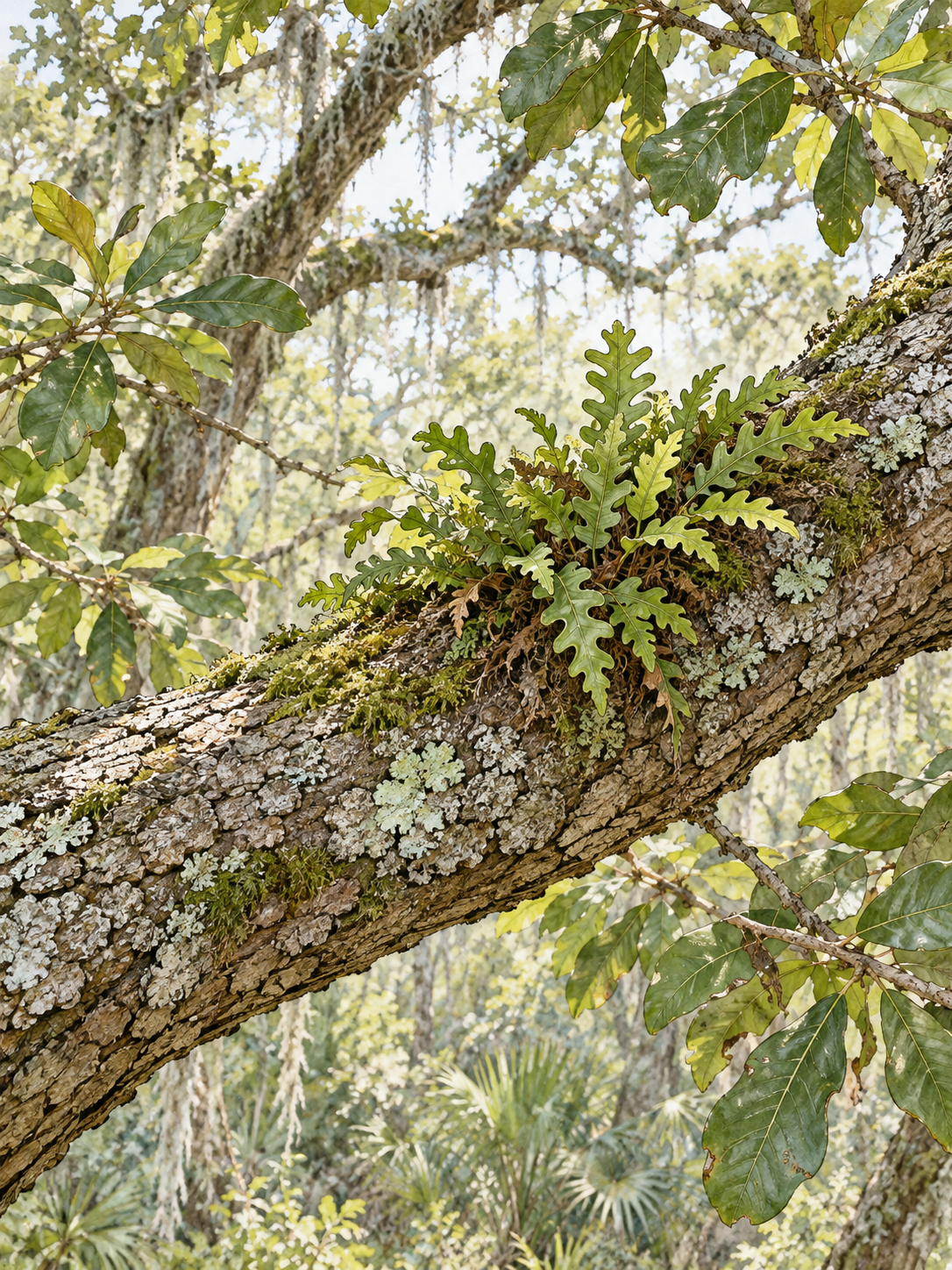
Small resurrection fern fronds grow on the bark of a larger oak branch.
A conceptual woodland view showing the fern's epiphytic position on a tree branch. Generated illustration.

Curling is part of the response

As fronds dry, their form changes. Curling draws the upper leaf surface inward and exposes more of the underside. A 2021 study of desiccation and rehydration in Pleopeltis polypodioides examined these shape changes alongside the recovery of water transport and photosynthetic function.

Restoring a green appearance is only the visible part of recovery. Cells and the plant's internal transport system must withstand drying, then function again as water returns. Researchers distinguish the recovery of hydration from the recovery of photosynthesis, because those are related processes rather than one identical event.

The ability is called desiccation tolerance. It differs from simply keeping enough water inside a plant throughout a drought. The fern can tolerate a substantial reduction in water and then repair or restart the systems needed for ordinary activity.

A dramatic example with ordinary constraints

How quickly a fern reopens depends on its condition and surroundings. The University of Florida describes changes within hours after rain, while another extension account describes the apparent recovery over about a day. These are useful observations, rather than a universal stopwatch for every frond.

Likewise, the dry state is a survival strategy, not continuous productive growth without water. The plant benefits when suitable wet periods return and allow photosynthesis and development.

A brown patch on a branch can therefore represent waiting rather than failure. Looking at it over several weather changes reveals more than judging it from one dry afternoon.

The resurrection fern makes a large idea visible on a very small stage: staying alive does not always require maintaining the outward appearance of activity. Sometimes survival means changing form, protecting what remains, and being ready to resume when the environment offers another opportunity.

See or hear more: Watch the fern reopen in a UF/IFAS-linked video.

Sources and further reading: UF/IFAS: Resurrection Fern; UF/IFAS: Hardy Native Air Plants; Desiccation and rehydration dynamics in the resurrection fern.

Explore more creative work at Incoprea.
The Immortal Jellyfish's Remarkable Reset Has Limits

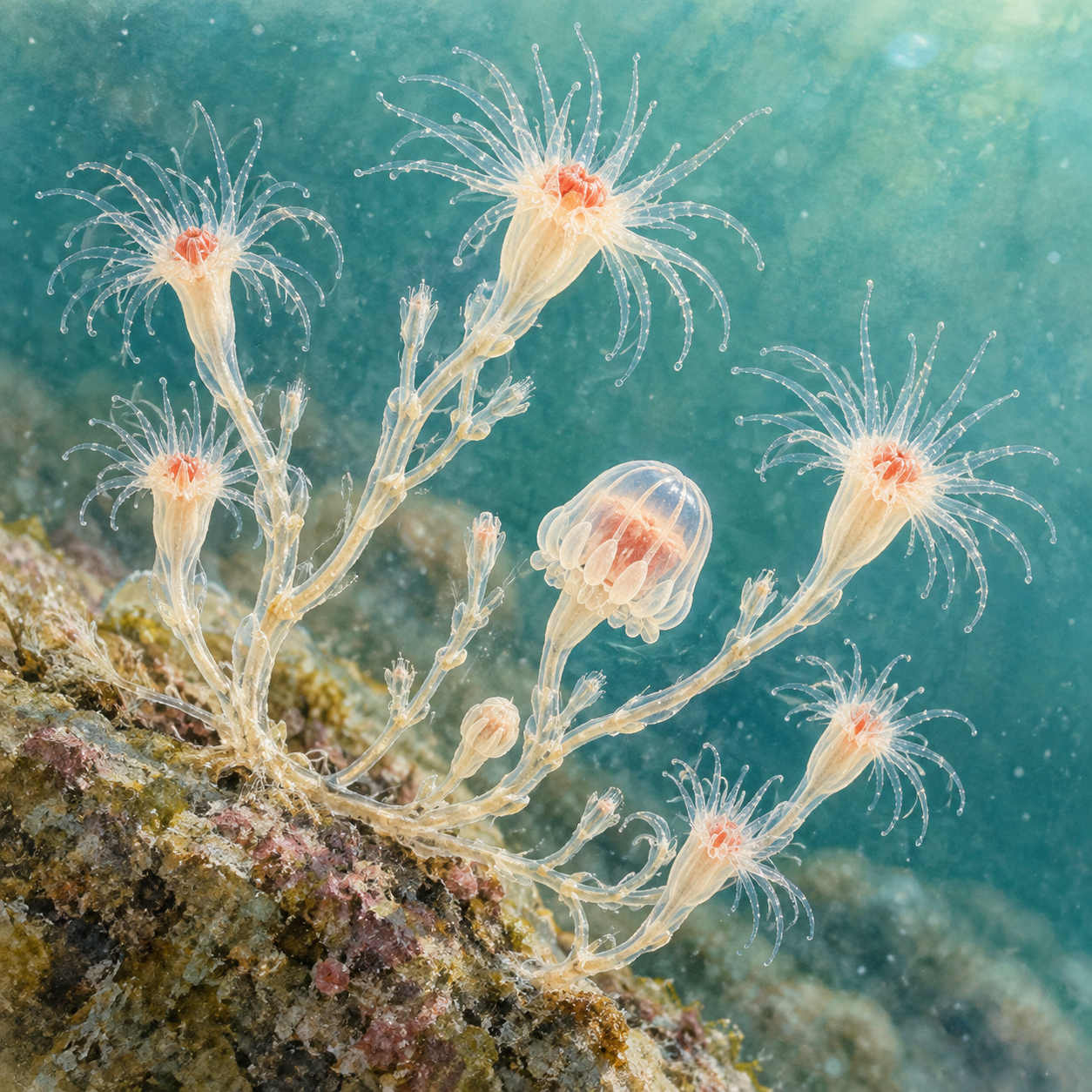
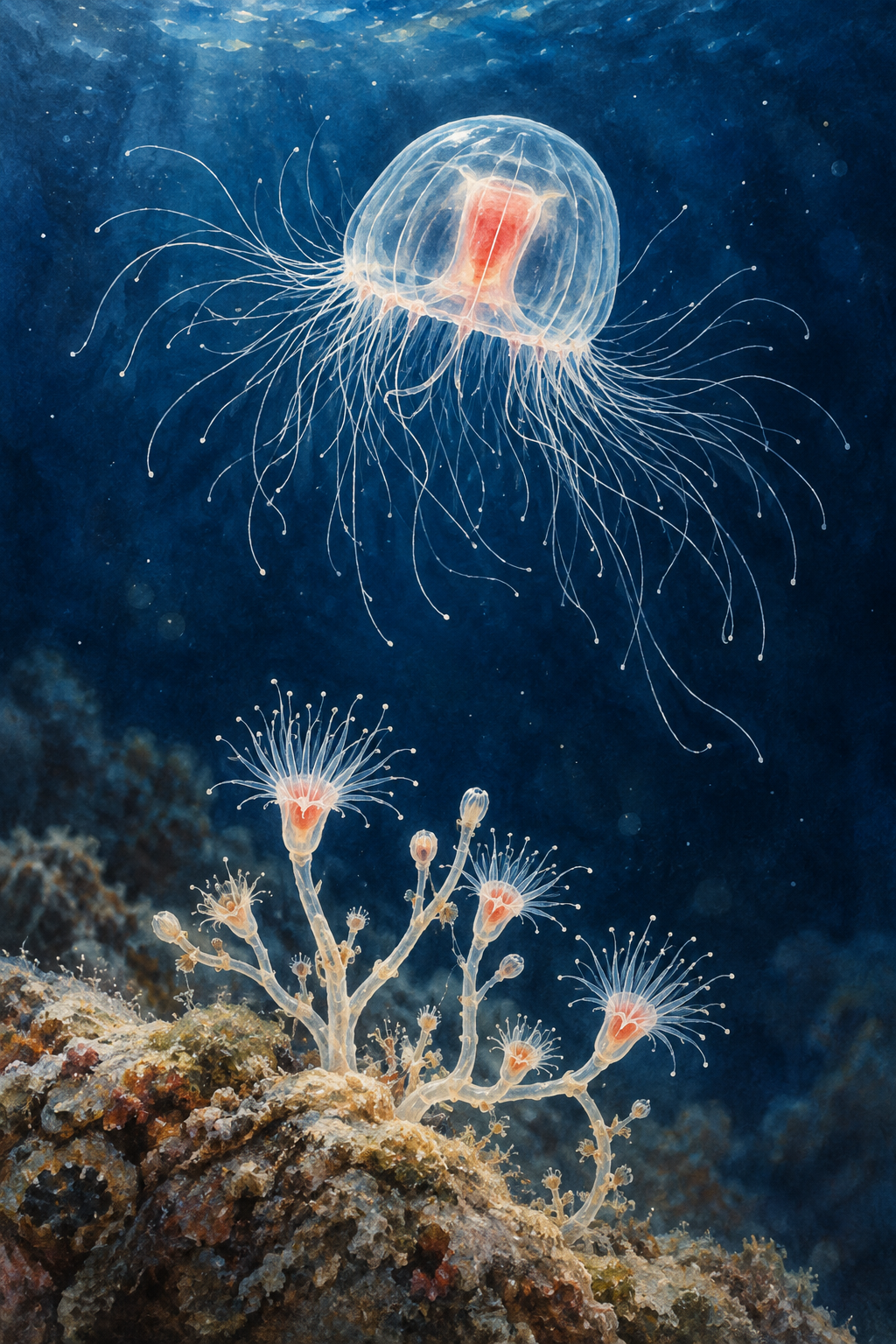
A transparent bell-shaped jellyfish floats above a small attached colony of polyps.
Medusa and polyp forms shown in an artistic life-cycle comparison with illustrative proportions. Generated illustration.

A tiny jellyfish has become famous for an ability that sounds like science fiction: it can reverse part of its life cycle. Turritopsis dohrnii, often called the immortal jellyfish, can transform from a free-swimming medusa into an earlier, attached form under suitable conditions.

That is an extraordinary kind of biological flexibility. It is also more specific than the nickname suggests. A way to restart development does not protect an animal from being eaten, infected, or damaged beyond recovery.

One life cycle, very different forms

The familiar jellyfish shape is the medusa: a bell-shaped animal with tentacles, moving through the water. Another stage in the life cycle is a polyp, attached to a surface and shaped very differently. Polyps can produce new medusae.

In T. dohrnii, a medusa can undergo a reversal process that includes a contracted, cyst-like stage before producing polyp structures. The animal reorganizes rather than simply shrinking into a smaller jellyfish. Calling the result a baby version of the same bell misses the change of body plan.

The Natural History Museum discusses this reversal as an escape from the usual one-way progression of the cycle. Laboratory research has demonstrated repeated reversals, giving scientists a system for examining cellular plasticity and rejuvenation.

An enlarged artistic polyp colony includes tentacled heads and a small medusa-like bud.
Conceptual enlarged polyp and budding-medusa forms, illustrating the ordinary forward stage of a hydrozoan life cycle. Proportions are simplified. Generated illustration.

The reset is a research problem

Researchers investigate how mature tissues change during the transition and which molecular programs become active. The question is not merely how an animal grows again, but how it alters its developmental organization.

A 2022 comparative-genomics study examined T. dohrnii alongside a related species, Turritopsis rubra. It identified differences involving processes such as DNA replication and repair, telomere maintenance, and cellular reprogramming. Those findings offer candidates for further investigation.

A gene difference is not automatically the cause of an entire trait. Comparing species highlights possible contributors; demonstrating their exact roles requires additional experiments. The research does not provide a simple recipe for making another animal immortal.

What “immortal” leaves out

The term often refers here to the capacity for repeated rejuvenation, rather than to a known individual that has lived forever. Observing a repeatable developmental process in a laboratory cannot establish the lifespan of every jellyfish in the open sea.

Reversal also involves conditions and vulnerabilities. A medusa has to survive long enough to complete the transition and establish the polyp stage. Its environment still contains predators, disease, and physical hazards. A reset pathway is one possible response, rather than an invulnerability shield.

Taxonomy matters, too. Older popular accounts sometimes attach the story to Turritopsis nutricula. Modern research on repeated post-maturity rejuvenation centers on T. dohrnii, and related species should not be assumed to share identical abilities.

The compelling fact survives all those qualifications: an animal can rebuild its developmental trajectory in a way most animals cannot. The science becomes more interesting when “lives forever” gives way to the precise question of how a mature body learns to begin again.

Sources and further reading: Natural History Museum: Immortal jellyfish; Comparative genomics of mortal and immortal cnidarians; Genome and transcriptome of repeatedly rejuvenating Turritopsis.

Explore more creative work at Incoprea.
Horseshoe Crab Blue Blood: Two Different Biological Stories

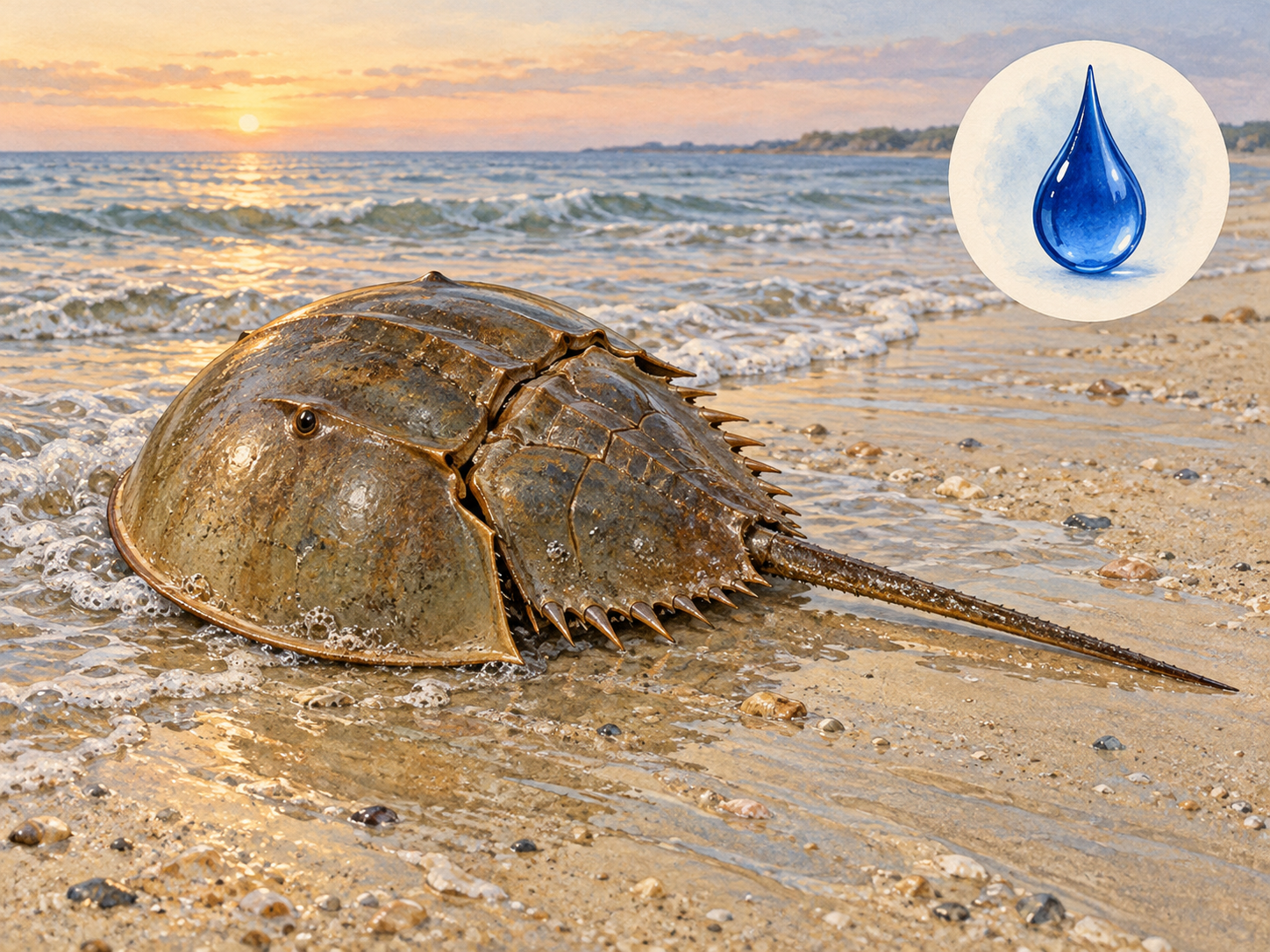
A brown horseshoe crab at the tidal edge beside a separate artistic blue-droplet vignette.
A horseshoe crab with a separate blue-droplet vignette representing its oxygenated circulatory fluid. Generated illustration.

A horseshoe crab looks like a small armored visitor from another age. Its helmet-shaped shell and long tail spine make it distinctive before you discover its most famous hidden feature: blue blood. That color has a chemical explanation, while the blood's role in laboratory testing has a different one.

Separating those stories makes the animal more understandable. The molecule that carries oxygen is not simply the same thing as the cellular system that reacts to bacterial material.

Copper helps carry the oxygen

Horseshoe crabs use hemocyanin, a copper-containing protein, to transport oxygen in their circulatory fluid. When oxygenated, this protein gives the fluid its blue color. Human red blood relies on a different oxygen-carrying protein, hemoglobin, whose iron-containing heme contributes the familiar red.

The contrast is about organized proteins and their chemistry, rather than a body filled with ordinary dissolved copper pigment. Hemocyanin binds oxygen and releases it under appropriate conditions, serving a physiological transport job.

Research on Limulus polyphemus, the Atlantic horseshoe crab, has examined how its hemocyanins bind oxygen and how conditions such as acidity affect that behavior. “Blue blood” is an arresting description of a functional molecular system.

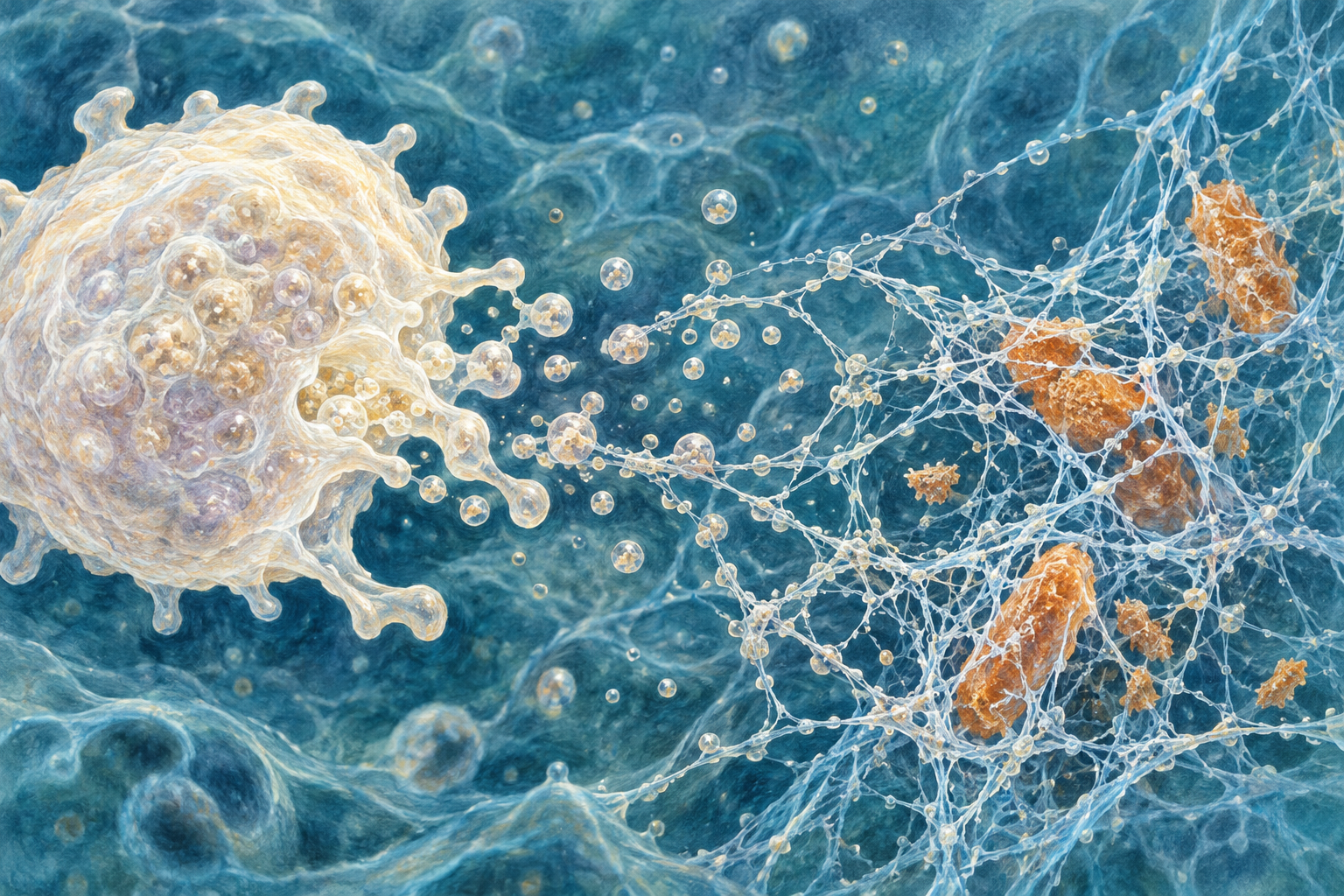
A conceptual immune cell releases components toward a forming mesh around bacterial fragments.
A microscopy-inspired conceptual view of immune-cell clotting activity. Colors, particles, and proportions are illustrative rather than measured anatomy. Generated illustration.

Immune cells detect bacterial material

The testing story begins with amebocytes, blood cells involved in the animal's defense. Their contents include a coagulation system that reacts to bacterial lipopolysaccharide, commonly discussed as endotoxin.

Limulus amebocyte lysate, or LAL, is an extract prepared from those cells. It contains the components used in assays for bacterial endotoxin. It is therefore misleading to describe LAL as the blue oxygen-carrying pigment, or as a single enzyme identical to hemocyanin.

A 1993 study in Infection and Immunity investigated proteins involved in binding lipopolysaccharide within this system. The reaction is a cascade: recognition of particular molecular material activates processes that lead toward coagulation.

The specificity matters. An endotoxin assay asks a defined question; it is not a universal detector of every possible contaminant. The animal's evolved defense mechanism became useful because researchers learned what that reaction could reveal.

A remarkable animal with a wider role

Horseshoe crabs belong to the chelicerate branch of arthropods and are more closely related to spiders and scorpions than to true crabs. Their everyday biology includes finding food, molting, and reproducing along suitable shorelines. Their importance does not begin and end in a laboratory.

The Smithsonian's National Zoo also notes the costs associated with collecting and bleeding them: some animals die after being returned. That makes the biological resource a conservation concern as well as a scientific one.

The useful lesson is a double discovery. Hemocyanin explains the unexpected color; amebocyte chemistry explains a sensitive response to bacterial endotoxin. Together they show how one animal's internal systems can become windows into both physiology and the practical questions humans bring to biology.

Sources and further reading: Smithsonian National Zoo: Horseshoe crab; Functional differences in horseshoe-crab hemocyanins; Lipopolysaccharide-binding proteins of Limulus amebocyte lysate.

Explore more creative work at Incoprea.
Noctilucent Clouds: Ice That Catches Sunlight After Dusk

Silver-blue rippled clouds shine in a dark twilight sky over a silhouetted lake shore.
An idealized twilight view of noctilucent clouds, rather than a recorded sighting at a named place and time. Generated illustration.

The landscape has darkened, ordinary clouds have turned grey, and then a fine blue-white lattice appears high in the twilight sky. Noctilucent clouds can look as if they produce their own light. Their name means night-shining, but their brightness comes from sunlight that still reaches their extraordinary altitude.

They occupy a different atmospheric neighborhood from the clouds that deliver rain. Understanding their height changes the apparent paradox: the observer can be in Earth's shadow while a thin cloud far above remains illuminated.

An unusually high place for water ice

Noctilucent clouds, also called polar mesospheric clouds, form near the top of the mesosphere. NASA places them roughly 76 to 85 kilometers above Earth's surface. That is far above the ordinary weather-cloud layer.

At those heights, the air is extremely thin and water is scarce. Under sufficiently cold conditions, tiny ice crystals can form. Sunlight reflected by the crystals gives the clouds their pale blue and silvery appearance.

The clouds are often associated with high latitudes during late spring and summer. That can seem backward: why would an ice cloud favor summer? The upper atmosphere has its own circulation and temperature behavior. The mesosphere can be particularly cold during the local summer, even while the surface is enjoying long, warmer days.

A schematic curved Earth lies partly in shadow while high clouds remain illuminated by sunlight.
Schematic twilight illumination with exaggerated cloud height and simplified light paths; the Sun and Earth are not shown to scale. Generated illustration.

A little material from space

Ice needs suitable starting material on which to form. NASA's AIM mission helped establish the role of very small particles called meteoric smoke, produced as material from space burns up in the atmosphere.

The term “smoke” does not mean a visible plume hanging above a meteor. It refers to tiny residual particles that become part of the upper atmosphere's chemistry and cloud formation. A familiar-looking ripple of ice can therefore include a connection to incoming extraterrestrial material.

This is one reason the clouds interest researchers beyond their beauty. Their formation depends on temperature, water vapor, particles, and atmospheric motion acting together.

The sky is a connected system

AIM observations revealed relationships between different layers of the atmosphere and helped scientists study waves and circulation. Conditions lower down can influence events much higher up, and changes in one polar region can be linked with changes in the other.

Researchers also examine how cloud occurrence relates to long-term changes in water vapor and temperature. A single striking evening is an observation, however, not a diagnosis of the entire climate system. Establishing a trend requires consistent measurements over time.

For a viewer, the essential geometry is enough to make the scene memorable. Low land lies in shadow; very high ice still meets the Sun. Fine textures that would be hard to notice in daylight stand out against a darkening background.

Noctilucent clouds show that sunset does not happen everywhere above you at once. Their delicate light marks the intersection of Earth's curved shadow with one of the coldest and highest cloud-making regions in the atmosphere.

See or hear more: See NASA's noctilucent-cloud animation.

Sources and further reading: NASA: Polar Mesospheric Clouds; NASA: Meteor Smoke Makes Strange Clouds; NASA: Taking AIM—10 science highlights.

Explore more creative work at Incoprea.
Blood Falls: Rust-Colored Brine Escaping an Antarctic Glacier

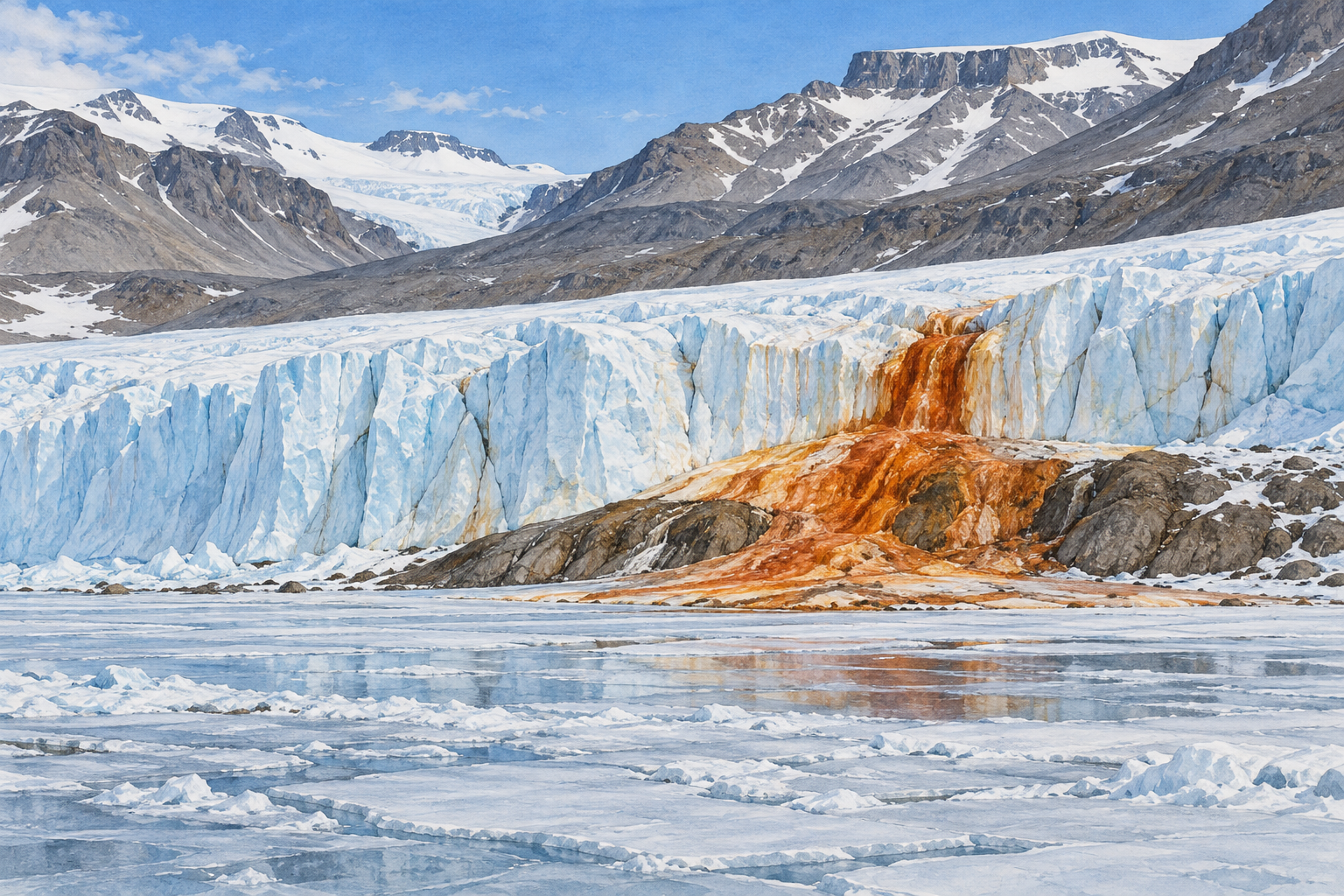
A rust-colored outflow stains the front of a pale Antarctic glacier above a frozen lake margin.
A conceptual Blood Falls landscape with simplified terrain and an iron-colored outflow. Generated illustration.

A rust-red stain across Antarctic ice is startling enough to earn a dramatic name. Blood Falls emerges near the end of Taylor Glacier, in the McMurdo Dry Valleys. Its color comes from iron-rich salty water and the changes that occur as that water reaches the surface.

The spectacle raises two distinct questions. Why is the outflow red? And how can liquid water travel through such a cold glacier? Solving one does not automatically solve the other.

Salt changes the freezing problem

A 2017 research team used radio-echo sounding to investigate the brine pathway connecting an underground water source with the outlet. Salt made the liquid easier to distinguish from surrounding fresh glacier ice in the radar measurements.

The University of Alaska Fairbanks account describes a route extending about 300 feet through the glacier toward the falls. The releases at the surface are sporadic, rather than a permanently flowing waterfall behaving like a familiar stream in a warm landscape.

Brine has a lower freezing temperature than fresh water. There is another contribution as well: water releases heat when it freezes, warming the adjacent environment. The researchers explained that the combination helps liquid movement remain possible inside very cold ice.

The glacier is therefore not a simple solid block with nothing happening within it. Its internal plumbing depends on water chemistry, temperature, pressure, and changing pathways.

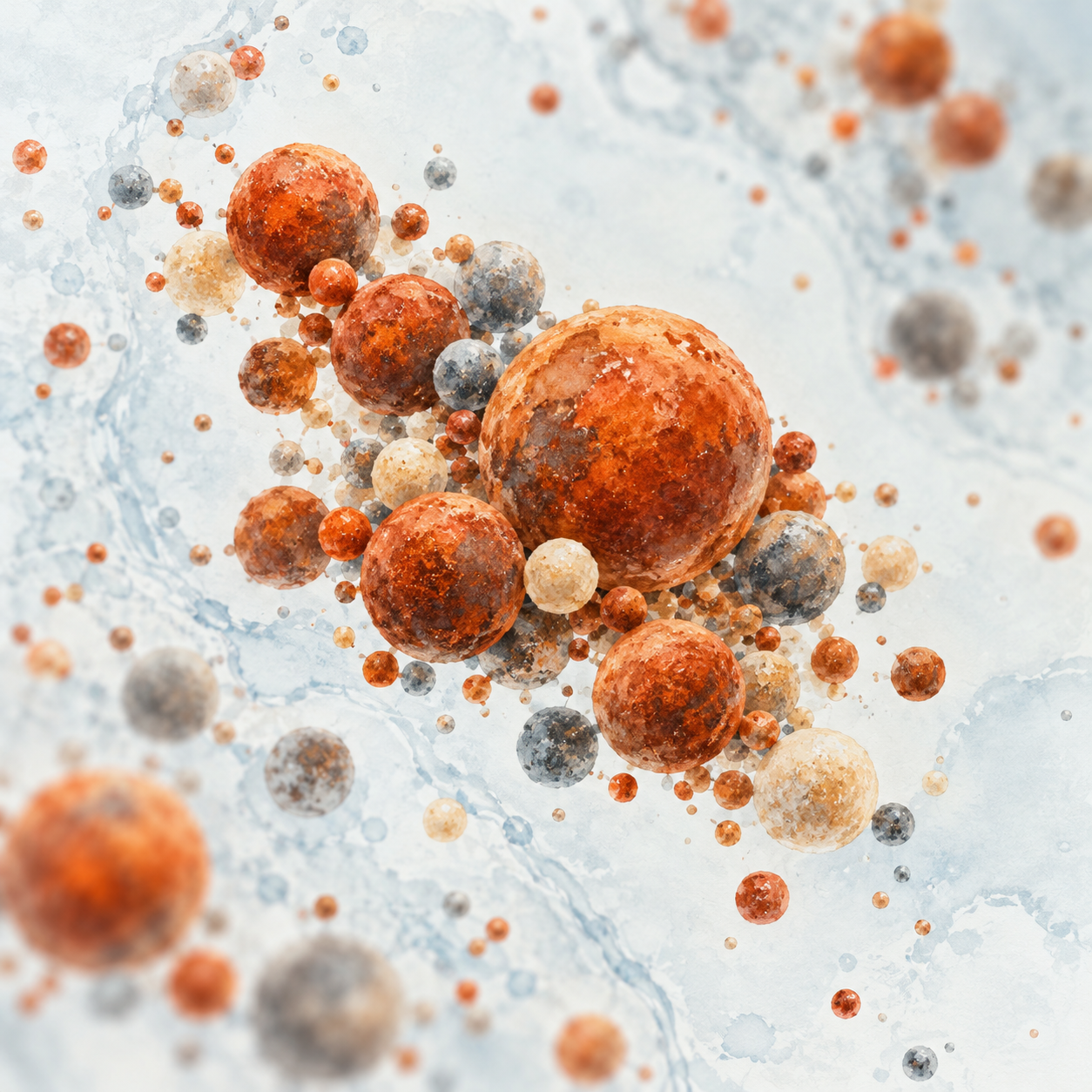
A conceptual enlarged cluster of orange and grey round particles floats against a watery pale background.
A conceptual view of iron-rich nanospheres. Colors, textures, and sizes are artistic, not actual electron-microscopy data. Generated illustration.

The red material gets a closer look

Iron-rich outflow changes color after contact with air. A 2023 investigation added a finer-scale explanation by examining solids from Blood Falls with transmission electron microscopy.

Johns Hopkins researcher Ken Livi identified abundant tiny, iron-rich spheres containing other elements as well. These nanospheres were non-crystalline: their atoms were not arranged in the regular structure expected of a conventional mineral crystal.

That distinction helped explain why earlier methods focused on identifying minerals could miss part of the material responsible for the color. “It looks like rust” remains a useful visual comparison, but detailed analysis reveals a more specific mixture and structure.

A landscape that tests our instruments

The brine also interests scientists studying life in difficult environments. Microorganisms have been investigated in the system beneath Taylor Glacier. Cold, darkness, and salty water create an unusual setting for examining the conditions under which life can persist.

Researchers have used Blood Falls as a place to think about planetary exploration, including how instruments might identify materials on a cold world such as Mars. The nanosphere work highlights a practical issue: a method excellent at recognizing crystalline minerals may leave other important material unresolved.

That is an analogy for instrument design, not evidence that the same organisms or deposits exist elsewhere. The Antarctic site gives researchers something real to measure when evaluating what a tool can and cannot reveal.

Blood Falls rewards looking beneath the name and beneath the ice. The red surface feature is the visible meeting point of hidden brine flow, freezing physics, iron chemistry, and the methods scientists bring to an unfamiliar landscape.

Sources and further reading: UAF: Researchers solve the Blood Falls flow mystery; Johns Hopkins: Seeing red at Blood Falls; An englacial hydrologic system of brine within a cold glacier.

Explore more creative work at Incoprea.
The Hawaiian Happy-Face Spider's Smile Is Only One Pattern

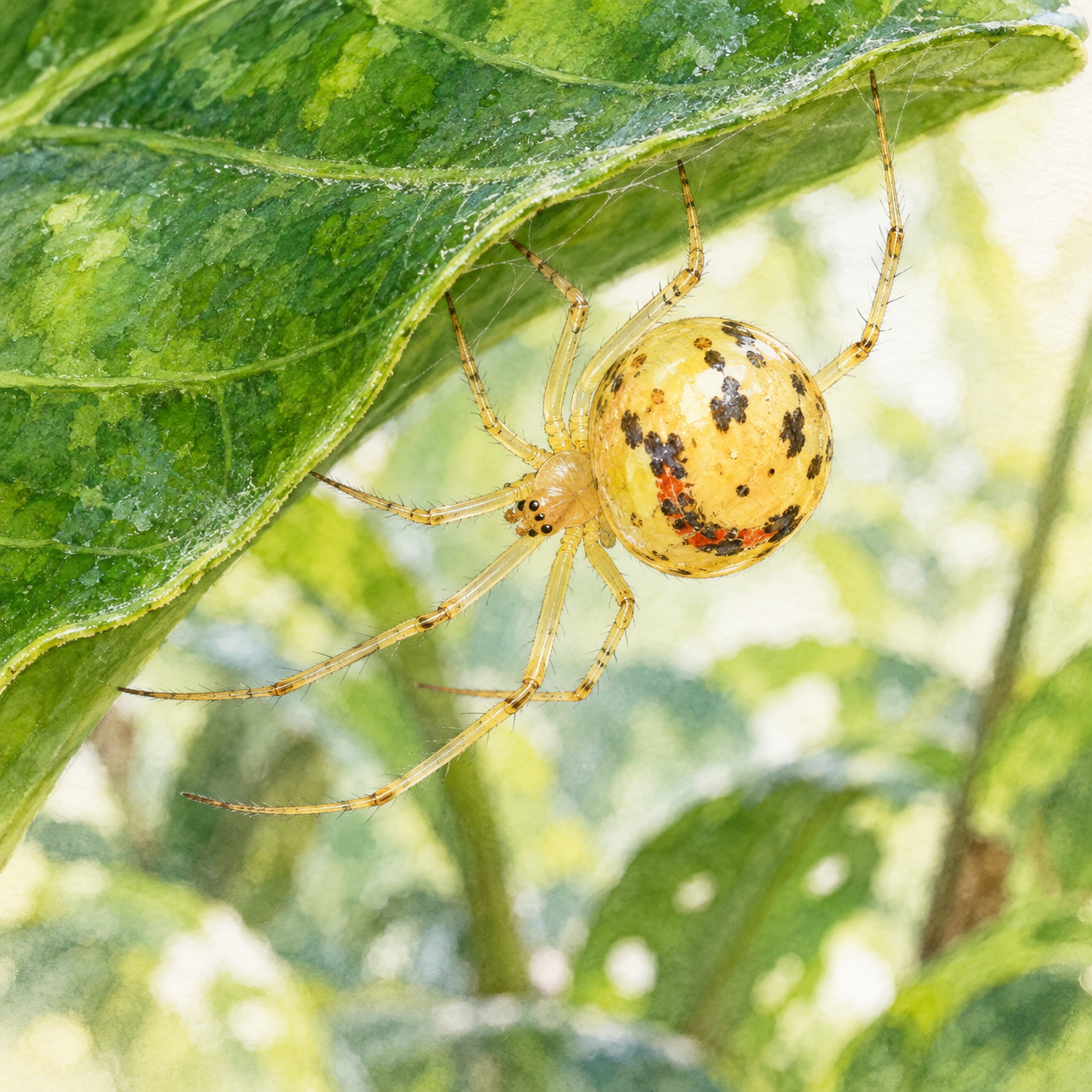
A pale-yellow spider with irregular face-like red and black abdomen markings hangs beneath a green leaf.
One artistic possible happy-face-spider pattern at enlarged scale; real individuals vary substantially. Generated illustration.

A pale spider beneath a Hawaiian forest leaf can appear to carry a tiny smile on its abdomen. The resemblance is striking enough to have given Theridion grallator its familiar name: the Hawaiian happy-face spider. The face, however, is something humans recognize in a color pattern, rather than an expression the spider is making.

Even more interesting, the supposed smile is only one possibility. Members of the species display a rich variety of markings, and some lack the celebrated face-like pattern altogether.

A very small forest resident

The National Park Service describes these spiders as only a few millimeters in size, living in wet and mesic Hawaiian forests. Their delicate webs are often associated with the undersides of leaves, where the spiders rest during the day.

Much of their hunting takes place at night. They catch small insects from a thread near the web or search nearby foliage. The bright-looking abdomen in a magnified portrait belongs to a tiny animal operating in a much larger, cluttered leaf environment.

Females also guard eggs and care for young after hatching. That behavior adds another dimension to a creature often reduced to a novelty photograph: its daily life includes feeding, shelter, and parental investment.

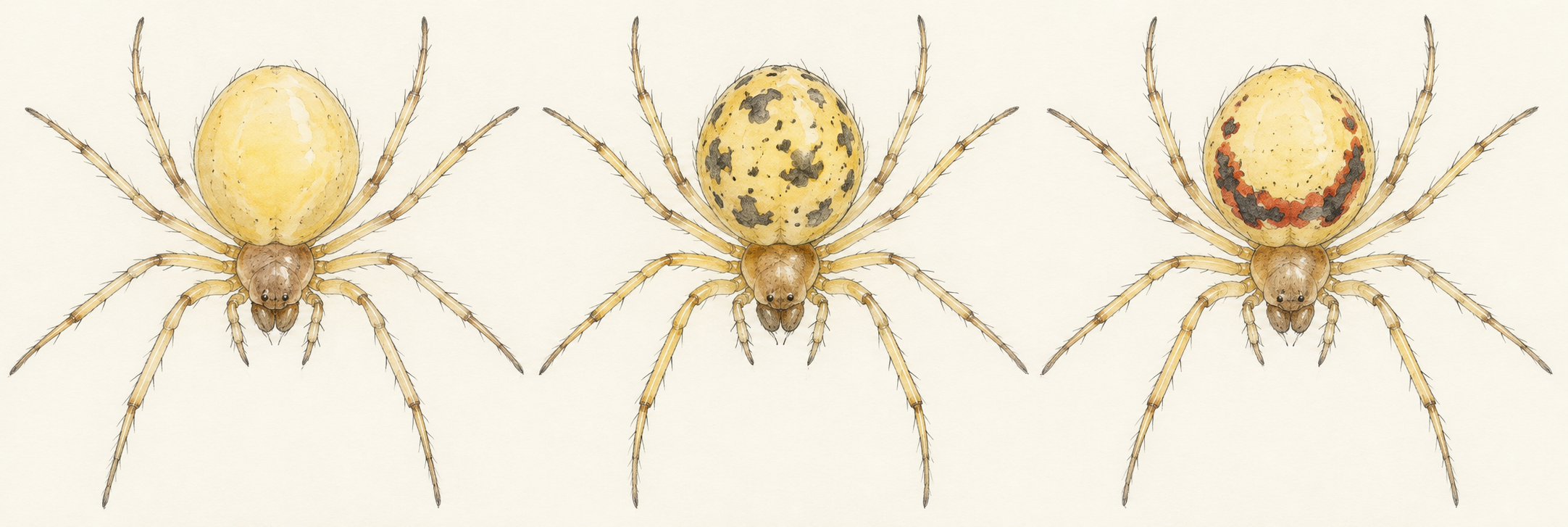
Three artistic happy-face-spider studies compare plain yellow, scattered dark marks, and a curved red-dark pattern.
A conceptual comparison of possible pattern variation, rather than exact named genetic morphs or identified specimens. Generated illustration.

The markings have a genetic story

The species is a classic example of color polymorphism, meaning that multiple visible forms occur within the same species. Research in Heredity examined the inheritance of its color and pattern variation.

A 1989 study found family patterns consistent with Mendelian inheritance, linking the visible variation with genetic differences passed between generations. The result is more complicated and more interesting than a single universal badge shared by every happy-face spider.

A photograph of a strongly marked animal can make that form seem typical of the entire species. The actual variation includes translucent yellow animals and several combinations of dark, red, and pale markings. Images are excellent at showing a memorable example; a study of a population is needed to describe the range.

A smile to us, a different signal in the forest

Why retain so many patterns? The National Park Service describes the purpose as unresolved and notes ideas involving concealment. The Bishop Museum account likewise discusses a possible role in avoiding bird predation.

Those are hypotheses about survival in the animal's environment. The fact that people see eyes and a curved mouth does not demonstrate that predators perceive the same face, or that the pattern evolved to look cheerful.

Human perception readily assembles familiar shapes from a few marks. Here, that habit gives us an engaging introduction to an animal whose real story concerns inheritance, variation, and life beneath leaves.

The most rewarding way to look at the happy-face spider is to notice both stories at once. Enjoy the apparent smile, then imagine the less theatrical individuals and the living forest around them. The species becomes a window into biological diversity within a population, rather than just an accidental emoji.

Sources and further reading: National Park Service: Hawaiian happy-face spider; Bishop Museum: Happy Face Spider; Heredity: What makes a happy face?.

Explore more creative work at Incoprea.
Greek Fire: The Lost Recipe Was Only Part of the Story

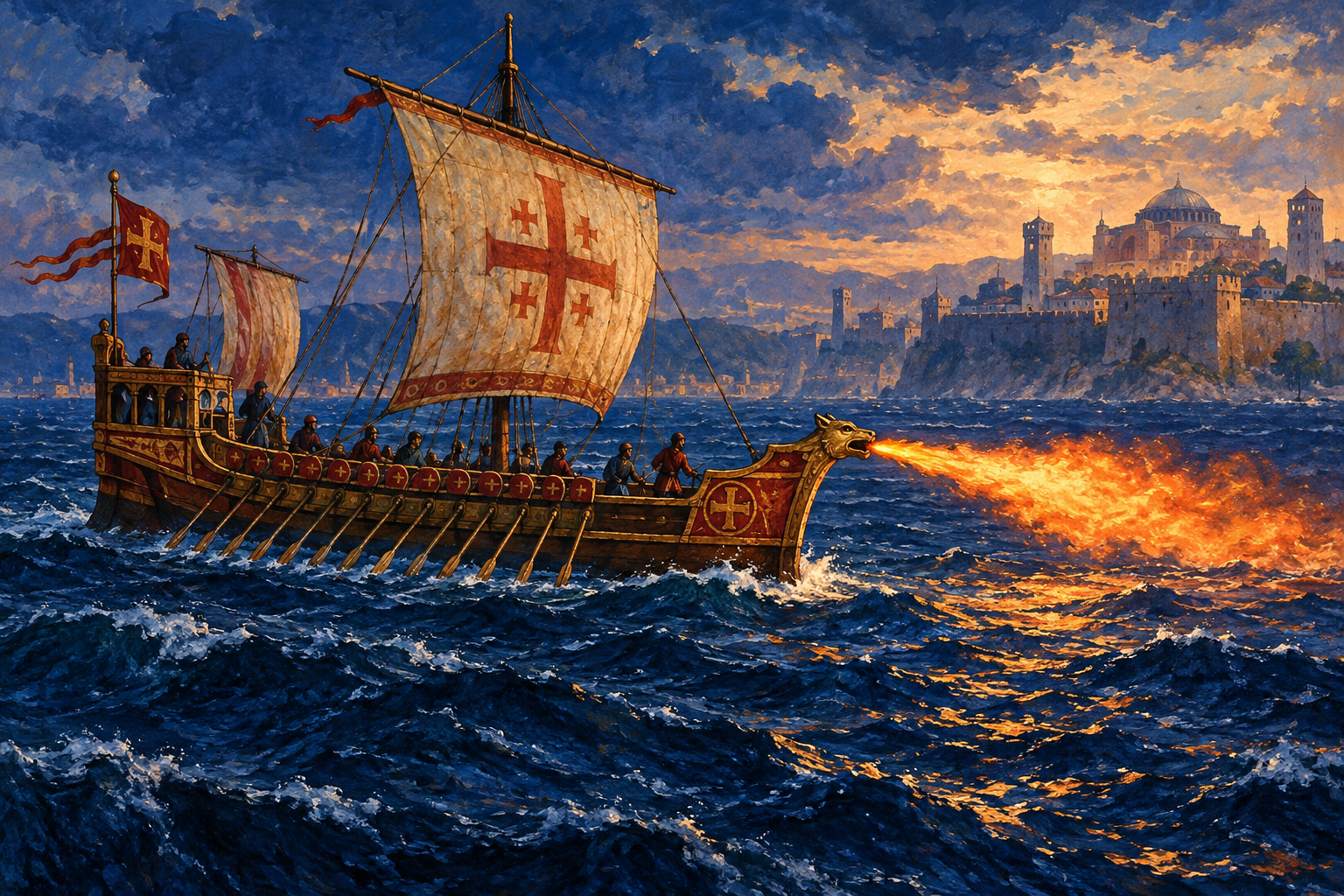
Generated historical illustration of a Byzantine oared ship projecting a flame from its prow on the sea.
An interpretation of the Byzantine naval tradition, not a reconstruction of its machinery. Generated illustration.

A stream of flame reaching from a ship's prow is one of the most memorable images of medieval warfare. Greek fire, associated with the Byzantine navy, has become shorthand for a vanished secret. Yet the recipe is only one part of the historical puzzle. A weapon at sea also depended on a vessel, equipment, trained operators and conditions in which it could be used.

The history is real; the details are uneven

Byzantine forces used incendiary weapons in naval warfare, and Greek fire was closely associated with their power. The dromon, an oared warship, formed an important part of that maritime system. Historian John Pryor's account of the Byzantine navy treats the ships and their equipment together, rather than imagining the combustible substance acting independently.

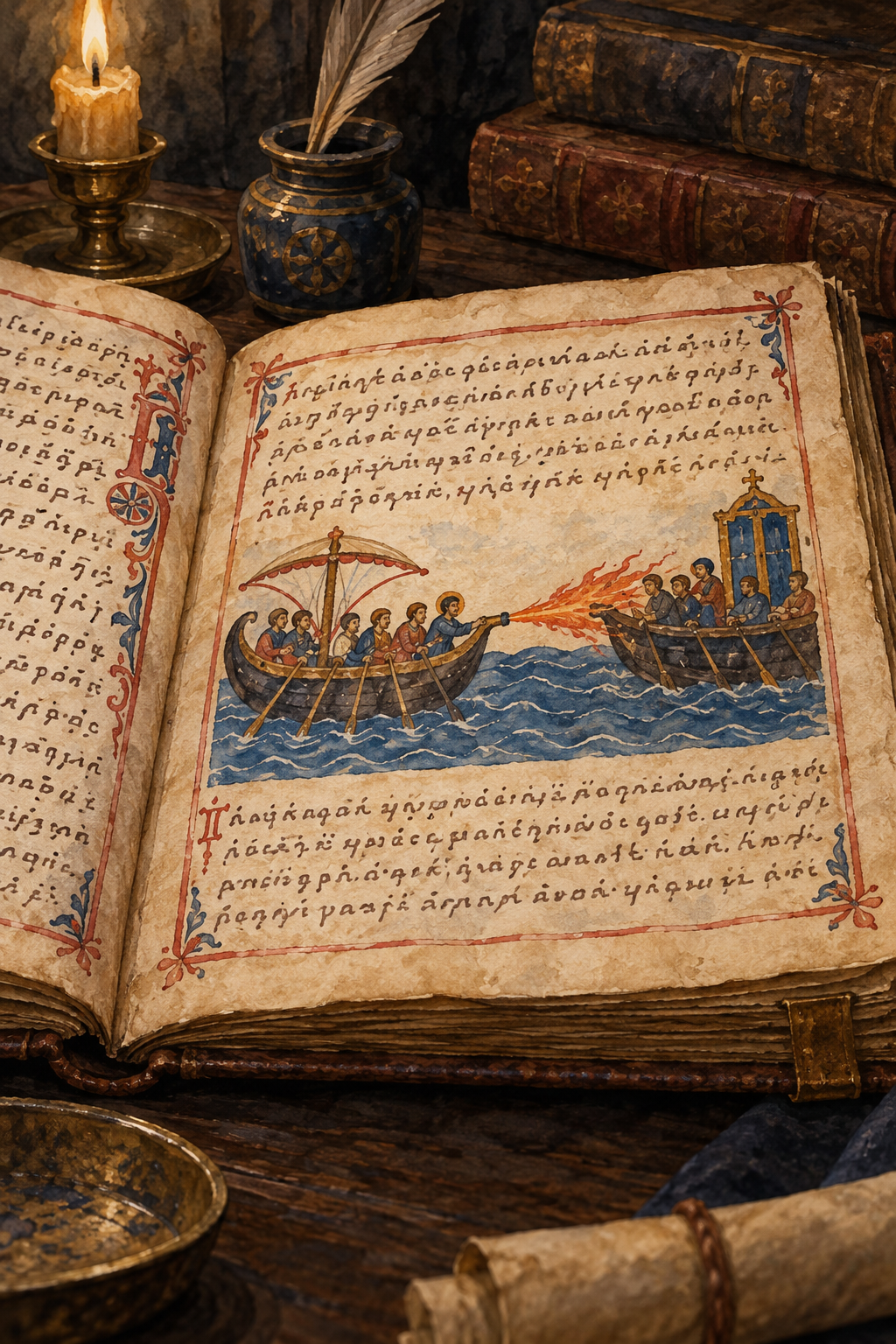
Texts and pictures provide evidence of its reputation and use. A famous illustration in the Madrid Skylitzes shows Byzantine ships attacking the fleet of Thomas the Rebel. The National Library of Spain's study identifies that image as part of a twelfth-century illustrated chronicle.

The date of an illustration matters. A medieval artist depicting an earlier event offers valuable historical evidence, but not a photograph of the event. The picture can tell us about how the weapon was represented without supplying every engineering detail.

Generated illustration of an imagined medieval chronicle containing a naval miniature.
An invented chronicle page shows how pictures can become historical evidence; it is not a manuscript facsimile. Generated illustration.

A secret is not the same as a missing formula

Byzantine accounts emphasized protecting the knowledge of the fire. Constantine VII's imperial advice linked that secrecy with religious authority. Modern scholars must separate the political message of such a passage from information about the weapon's actual operation.

The precise composition remains debated. A plausible modern reconstruction can test whether a proposed system is physically workable, but its success does not establish that it reproduces the original formulation. Matching one reported effect is not the same as matching the entire historical device.

There is also no reason to assume every later mention of a frightening incendiary refers to an identical mixture. Names can travel, broaden and change. Researchers need to examine the author, period and setting of an account before treating it as a specification for one timeless invention.

The overlooked invention was the system

Focus only on the liquid and it is easy to miss the larger achievement. A fleet had to equip ships, maintain specialized knowledge and coordinate people at sea. The useful technology was the combination of material and organization.

That perspective makes the subject more interesting than the familiar claim that an ancient substance was impossibly advanced. Skilled people could develop a powerful practical method without leaving us a complete explanation of it. Losing their working tradition could leave a gap that a surviving written reference does not fill.

Greek fire remains a compelling historical question because we know enough to recognize its importance and too little to declare every detail solved. The bright flame in the manuscript is an invitation to investigate the surrounding world, not merely to guess an ingredient.

Sources and further reading: John Pryor on the dromon and Byzantine navy; National Library of Spain: the Madrid Skylitzes; Southern Cross University: Greek fire and imperial secrecy.

Explore more unusual history and creative ideas at Incoprea.

Egyptian Blue: The Ancient Pigment with an Invisible Signal

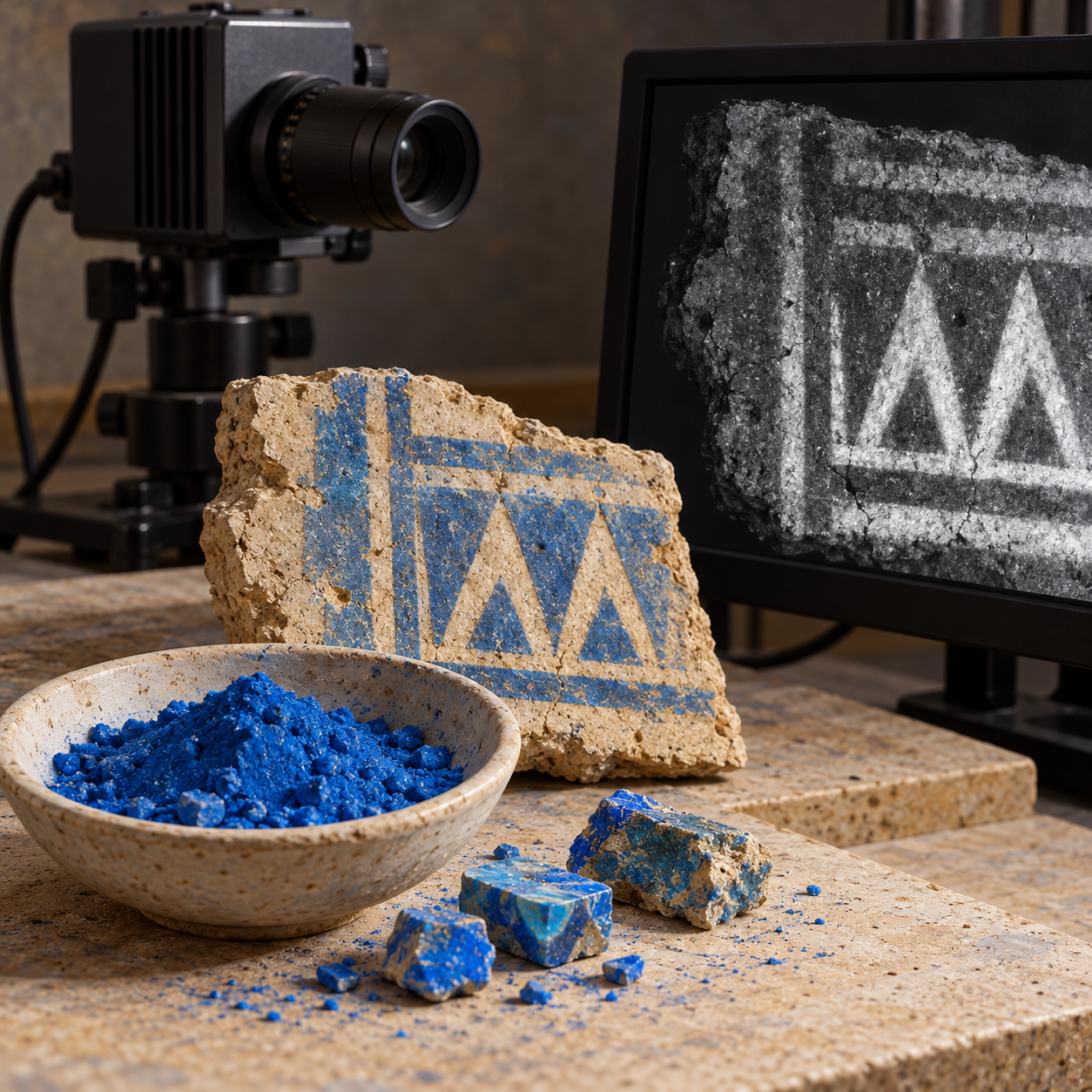
Generated laboratory-inspired illustration of blue pigment, a painted fragment and imaging equipment.
A conceptual materials study; the screen is illustrative, not measured data. Generated illustration.

A patch of Egyptian blue can look like an ordinary fragment of old paint. Under the right examination, it sends a second signal that our eyes cannot see. Illuminate this ancient pigment with visible light and it can emit near-infrared light, allowing a specially equipped camera to detect traces that seem almost absent.

Blue made by people

Egyptian blue is a synthetic calcium copper silicate pigment, also known by the mineral name cuprorivaite. Ancient craftspeople produced it through high-temperature processing rather than simply grinding a naturally blue stone. It is commonly described as the oldest known synthetic pigment.

The name does not mean that every occurrence is Egyptian. The material circulated widely, and it has been found in painting and objects from different parts of the ancient Mediterranean. Its visible shade can vary with factors including the size of the pigment grains.

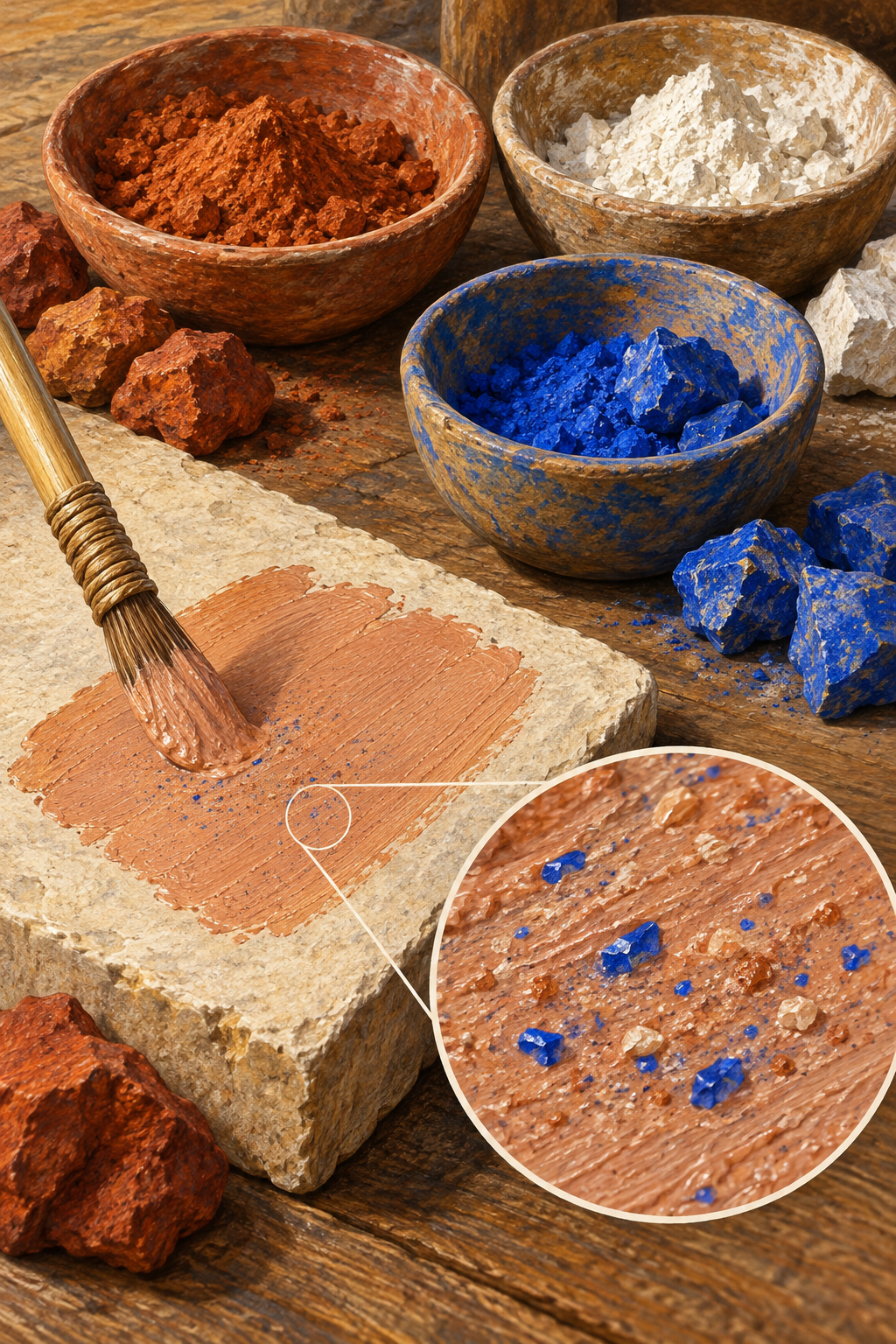
That distinction between a material and a color is useful. Two blue surfaces may contain different pigments, while a surface containing Egyptian blue may not look blue at all if the material was mixed sparingly with other colors.

Generated illustration of blue pigment grains mixed into ochre paint, with an enlarged conceptual inset.
Small pigment additions can alter a paint mixture. The inset is conceptual, not a micrograph. Generated illustration.

A camera notices what an eye misses

The method called visible-induced infrared luminescence, or VIL, takes advantage of the pigment's characteristic response to illumination. The emitted near-infrared light can be recorded with suitable imaging equipment. In an analytical image, it may be displayed as bright areas against a dark background.

This is not an ancient paint that glows blue in the dark. The emission is outside ordinary human vision, and the image is a way of presenting a measurement. The difference matters: the exciting effect occurs in the examination, not as a visible magical shine on the artifact.

British Museum researchers have used the technique to detect remnants of Egyptian blue on the Parthenon sculptures. Those small surviving traces help investigate surfaces whose original painted appearance has largely been lost.

The blue hiding in a face

Research published by the Getty describes another surprising use in a Roman Egyptian portrait. VIL and complementary elemental mapping revealed Egyptian blue in parts of the sitter's face and neck. In some areas it helped modulate flesh tones even where an obvious blue hue could not be seen.

This turns pigment detection into evidence about artistic decisions. A painter could mix a small amount into another color for a subtle visual effect. Modern viewers who search only for bright blue patches might miss that skill.

The strongest interpretation combines techniques. Luminescence can locate a characteristic response, microscopy can examine particles, and elemental analysis can add information about composition. Each observation narrows the possibilities.

Egyptian blue connects two kinds of looking: the artist's sensitive handling of color and the scientist's ability to detect a signal beyond sight. A tiny grain of pigment can preserve both a material recipe and a clue to how a brush once moved.

Sources and further reading: Getty: Egyptian blue in Roman Egyptian portraits; British Museum: paint and the Parthenon; Getty: elemental mapping and luminescence imaging.

Find more art and unexpected ideas at Incoprea.

The Andean Pottery Vessels That Sing When Water Moves

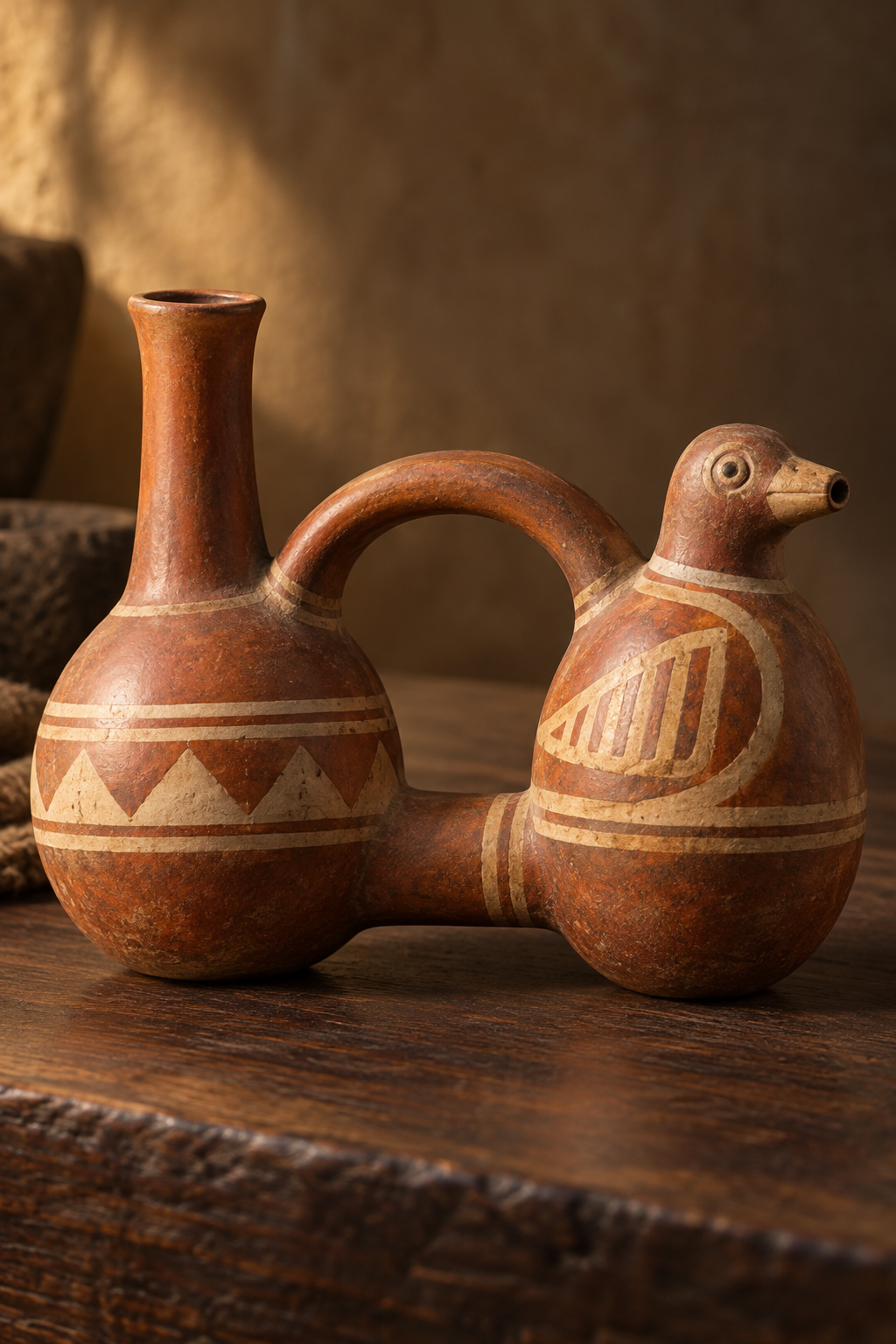
Generated illustration of a two-chamber Andean-inspired pottery vessel with a pouring spout and bird-shaped whistle.
An interpretive vessel inspired by Andean ceramic sound-making traditions. Generated illustration.

A ceramic bird sits quietly on a shelf. Tilt the vessel beneath it and, in certain designs, a warbling whistle emerges. Ancient Andean potters made objects that are both sculptures and sound-producing devices. Moving water helps move air, and a small feature hidden in the pottery turns that air into a voice.

The water is a moving part

A whistling vessel may have one chamber or two connected chambers. Depending on the design, it can be sounded by blowing into a spout or by allowing liquid to move inside. The mechanism is not the same in every example.

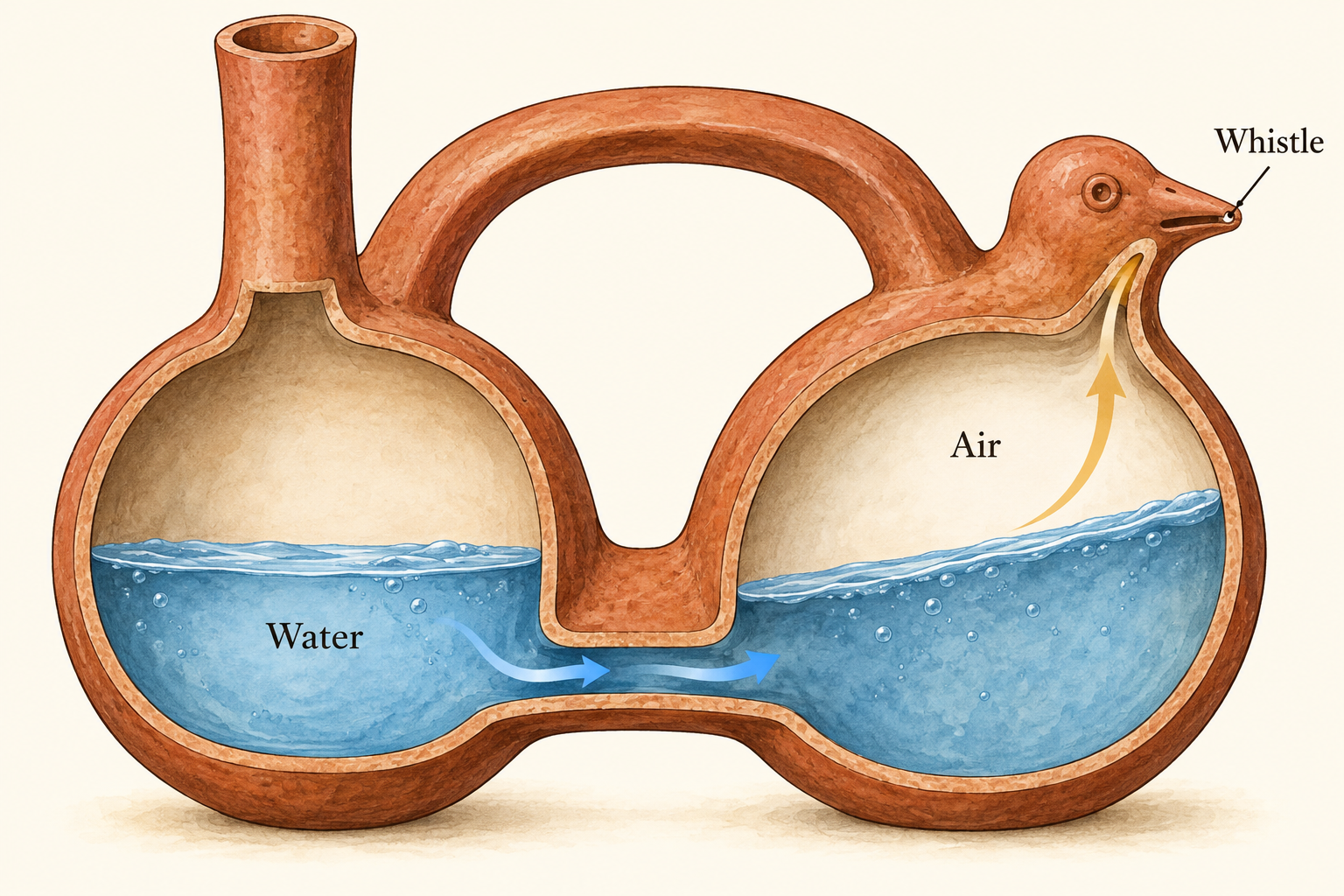
The Metropolitan Museum of Art describes a Chimú double-chamber jar from Peru's north coast. When partially filled and rocked, water passes between the chambers. Displaced air travels through the whistle in the modeled bird's beak, producing a twittering sound.

The water therefore contributes to an air-driven instrument. It does not need to vibrate like a string or strike a surface like a drum. Shape, passages and openings govern how air reaches the whistle. A potter had to consider the interior as well as the attractive exterior.

Generated conceptual cutaway showing water moving between vessel chambers and air passing toward a whistle.
A simplified cutaway explains displaced air; actual vessel passages and whistle forms vary. Generated illustration.

A family of designs, not one mysterious object

Such vessels belong to a wider history of Andean sound-making ceramics. The Met's collection also includes a Wari feline-shaped jar dated approximately 500–900. Its description explains that tilting the partly filled bottle forces air out to make sound.

The feline's painted coat, burnished surface, spout and bridge handle show how carefully visual and acoustic features could be combined. A figure that looks decorative can also house part of the functional design.

Moche artists made whistling vessels too, including architectural forms discussed in the Met's publication Design for Eternity. In one example, the sound mechanism is concealed as a figure within a miniature structure. The vessel makes us look for an unexpected relationship between modeled space and airflow.

We can hear the mechanism more clearly than its meaning

It is possible to explain how an object makes sound while remaining uncertain about exactly when and why people used it. The Met notes the limits of knowledge about the original roles of many pre-conquest instruments. Ceremonial interpretations may be plausible, but a pleasing modern demonstration cannot establish a complete ancient ritual.

Even the sound invites caution. An old object, a restoration and a modern replica can differ. A demonstration tells us something about the particular instrument being played and the way it is being handled.

What survives securely is a remarkable union of craft and observation. These makers shaped clay so that movement, air and an animal form worked together. They understood how an apparently ordinary container could do something surprising.

The next time a vessel whistles in a museum recording, imagine the planning hidden behind its surface. A little ceramic bird can contain a sophisticated idea about motion, pressure and sound.

Sources and further listening: The Met's Chimú whistling jar and audio; Wari feline whistling jar; Design for Eternity: architectural sound vessels.

Explore music, art and creative curiosity at Incoprea.

Uluburun: A Bronze Age Trade Network on the Seabed

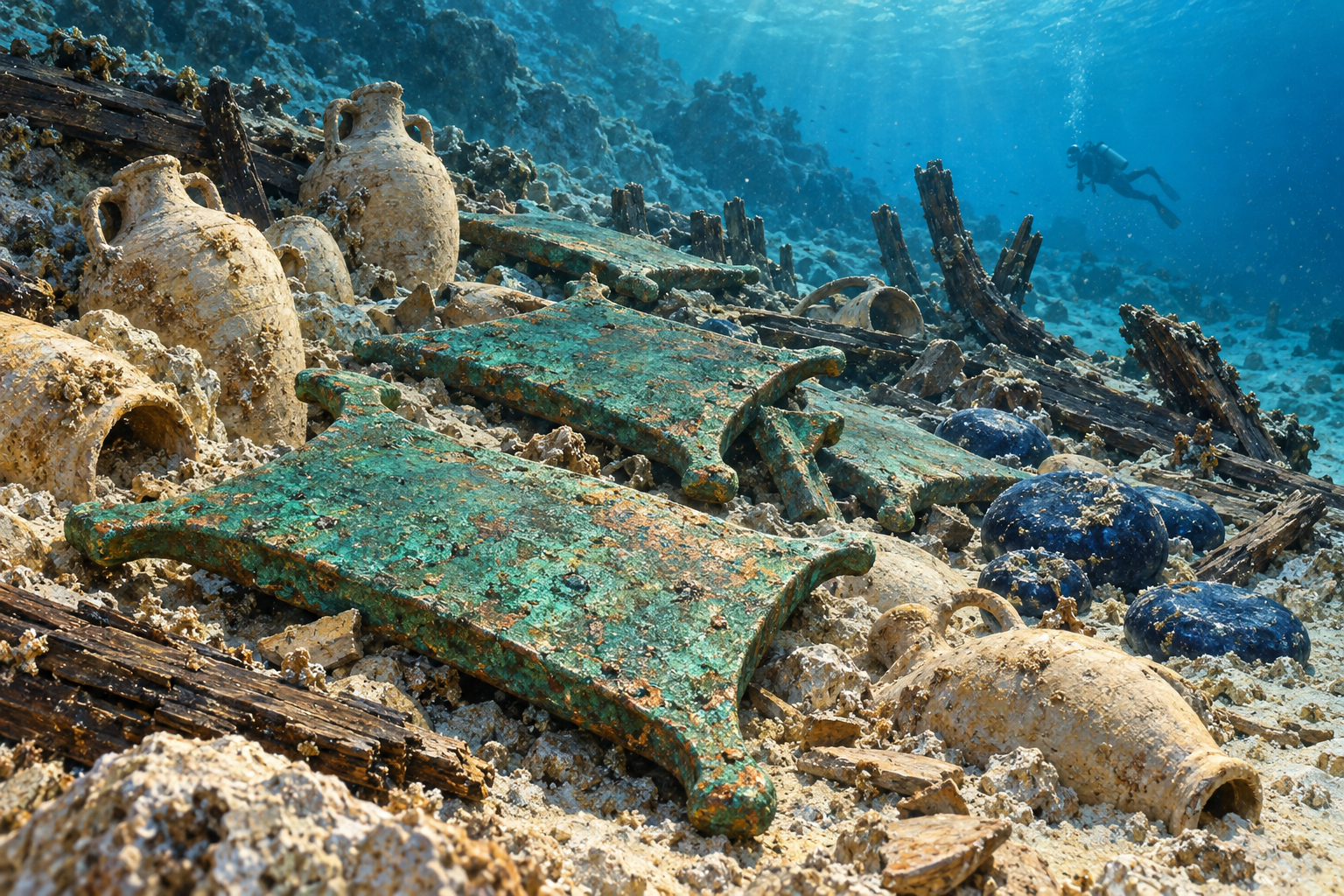
Generated illustration of Bronze Age copper ingots, storage jars and glass cargo on an underwater wreck site.
A cargo-inspired scene, rather than a reconstruction of the excavated site layout. Generated illustration.

The first clue was a strange shape on the seabed. In 1982, a Turkish sponge diver spotted objects he described as metal biscuits with ears. They were part of a shipwreck that would offer an extraordinary view of Late Bronze Age exchange: the Uluburun wreck, near KaÅŸ on Turkey's Mediterranean coast.

A cargo larger than one story

The Institute of Nautical Archaeology excavated the wreck over eleven seasons between 1984 and 1994. The ship sank more than three thousand years ago, around the late fourteenth century BCE. Its cargo included substantial quantities of copper and tin, the metals combined to make bronze.

Many copper ingots had an oxhide shape: broad slabs with projecting corners. Those distinctive forms were the diver's biscuits with ears. They make raw material visible as organized cargo, rather than as a finished tool in a museum case.

Other finds included pottery, glass ingots, ivory, jewelry and beads. Some objects were valuable finished goods; others were materials waiting to be transformed. A single voyage could link extraction, manufacture, transport and elite consumption.

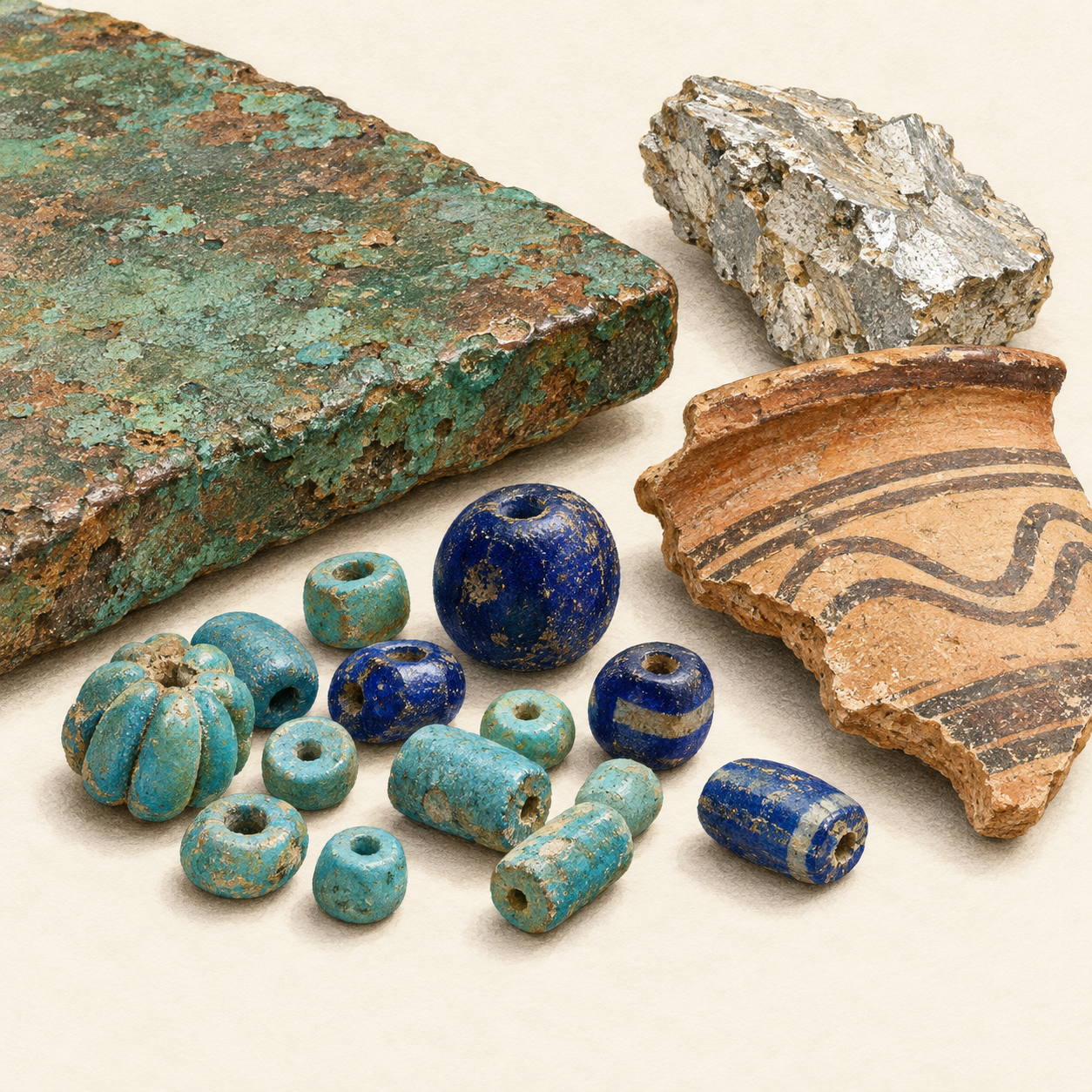
Generated illustration of beads, copper, tin and pottery inspired by the range of Uluburun cargo.
Different materials reveal different connections. These interpretive examples are not a catalog of exact finds or relative sizes. Generated illustration.

Small objects explain the large network

A study at Texas A&M examined the wreck's many faience and glass beads. Their abundance points to beads as an important trade commodity, not merely incidental decoration. Ordinary-looking units of cargo can reveal the scale of an industry.

Personal belongings and shipboard equipment add another layer. They need to be distinguished from goods intended for delivery. A balance weight might help explain exchange practices, while an object belonging to a traveler raises a different question.

Cemal Pulak's account of the wreck emphasizes the diversity of the assemblage: raw materials, manufactured objects, personal effects and equipment found together. That association is what makes a carefully excavated shipwreck so powerful. Objects that might be isolated clues on land arrive as parts of one archaeological setting.

Connected does not mean fully mapped

The cargo points toward a highly interconnected Mediterranean world. It does not hand researchers a complete shipping manifest, exact route or uncontested identity for every person aboard. A material's source, an object's style, the owner's origin and the ship's last port are different questions.

Scientific analysis and comparison can narrow those possibilities. The surviving hull and anchors also matter, even when they are less glamorous than jewelry. They help investigate how such a load traveled at all.

The wreck's fascination lies in that mixture of scale and detail. A heavy ingot belongs to metallurgy; a small bead belongs to adornment; a storage jar belongs to packaging and provisions. Together they show people moving diverse goods across long distances.

Uluburun makes the Bronze Age feel less like a collection of separate civilizations and more like a world of relationships. The ship stopped traveling, but the objects it carried still let us follow connections that once crossed the sea.

Sources and further reading: Institute of Nautical Archaeology excavation account; Cemal Pulak: Uluburun Shipwreck; Texas A&M study of faience and glass beads.

Explore more history, art and curiosity at Incoprea.

Pazyryk: The Ice That Preserved a World of Animal Art

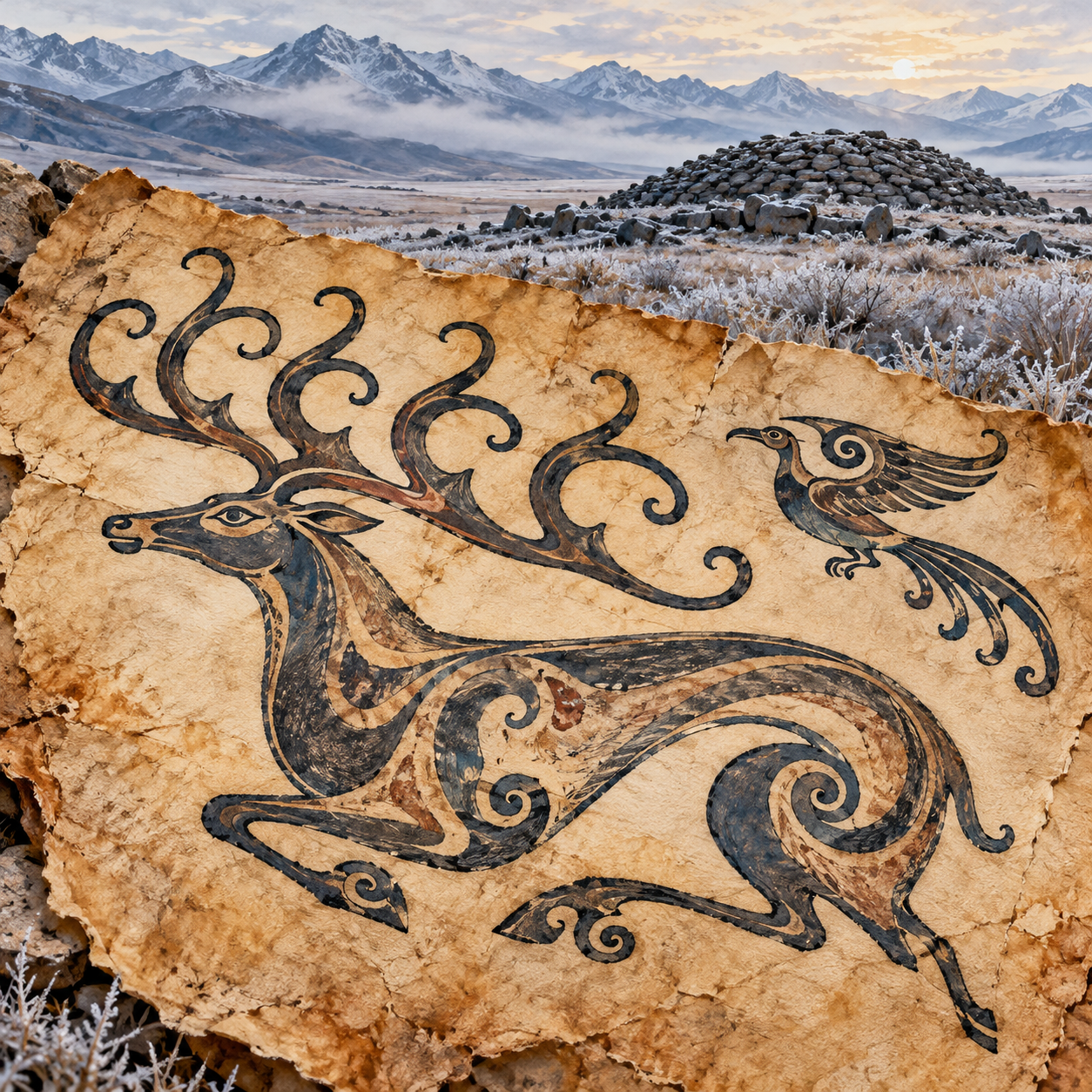
Generated illustration of an animal-style deer and bird on parchment against a frosty Altai burial-mound landscape.
Interpretive animal motifs inspired by the artistic tradition, drawn on paper rather than skin. Generated illustration.

Gold and stone often survive long enough to dominate our picture of ancient life. Cloth, leather, wood and skin usually fare less well. The frozen burials associated with the Pazyryk culture in the Altai Mountains offer an unusual exception. Ice preserved materials that allow researchers to see a world of clothing, craftsmanship and elaborate tattoo art.

A remarkable accident of preservation

At some burial mounds, water entered underground chambers and froze. The ground remained cold enough that the contents did not thaw during summer. The result was an exceptional archive of organic materials more than two thousand years old.

Pazyryk belongs to the wider early Iron Age world commonly called Scythian. That term covers varied pastoralist peoples across a vast region, rather than one uniform society with identical customs everywhere.

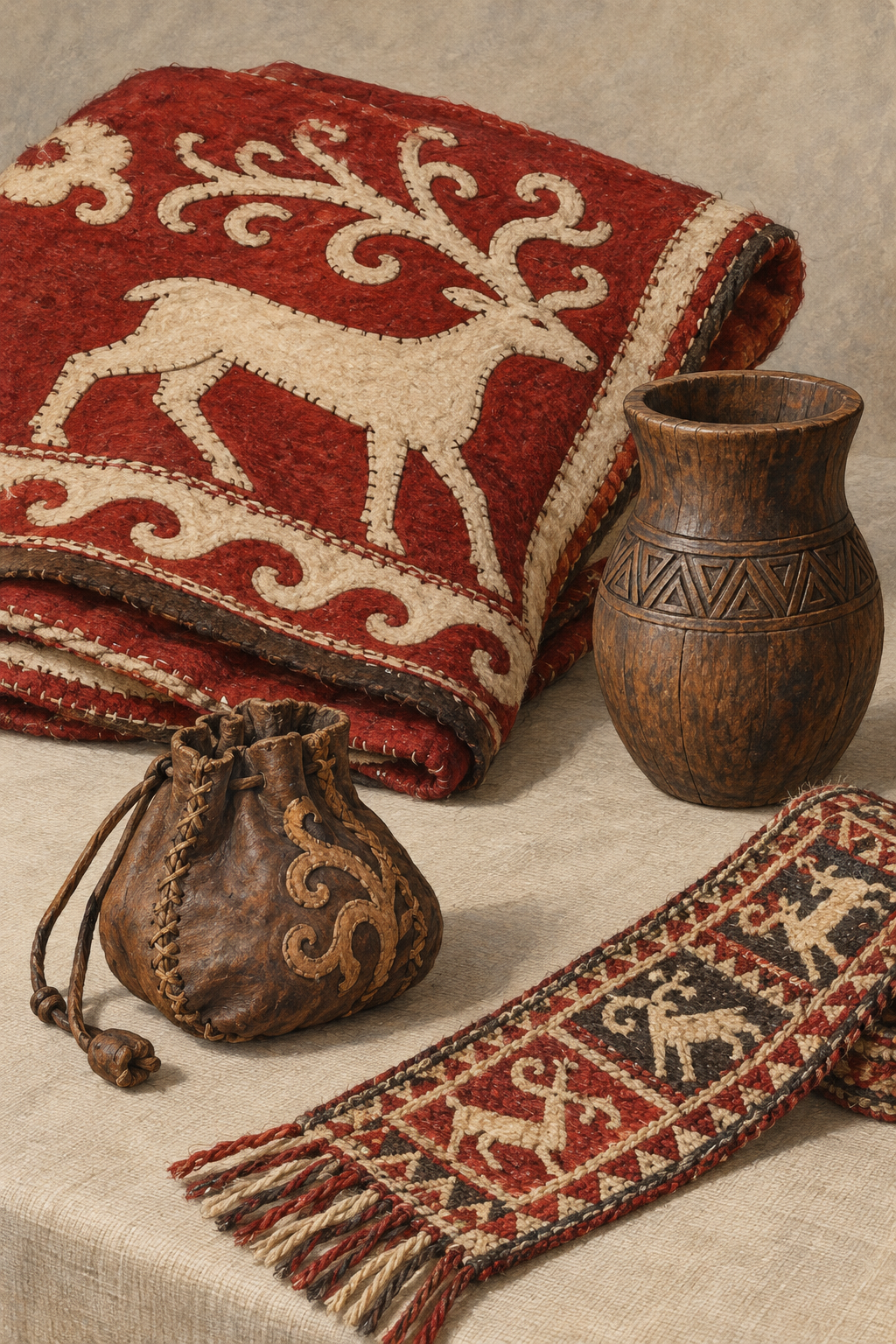
The burials contained personal ornaments, wooden and pottery vessels, leather items, textiles and other objects. Their survival changes what can be investigated. A metal ornament can suggest how someone dressed, but an actual garment or leather object can reveal construction and material choices directly.

Generated illustration of felt, leather, wood and woven cloth inspired by materials preserved in Pazyryk burials.
Ice can preserve organic materials that disappear at many other sites. These are imagined examples of craft types. Generated illustration.

Images carried on the body

Preserved tattoos include animals and fantastical composite creatures. Their flowing forms connect with the animal-style art visible on other objects from the region. The images are intricate enough to invite appreciation as art before we try to assign them a single meaning.

Their original significance is harder to recover. A tattoo may have expressed affiliation, belief, personal history or more than one idea. Similar-looking imagery does not guarantee that every wearer understood it in the same way. Modern interpretations should remain tied to evidence.

A 2025 study in Antiquity used high-resolution near-infrared imaging and experimental comparison to investigate how Pazyryk tattoos were made. It moved beyond broad descriptions of style toward the details of tools, marks and technique. The authors argue that the improved data can help distinguish individual artistic hands.

Preserving the person behind the pattern

That shift is compelling. A familiar design is not just a cultural symbol reproduced automatically. Someone created it, with particular skills and decisions. Looking at the marks can bring the maker back into a story that otherwise speaks only about a whole people.

Frozen burials also require care in how they are discussed. The preserved individuals were people, and the images attached to them are part of human lives and funerary histories. Curiosity about the art need not turn the remains into spectacle.

The physical conditions that preserved this evidence are themselves important. Researchers note threats to frozen archaeological sites from warming and thawing. An unusually rich archive can also be unusually vulnerable.

Pazyryk rewards a broader idea of an ancient treasure. It may be a textile, a worked piece of wood or a line in a tattoo whose maker has been gone for centuries. The ice kept details that let us see more than the durable objects normally left behind.

Sources and further reading: British Museum: frozen burials and their contents; Introduction to the Scythian world; 2025 research on Pazyryk tattooing methods.

Explore art and unusual history at Incoprea.

Chuño: The Andean Potato Technology Built Around the Weather

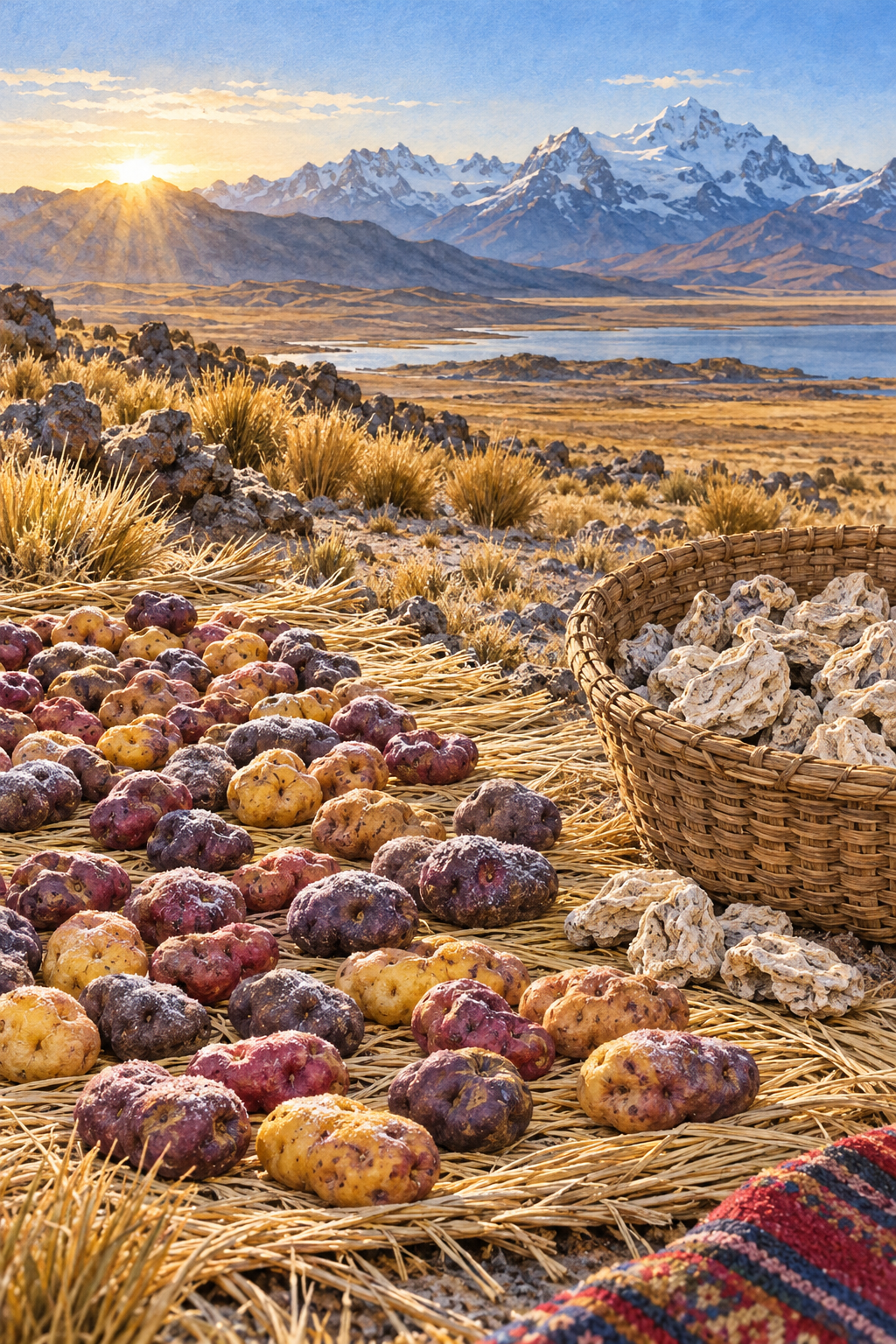
Generated illustration of potatoes and dried chuño in a woven basket on a frosty Andean plateau.
An interpretation of highland conditions and potato preservation, not a step-by-step processing guide. Generated illustration.

A cold night that threatens a crop can also help preserve it. In the high Andes, generations of farmers have used freezing temperatures, dry air and sunlight to transform potatoes into chuño. It is a food with a long history and an inventive method: make the local climate part of the processing system.

Preservation beyond a fresh harvest

Fresh potatoes contain considerable water. Turning them into a dry, storable product changes how long a harvest can remain useful. Chuño is often described as a traditional freeze-dried potato, although the process includes human labor and several operations rather than one automatic natural event.

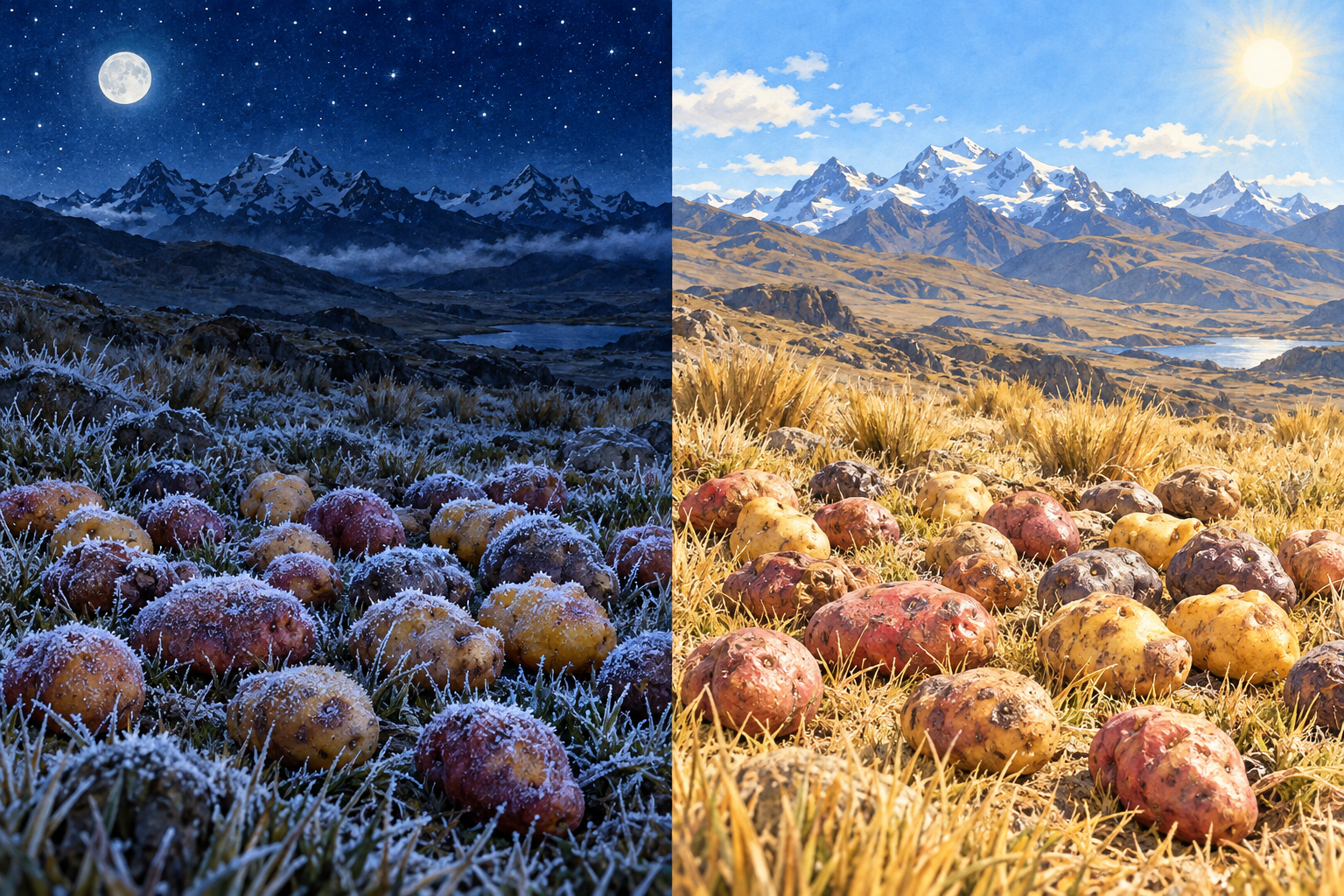
The Food and Agriculture Organization describes freezing at night and exposure to solar radiation during the day as central elements. People also tend and handle the tubers, and some methods include treading and peeling. The landscape supplies conditions; experienced producers organize the work.

That combination is the technology. Knowing which potatoes to use, when conditions are suitable and how to manage the material is as important as the frost itself. An open field does not become a food-processing system without knowledge.

Generated comparison of potatoes exposed to a frosty Andean night and a dry sunny day.
Cold nights and dry daytime conditions are part of the environmental knowledge behind chuño. This comparison is conceptual, not a processing timetable. Generated illustration.

There is more than one kind of chuño

Black and white chuño differ in their processing. A study by Stef de Haan and colleagues describes regional variants in Peru. Black chuño involves tending, treading, freezing and drying, while white chuño typically includes exposure to water in a more elaborate sequence.

The white product is also known by names including tunta and moraya in different settings. The FAO's profile of a Peruvian producer describes a long sequence using freezing, water and drying. It should be read as one documented tradition, rather than a universal timetable for every region.

The study found that processing choices reflect tradition, environmental conditions and market demand. Available water matters. So do the cultivar and the qualities people want in the finished food. The method is local and adaptable, not a single recipe copied unchanged everywhere.

An old practice with a living future

Chuño is not merely an archaeological curiosity. Contemporary producers continue to make and sell it, preserving expertise through practical work. The FAO notes its mention by early Spanish chroniclers, but the tradition belongs just as much to people carrying it forward today.

It is tempting to describe such a technique as simple because it does not require industrial machinery. A better description is carefully matched to its environment. Timing, repetition and judgment can make a process sophisticated even when its tools are familiar.

The same dependence creates a vulnerability: a method organized around reliable cold nights needs those nights to occur. Understanding traditional processing therefore also means understanding the climate and local resources that support it.

Chuño makes an everyday food tell a larger story about ingenuity. The achievement is not just saving a potato. It is turning detailed knowledge of a place into a practical way of keeping a harvest useful.

Sources and further reading: FAO: chuño blanco and living production traditions; De Haan and colleagues: regional processing variants; FAO: potato processing and local conditions.

Discover more creative connections at Incoprea.

Viking Sunstones: A Beautiful Optical Idea with an Evidence Gap

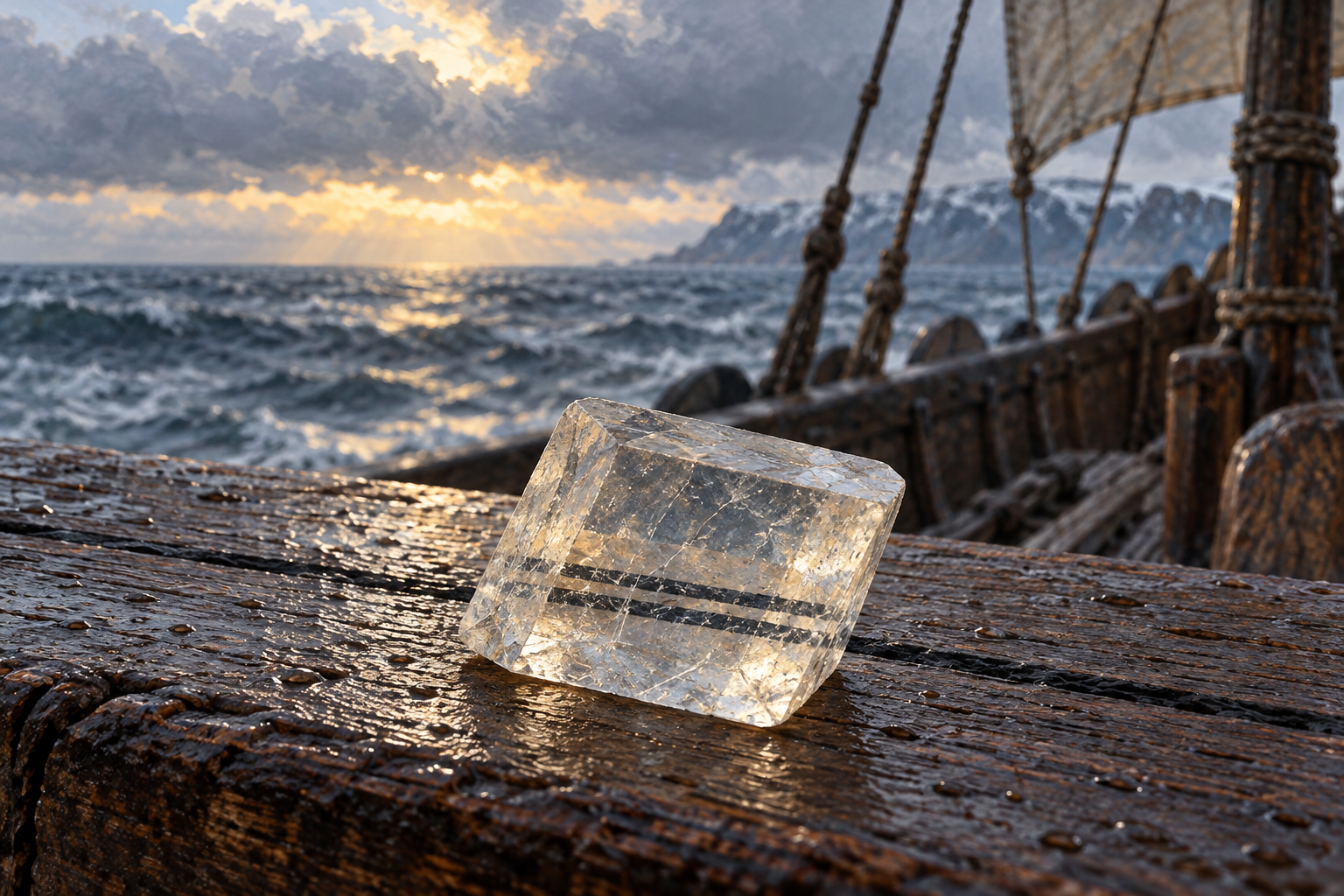
Generated illustration of a clear calcite crystal doubling a dark line, with a cloudy sea and wooden vessel behind.
A visual interpretation of the optical hypothesis, not evidence of a recovered Viking tool. Generated illustration.

A transparent crystal that helps a sailor locate the Sun behind clouds sounds like a detail from a saga. It is also the basis of real optical experiments. The proposed Viking sunstone sits at the meeting point of those two worlds: a physical method that can be tested and a historical use that has not been securely established.

The sky contains more information than brightness

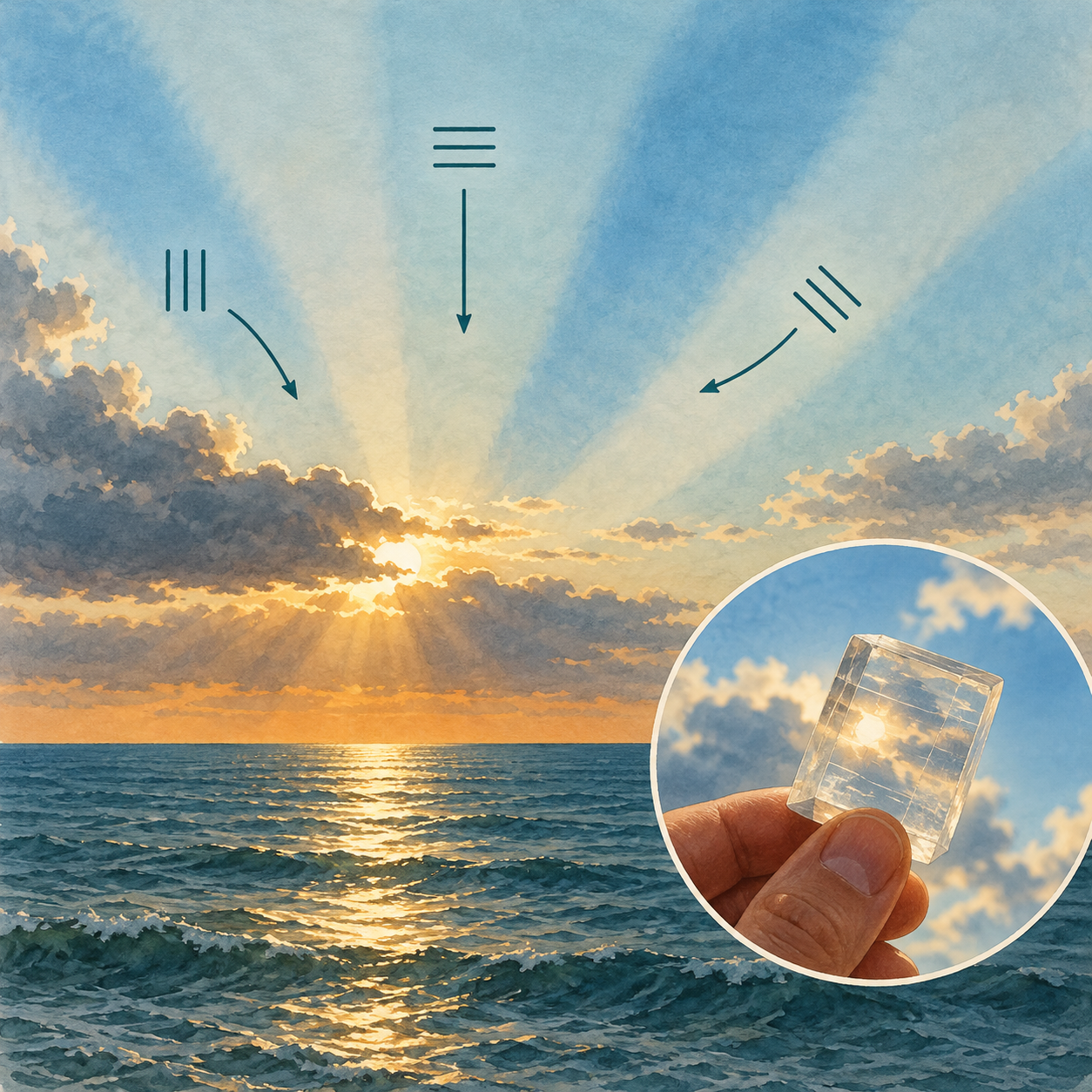
Light scattered in the atmosphere can become polarized, meaning its vibrations have a patterned orientation. Under suitable conditions, that pattern contains information related to the Sun's position, even when the Sun itself is difficult to see.

Certain crystals can help reveal differences in polarization. Transparent calcite, often called Iceland spar, is a prominent candidate. It also produces double refraction, making an image seen through it appear doubled. Other minerals have been investigated as possible sunstones too.

None of this requires a crystal to glow, possess a compass needle or respond mystically to north. It is an interaction between light and material. Turning the interaction into useful navigation requires observation, interpretation and a workable procedure.

Generated conceptual illustration of polarized skylight and a transparent crystal.
Sky polarization is a physical effect. The symbols are conceptual and do not establish how Viking navigators worked. Generated illustration.

What experiments can actually demonstrate

Studies have tested crystal-based methods of estimating directions under different conditions. Researchers have considered combining such observations with a proposed Sun-compass system. These investigations can show whether a procedure is feasible and how large its errors might be.

A 2017 study also acknowledged the practical limits of idealized tests. A cold, rolling vessel is a more difficult observation platform than a laboratory or planetarium. Crystal quality, sky conditions and a person's ability to make a judgment all affect performance.

A 2026 article in the American Journal of Physics uses the idea explicitly as a laboratory exercise rooted in speculative history. Its observations found polarization-based navigation most useful under partly cloudy conditions, with fully obscured skies making the signal difficult or impossible to observe in that activity.

Could have is an important phrase

Medieval references to a sunstone invite interpretation, but they do not supply an unambiguous manual for crystal navigation at sea. A successful modern demonstration cannot turn a literary passage into a complete equipment list.

The historical claim therefore needs to be kept separate from the optical result. Showing that a crystal-assisted method can work establishes a possibility. Showing that Viking navigators actually used it requires evidence from their world.

That gap does not make the topic a disappointment. It makes it a useful example of how disciplines ask different questions. A physicist can investigate light; a historian can examine the wording and setting of a text; an archaeologist can test an object's context.

The sunstone is most interesting when those questions remain visible. The crystal's behavior is remarkable enough on its own, and the unresolved history gives us a reason to keep looking carefully rather than announce that a saga has been proved.

Sources and further reading: Royal Society: experimental sunstone research; Study of hypothetical navigation accuracy; 2026 physics teaching study.

Explore more unexpected science and history at Incoprea.

Roopkund Lake: The Discovery That Made a Mystery More Complicated

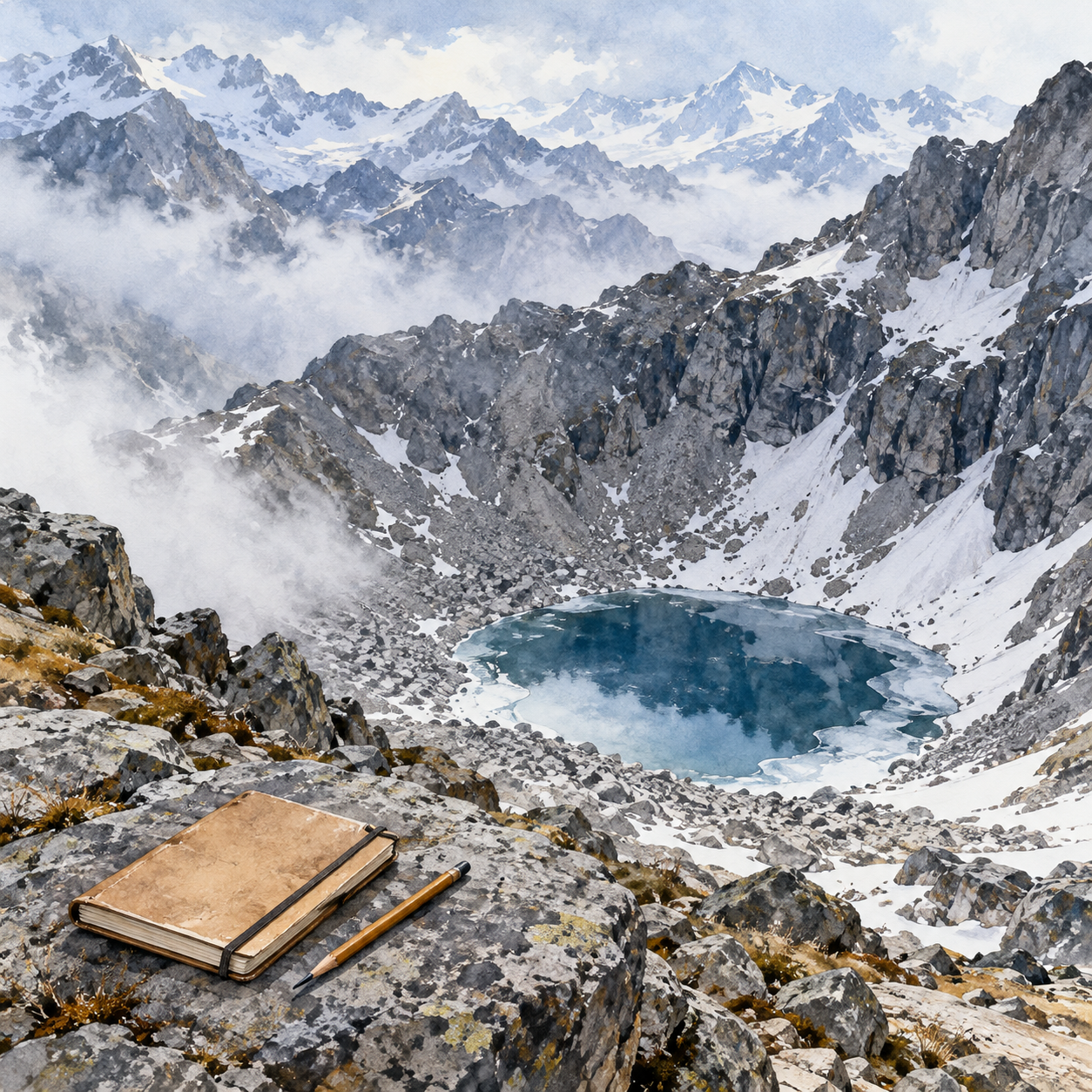
Generated illustration of a small high Himalayan lake among rocky slopes, with a field notebook in the foreground.
A landscape inspired by the site's high-altitude setting, not a documentary view. Generated illustration.

High in the Indian Himalayas, a small lake holds an unsettling archaeological question. Human remains scattered around Roopkund have inspired stories of a single disaster. A scientific study published in 2019 revealed a more complicated picture: the sampled individuals did not all belong to one population or one time.

The same place, different centuries

Roopkund sits more than five thousand meters above sea level. Its remote setting makes a dramatic shared fate easy to imagine. Yet an object's location does not by itself establish when it arrived there, and people found together are not necessarily people who traveled together.

The 2019 research combined ancient DNA, radiocarbon dating, stable-isotope measurements and examination of the remains. Genome-wide data from thirty-eight individuals clustered into three ancestry groups. Twenty-three had ancestry within the range of present-day South Asian variation, fourteen had eastern Mediterranean-related ancestry, and one had Southeast Asian-related ancestry.

These are genetic relationships, not passport labels. They do not automatically tell us a person's birthplace, language or identity. The surprising pattern provides evidence to investigate, rather than a complete biography.

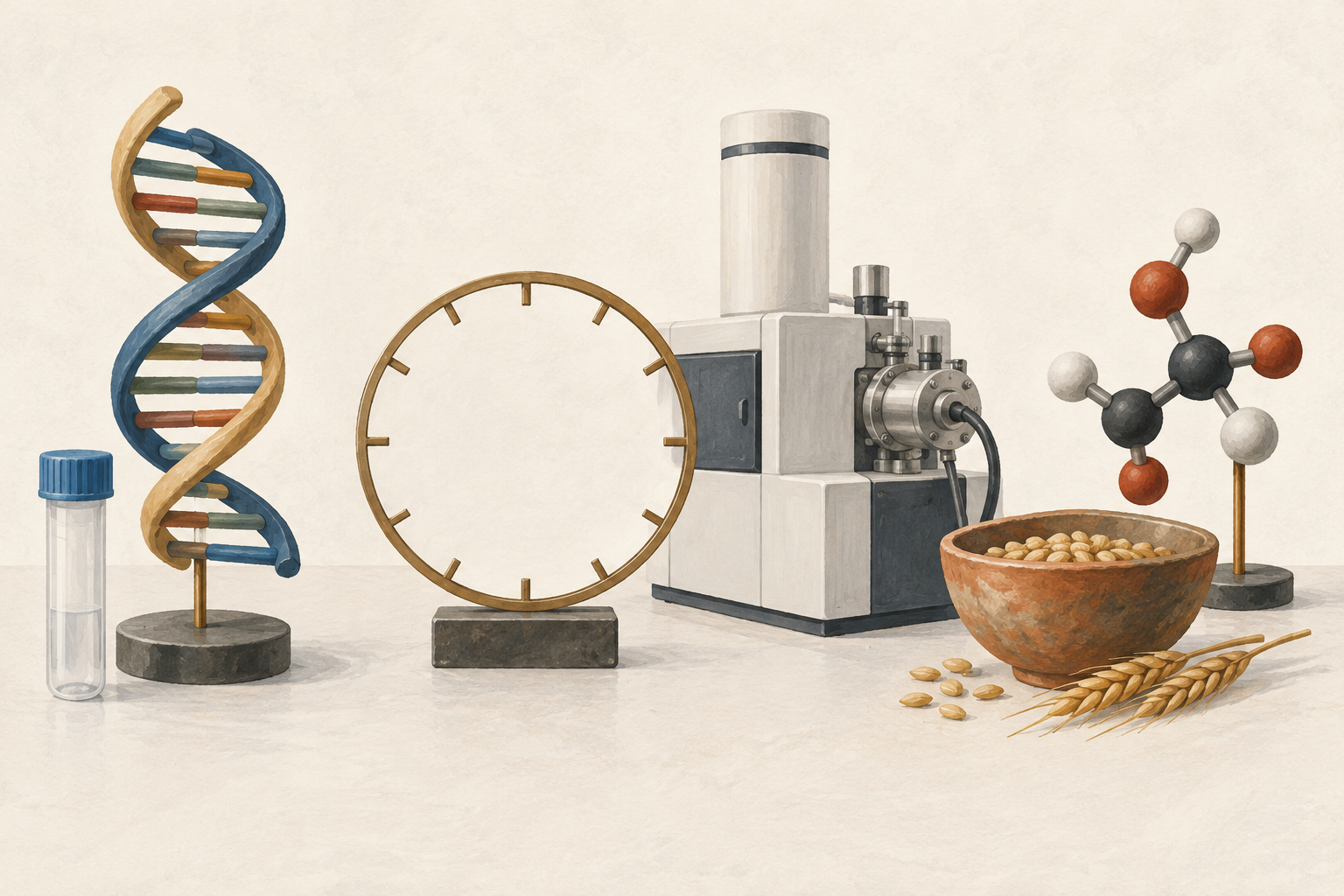
Generated illustration symbolizing genetic ancestry, radiocarbon dates and diet evidence.
Different laboratory methods answer different questions; the objects here symbolize those methods rather than the actual Roopkund samples. Generated illustration.

Dates disrupted the simplest explanation

Radiocarbon dating showed a large separation between the earlier and later groups. The study placed the South Asian-related individuals broadly around the first millennium CE and the other sampled individuals roughly a thousand years later. There was variation even within the earlier dates.

Penn State's account describes how unexpected dating results prompted researchers to check the laboratory records and analyze more material. The disagreement with an anticipated single-event explanation became a discovery when independent lines of evidence supported it.

The study therefore argues against explaining all the sampled remains with one catastrophic incident. It does not establish exactly how every person died, why the later group was there, or whether every individual at the site would fit the patterns in the sample.

A mystery needs context, not just a striking result

Roopkund's archaeological setting has been disturbed by rockslides and by visitors moving or removing material. That makes relationships among remains and artifacts harder to interpret. Losing context means losing information that even a sophisticated laboratory cannot simply restore.

The location is associated with a pilgrimage route and local traditions concerning Nanda Devi. Such traditions are part of the place's history. Connecting a particular tradition with particular sampled individuals, however, requires evidence rather than a convenient match.

The discovery is a useful example of scientific progress that opens more questions. Before testing, one story seemed capable of covering the whole scene. After testing, researchers could distinguish histories that had become mixed in the same landscape.

The unknown people at Roopkund deserve more than a dramatic nickname. Careful study can tell us something about their ancestry, dates and diets while acknowledging how much remains missing. The lake's strongest lesson is that an apparently single mystery can contain several human journeys.

Sources and further reading: Harney and colleagues' 2019 study; Penn State: the radiocarbon investigation.

Continue exploring unusual history at Incoprea.

Great Zimbabwe: The Stone City Built in an African Tradition

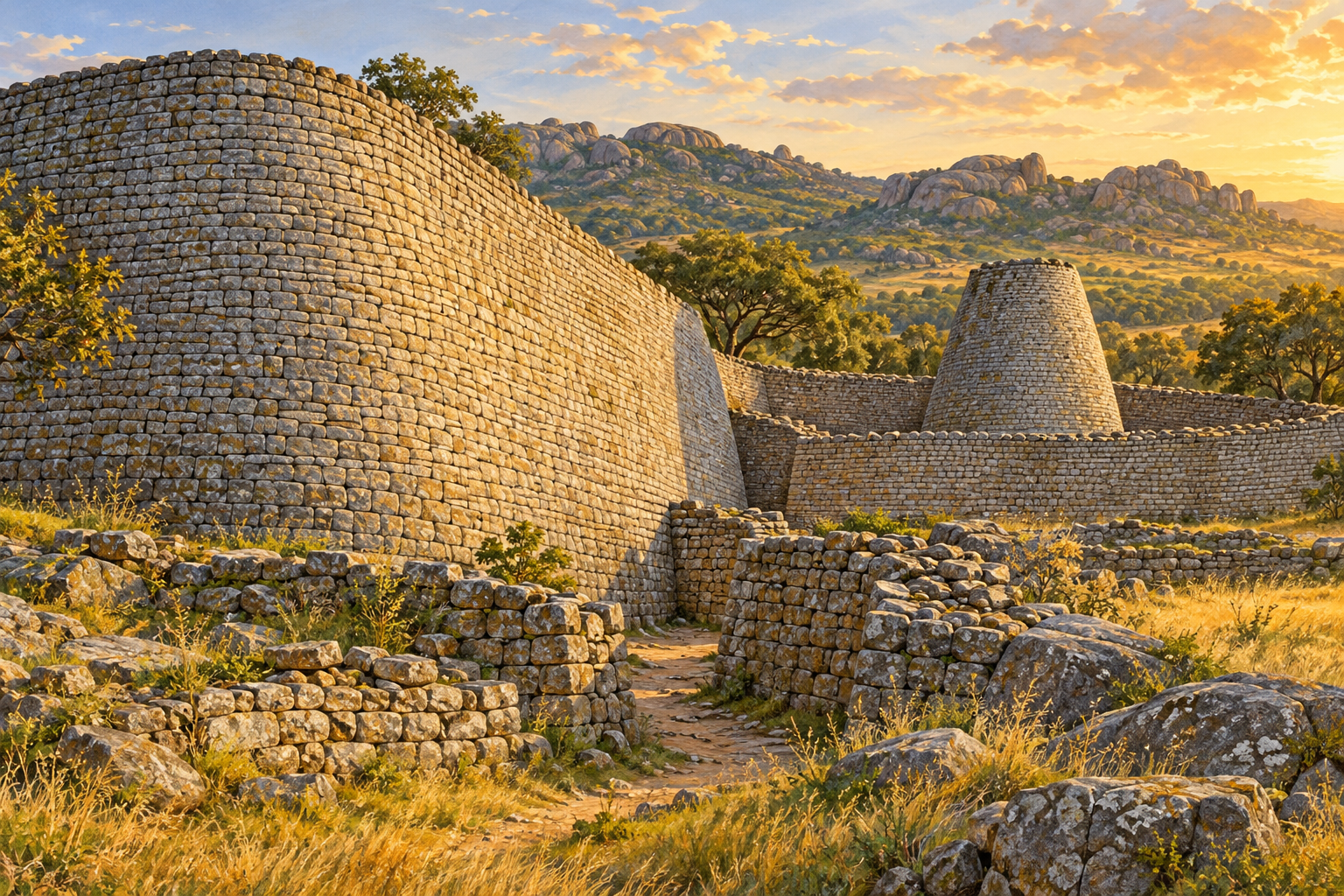
Generated illustration of curving granite walls and a conical stone tower inspired by Great Zimbabwe.
An architectural interpretation inspired by the Great Enclosure, not a measured site reconstruction. Generated illustration.

The walls of Great Zimbabwe do not need sharp corners to make an impression. They curve through the landscape in long courses of carefully fitted granite. Their scale is striking, but their craft is just as interesting: blocks laid without mortar, an architectural tradition shaped by local material and local knowledge.

A city, not just a surviving wall

Great Zimbabwe was a major African settlement and the capital of a state that influenced much of the Zimbabwean plateau. Its development began in the medieval period, with economic prominence especially between the twelfth and fifteenth centuries.

The best-known surviving areas include the Hill Complex, Great Enclosure and Valley Enclosures. The large stone walls were part of a built environment that also contained earthen structures. Surviving stone can therefore give an incomplete impression of what the occupied city looked like.

Granite from surrounding hills supplied an important resource. It could split into slabs and be worked into manageable blocks. Later masonry demonstrates especially close, level courses and flowing forms. The walls' broad bases and tapering profiles also contribute to their stability.

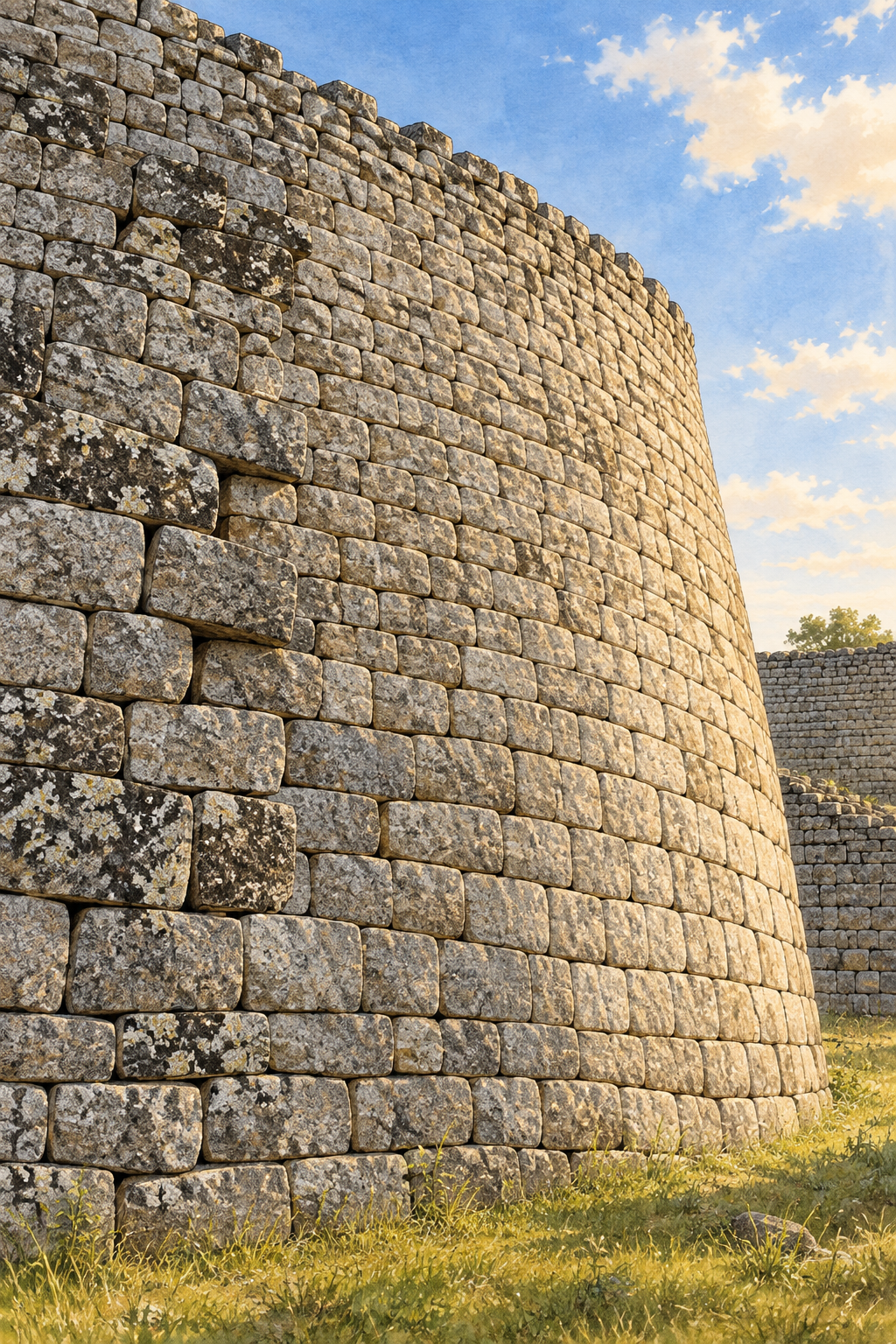
Generated architectural close-up of fitted granite blocks in a curving dry-stone wall inspired by Great Zimbabwe.
Skilled fitting and careful wall geometry help explain Great Zimbabwe's masonry. This is an interpretive view, not a measured reconstruction. Generated illustration.

Architecture connected to an economy

The city was sustained by more than impressive building. Archaeological evidence points to cultivation, livestock, weaving, metalworking and exchange. Imported glass beads and ceramics show connections extending toward Indian Ocean trade.

Those connections are part of the city's achievement, not a reason to assign its construction to outsiders. Earlier European claims of a foreign origin reflected prejudice, and archaeological investigation established its local African history. The builders belonged to the ancestors of Shona communities.

The carved soapstone birds associated with the site add an artistic dimension. Their exact meanings remain debated, though they have been interpreted in relation to authority and religious significance. Their modern role as national symbols gives the ancient work a continuing public life.

The questions worth asking now

Knowing who built a place does not mean that all questions about it have been answered. Researchers continue to investigate daily life, craft production, food systems and the surrounding settlements that supported the city.

A 2025 account by Tawanda Mukwende, a scholar at Great Zimbabwe University, emphasizes both material evidence and the importance of local Shona concepts in interpretation. A city's history is not adequately understood by measuring its walls alone.

The architecture offers a particularly useful lesson in what survives. Durable stone captures our attention, while the earthen buildings, wooden tools and ordinary activities may require different kinds of reconstruction. The monumental part and the everyday part belonged to the same society.

Great Zimbabwe is not an unexplained object waiting for an exotic origin story. It is a locally built city whose history becomes richer as investigators ask more precise questions. Look closely at the fitted blocks and then imagine the workshops, households and networks around them. The walls are a beginning, not the whole place.

Sources and further reading: Tawanda Mukwende's 2025 account; The Met: architectural tradition and historical interpretation; UNESCO World Heritage description.

Explore more art and cultural history at Incoprea.

Timbuktu's Manuscripts: A City of Readers, Teachers and Scribes

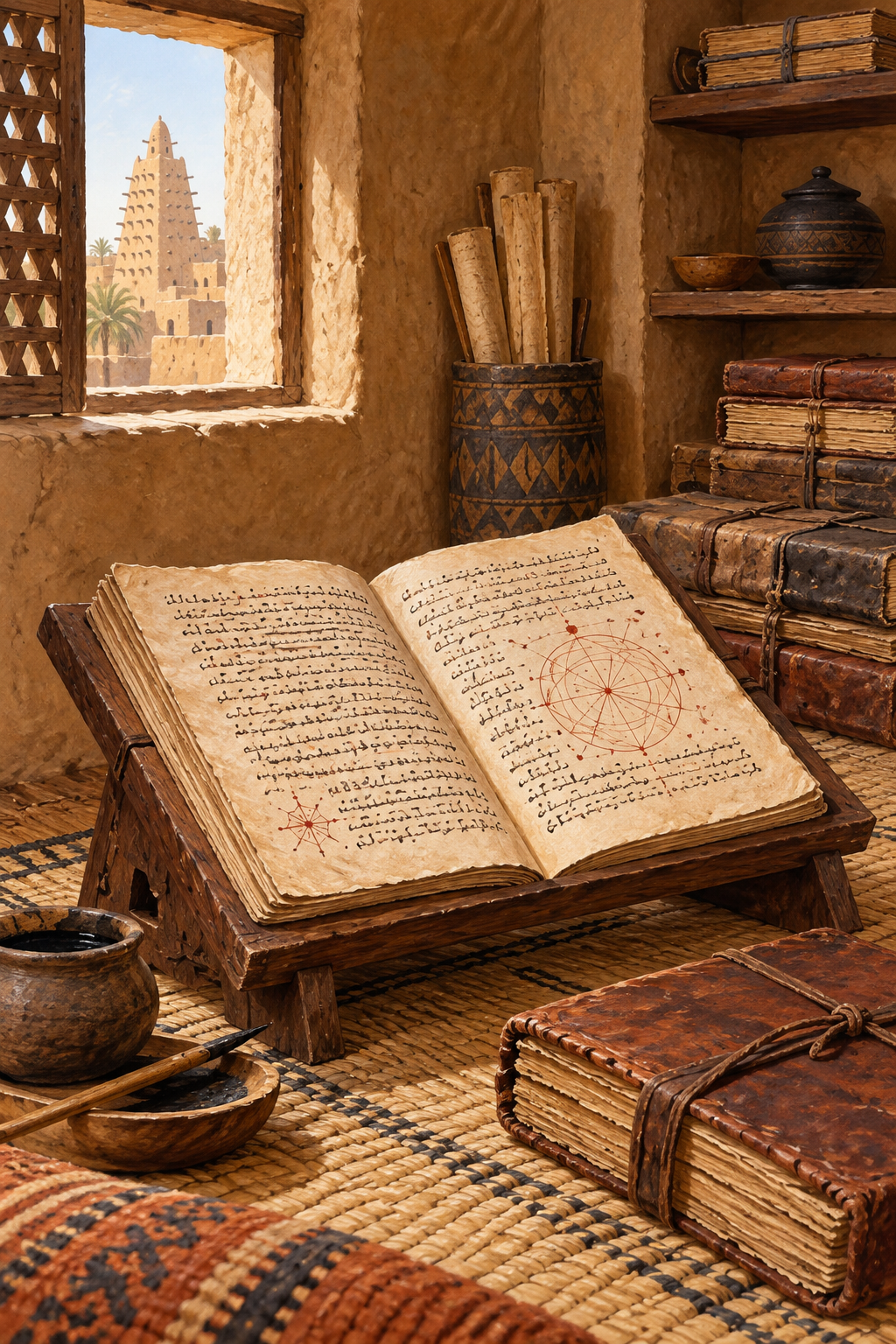
Generated illustration of an open manuscript, geometric diagram and leather-covered books in a Timbuktu-inspired study.
An imagined scholarly setting; the marks and diagram do not reproduce a specific manuscript. Generated illustration.

Timbuktu is often used as a synonym for somewhere impossibly distant. Its manuscripts tell a different story. This West African city was a place people traveled toward for knowledge, commerce and religious study. Its handwritten books preserve an intellectual world that is easier to appreciate by opening specific pages than by repeating a legend about hidden treasures.

What was on the page?

The Library of Congress's exhibition of manuscripts from Timbuktu includes works on astronomy, arithmetic, Islamic law, commerce and ethical conduct. These subjects belonged to a scholarly culture in which learning could connect religious understanding with practical questions.

One arithmetic commentary explains operations through charts and worked problems. Another manuscript uses verse to help students remember aspects of commercial law. A text on astronomy includes a diagram of the heavens and discusses using stellar motions to reckon the seasons.

The examples make the collection feel less abstract. A manuscript could train a student, organize an argument or address a legal problem. It was an object used in a practice, not simply a beautiful page intended for a modern display case.

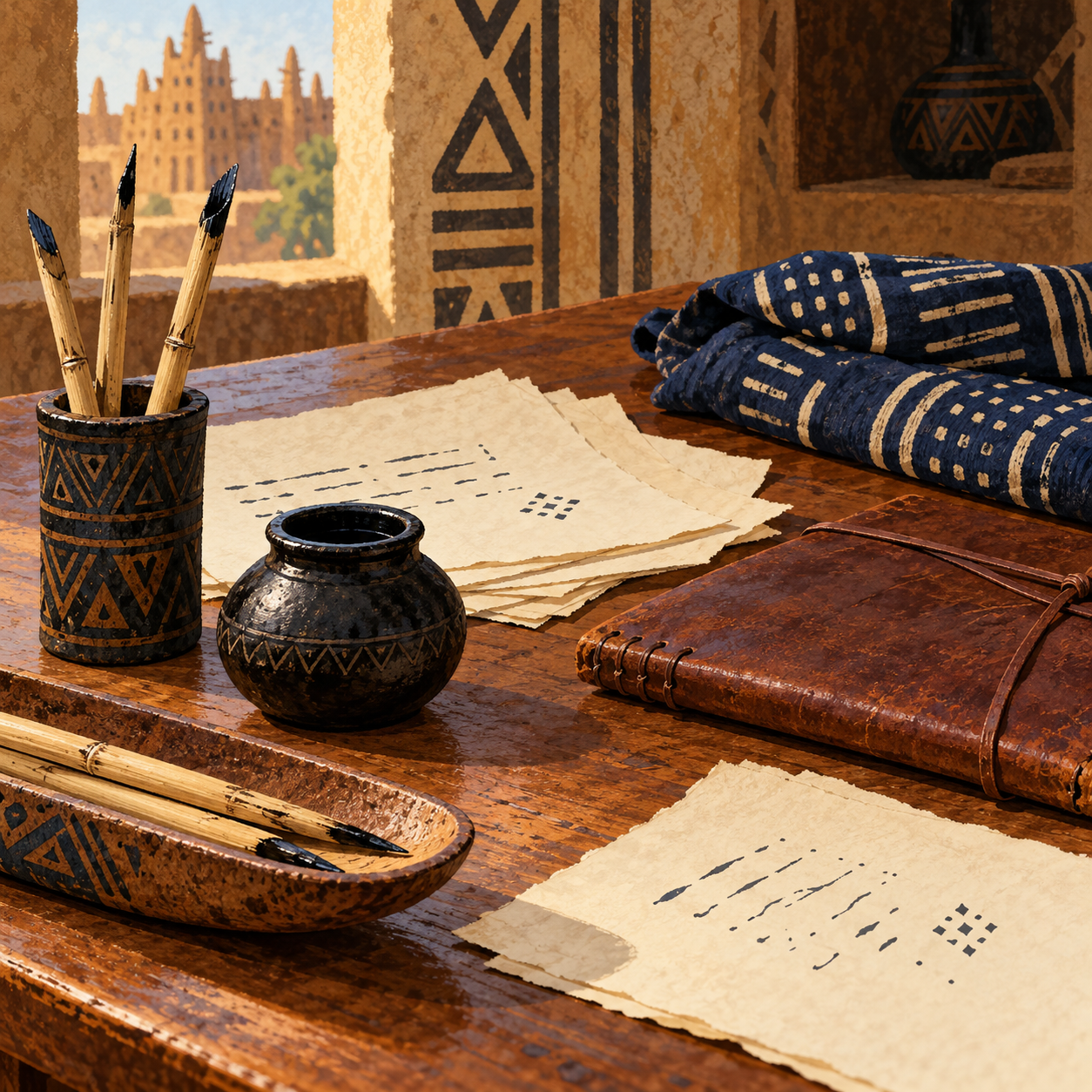
Generated illustration of reed pens, ink, writing sheets and book coverings.
Manuscripts also tell stories about materials and skilled copying. The tools and indistinct writing are imagined examples. Generated illustration.

A copy can contain a history

Many manuscripts preserve copies of works rather than unique authorial originals. That does not make them uninteresting duplicates. Producing a copy took labor, materials and choices, and the resulting object could acquire notes and a history of use.

A University of Hamburg research project examines scribes and copying practices in the broader Middle Niger manuscript collections. Its questions include how the work of professional copyists differed from that of students and scholars, and what decoration and materials can reveal about production.

The project also draws on contemporary testimony and the practices of living scribes. This links the physical archive with knowledge that does not reside on the page alone. A pen, an inkpot or a leather cover can be part of the scholarly story too.

Reading beyond the treasure label

A famous collection can attract attention through its scale, age or survival. Those are important features, but they should lead toward studying content. Which works were read? How were they taught? What kinds of commentary or correspondence survive? Different collections and periods may give different answers.

The phrase Timbuktu manuscripts also needs care. It can refer broadly to collections with connections beyond the city itself. The history of ownership, copying and movement matters when explaining an individual item.

Digital displays provide a useful starting point. The Library of Congress exhibition lets readers inspect selected pages with descriptions explaining their subjects. Even without reading the script, one can notice diagrams, layout and the material character of a particular manuscript.

The strongest reason to preserve these books is that people can continue to study them. They show scholarship as an activity carried by writers, teachers, readers and custodians. Timbuktu becomes more interesting when it stops being a shorthand for distance and becomes a place of intellectual work.

Sources and a page to explore: Library of Congress: Timbuktu's scholarly history; Browse manuscript pages and their subjects; University of Hamburg: scribes and copying practices.

Explore more art, ideas and creative work at Incoprea.
Silbo Gomero: A Sentence Whistled Across a Valley

A conceptual scene of whistled communication across La Gomera's terrain, with unnamed figures. Generated illustration. A whistle can mea...