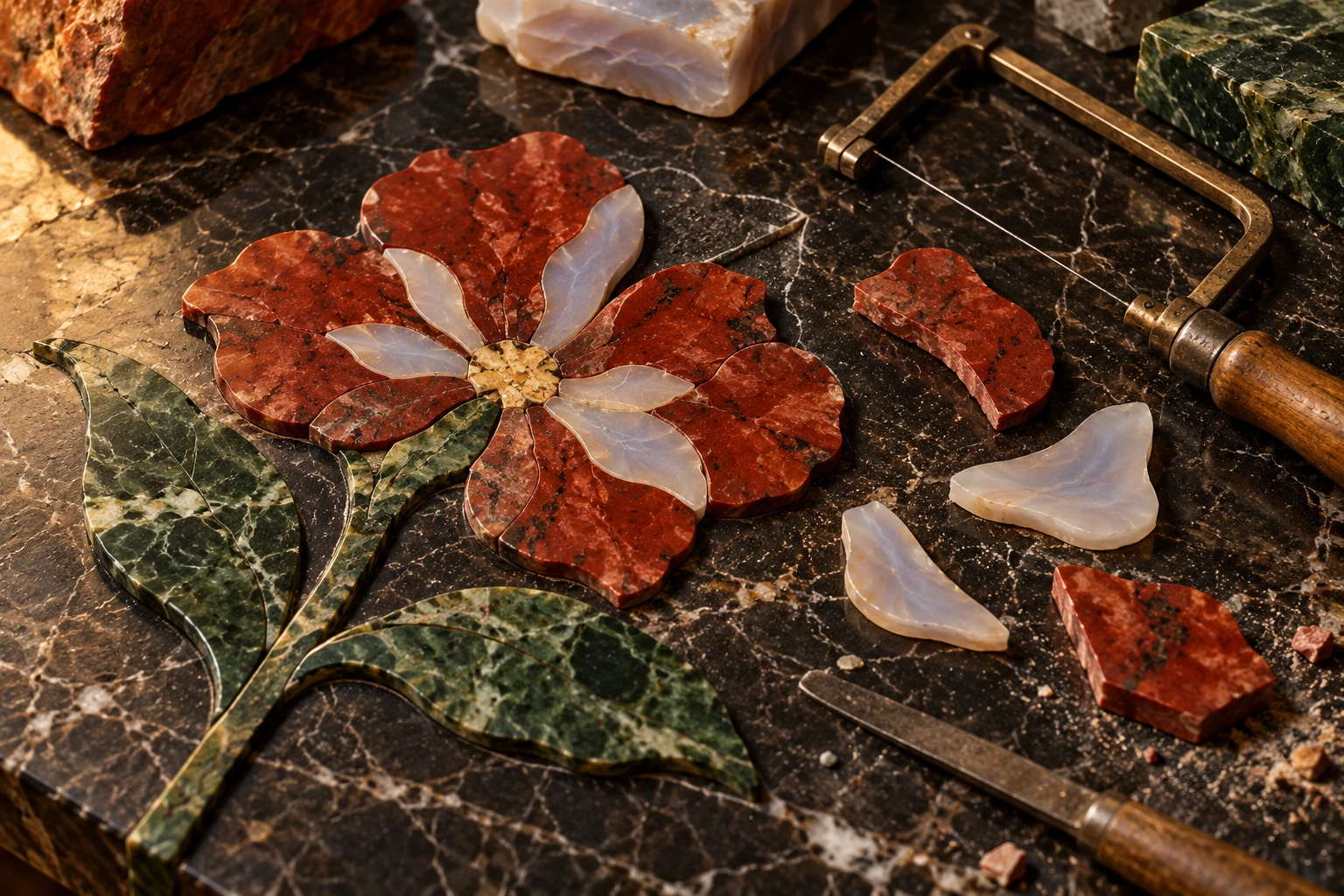
A stone flower can appear to have a painted highlight. Move closer and the pale edge may turn out to be a different mineral, fitted so precisely that the join nearly disappears. The shading might also run through a single piece of stone, selected and turned until its natural color did the work of a brush.
Hardstone inlay rewards this change of distance. From across a room, it is an image. At arm’s length, it becomes an assembly. Closer still, it records a conversation between a design and materials that arrived with patterns of their own.
The picture begins with a limited palette
The Victoria and Albert Museum’s technique explanation describes pietre dure as precisely cut hardstones arranged into an image or pattern, usually within a marble panel, then polished. It is tempting to think of the work as a jigsaw puzzle. That analogy misses a crucial difficulty: the artist is not simply dividing a printed image into pieces. Each piece must be found within the available stone.
The Metropolitan Museum’s account of the court workshops describes full-scale designs whose color instructions had to allow for the natural palette. Craftspeople could alter small details to exploit patterns in the hardstone. A damp abrasive on the wire of a bow saw helped cut the material. The skill includes looking for the right passage inside a slab, as well as shaping its perimeter.
A leaf offers an easy way to think about the problem. You need an outline, a general green, and perhaps a light vein. If an existing pale streak crosses the stone at the wrong angle, you can rotate the intended leaf, choose a different section, change the design, or accept another effect. Each choice changes what can fit around it.
Florence was a workshop, not an abstract style
The Opificio delle Pietre Dure’s museum traces its collection to the artistic manufacture founded by Ferdinando I de’ Medici in 1588. Its displays include stone samples, workbenches, tools, and demonstrations of production stages. Those material surroundings are part of the history: a court’s luxurious finished object required organized expertise, supplies, and sustained labor.
“Painting in stone” is a useful description of the visual ambition, provided it does not erase the differences from painting. A brush can lay one color over another. A fitted stone edge has to meet another edge. A naturally patterned surface cannot always be moved without changing the picture. The medium offers durable color and unusual depth, while imposing its own constraints.
The Met’s historical exhibition also follows the movement of workers and patronage among European courts. That is a more concrete account than saying a style simply “spread.” Skills traveled with people, commissions, workshops, materials, and the prestige attached to owning the result.
Read a small landscape in three passes
Try this looking sequence with the Met’s online image of a seventeenth-century Castrucci workshop landscape. The museum identifies agate, jasper, and other hardstones among its materials, and relates the workshop to Prague under Rudolf II. Its suggestion that the panel once belonged to a cabinet is presented as a likelihood, not a surviving complete furnishing history.
- First pass: read the view. Ignore the joins and follow the image’s space. Where does your eye enter? Which shapes seem distant? What creates a sense of depth?
- Second pass: follow boundaries. Look for a change that could be a fitted edge rather than a depicted outline. Notice when a boundary belongs both to the object and the scene.
- Third pass: inspect internal patterns. Find a streak, band, or mottled area within one piece. Ask how that geological pattern has been recruited to suggest a different material or a feature in the landscape.
You do not need to identify every mineral to enjoy this exercise. Indeed, the museum’s material list is a better starting point than guessing a gemstone from the color on your phone. Screen settings, lighting, polishing, and the natural range of stones all complicate identification.
A design exercise with found paper
For a safe, inexpensive way to explore material-led composition, collect a few scraps of patterned packaging or old magazine pages. Choose an original simple leaf or fruit shape. Before cutting, place a paper window over a scrap and move it around. Watch how the same outline changes when a printed streak becomes a vein or a pale area becomes a highlight.
Now impose a rule: use each scrap’s existing marks; do not paint new ones over them. Make three versions of the same shape with three different internal patterns. Compare which seems rounded, which seems flat, and which suggests an entirely different subject.
This is a paper analogy, not a lesson in cutting stone. It isolates one decision that a finished inlay can hide: finding an image inside material that is already patterned. The exercise also makes waste visible. The most useful section may occupy only a small part of the available sheet.
At the edge of a petal, compare the stone’s natural markings with the boundary the maker cut. One follows the material; the other establishes the image. Their meeting is where selection becomes composition.
The work continues after the masterpiece
A later example shows how many hands such projects could involve. The Uffizi’s account of the Table of the Muses describes work begun in the 1830s, with contributions to its elaborate base and final bronze casting as well as the stone decoration. The table reached its Pitti Palace setting in 1855. A finished object can therefore gather several materials, professions, and periods of labor into one apparently unified presence.
The present-day Opificio is also a conservation, research, and training institute. The name carries a history of making alongside an ongoing responsibility to care for things already made. Next time a polished surface seems effortless, look for the seam. It is where a material constraint became an artistic decision.
Sources and a closer look
V&A: how pietre dure is made; The Met: Art of the Royal Court; Opificio delle Pietre Dure museum; The Met: Castrucci workshop landscape; Uffizi: Table of the Muses; Italian Ministry of Culture: the Opificio today.
Find more art, ideas, and unexpected connections at Incoprea.