An e-reader can look almost stubborn after its battery dies. The last page may remain on the screen, even though pressing the buttons does nothing. This is not necessarily a frozen computer continuing to display an image. In an electrophoretic display, the visible arrangement can persist after the power that created it has gone away.
That detail shifts the question from “How is the screen lit?” to “What physical state is the screen holding?” Ordinary ink stays where a printer puts it. Electronic paper instead lets an electric field rearrange tiny pigment particles, then takes advantage of their ability to remain in a visible state.
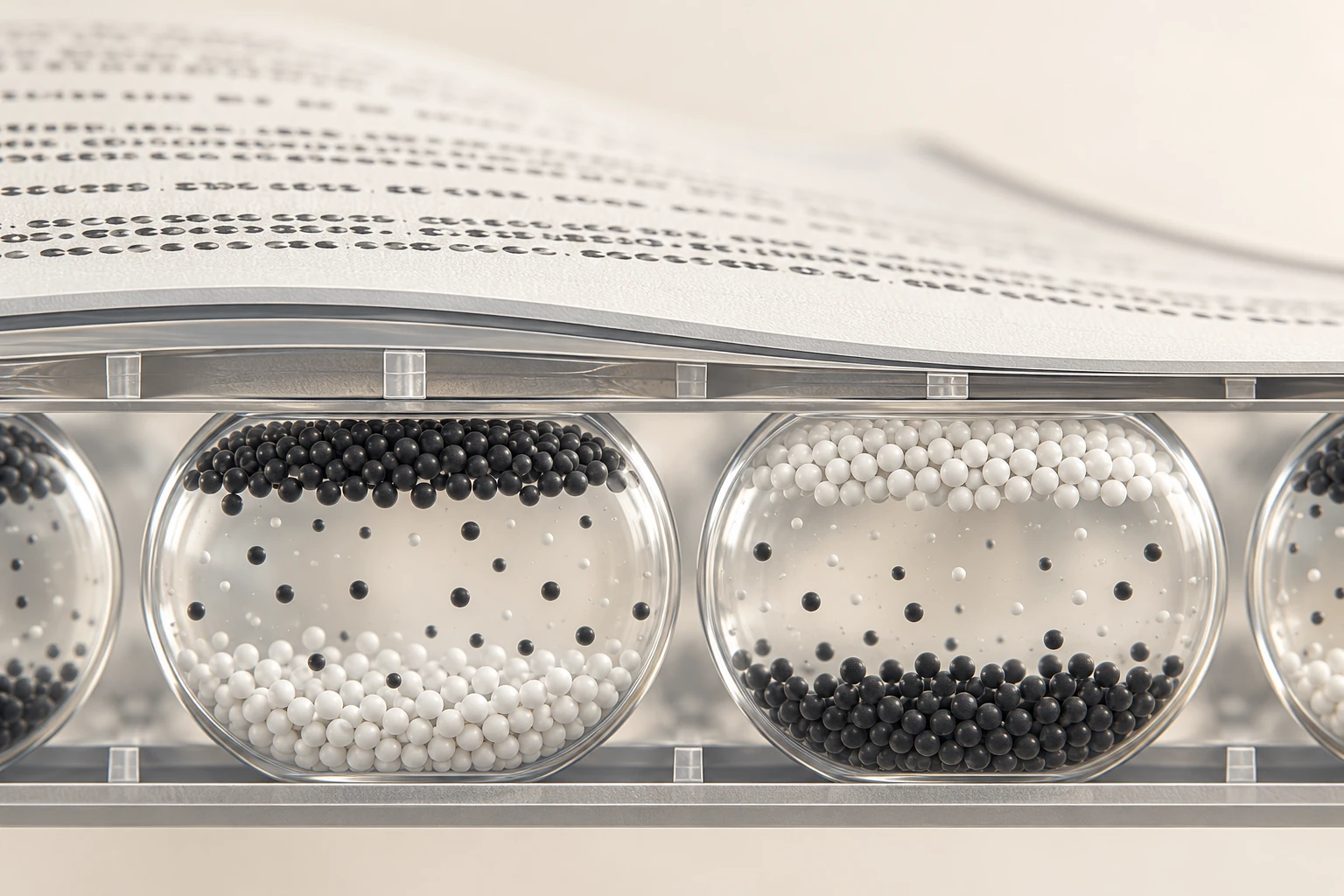
A page assembled from moving pigment
In its two-particle technology explanation, E Ink describes black and white particles suspended in fluid inside tiny capsules. Applied fields move particles so that the viewer sees a lighter or darker surface. The drawing above enlarges this idea enormously; neither its spheres nor their spacing should be read as a microscope image.
The device does not move a printed letter bodily from one position to another. It changes the appearance of many small locations to form a new arrangement of strokes. On the scale of a page, the result resembles writing. On the scale of the material, the job is to control which pigment contributes to what the reader sees.
A helpful analogy is a reversible display made from tiles. If tiles can hold their chosen face without continuous effort, changing a sign takes work but leaving it readable need not. The analogy leaves out the electrical waveform, fluid behavior and addressing electronics, but it identifies the important separation between making a state and maintaining it.
The battery claim needs a boundary
The manufacturer calls this property bistability: an image can remain with power removed. That describes the display's holding behavior. It does not mean an entire e-reader uses no power whenever a person pauses. A processor, touch system, wireless connection or lamp may still consume energy.
Try a deliberately fictional budget. Suppose a display update uses one energy token and holding its state uses none, while a reading lamp uses two tokens per minute. Turn one page every two minutes for twenty minutes. The display would spend ten tokens on ten changes; the lamp would spend forty. These invented numbers are not measurements of a product. They show why “power only when changing” cannot predict device battery life without a system boundary.
The same thought experiment explains why an infrequently changing sign suits a different display task from fast video. The first spends much of its life holding useful information. The second repeatedly requests new states. A material advantage that depends on quiet intervals becomes less decisive when quiet intervals disappear.
Reflecting light changes the reading experience
E Ink's account of reflective reading explains that the pigments return light from the environment. The page itself does not need a backlight shining through it. In a dark room, however, reflected light has to come from somewhere: a room lamp or a device's optional front light. Reflection does not create illumination.
This gives a simple observation sequence. If you own an e-reader, turn its front light off and view the same page in a bright room, by a window and in a dim corner. Keep the font and page unchanged. You are varying the light reaching the surface while holding the page content still. Compare with a printed page nearby rather than relying on memory of how bright it looked a minute ago.
Now change the display's font size. A longer pause or a brief refresh appearance belongs to the updating process, not to the act of holding the old image. Write down separately what happens while the page changes and what happens after it settles. The separation is more informative than deciding whether the whole device “feels like paper.”
The route to a page can matter as much as the final page
A settled page and a changing page are different design tasks. Even when two displays finish with similar-looking letters, the route they take between images can feel different to a reader.

The 1998 paper by Comiskey and colleagues framed electronic ink as a material problem: moving scattering or absorbing microparticles to create a switchable reflective display. That is a different physical route from the molecular behavior of a liquid-crystal display. The material establishes possibilities; controlling its transitions is another part of making a useful page.
A much later E Ink announcement from March 2025 describes a wave-like update effect and changed driving waveforms for particular Spectra signage products. The manufacturer presents these as ways to soften refresh transitions and extend available color choices. This is a product-family claim, not evidence that every existing e-reader received the same behavior or a software update.
The important connection is that an image is not controlled only by naming its final pixel values. A physical medium has to be driven from one state to another. A material description and a control strategy answer different parts of the question.
Make a transition diary
If you already have a reader, choose two ordinary pages: one mostly text, one containing a large dark illustration. Keep the front-light setting fixed. Observe a text-to-text change, then a change involving the illustration. Record the visible transition separately from the settled result.
Use three columns: what changed, what happened during the update, and what remained after it finished. If the device has an ordinary documented full-refresh option, compare the same sequence with that option. Otherwise leave its settings alone. A visible difference is a description to investigate, not an automatic diagnosis of damage.
For a publication, this diary can reveal a practical editorial question: is an essential label still clear after an ordinary page turn? Large dark areas and subtle charts deserve inspection on the intended device. A cover that looks beautiful on an emitting monitor has not yet answered that question.
The quiet page is therefore an endpoint with a history. Appreciating the material means watching how it arrives there, then deciding whether the finished information serves the reader.
Color electronic paper is more than one recipe
One color approach places filters above a black-and-white ink layer. E Ink's Kaleido description lists the backplane, ink layer, color-filter layer and protective sheet. Other electronic-ink families use multiple colored pigments. Calling all of these “tiny black and white balls” loses the difference between the optical material and the layers added around it.
For a reader choosing how to present a map, this matters more than the marketing label. Can symbols be distinguished in grayscale? Does the legend depend on two similar pale colors? Does small colored text remain legible? Those are questions to test on the actual display, rather than infer from the number of colors its specification names.
| Observation | Useful next question |
|---|---|
| The page stays when power disappears | Is the image retained, or is the device still responding? |
| The page is hard to read in darkness | What external or front lighting reaches the reflective surface? |
| A page turn behaves differently from a static page | Which part of the experience belongs to updating? |
| A colored chart loses clarity | Does the chart also work through labels, shapes and contrast? |
The enduring page is a small reminder that a computer's output can have a physical memory of its own. The pixels do not have to repeat the act of displaying every moment in the same way. Sometimes the cleverest energy-saving move is to make a useful change, then let the material remain exactly where it was put.
Sources and a closer look: E Ink: electrophoretic particle systems; E Ink: bistability and reflection; E Ink: paper-like reading; E Ink: Kaleido layer structure.
Explore art, experiments and other unexpected connections at Incoprea.




