Showing posts with label Discovery. Show all posts

Wednesday, October 14, 2026

Ugaritic: An Alphabet Written With Cuneiform Wedges

A tablet covered in wedges can make us expect a writing system with hundreds of signs. At Ugarit, some of those wedges do a different job. A compact set of signs records the local language alphabetically, while other scribes in the same city use the older, more elaborate traditions of Akkadian cuneiform.

The surprise is a useful one: a writing tool does not dictate a single way of representing speech. Pressing a stylus into clay can serve several languages and several systems. Once those distinctions are visible, an ancient tablet becomes more than an example of something called cuneiform.
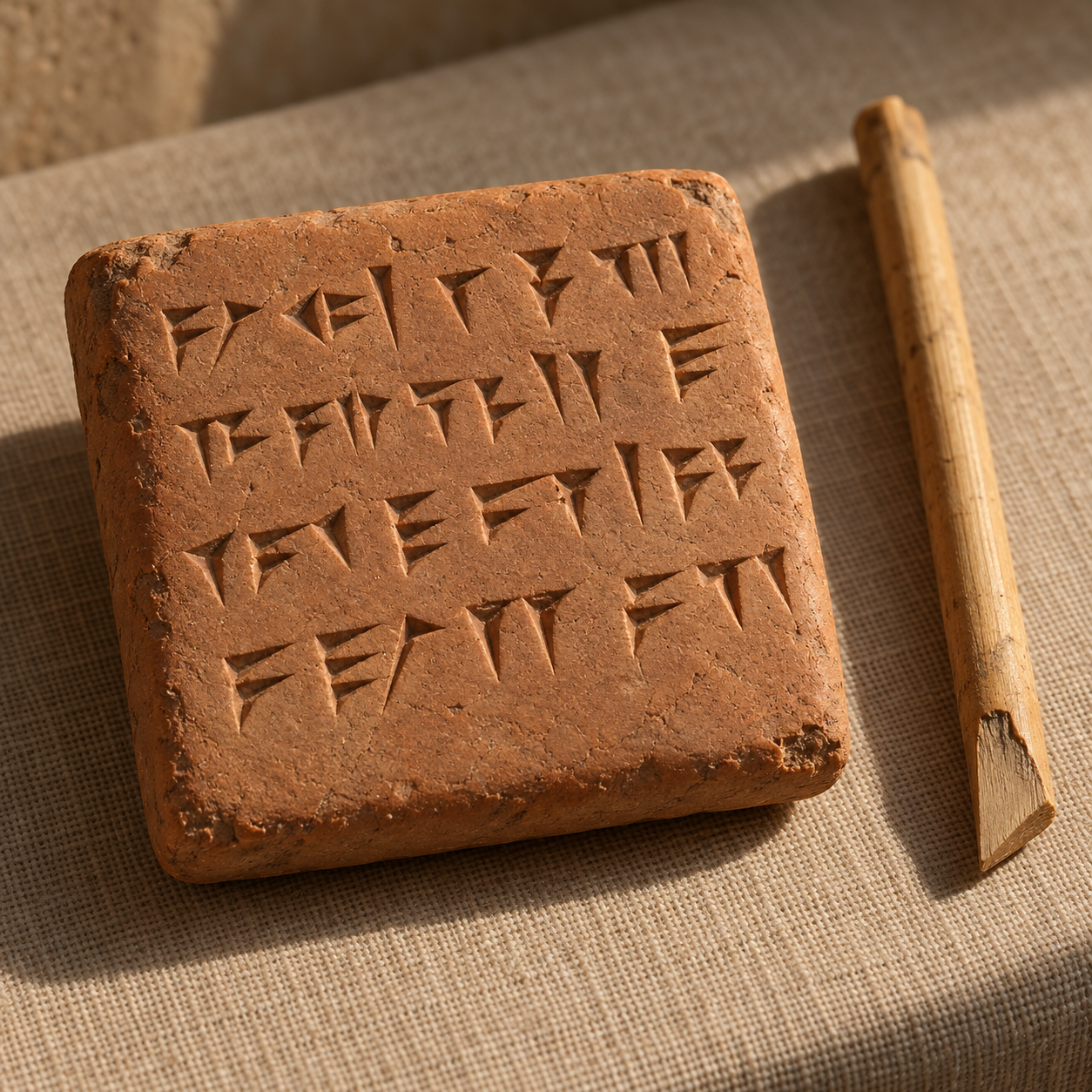
An interpretive clay tablet with wedge-shaped marks rests beside a stylus.
Illustration inspired by alphabetic cuneiform. The marks are illustrative, not a transcription, authentic inscription or readable Ugaritic message.

Three questions hidden in one label

Ask separately about the material, the script and the language. Clay is the writing surface. Cuneiform describes the wedge-shaped impressions. Ugaritic is both the name given to the local language and, in a related use, to its alphabetic writing. These labels answer different questions.

The distinction is familiar in modern life. English and Spanish can use the same letter shapes without becoming the same language. A language can also be written in different scripts. The Ugaritic case adds a further possibility: a similar-looking technique can support systems organised at different levels of sound.

Ugarit, at modern Ras Shamra on Syria's Mediterranean coast, belonged to a multilingual Late Bronze Age world. Its documents include administration, correspondence, legal material, literature and scribal exercises. The city is valuable for studying what writing did in practice: record, communicate, teach and preserve texts within a particular society.

What the thirty signs represent

The standard long Ugaritic alphabet has thirty signs. Specialists often call it an abjad, or a chiefly consonantal alphabet. This wording avoids suggesting that vowels are represented in the same regular way as in English. Three signs associated with the glottal stop introduce additional vowel-related distinctions, so the simple slogan “no vowels” also needs care.

By contrast, the Akkadian cuneiform tradition combines signs with syllabic and word-sign functions. The difference lies in what a sign represents, not in whether its wedges look horizontal or vertical. Similar materials and tools can conceal very different relationships between mark and speech.

Mnamon, the scholarly guide maintained by Scuola Normale Superiore, also describes rarer alphabetic forms at Ugarit: a shorter set and an alphabet with another ordering tradition. The thirty-sign system is the central reference point, but it should not erase all variation. Even a letter list has a history.

A school exercise that became evidence

An abecedary is a sequence of letters in order. The French Ministry of Culture's account identifies tablet RS 12.033 as the first complete Ugaritic abecedary discovered, found during Royal Palace excavations in 1948. Other examples have supplied comparisons. Their repeated sequences helped confirm which marks belonged to the alphabet and how they were ordered.

The small educational object thus works at two scales. For an ancient learner, an ordered sequence could support practice and recall. For modern researchers, comparison across sequences can help distinguish a letter from a damaged shape or a variant. Repetition makes the tablet informative without turning it into a bilingual dictionary.

The ministry's discussion places such exercises within scribal learning and notes examples from palace and private archives. An alphabet was teachable, but a short inventory by itself does not establish how many people could read. Access to teaching, the uses of texts and the organisation of a community matter too.
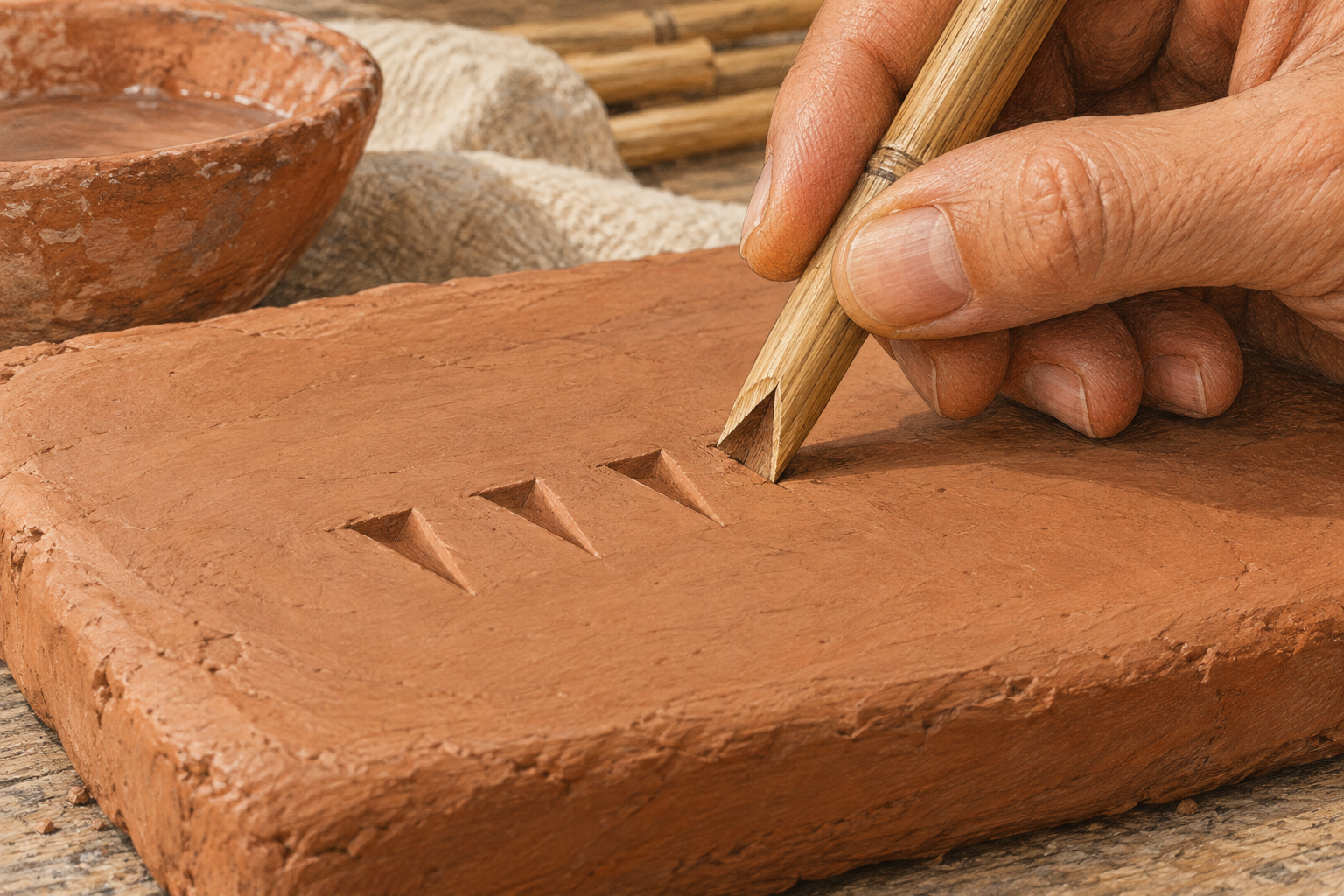
A hand presses a shaped stylus into clay beside a few wedge impressions.
Explanatory illustration of making wedge impressions in clay. The marks do not form an authentic inscription, and the hand and tool are interpretive.

A wedge is made by an action. Angle, pressure and spacing turn a tool into an impression. In an authentic tablet, those features may help a specialist recognise a sign or a hand. The explanatory image above isolates that physical process; its marks are not a passage to translate.

Look at an alphabet without pretending to read it

Open the Ministry of Culture's RS 12.033 feature. The page is in French, but the named tablet and discussion provide a precise starting point. Use the catalogue identifier when following links: an incomplete abecedary is not interchangeable with this complete example.

Begin with three observations. Notice the division into lines. Choose one cluster and count the impressions you can actually distinguish. Then look for a cluster elsewhere whose arrangement differs. Do this before consulting a sign chart, so that a modern label does not decide in advance what you think you see.

Keep the evidence layers separate
LayerWhat it can establish
PhotographVisible impressions, damage, spacing and layout.
Sign identificationWhich impressions form a letter and which variants count together.
Ordered comparisonWhere a letter belongs in an attested sequence.
Language analysisSound values, grammatical relationships and meanings in texts.

The steps build on one another. A photograph does not supply pronunciation by itself. Equally, the inability to pronounce a sign does not prevent a careful observation about its position. That is a useful antidote to the idea that an unread ancient object offers only mystery.

An important alphabet without a race for first place

The alphabet has a complicated early history. Penn Museum's discussion of that history emphasises scattered evidence, changing interpretations and the difficulty of tracing continuity. Giving Ugarit the title “the first alphabet” would flatten that wider story and obscure what makes its evidence distinctive.

Its achievement is interesting on its own terms. Alphabetic writing was adapted to a clay-and-stylus environment and used alongside other established systems. An abecedary lets us see the organisation being taught, while other documents show writing doing work beyond the classroom.

Return to the opening tablet and the wedges look different. Their shape no longer tells you the entire story. The better questions are what the signs encode, which language a writer chose, who learned to make them, and what the finished object was expected to accomplish.


Sources and further reading

Explore more art, stories and discoveries at Incoprea.

How a Brittle Star Can Find Its Way Without Eyes

A red-brown brittle star with five spiny arms rests on pale reef rubble.
Natural-history illustration of a brittle star. It is not a photograph of an experimental animal.

A red brittle star moves through a reef with five slender arms, yet it has no familiar pair of eyes. That does not mean it is blind to every useful feature of its surroundings. Research on a Caribbean species has shown that light-sensitive cells spread across the body can contribute to spatial vision.

The distinction is important. Detecting that light has become brighter is not the same as distinguishing where something is. Researchers had to test the animal's behavior to discover whether its distributed sensors could provide information about visual patterns.

From light detection to spatial information

The species discussed in the research was called Ophiocoma wendtii; more recent work uses Ophiomastix wendtii. It changes color between a dark reddish-brown daytime appearance and a paler state at night. Its body is covered with numerous putative photoreceptors.

In experiments reported in 2020, the animals responded to visual stimuli in ways that supported spatial vision. Their responses were coarser than the detailed images humans resolve. A distributed visual system does not imply that the animal sees a sharp, human-like picture of the reef.

For an animal searching for shelter, a coarse distinction can still be useful. Locating a dark area or a suitable refuge may matter more than recognizing intricate details. What counts as useful vision depends on the behavior it serves.

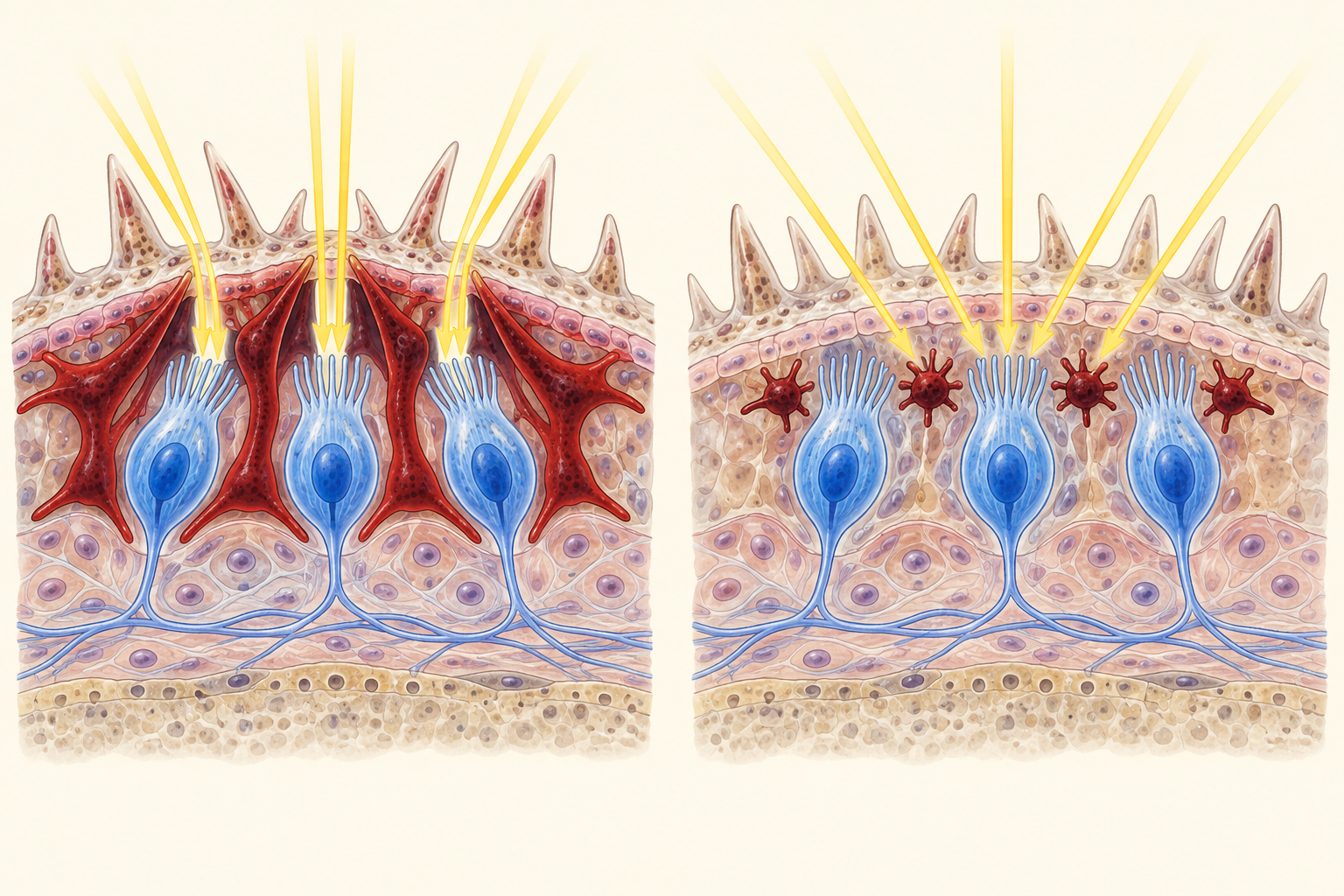
A simplified tissue comparison shows expanded versus contracted pigment around light-sensitive cells.
Conceptual illustration of pigment screening. Expanded pigment limits incoming directions on the left; contracted pigment allows a broader field on the right. Cell shapes and arrangement are schematic.

Color changes the view

The researchers connected visual performance with pigment cells called chromatophores. When pigment is expanded, it can screen light-sensitive cells from some directions. This restricts their fields of view and helps directional information emerge from the distributed network.

In the pale state, contracted pigment provides less screening. The studied animals lost the demonstrated spatial response under those conditions, even though being unable to perform that visual task does not mean every ability to sense light vanished.

A light-sensitive cell needs a direction as well as a signal

Imagine placing one light meter in an open room. Its reading can tell you that illumination changed, but does not necessarily identify which wall became brighter. Restricting the directions from which light reaches a sensor can add spatial information. A group of sensors with different restricted views can then supply relationships that an unrestricted brightness reading lacks.

The pigment-screening account uses this distinction. Expanded pigment limits some incoming directions around receptors. Contracted pigment allows a broader range. No miniature lens is required for that particular change in directional information, although the animal must still use the distributed signals to produce useful behavior.

The diagram isolates that optical relationship. It does not show a measured array of identical cameras, and the illustrated arrows do not establish the animal's visual resolution. Behavioral tests are needed to ask what distinctions it can actually make. Anatomy provides possible machinery; performance tells us what the living animal can do with it.

This helps explain the difference between failing a spatial task and losing every light response. A sensor can remain light-sensitive while the directional arrangement needed for the task is ineffective. The nighttime results therefore sharpened the question about pigment rather than simply proving that the animal had switched all its receptors off.

Why the crystal-eye story changed

Older explanations proposed that small calcite structures in the skeleton acted as microlenses connected to underlying nerves. The idea became a striking example of an animal using its body as an eye. Later anatomical research found that the photoreceptor network was independent of those supposed lenses and did not support their proposed optical role.

Follow-up work continues to examine what this form of vision can achieve and how it functions in the animal's environment. The fascinating claim is already substantial without calling every skeletal crystal an eyeball: an animal lacking discrete eyes can combine distributed receptors, pigment and behavior to obtain useful information about space.

Compare the predictions before admiring the explanation

The crystal-lens story and the pigment-screening story suggest different anatomical relationships. If a skeletal structure were an image-forming lens, relevant light-sensitive elements would need an arrangement that made optical use of it. Later anatomical work found a distributed receptor network that did not support the proposed lens connection. An attractive shape in the skeleton was not enough.

The behavioral comparison adds another level. Dark and pale states, related species and visual targets let researchers ask when the demonstrated response appears. Oxford's account describes how the team considered alternative explanations for the day–night difference, including motivation and illumination. The pigment interpretation gained value by fitting observations across those comparisons.

Read one figure from the linked papers with a specific question: does it show the tissue, the predicted directions of light, or the animal's response to a target? Keep those categories separate on a first pass, then follow the proposed connection between them. It is easier to assess a mechanism when a behavioral result is not mistaken for a photograph of the optical process itself.

The remaining interest concerns what coarse spatial information does for a moving brittle star. A refuge need not be represented in fine detail to be useful. The appropriate comparison is with the animal's actual navigation problem, rather than with the sharpness of a human view or the quality of a camera photograph.

Sources and further reading: Oxford Museum: Color-changing brittle stars can see · Whole-body photoreceptor networks independent of lenses · Extraocular vision and chromatophore movement: original paper · Follow-up: Run and hide, visual performance

Before Gene Editing, CRISPR Was a Bacterial Defense System

A conceptual bacterial DNA ribbon contains repeating blue sections and differently colored spacers beside a phage.
Conceptual illustration of a CRISPR array. Colors represent repeats and varied spacers, not actual DNA sequences or a measured molecular structure.

CRISPR is widely associated with editing genes, but its story begins in the ongoing struggle between microbes and the viruses that infect them. Certain bacteria and archaea keep short sequences of foreign genetic material in their own genomes. Those sequences can help them recognize a later encounter.

This is a molecular form of acquired defense. The organism is not consciously remembering an event. Instead, a record in DNA can provide the sequence information needed to direct protective machinery toward an invading target.

Repeated sequences with meaningful gaps

CRISPR stands for clustered regularly interspaced short palindromic repeats. A CRISPR array contains repeated stretches separated by sequences called spacers. Researchers noticed that some spacers matched genetic material from viruses and other foreign elements.

That match was a clue, but an explanation needed experiments. In 2007, researchers working with Streptococcus thermophilus showed that bacteria challenged by phages acquired new spacers derived from the viral genomes. Adding or removing particular spacers changed resistance to the corresponding phages.

The result linked a specific sequence record to a specific protective effect. It helped establish that CRISPR arrays and associated genes could provide acquired resistance. Not every bacterium has such a system, and bacteria possess many other defenses as well.

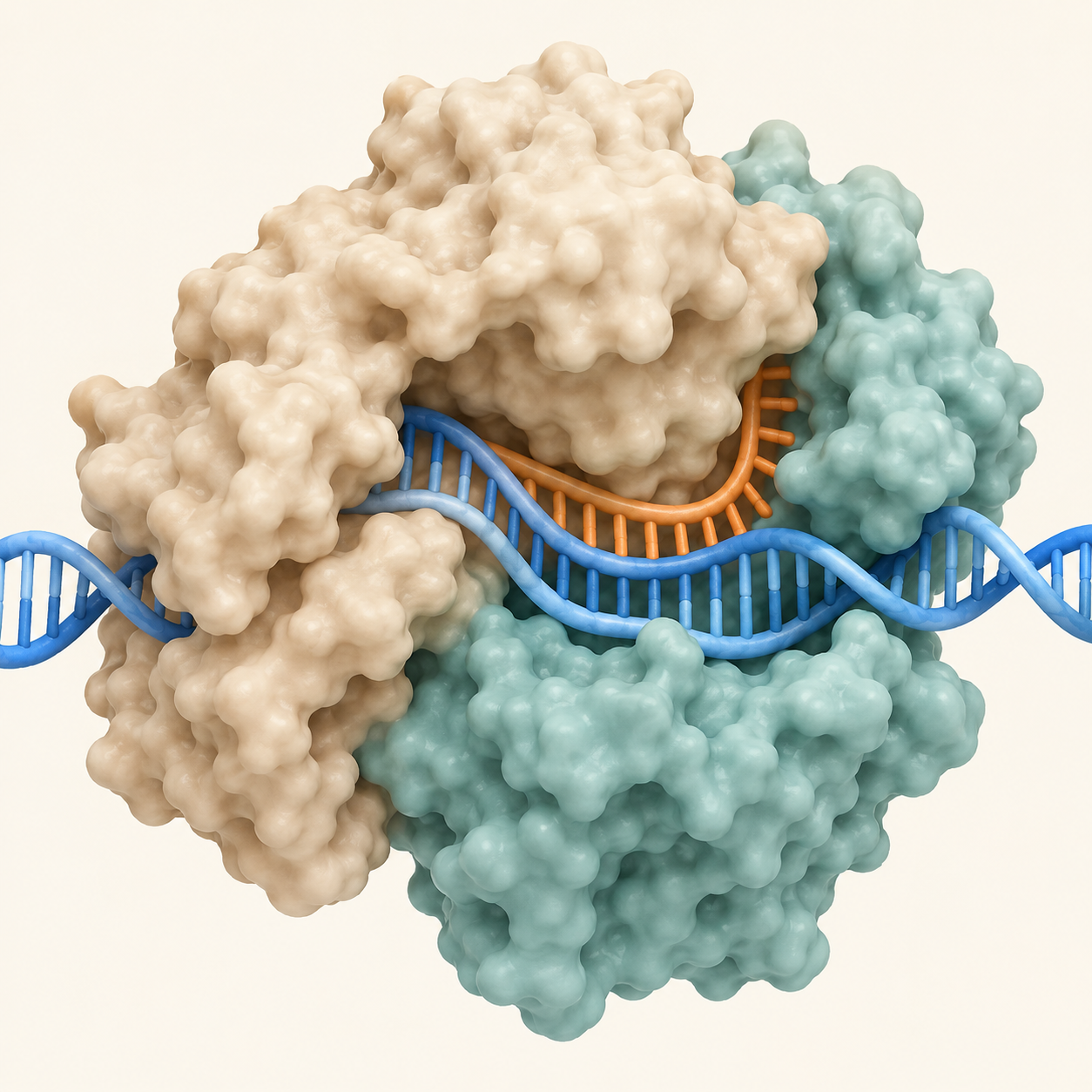
A conceptual protein surrounds a DNA strand alongside an orange RNA guide.
Conceptual illustration of RNA-guided DNA recognition. Protein and nucleic-acid shapes are approximate, not a solved Cas9 structure.

What made the resistance experiment convincing?

A matching sequence could have been an interesting coincidence. The stronger question was whether changing the sequence record changed what happened during a viral encounter. Barrangou and colleagues connected those levels: the bacterial record acquired new spacers, and adding or removing particular spacers changed resistance to corresponding phages. A record and a protective effect were tested together.

That distinction is useful far beyond CRISPR. Finding a feature in successful survivors establishes an association. Altering that feature and comparing the outcome can help establish a causal role. It still matters which organism, virus, and conditions were tested. One controlled result should not silently become a claim that every microbial immune system works identically.

Read a molecular memory without treating it as a mind

Imagine a row of identical dividers with different small tokens between them. The repeated dividers represent repeats; the varied tokens represent spacers. Suppose one token corresponds to part of a virus encountered earlier. The row is a stored pattern. By itself, it is not yet the mechanism that recognizes or stops anything.

Now ask what else must be present. The sequence has to be expressed in a usable form. A guide needs molecular partners, and those partners must recognize an appropriate target in the right context. Finally, a protective event has to follow recognition. The comparison helps prevent a common shortcut: treating an informative DNA pattern as if it were a complete, self-operating memory.

In the illustration above, look separately for the repeated features and the differences between them. Its colours are visual aids rather than a sequence you could use in an experiment. They help show organization; they cannot show whether a particular spacer provides protection against a particular virus.

A sequence becomes a guide

CRISPR-associated proteins are called Cas proteins. In many systems, the stored sequence information is transcribed and processed into RNA guides. A guide can direct a protein or protein complex toward complementary foreign genetic material. The details differ among CRISPR system types.

Cas9 is one famous example of an RNA-guided enzyme that can cut DNA. Other systems use different proteins, and some target RNA. It would therefore be misleading to describe all natural CRISPR defense as the same pair of molecular scissors.

Successful recognition is also more demanding than simply finding a short matching string somewhere in a cell. The system must distinguish an appropriate target and operate in its molecular context. Viruses can change, and some have evolved mechanisms that interfere with CRISPR defenses. The interaction remains an evolutionary contest.

The invader can interfere with the defence

There is another reason to avoid treating the stored record as a guarantee. Bondy-Denomy and colleagues identified phage genes that inhibited a CRISPR–Cas defence in Pseudomonas aeruginosa. Their 2013 paper established examples of what became known as anti-CRISPR genes. The finding concerns molecular countermeasures, rather than a virus making a conscious tactical decision. Read the original anti-CRISPR study.

This adds an important dimension to the story. A bacterium may have a recognizable sequence record while another part of the encounter prevents effective defence. A failed defence is therefore not automatically evidence that the record was absent or that matching never occurred. Biology often requires a sequence of working steps, with more than one place where the outcome can change.

Targeting and editing are different achievements

The 2012 Cas9 study examined a particular molecular system and showed that its RNA guidance could be reconfigured. It did not show that a chosen DNA cut automatically produces every desired final genome. That later task brings repair, delivery, and the condition of the recipient cells into the explanation. The distinction is central to understanding why an elegant molecular result can open a field of research without completing it.

When you encounter a CRISPR headline, try locating its actual achievement. Is it about a natural defence, a protein recognizing a target, a change measured in cells, or an application tested in an organism? All are interesting. Naming the level makes the evidence easier to assess and restores the microbial discovery story behind the famous tool.

The origins remain as interesting as the applications. A biological system shaped by viral encounters became a research tool because scientists asked what its unusual DNA pattern was doing. CRISPR's history shows how careful work on microbial life can uncover mechanisms with uses that were never apparent from the first observation.

Explore more creative curiosity at Incoprea.

Famous Last Meals is now in paperback — stories, history and 25 recipes

Famous Last Meals: Stories, History, and Recipes is now available in paperback on Amazon. The illustrated collection brings together 23 his...