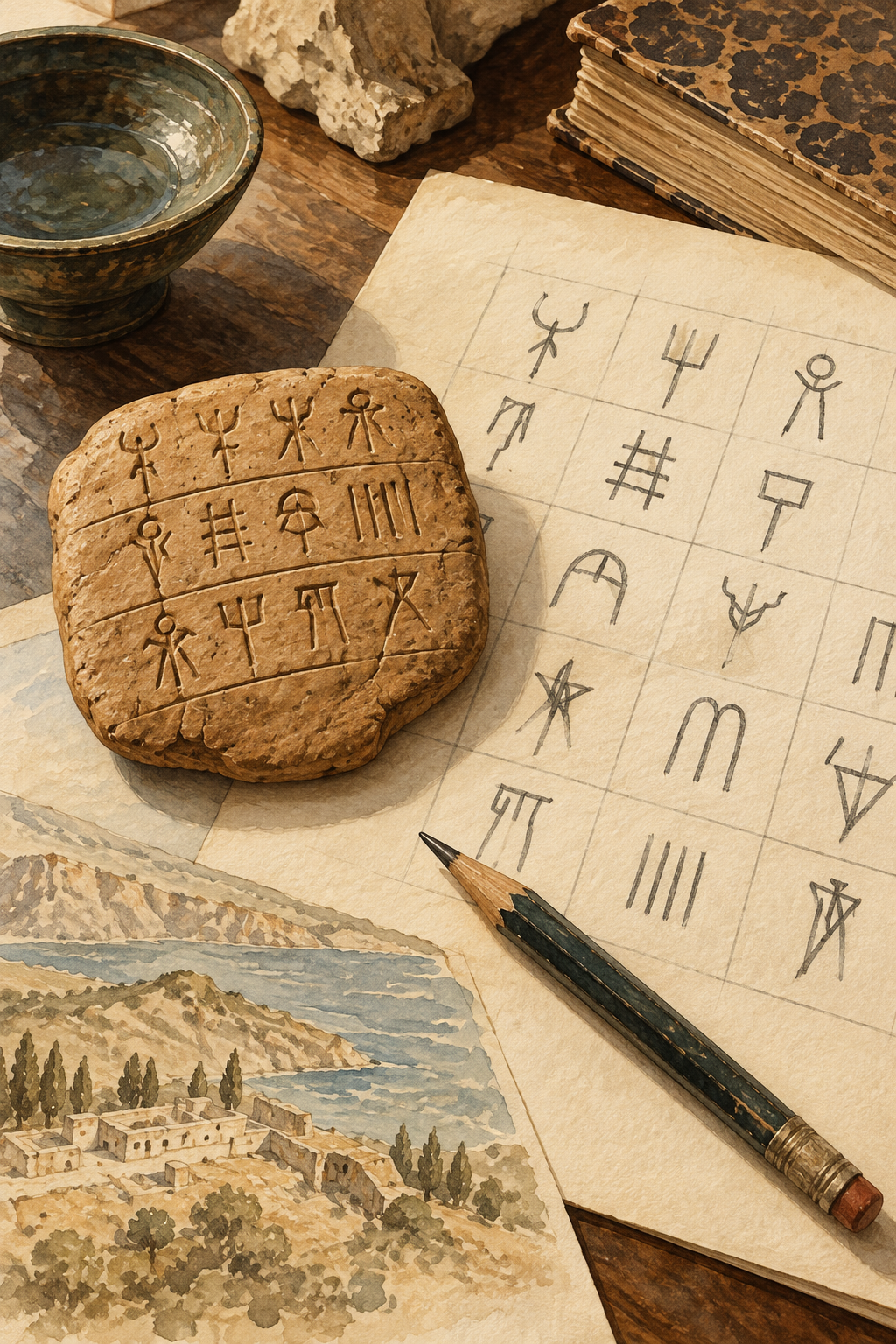
The clay tablets were not written to impress future readers. They recorded allocations, goods, livestock and people in Bronze Age palace administrations. Yet the effort to understand their script, Linear B, became one of the twentieth century's most celebrated decipherments.
In 1952, Michael Ventris reached the crucial conclusion that Linear B recorded an early form of Greek. The result changed what scholars could know about the Mycenaean world. It also showed how far careful pattern analysis could go when no straightforward bilingual key was available.
Patterns before a language name
Decipherment requires more than matching a mysterious sign to a familiar letter. Researchers must determine what the signs represent, how words behave and whether proposed readings work consistently across texts. A plausible reading of one short passage can be a coincidence.
Alice Kober's work was fundamental. She studied recurring patterns and related word forms without forcing an early assumption about the underlying language. Her analysis helped establish relationships among signs and endings, providing a disciplined framework on which later work could build.
Ventris organized evidence into grids and tested changing hypotheses. Likely place names supplied useful clues to sound values. The Greek interpretation then had to explain the larger body of evidence, rather than merely make one name look convincing.
| Clue | What it could help reveal |
|---|---|
| Recurring word endings | Grammatical relationships |
| Likely place names | Possible sound values |
| Consistent readings across tablets | A test of the proposed language |
A breakthrough strengthened by collaboration
Ventris was an architect with an intense interest in the problem. Once the Greek interpretation emerged, he sought the linguistic expertise of John Chadwick at Cambridge. Their collaboration helped develop, test and publish the decipherment, including a scholarly paper in 1953.
The story is therefore larger than a lone flash of genius. Earlier analysis, access to tablet evidence, repeated testing and expertise in Greek all mattered. The surviving research history makes those contributions visible.
Linear B is a syllabic script with additional signs used in administration, including representations of commodities and numbers. Its spelling conventions do not reproduce every sound distinction in Greek. Reading it requires understanding those conventions as well as recognizing individual signs.
What the tablets actually tell us
The recovered language is Mycenaean Greek, considerably earlier than the Greek of classical literature. The tablets illuminate palace economies, workforces, religious offerings and the organization of goods. Their often mundane subject matter is precisely what makes them valuable evidence for daily institutions.
They do not supply a lost collection of Homeric poems. Nor did solving Linear B automatically solve Linear A, a related but different script whose underlying language remains unresolved. Similar-looking signs do not guarantee the same language or the same sound values.
Cambridge's account of the decipherment follows the people and evidence behind the result. What emerged from rows of administrative signs was not just a readable script, but an earlier chapter in the history of Greek—and a model of how patient scholarship can make a bold conclusion testable.
Sources and further reading: Cambridge Classics: Decipherment of Linear B; Cambridge: The decipherment sixty years on; Gonville & Caius: Kober, Ventris and Chadwick.
Explore more creative discoveries at Incoprea.




