Imagine lifting an archive by its main cord. Pendant cords hang below it; some branch into smaller cords; knots occupy particular positions. The record has order, but it is neither a page nor a carved tablet. Andean khipu, also spelled quipu, make information physical in a form that can be handled.
The most accessible doorway is numerical. Many khipu record numbers using decimal relationships. The harder question often follows immediately: numbers of what, organised for whom, within which activity? Reading a quantity is a substantial achievement, but a quantity does not supply its own heading.
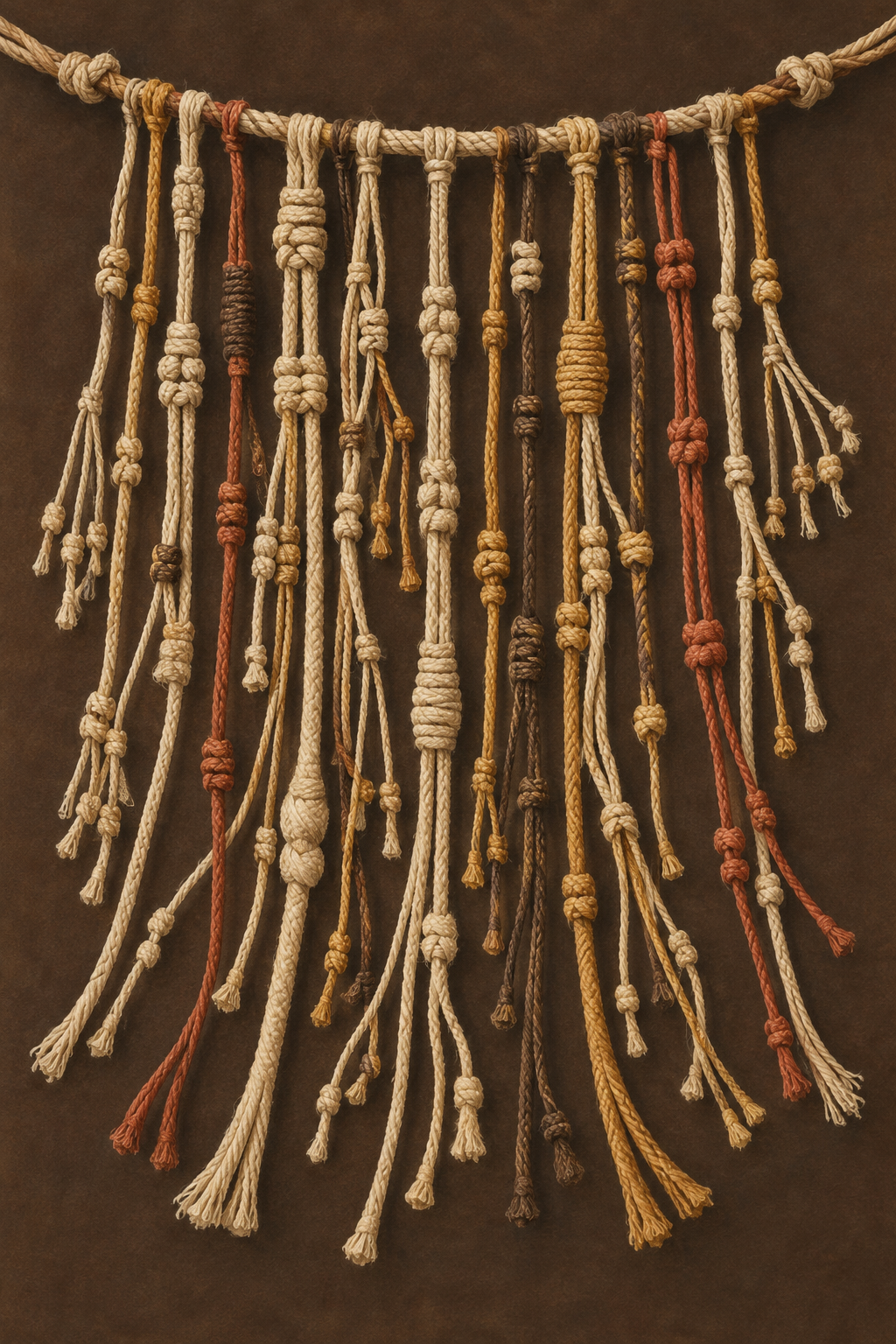
How a number occupies a cord
In a conventional numerical khipu, knot type and position help distinguish units from higher decimal places. Pendant and subsidiary cords organise further relationships. The National Institute of Standards and Technology's museum explanation illustrates this base-ten arrangement and its connection to Inka administration.
Position does real work. A group associated with hundreds is not equivalent to the same number of knots in a tens position. The structure therefore differs from a simple tally in which each mark represents one more item. It encodes relationships among places as well as counts.
A modern analogy is a spreadsheet made tactile. It is useful if it reminds us that a value belongs to an organised field. It becomes misleading if it makes us imagine that every khipu follows one universal table with modern labels hidden inside it.
A small place-value exercise
Consider the number 243: two hundreds, four tens and three units. Now compare 234. The same three digits appear, but two have changed positions. Their relationship to place changes the value.
A numerical khipu uses its own knot conventions to maintain such distinctions. The example here explains decimal organisation; it is not an instruction for making an authentic historical record. To study the actual knot types, use the labelled illustrations in the mathematical and museum resources below.
Next ask what 243 means. It could count people, goods or something else entirely. Without a category and a context, the number is incomplete as a historical statement. This is where cord grouping, colour, attachments and comparisons with other records become important questions.
When cords meet a written census
Manny Medrano and Gary Urton compared six colonial-period khipu with a Spanish census associated with Peru's Santa Valley. Harvard's account describes correspondences involving social organisation and named people. The match offered a way to relate particular cord structures to an independently documented record.
The achievement depends on the specificity of the comparison. A census supplies categories and relationships that an isolated khipu might not reveal. The khipu supplies an Andean material record that can be examined alongside the colonial text. Neither should be treated as a transparent substitute for the other.
It does not follow that all surviving khipu become readable through the same key. A strong interpretation of one group is a basis for further testing. It must be checked against other objects and contexts before being generalised.
Colour needs a community of readers
Harvard's account of later work on khipu from San Juan de Collata emphasises the difficulty of assigning meaning to colours across different regions and periods. A red cord is visible. Its intended category or sound value cannot be recovered simply from the modern viewer's associations with red.
That is a familiar feature of information systems. A colour has meaning because users share conventions. Remove the legend from a complex map and some relationships remain visible while others become ambiguous. The loss is contextual, not evidence that the map never carried useful information.
Researchers also investigate whether some khipu record narrative or linguistic content beyond conventional numerical accounting. The proposals need to be attached to particular evidence. Announcing a fully decoded lost alphabet would erase both the diversity of objects and the work still required.
Examine the craft before searching for a message
A cord has material features: fibre, twist, thickness, colour, attachment and knots. The maker had to produce and arrange those features through textile knowledge. Information and craft are not separate layers pasted together afterwards; the choices are embodied in the object.
The Khipu Field Guide offers an independent research resource with renderings and documented features. Its descriptions distinguish that database from the earlier Harvard database. Treat a rendering as a structured representation, then ask what measurements and observations underlie it.
- Follow one pendant cord from its attachment towards its end.
- Notice where knots form groups and where space separates them.
- Identify a subsidiary cord or a change in grouping, if present.
- Compare the rendering with its description. Which details represent observed material, and which values follow a reading convention?
The exercise slows the urge to search immediately for a hidden sentence. A good account begins by preserving the object accurately enough that different interpretations can be compared.
An archive larger than our idea of writing
Khipu were important in Inka administration and continued in varied forms after the Spanish conquest. That long history is another reason to resist one explanation for every object. Contexts changed, and practices could change with them.
The surviving cords also represent an uneven sample, affected by preservation and collecting. Losing a shared interpretive tradition can make a sophisticated record difficult for outsiders to understand. Difficulty belongs to our present access to the system, not to an absence of thought in its makers.
A numerical value, a secure grouping or a successful match with a census can restore part of that access. Each makes the archive a little less remote. The reward is a broader understanding of how people organise knowledge: with fibres and fingers as well as ink and eyes.




