The first surprise is the scale. An object small enough to rest in a hand can make a sound that seems to belong to a much larger creature. In a recording, the voice can shift from breathy friction to a rough, alarming cry. Before deciding what the sound means, it helps to separate three questions: how the whistle works, where an ancient example was found, and what a listener hears today.
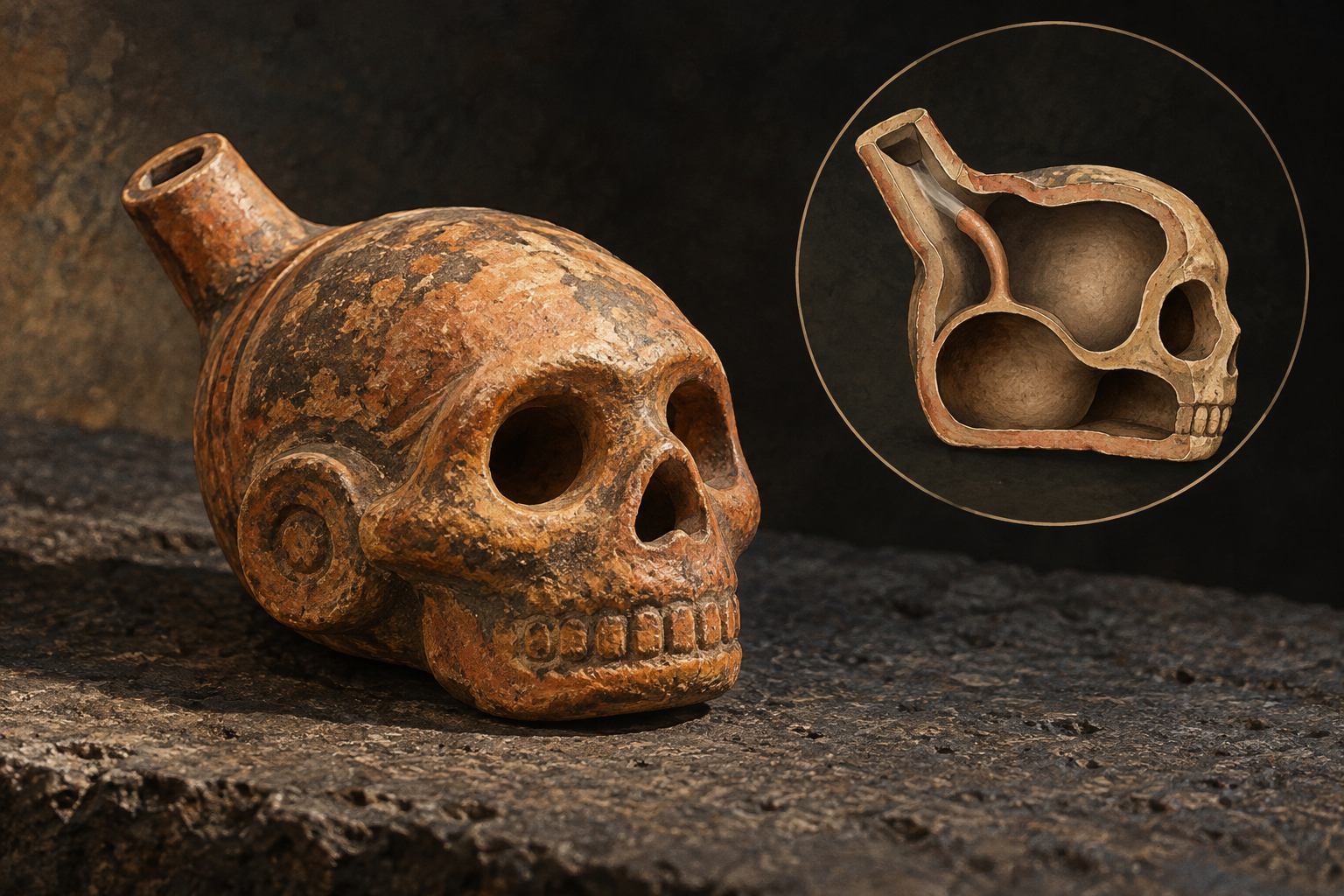
The objects commonly called Aztec death whistles are associated with the Mexica world of central Mexico. “Skull whistle” is a useful description of their form; the dramatic nickname already points toward an interpretation. The history becomes more interesting when the name begins an investigation instead of finishing it.
Clay gives moving air a difficult route
A 2024 research study of skull whistles examined artifacts, recordings, replicas, and reconstructions. The small ceramic bodies contain a complex internal arrangement. They can produce softer hiss-like sounds as well as harsher, scream-like ones. A single modern demonstration does not exhaust the possibilities of the instrument.
The University of Zurich’s account of the work describes digital reconstructions based on original objects in Berlin’s Ethnological Museum. Opposing chambers and turbulent airflow help produce the distinctive sound. An exterior skull face tells you little by itself about that internal route.
Think about what changes when an instrument is played. The object supplies a geometry, but a player supplies air. How forcefully the player blows can change the resulting sound. That is why a breathy recording and an alarming recording need not represent two wholly different kinds of object. It is also why a video of a large souvenir replica cannot, on its own, tell you what every ancient whistle sounded like.
The practical question for a demonstration is specific: what instrument is being played, and under which conditions? A convincing performance can be enjoyable without becoming an archaeological reconstruction. Knowing its limits gives you more, rather than less, to listen for.
The place of discovery matters more than the nickname
Roberto Velázquez Cabrera’s study in INAH’s journal Arqueología discusses a fragment from Mazatepetl and the wider family of noise-producing instruments. It also reports two skull-faced whistles associated with a sacrificial burial at the temple of Ehecatl in Tlatelolco. That is a concrete archaeological context, not an inference drawn merely from a frightening sound.
The association makes ritual interpretation worth investigating. It does not supply a complete performance script. Which moments involved sound? Who played, and who listened? Were the whistles sounded together, separately, briefly, or repeatedly? The surviving objects and their setting help frame those questions without answering every one.
INAH’s description of Tlatelolco places the temple within a larger ceremonial landscape containing many kinds of offerings and burials. Looking at that larger setting guards against treating one unusual instrument as a summary of a whole society. Wind, death imagery, religious practice, and skilled clay manufacture belong to overlapping histories.
The familiar internet picture of an army advancing behind hundreds of screaming whistles requires a different kind of evidence. The 2024 paper identifies the warfare association as unsubstantiated. The ability to imagine an intimidating use is not evidence that the use occurred. A clear distinction here preserves the real archaeological mystery.
A modern experiment asks a different question
The Zurich research also investigated present-day listeners. Participants tended to judge the whistle sounds as unpleasant or frightening, and their descriptions placed the sounds between familiar categories such as voices and artificial mechanisms. Brain-imaging work explored the processing of those sounds. These results address how modern participants responded to the experimental recordings.
That uncertainty of origin is worth noticing in your own listening. A sound may resemble a cry without being a human voice. You can feel that resemblance while still searching for its source. The ambiguity is part of what makes the recording hold attention.
Modern reactions do not provide direct access to an ancient listener’s understanding. Someone who recognized a ritual sound might hear significance that an unfamiliar listener misses. An alarming sensation, a learned association, and a ceremonial meaning need not be identical things. The instrument’s history requires acoustic investigation and cultural evidence to remain in conversation.
Compare the recordings before choosing a story
The researchers’ CAN Lab sound page offers an unusually useful set of examples: a short recording of an original whistle and replica sounds labeled by low, medium, and high air pressure. The page also includes longer replica examples. Begin at a comfortable low playback level and use the short samples for a first comparison.
- Choose descriptive words first. For each sample, note two qualities such as breathy, grainy, steady, pulsing, rough, or bright. Keep a description of sound separate from the scene it makes you imagine.
- Compare the labeled replica conditions. What changes as the stated pressure changes? Listen for texture and continuity, rather than judging only which file seems loudest.
- Return to the original recording. Describe one resemblance and one difference. Do not assume that the original and replica had identical dimensions, players, microphones, or recording conditions.
- Read your first notes again. Which words describe something audible, and which describe an imagined source or emotion?
This is a listening notebook, not a controlled experiment. A web player, speakers, and recording choices affect what reaches you. The exercise still reveals an important distinction: a recorded sound offers evidence of one sounding event, while an account of ancient use makes a larger historical claim.
Try a small evidence check
Consider these three statements: a skull-faced whistle occurred in a ritual burial; a particular modern participant found a recorded whistle frightening; an ancient army used massed whistles to frighten opponents. They may all sound compatible, but they require different supporting records.
Which evidence belongs to which claim?
A documented excavation context can support the burial association. A listening study can support a statement about the participants it tested. Neither record alone establishes the army story. That claim would need its own historical or archaeological support. Moving from one claim to another without that support is the point where a plausible story becomes speculation.
Return finally to the clay object. Its makers achieved a remarkable transformation of breath into an unsettling texture. We can investigate that achievement, compare carefully labeled recordings, and ask better questions of the archaeological setting. The whistle does not need an invented battle to remain extraordinary. Its real voice and its incomplete history already give us plenty to explore.
Follow another strange sound
Consider how an instrument changes the relationship between sound and touch in The Glass Armonica Moves the Instrument Under Your Fingers. Then compare a different archaeological claim in The Baghdad Battery: When a Name Gets Ahead of the Evidence.
Explore more art, ideas, and independent projects at Incoprea.




