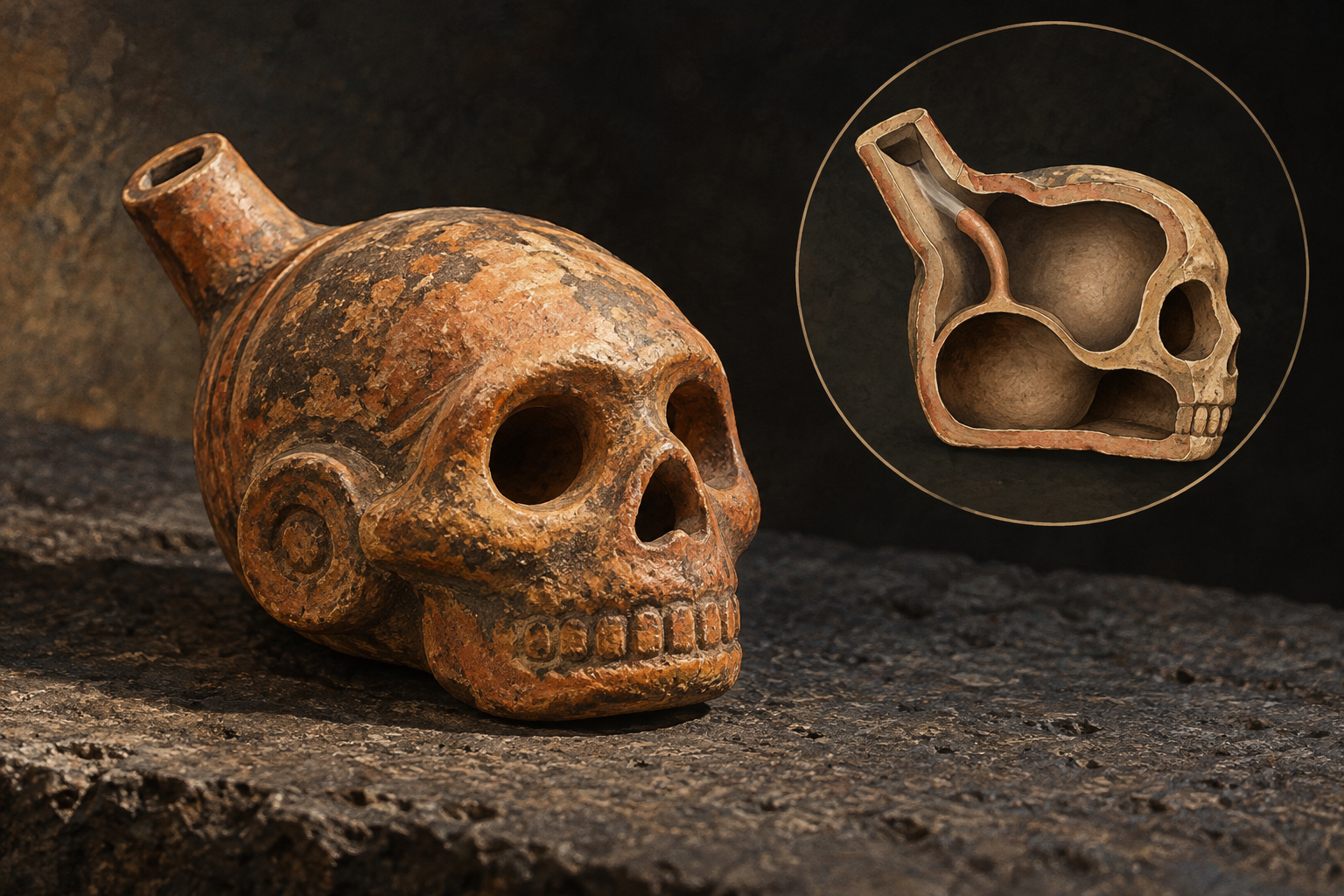
A little clay object can sound surprisingly like something alive. Blow into an Aztec skull whistle and, depending on its construction and the force of your breath, it may release a rough hiss, a windy rasp, or a piercing sound that listeners compare with a scream. That unsettling voice has helped turn an archaeological instrument into an internet legend.
First, a useful correction: the objects commonly called “death whistles” are associated with the Aztec world of Mexico, rather than the Inca civilization of the Andes. “Skull whistle” is the more neutral name used in a recent scientific study. The dramatic nickname is memorable, but it can smuggle an interpretation into the description.
A tiny instrument with complicated airflow
The researchers studied original artifacts, recordings, replicas, and digital reconstructions. The clay whistles they describe are only about three to five centimeters across. Inside that small body, connected chambers and narrow passages direct interacting streams of air. The result is much noisier than the clear, steady tone we expect from an ordinary whistle.
That distinction matters when watching modern demonstrations. A large commercial replica, blown extremely hard, need not sound exactly like a fragile original played gently. The sound is a product of an object's geometry and how someone uses it. An impressive video is not, by itself, a faithful recording of an ancient ceremony.
What the archaeology actually suggests
Archaeological finds at Tlatelolco connect some skull whistles with ceremonial burials. Their imagery and their wind-like sound have prompted interpretations involving death, the underworld, and the wind deity Ehecatl. An INAH study discusses these associations cautiously: they are clues to possible ritual meanings, not a surviving instruction manual.
The popular picture of entire Aztec armies terrifying opponents with massed whistles is much harder to establish. The 2024 research paper explicitly describes the warfare association as unsubstantiated. A sound that seems useful for intimidation today does not prove that it was used that way centuries ago.
The mystery includes our own ears
University of Zurich researchers also asked modern listeners to judge whistle recordings. Participants often found the sounds unpleasant and frightening, while struggling to decide whether their origin was human, animal, or mechanical. Brain-imaging experiments explored how those ambiguous sounds were processed.
These findings help explain the whistle's contemporary power: it sits in an awkward space between voice and noise. They cannot tell us exactly what an Aztec listener felt, because experience, expectation, and cultural meaning shape listening. The study's modern participants were not people transported from ancient Mexico.
The most interesting version of this story leaves room for that uncertainty. Here is a real, ingenious sound-making object, embedded in a rich cultural world that archaeology can only partly recover. Its strange voice is compelling enough without adding a battle scene the evidence has not supplied.
Sources and further reading: 2024 skull-whistle study in Communications Psychology; University of Zurich research summary; INAH: Silbato de la muerte.
Explore more creative work at Incoprea.


