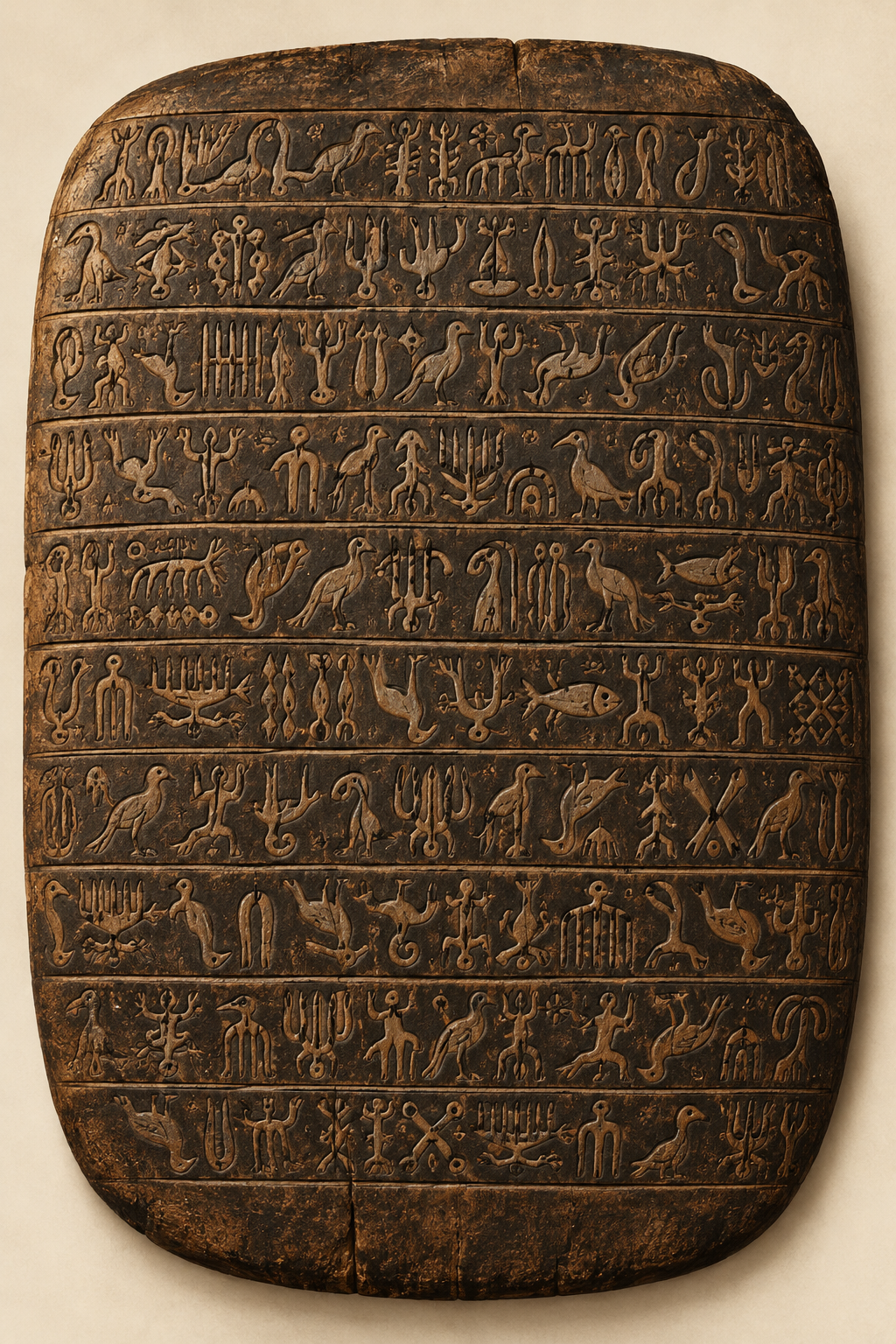
A carved bird can be recognisable without being readable. On the wooden objects bearing rongorongo, forms that resemble bodies, creatures and other shapes appear in organised sequences. The eye wants to turn recognition into a message. The research problem begins where that impulse stops.
Rongorongo belongs to Rapa Nui's cultural heritage. Its surviving corpus is small and dispersed, and no decipherment has achieved general acceptance. Yet research can still make substantial progress: document a surface more accurately, distinguish a carving from damage, compare sequences and investigate the age of the wood.
First establish what the object is
A museum photograph does not always depict an original wooden tablet. The British Museum record Oc1981,Q.1642, for example, identifies a plaster cast. Its notes correct an earlier statement about the original's location, identifying the original object in Santiago, Chile.
This is more than a technicality. A cast, a photograph, a hand drawing and an original surface preserve different kinds of evidence. A cast may make the form available at a distance, while a botanical analysis requires the wooden object itself. A drawing can clarify a sign and also introduce choices about a worn groove.
Begin any comparison by recording the object identifier, material and kind of reproduction. That small habit prevents two pictures of the same underlying inscription from being mistaken for independent witnesses. It also makes later corrections easier to follow.
The direction of the lines is part of the evidence
One striking feature of many rongorongo inscriptions is the alternating orientation of successive lines, often called reverse boustrophedon. Following the next line involves turning the orientation around. The arrangement offers a structural clue about how a tablet could be followed or handled.
It does not by itself establish what a sign represents. A shape resembling an animal might function as a word, a sound-related element or something else within a conventional system. Modern familiarity with the pictured creature cannot settle the relationship between mark and language.
Repeated groups and the arrangement of lines do offer material for comparison. The challenge is to distinguish meaningful recurrence from visual resemblance, and to identify which forms count as variants of a sign. A dependable corpus is therefore part of decipherment, not a clerical task that can simply be assumed complete.
A clearer surface is a real discovery
The University of Bologna's INSCRIBE project has used three-dimensional documentation in its study of the tablets. A primary study of the Échancrée tablet, Text D, presents a model and reassesses earlier hand-drawn transcriptions. Surface geometry can reveal details that were difficult to see in a single photograph.
Think of moving a light across an incised surface. A groove can become visible from one direction and faint from another. A three-dimensional record offers additional ways to inspect those relationships. It can improve the account of what was carved, including damaged areas and possible corrections.
That improvement is consequential even if no translation follows. A proposed reading should be tested against the best available record of the signs. If its evidence rests on a feature introduced by a drawing, a more precise model can change the argument.
Four objects, several dates
A 2024 study by Silvia Ferrara and colleagues radiocarbon-dated wood from four tablets held in Rome. One sample yielded a mid-fifteenth-century date, while the others fell within the nineteenth century. The result is important for discussing whether the tradition began before European contact.
But radiocarbon analysis dates organic material, not the act of cutting a sign into it. A tree grows; wood is obtained; an object is prepared; signs are carved; the object is collected. These events can occur close together or be separated by substantial intervals.
The researchers consider the problem of old wood, including the possibility that a piece existed before inscription. The older result changes the evidence available for the debate. It cannot be converted automatically into the precise date of the text or the first invention of rongorongo.
A chronology puzzle
Suppose you know that wood formed before 1500 and that an object was in a documented collection by 1900. Which of those dates tells you when it was carved? Neither supplies an exact answer. The carving must be considered within a sequence of events, and further contextual evidence is needed to narrow it. This is a simplified reasoning example, not a date assigned to a particular tablet.
How to inspect a proposed solution
Choose one original-object photograph or a figure in the INSCRIBE research. Notice the row structure, then look for a group that seems to recur. Ask whether the source identifies it as a repeated sequence or whether that is only your visual impression. Do not attempt to turn the illustrative artwork here into a sign chart.
Now imagine a proposed translation of that group. What would make it persuasive? It should explain the same forms consistently elsewhere, address grammatical or structural patterns and remain open to independent testing. A vivid message attached to one attractive cluster has not yet met that standard.
It is also worth asking what the proposal does with inconvenient material. Does it explain damage and variants, or change the rules whenever a sign does not fit? Does it distinguish a transcription from a translation? Those questions are accessible to a careful reader without claiming expertise in the script.
Uncertainty belongs to a human history
The tablets are not culturally ownerless puzzles awaiting a spectacular outsider solution. They belong to the history of Rapa Nui people, and their collection and dispersal form part of the conditions under which they are now studied.
A useful account can acknowledge the unresolved language while remaining specific about objects, methods and findings. Better documentation and chronology reduce uncertainty in real ways. The reward is not always a hidden sentence finally spoken aloud. Sometimes it is a more faithful record of what survives, and a clearer understanding of the next question worth asking.