A list of sheep can change the history of a language. So can a record of oil, a worker's name or a notation about a vessel. Linear B mattered because these modest documents revealed that Greek was being written in the Bronze Age, centuries before the alphabet familiar from later Greek inscriptions.
The achievement is easy to turn into a detective story with one triumphant moment. The more interesting version includes patient sign lists, grammatical patterns, disagreements and tests against documents that a proposed reading had not been designed to explain. It also asks what we hear when an archive opens—and whose voices remain outside it.
First recognise the kind of page
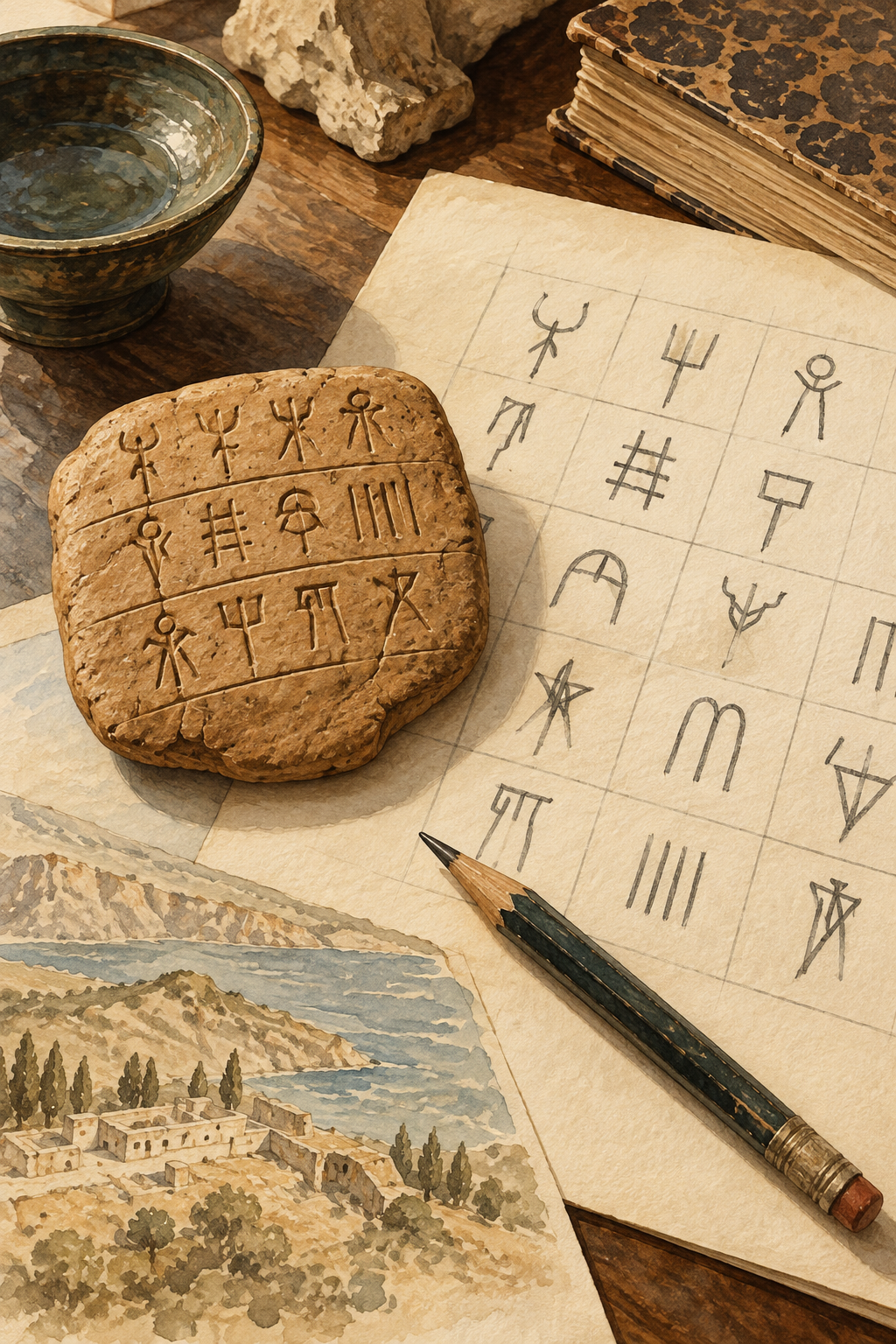
Linear B occurs on clay tablets and other administrative objects from palatial settings on Crete and the Greek mainland. The script combines signs used for syllables with signs for commodities, quantities and measures. A record can therefore present several kinds of information together, much as a modern stock sheet combines names, product symbols and numbers.
Scuola Normale Superiore's Mnamon guide describes page-shaped tablets as final registrations and narrower leaf-shaped tablets as preliminary ones. Labels and sealings belong to the same administrative world. The object is part of a filing system, not simply a mysterious sentence detached from its setting.
This matters before decipherment even begins. Repeated signs beside quantities can suggest a list. A recognisable animal sign can narrow the subject. Neither observation supplies all the spoken words, but both constrain what a successful reading must explain. The documents were already communicating some of their organisation before scholars could read their language.
Patterns before a preferred answer
Alice Kober examined recurring groups and changes at the ends of words. Those relationships suggested a language with grammatical inflection. Her work helped establish a framework in which signs could be related without immediately deciding what every sign sounded like. Emmett L. Bennett Jr.'s systematic classification helped provide a dependable sign inventory.
These are different jobs. One asks which marks count as the same sign. Another asks how signs behave in words. A third assigns sound values and tests a language. Confusing them makes decipherment look like inspired guessing, when much of its force comes from keeping the questions separate.
Michael Ventris reached the decisive Greek reading in 1952. Cambridge's account records that John Chadwick joined the work within weeks, bringing expertise in the history of Greek. Their first scholarly publication appeared in 1953, followed by further collaboration. The date of a breakthrough is useful; the network of work behind it explains why the breakthrough could hold.
A proposed reading had to produce more than a few attractive names. The same sign values needed to make sense across many groups and records. A theory that requires a new exception whenever it meets an inconvenient tablet has not earned the same confidence as one that keeps generating coherent results.
Why syllables make a difference
A syllabary does not work like the English alphabet. In Linear B, many phonetic signs represent a vowel or a consonant-plus-vowel combination. Writing Greek with that toolkit involves spelling conventions; the written form is not a complete sound recording. A transliteration can therefore look unexpectedly different from a familiar later Greek word.
When you encounter a scholarly transliteration, hyphens commonly separate the signs' syllabic values. They do not mean that the ancient speaker paused between each printed segment. Numbers and commodity signs may be represented separately. The modern presentation is an analytical aid layered over the clay surface.
This distinction is useful beyond Linear B. A photograph shows marks. A transliteration identifies and renders them according to conventions. A translation proposes their meaning in another language. Move among those layers deliberately and it becomes easier to see where damage, uncertainty or interpretation enters a reading.
Try reading the document before reading the language
Cambridge's CaLiBRA photographic archive provides a direct encounter with Linear B tablets from Pylos. Its search accepts identifiers with site or series prefixes. Choose a tablet image rather than a decorative rendering, enlarge it, and begin with its layout.
- Count visible lines and note where a line is interrupted by damage.
- Look for groups that seem to recur. Mark your observation in words rather than assigning sounds.
- Separate what looks like a quantity from what looks like a longer sign group.
- Check the catalogue or an accompanying scholarly reading. Which of your visual distinctions survived the comparison?
You are not trying to repeat the decipherment in five minutes. The useful experience is discovering how much can be observed without translation, and how much remains inaccessible without trained comparison. An isolated resemblance is weak evidence. A repeated distribution across a corpus is a different kind of clue.
A question to take into the archive
Suppose a tablet lists a person beside a quantity. Does that mean the person owns the goods, receives them, owes them, supervises them, or is counted with them? Layout alone may not settle the relationship. The question explains why grammar, parallels and archaeological context must accompany a sign chart.
What the reopened archive lets us hear
The tablets illuminate administration: goods, personnel, allocations and the interests of institutions. They make the Bronze Age more specific, populated with recorded names and obligations rather than only palaces and impressive objects. Their ordinary subject matter is part of their historical power.
They also present an uneven view. An administrative record describes people in the categories the institution needed. It rarely gives the account those people might have chosen to tell about themselves. Treating every entry as a transparent portrait would make the palace's paperwork stand for the whole society.
Nor does the decipherment automatically solve Linear A. Related-looking scripts can serve different languages, and a sound value transferred from one system does not guarantee a meaningful reading in another. Linear B's success is most compelling when its limits remain visible: a substantial archive became readable through a method that could be checked, argued over and extended.




