Two dark marks and a curved line can be enough for a human to see a face. On the abdomen of a tiny Hawaiian spider, that resemblance has become a famous name. The happy-face spider appears to smile in some photographs. Other members of the same species look quite different, and some have no celebrated face-like marking at all.
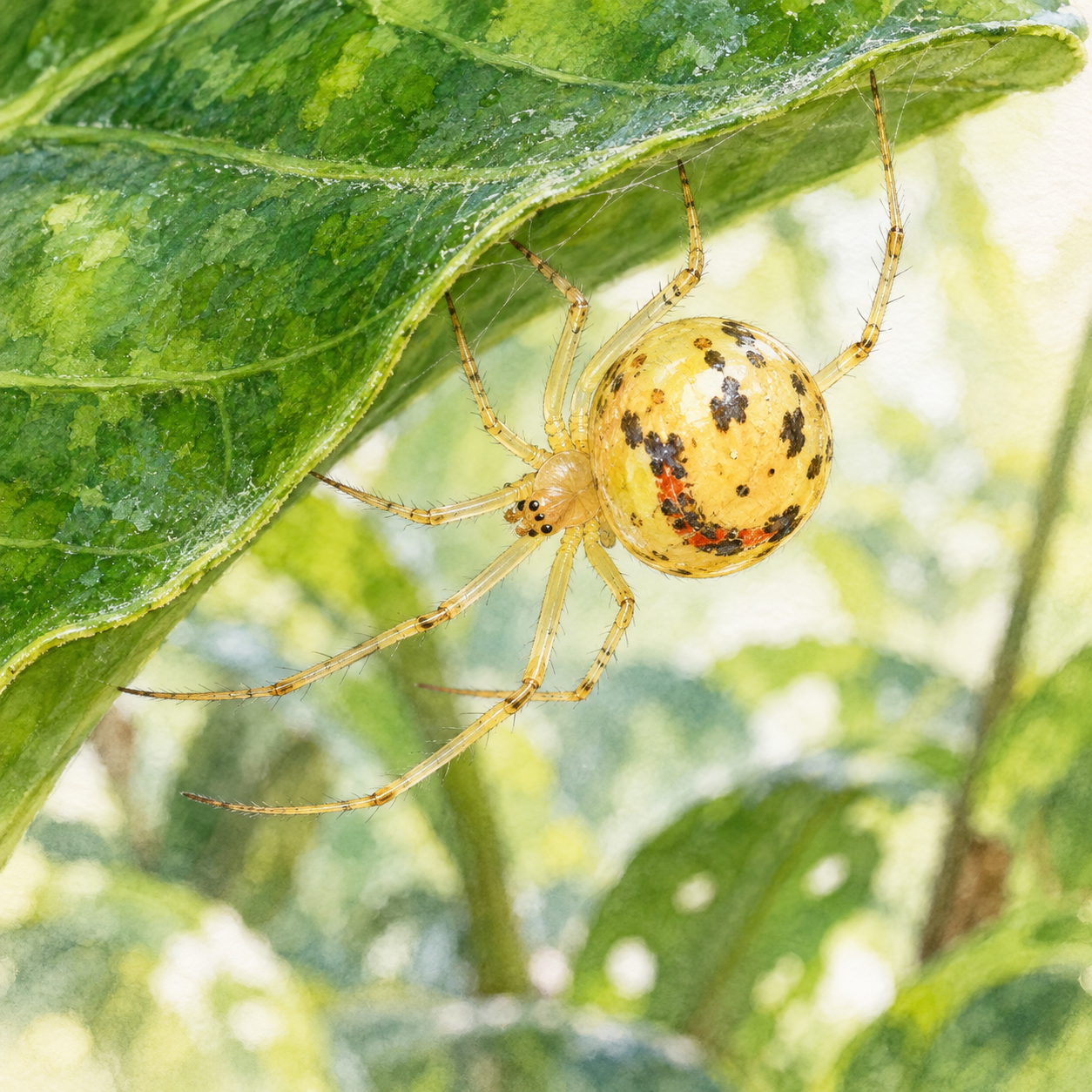
Theridion grallator is a small spider of Hawaiian wet and mesic forests. Its popular portrait is an invitation to look, but it can also narrow what we notice. The full story includes inheritance, development, feeding and a delicate way of living beneath leaves. The supposed smile is one possible visual outcome within that larger biology.
Look at the spider before the face
Haleakala National Park describes a spider less than five millimeters long that occupies thin webs beneath leaves. It spends the day near this shelter and catches small prey mainly at night, either dangling near the web or searching neighboring foliage. The enlarged abdomen in a portrait belongs to a very small animal in a visually crowded environment.
Females guard their eggs and care for young after hatching. That behavior changes the image of a novelty spider into an animal investing in offspring. A leaf underside can be a resting place, a hunting location and a nursery. The biological importance of the site is easy to miss when the photograph crops away everything except the pattern.
Try describing the main illustration without using any face words. Record the position, color and shape of each mark. “A dark curved band near one end” is a different description from “a smile.” Both may point to the same feature, but the first is easier to compare across animals whose markings do not fit a recognizable expression.
Variation belongs to the species
The species shows color polymorphism: multiple visible forms occur within it. Pale translucent yellow forms and patterns involving red, dark or white areas can all belong to happy-face spiders. Bishop Museum describes many patterns. One dramatic individual therefore cannot stand in for the entire population, even when it becomes the photograph most often shared.
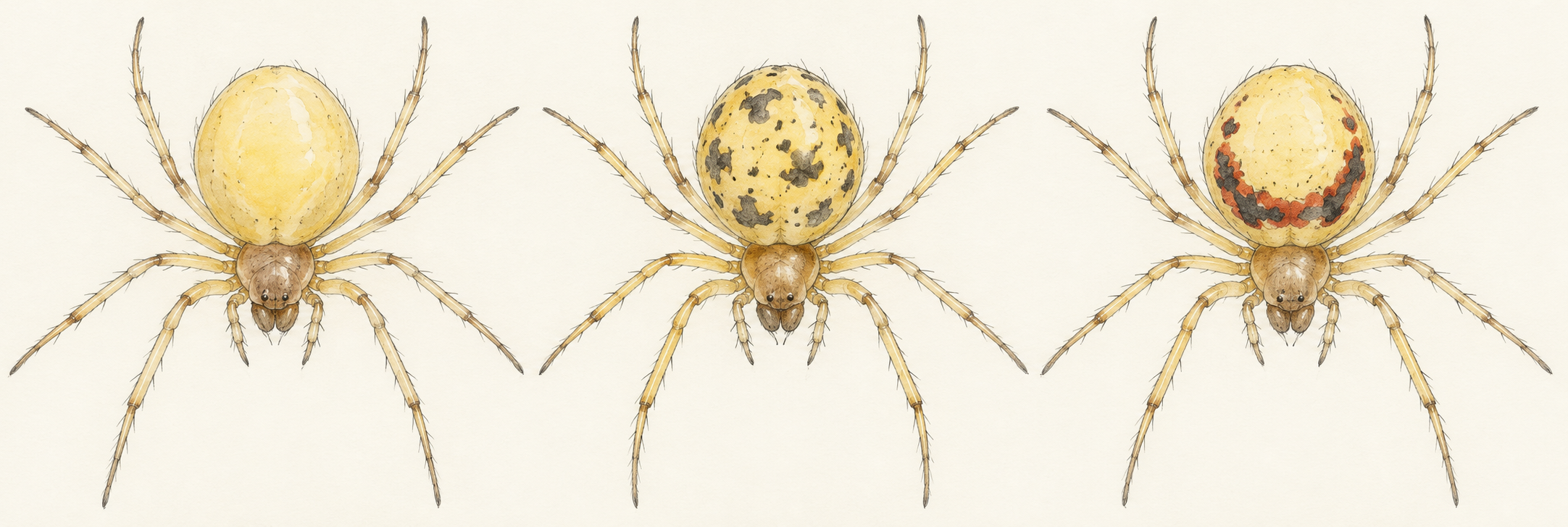
The supporting comparison is an illustrative introduction to variation, not a set of named genetic morphs copied from identified specimens. In actual research, categories need consistent definitions. Whether two markings belong to the same category depends on the question being asked and the features used to classify them, rather than on how similar their expressions seem to us.
Imagine a gallery containing ten especially cheerful-looking spiders. Would it tell you the proportion of cheerful-looking individuals in a forest? Only if the method of selecting photographs supplied that information. A gallery chosen for memorable patterns is useful for showing possibilities. A population survey needs a sampling method that also records the less spectacular animals.
The pattern is built during development
Rosemary Gillespie and Bruce Tabashnik investigated color-pattern inheritance in a 1989 study. Their family observations were consistent with Mendelian inheritance involving a locus with patterned forms dominant to the unpatterned form in the material examined. That finding links visible variation to inherited differences rather than treating each abdomen as an independently painted accident.
Their observations also showed that spiderlings began unpatterned and acquired markings over time. Some patterns took much longer to develop than others. A photograph of a young animal therefore supplies different information from a photograph of an adult. Age can affect what is visible without meaning the individual belongs to a permanently unpatterned category.
That is a valuable distinction whenever appearance is used to infer inheritance. Ask whether a trait is expressed at the life stage being examined. The absence of a visible adult feature in an immature animal does not automatically establish the absence of the inherited capacity to produce it. Development connects genetic possibilities with the form a camera records today.
Base color can change for another reason
Gillespie also studied diet-induced color changes. The spider's translucent abdomen can change its background appearance after certain prey are consumed. In laboratory observations, these changes could be rapid and reversible. They add another dimension to color variation, distinct from the inherited superimposed markings examined in the pattern study.
This does not mean a spider chooses a cheerful expression after a meal, or that feeding explains every difference among morphs. It means that a visible color can have more than one source. Pigmentation, translucency and contents seen through tissue can all contribute to what appears in a photograph.
For a simple reading exercise, separate the abdomen into a background and marks placed over it. Then ask which kind of change a report describes. A shift in the background tint is not necessarily the same event as the developmental appearance of a dark band. That distinction makes apparently conflicting descriptions of spider color easier to understand.
Whose eyes would explain the pattern?
Predator avoidance and concealment have been proposed as explanations for the spider's coloration. Bishop Museum describes the suggestion that patterns may help prevent bird predation. A proposed advantage must be assessed in the environment and visual system of the relevant predator. Human recognition of a smile does not by itself identify the evolutionary function of the marks.
Nor must every color difference have one simple cause. Inherited variation can be maintained within a population while development and feeding alter an individual's appearance. Looking for those overlapping processes is more rewarding than trying to translate the abdomen into an emotion. A spider beneath a leaf has no obligation to resemble the nickname humans gave it.
The apparent smile can remain delightful. It becomes a starting point for a more attentive view: a tiny hunter, a guarded brood, an unfolding pattern and a population containing many different forms. The wonder is not lost when the face dissolves into markings. It expands into the biological reasons that no single portrait is the whole species.




