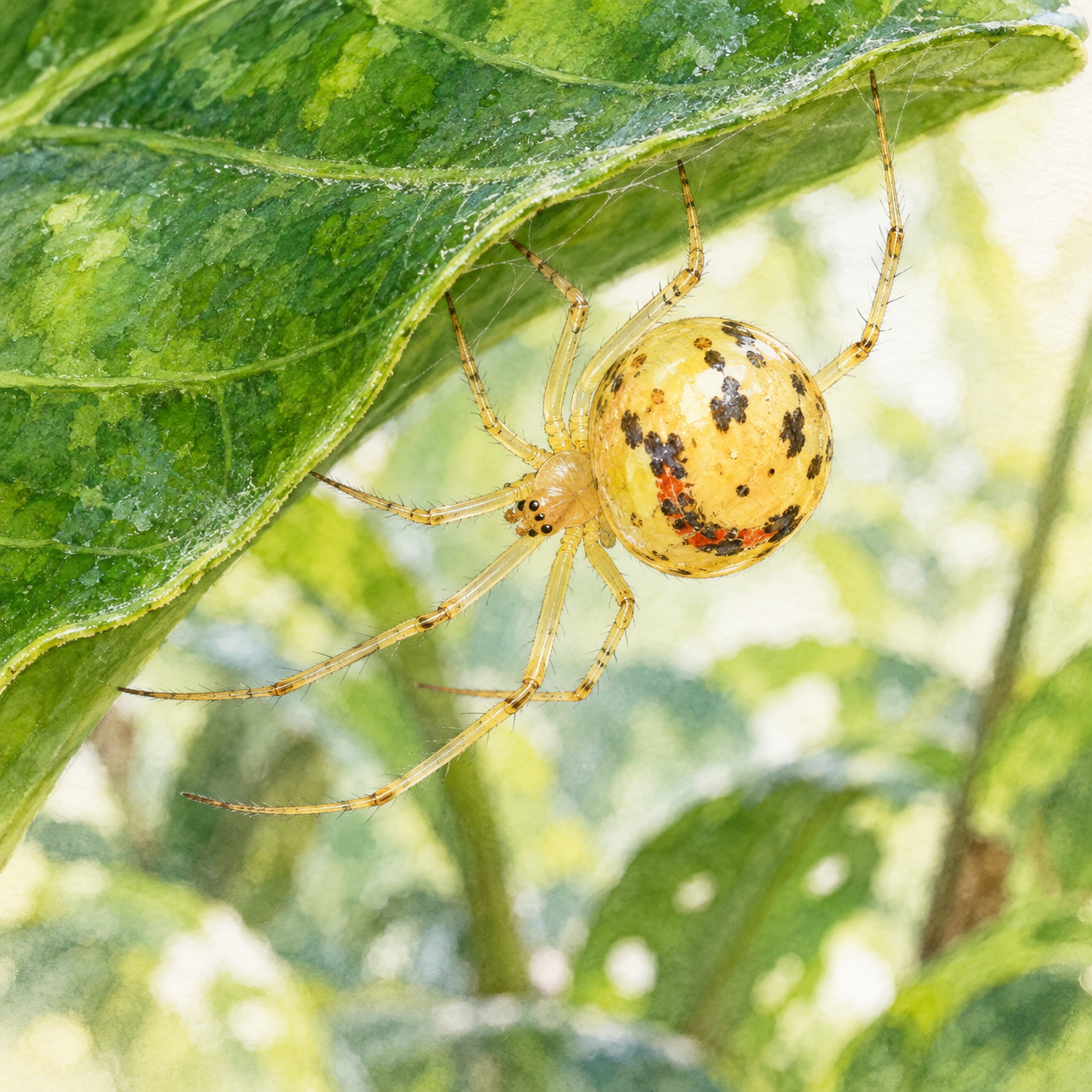
A pale spider beneath a Hawaiian forest leaf can appear to carry a tiny smile on its abdomen. The resemblance is striking enough to have given Theridion grallator its familiar name: the Hawaiian happy-face spider. The face, however, is something humans recognize in a color pattern, rather than an expression the spider is making.
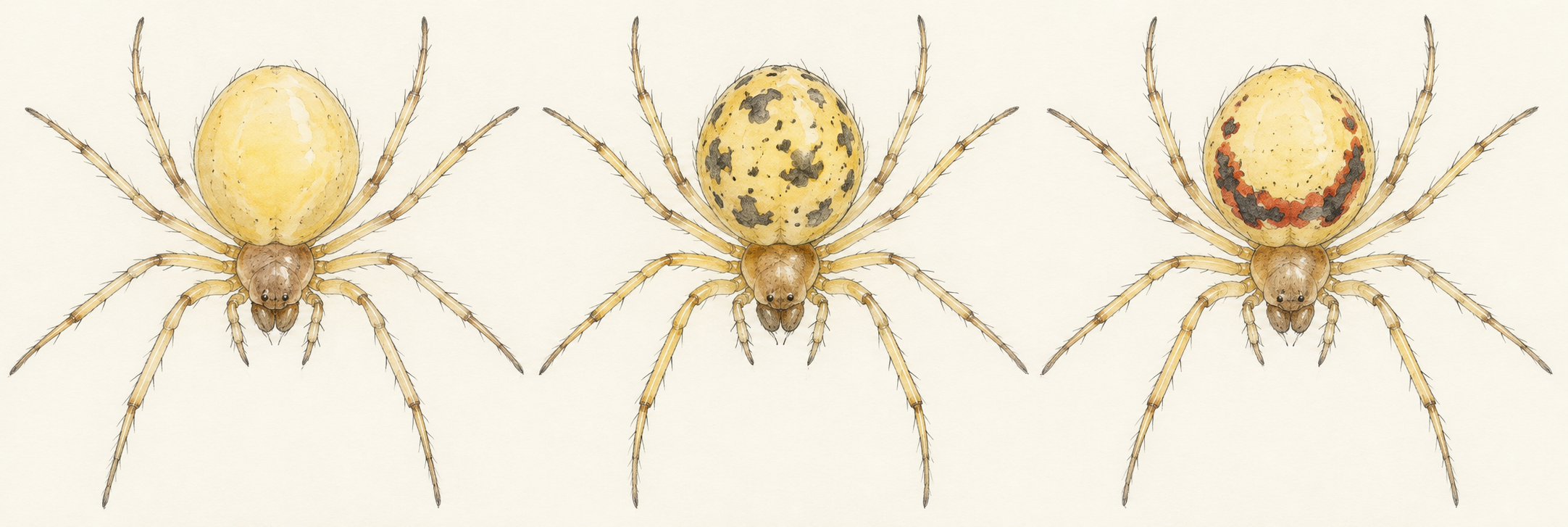
Even more interesting, the supposed smile is only one possibility. Members of the species display a rich variety of markings, and some lack the celebrated face-like pattern altogether.
A very small forest resident
The National Park Service describes these spiders as only a few millimeters in size, living in wet and mesic Hawaiian forests. Their delicate webs are often associated with the undersides of leaves, where the spiders rest during the day.
Much of their hunting takes place at night. They catch small insects from a thread near the web or search nearby foliage. The bright-looking abdomen in a magnified portrait belongs to a tiny animal operating in a much larger, cluttered leaf environment.
Females also guard eggs and care for young after hatching. That behavior adds another dimension to a creature often reduced to a novelty photograph: its daily life includes feeding, shelter, and parental investment.
The markings have a genetic story
The species is a classic example of color polymorphism, meaning that multiple visible forms occur within the same species. Research in Heredity examined the inheritance of its color and pattern variation.
A 1989 study found family patterns consistent with Mendelian inheritance, linking the visible variation with genetic differences passed between generations. The result is more complicated and more interesting than a single universal badge shared by every happy-face spider.
A photograph of a strongly marked animal can make that form seem typical of the entire species. The actual variation includes translucent yellow animals and several combinations of dark, red, and pale markings. Images are excellent at showing a memorable example; a study of a population is needed to describe the range.
A smile to us, a different signal in the forest
Why retain so many patterns? The National Park Service describes the purpose as unresolved and notes ideas involving concealment. The Bishop Museum account likewise discusses a possible role in avoiding bird predation.
Those are hypotheses about survival in the animal's environment. The fact that people see eyes and a curved mouth does not demonstrate that predators perceive the same face, or that the pattern evolved to look cheerful.
Human perception readily assembles familiar shapes from a few marks. Here, that habit gives us an engaging introduction to an animal whose real story concerns inheritance, variation, and life beneath leaves.
The most rewarding way to look at the happy-face spider is to notice both stories at once. Enjoy the apparent smile, then imagine the less theatrical individuals and the living forest around them. The species becomes a window into biological diversity within a population, rather than just an accidental emoji.
Sources and further reading: National Park Service: Hawaiian happy-face spider; Bishop Museum: Happy Face Spider; Heredity: What makes a happy face?.
Explore more creative work at Incoprea.