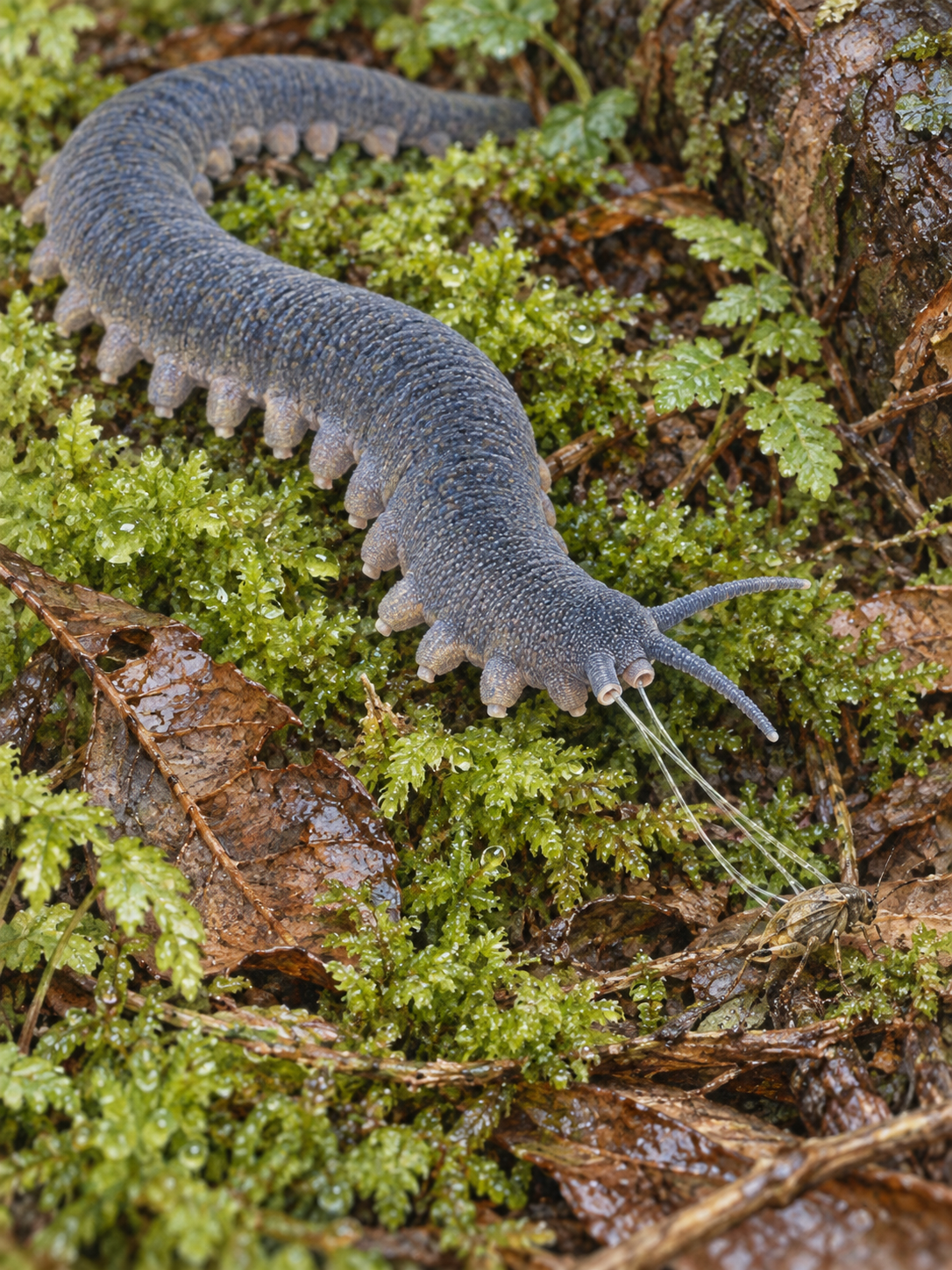
A velvet worm seems poorly equipped for a chase. Its soft body moves on numerous short legs, and its prey can be quicker and harder-shelled. The worm's solution is to send a material ahead of itself: jets of slime that entangle the target.
The attack combines an unusual delivery system with an unusual substance. Both have attracted researchers who want to understand how a living animal rapidly turns fluid into a useful structure.
Small openings, wide coverage
Velvet worms, or onychophorans, eject slime from paired papillae near the head. The streams move from side to side, creating a disorderly net rather than two perfectly straight lines.
A 2015 study combined anatomy, experiments, and fluid dynamics to investigate this oscillation. The researchers found that interactions between the flowing fluid and the elastic delivery structures could produce the rapid movement passively. The animal does not need a separate, precisely timed muscular twitch for every sweep.
That distinction makes the mechanism economical. The tissue and the flow participate in generating the spray pattern. Geometry and physical instability become part of a biological tool.
A fluid becomes a fiber
The slime is protein-rich. On ejection, it changes through a gel-like state into stiff fibers. A struggling target encounters material that is no longer simply a puddle of liquid.
McGill researchers have examined the molecular organization behind those changes. Their 2023 account describes fibers with strength comparable to nylon under the tested conditions, while also noting that the material can dissolve in water and be formed into fibers again.
“Comparable to nylon” should not be stretched into a claim that every property matches an industrial nylon product. Strength, stiffness, wet behavior, and durability are different measurements. The useful surprise is the combination of rapid assembly and experimentally demonstrated reversibility.
| Part of the attack | What contributes |
|---|---|
| Delivery | Paired papillae and moving fluid |
| Coverage | Rapidly oscillating jets |
| Capture material | Protein-rich slime forming fibers |
Inspiration needs further experiments
Researchers have identified uncommon chemical modifications in the slime and continue investigating how its components produce their behavior. These findings may inform materials designed to assemble, dissolve, or be reused in controlled ways.
An interesting natural material is not automatically a finished manufacturing process. Making a reliable synthetic equivalent requires understanding which features matter, how to produce them, and how they perform outside the animal's circumstances.
The velvet worm's own problem is immediate: keep a target from escaping. Its body supplies a spray apparatus, and the sprayed material helps create the trap.
The resulting net is fascinating because the mechanism does not belong to the animal alone. Flow, flexible tissue, proteins, and the surrounding environment cooperate. A slow-looking creature solves a fast encounter by letting physics and material change do some of the work.
Sources and further reading: Nature Communications: Velvet-worm jet oscillation; Harvard: A split-second slime attack; McGill: Reversible velvet-worm fibers.
Explore more creative work at Incoprea.




