A fountain pen contains enough ink to make an impressive blot, yet a working nib usually gives paper only a narrow line. Gravity is present, but the pen cannot simply be a bottle with a small hole. It has to supply liquid while preventing an uncontrolled pour, and it has to replace the space left by the ink that departs.
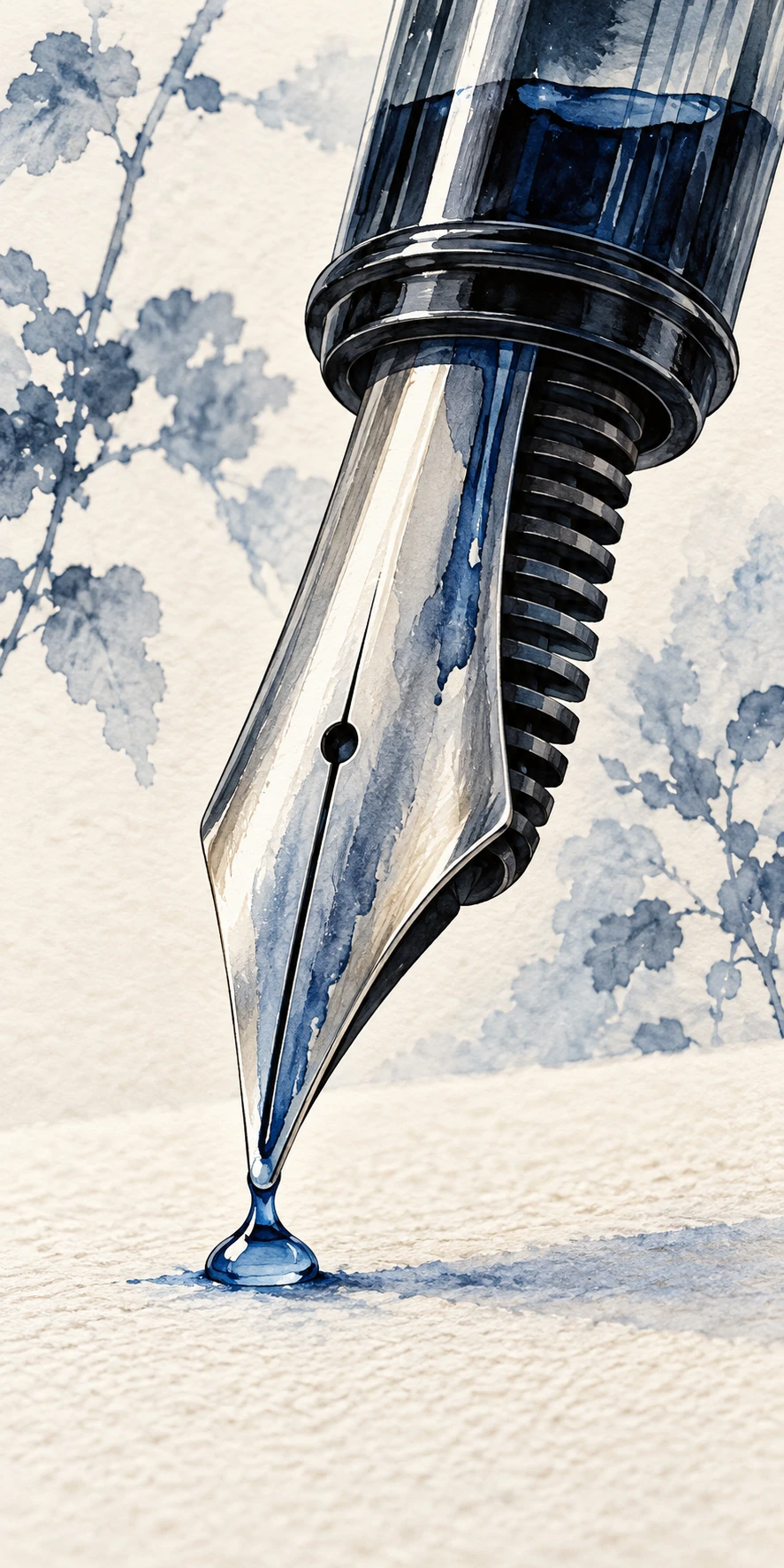
The nib, feed, reservoir, and page form one flow system. This enlarged study simplifies the internal passages.
The familiar shiny nib is only the most visible part of the arrangement. Under it sits the feed, a component whose small channels and fins can look less glamorous but do essential work. A continuous written sentence depends on an exchange between ink, air, solid surfaces, and absorbent paper.
A narrow space can help a liquid move
Capillary action involves the behavior of a liquid at narrow spaces and surfaces, including attraction to the material and cohesion within the liquid. The US Geological Survey's explanation uses familiar examples to show why liquids can move through small passages without a tiny mechanical pump at every point.
Paper makes the pen-and-page combination especially interesting. Its fibers and the spaces among them draw liquid away from the contact. The page is an active participant in making a line. Two papers can therefore give the same pen and ink a different-looking result, even before anyone changes their handwriting.
The feed is also an air-management device
PILOT's illustrated technical lesson describes ink grooves that carry liquid, comb-like grooves that hold surplus ink, and an air path into the reservoir. Ink can leave smoothly only if the changing reservoir conditions allow it. Air entering as ink is consumed is part of that continuing supply.
Imagine a rigid, perfectly sealed reservoir with a fixed amount of air above the ink. Let some liquid depart without admitting replacement air. The trapped gas expands and its pressure falls. That changing pressure resists continued outflow. The exact behavior of a real pen depends on its reservoir and feed design, but the thought experiment shows why “make the ink channel narrower” is not the complete solution.
A nineteenth-century problem still recognizable today
Lewis Waterman's 1884 patent describes a feed piece with a groove and narrow fissures. Its text discusses outward ink movement and incoming air, including the problem of bubbles interfering with the ink duct. The document is useful because it makes the engineering problem explicit in the inventor's own description.
A patent is not proof that one person invented every part of an entire technology. It is a specific claim, with drawings and an argument about an arrangement. Looking at it this way is more revealing than treating it as a simple first-inventor certificate. The interesting continuity is the need to regulate a flow that otherwise alternates between too little and too much.
Watch the paper before blaming the nib
You can make a useful comparison without dismantling a pen. Use a working pen normally on two papers you already have. Write the same short word with a similar pace and light, ordinary pressure. Note the line edge, apparent width, drying behavior, and any visible spreading along the fibers. Keep the pen and ink constant.
Do not change paper, ink, pressure, and writing speed together and then attribute the result to one variable. A rougher edge is an observation. Saying it proves a defect in the feed is a much larger conclusion. The page, nib, ink formulation, and pace all belong to the writing system.
Predict the effect of removing one participant
If the page stops drawing ink away as effectively, a full reservoir alone cannot guarantee the same line. If air exchange is obstructed, an initially wet nib may still write briefly from ink already near its tip. A short successful stroke and a long uninterrupted page test different parts of the supply chain.
The blue line is therefore a record of cooperation. A reservoir stores ink, small spaces control its movement, air makes room for its departure, and a fibrous surface accepts it. A fountain pen can feel personal because it makes this physical conversation unusually visible at the point where a hand becomes a sentence.
A person enters a monument that is already ancient and leaves a mark on its wall. Centuries later, another visitor tries to read that mark. At Maeshowe in Orkney, the walls do not belong to one historical moment. They hold evidence of a Neolithic tomb, later Norse visitors, and modern efforts to investigate and protect both.
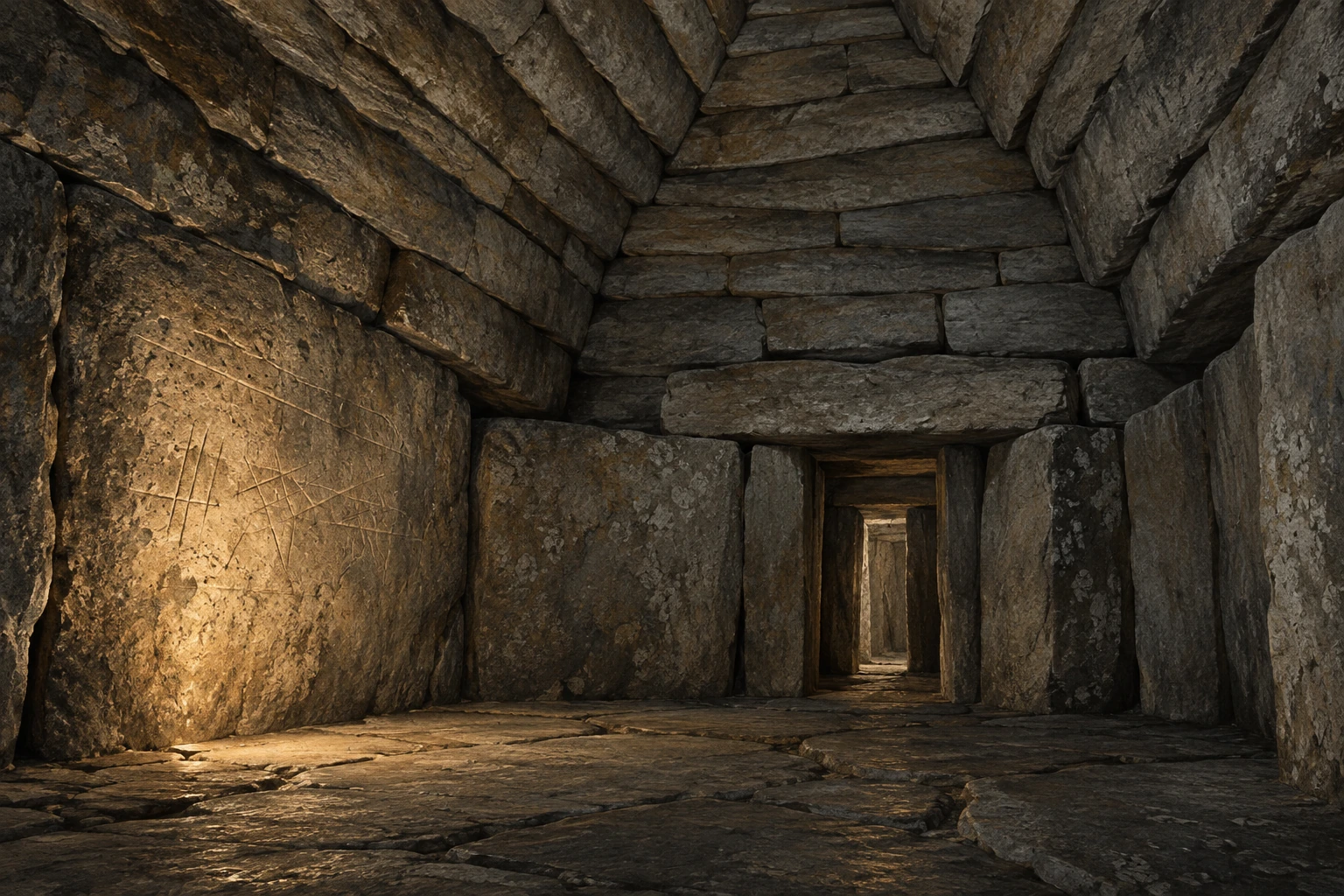
A chamber can outlive its first purpose. The invented incisions stand for later visitors rather than a transcribed Maeshowe inscription.
The temptation is to let the liveliest writing take over the whole story. Runic graffiti can seem more conversational than a monumental stone chamber. Yet the runes are late arrivals in a much older building. Keeping those timelines separate makes the place more remarkable.
This sounds obvious when stated plainly. It becomes less obvious in a cropped photograph that shows a rune beside a carefully dressed stone. Images place things next to one another; historical argument has to establish whether they were made together. Physical proximity is evidence of a relationship, but not necessarily of shared date or purpose.
The tomb's construction also deserves attention on its own terms. A low passage leads into a central chamber with side cells. Stone size, positioning, and the transition from passage to room organize an experience that the later writers inherited rather than invented.
Where a line is matters as well as what it says
The World Heritage nomination dossier discusses the Norse inscriptions and the history of recording them. It includes the position of a high inscription as well as its reading. Placement can become evidence: a mark's height raises questions about the state of the chamber when somebody carved it.
A translation gives a modern reader access to language. A measured location gives access to an action in space. Together they can suggest more than either alone, but they still need careful limits. An inscription that boasts about a feat is evidence that someone made that claim. It does not automatically verify every event being described.
Names, declarations, joking, and claims about other visitors can all invite a very modern sense of recognition. That recognition is enjoyable. It should not turn every line into a reliable diary entry, or every modern translation into a direct recording of a speaker's voice.
Three histories in one chamber
Layer of history
A useful question
Neolithic construction and use
What do the architecture and archaeological context show?
Later Norse entry and inscriptions
What was carved, where, and how is it dated and read?
Modern excavation and conservation
What has been exposed, altered, recorded, or supported?
The monument you see also has a conservation history
The 2008–13 World Heritage management plan records an 11-meter passage and describes a concrete cap installed in 1910–13 above the chamber. It notes that the present upper height is probably lower than the original apex. A modern protective intervention is therefore part of the structure's present condition.
That is not a reason to dismiss the monument as inauthentic. It is a reason to ask better questions about which parts of a visible condition are ancient, which are reconstructed, and which support survival. Conservation choices can preserve access to evidence while also changing what a visitor experiences.
Try reading a monument photograph in two times
Choose a photograph in the official site account or nomination dossier. First describe only visible relationships: passage, chamber, wall, incision, light. Then add dates from the record. Mark any part for which you do not have a date. The exercise tests how quickly the eye turns several periods into one apparently continuous scene.
There is no need to flatten Maeshowe into either a solemn prehistoric mystery or a collection of amusing Viking messages. The building's long life includes both, alongside many gaps. Its depth comes from the coexistence of histories that remain distinct.
The next time you encounter writing on an old wall, begin with two questions: how old is the wall, and how old is the writing? The distance between those answers may be where the most interesting story starts.
A birthday invitation survives because somebody once wrote on something that looks almost too slight to be an object: a thin leaf of wood. Its endurance is extraordinary. Its purpose is wonderfully ordinary. Claudia Severa wanted Sulpicia Lepidina to come and make a celebration more enjoyable.
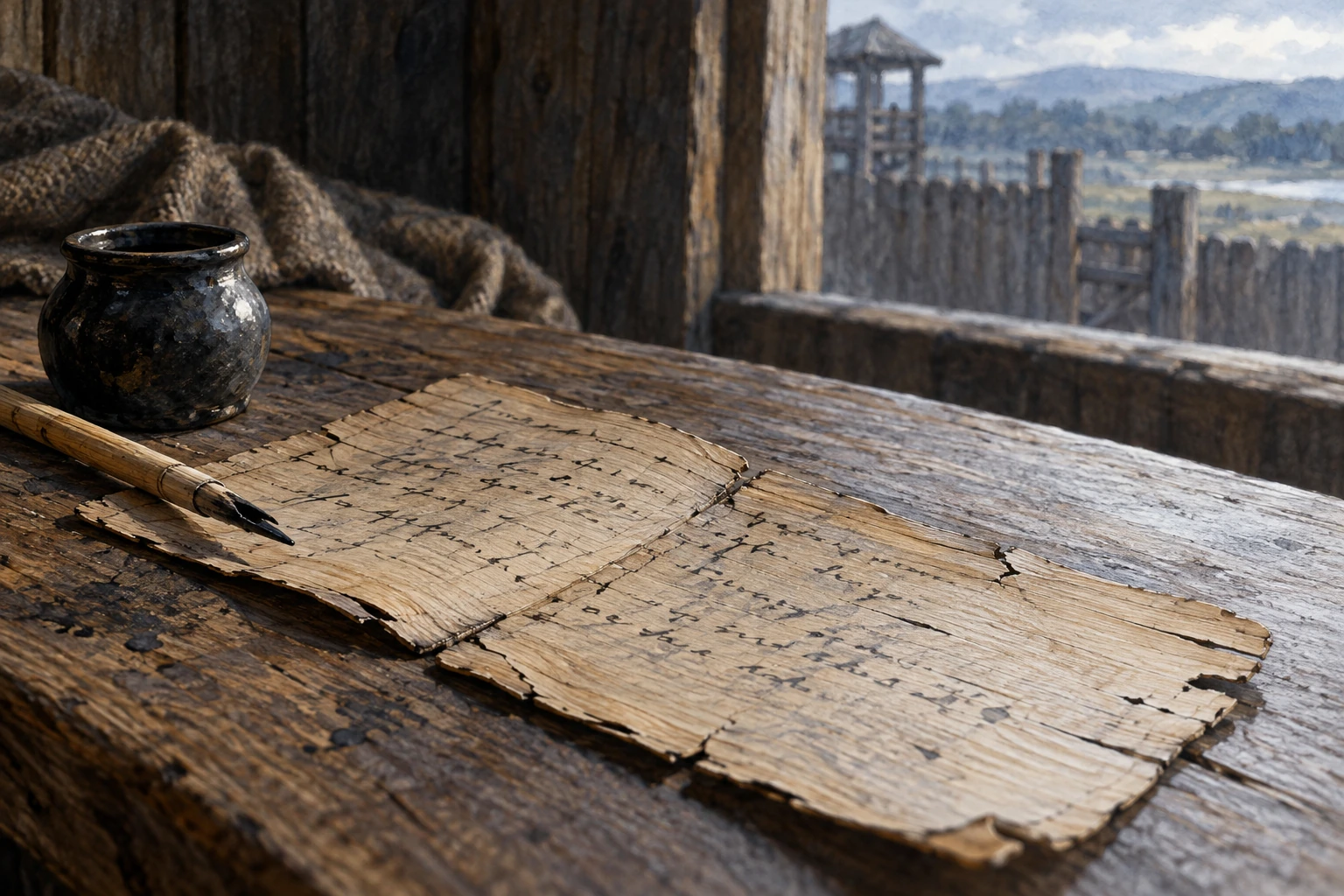
A thin wooden leaf could carry a personal letter. The imagined marks here are not a transcription of a Vindolanda tablet.
The invitation is Vindolanda tablet 291, dated by its archaeological context to 97–105 CE. It belongs to a Roman military settlement in northern Britain, but it does not read like an imperial proclamation. Family greetings share space with the invitation. The surviving text gives the occasion as 11 September.
First, put the writing surface back into the story
The leaf format matters. Thin wood offered a smooth writing surface that could be folded. Layout had to accommodate that physical arrangement, just as the outside of an envelope has a different job from the letter inside. Notches on some letters may have anchored binding cords. The editors present that as an interpretation of the evidence rather than an intact ancient postal procedure we can watch from beginning to end.
Try picturing the difference between a letter laid flat in a publication and the same object handled, closed, carried, and opened. Reading the words answers what was said. Looking for a fold, an address, or an edge answers how the communication worked. Those are related questions, but they need different kinds of observation.
Two hands are more interesting than one famous sentence
The British Museum identifies two hands in the invitation. The scholarly edition attributes the short personal closing to Severa herself, while the main text has a different hand. That shift gives the letter an additional texture: a message could be prepared by someone else and still end with the sender's own written greeting.
This is stronger evidence for a particular writing practice than for the literacy rate of an entire society. It would be a leap to turn one woman's autograph into proof that every woman could write. It would also be a mistake to treat the use of a scribe as proof that a sender could not. A document records an action under particular circumstances; it rarely supplies every reason behind that action.
The invitation's warmth can feel immediately familiar. That feeling is a useful entrance, provided it does not erase differences in status, household organization, and military life. We can recognize a wish for company without pretending that the rest of Severa's world was our own.
A modern edition separates what survives from what has been supplied or remains doubtful. On tablet 291's page, compare the diplomatic text, edited text, and translation. Brackets and dotted letters are not ornamental scholarly clutter. They tell you where an editor has crossed from visible traces to a reasoned reading.
What changes a fragment reading?
An invented fragment separates useful letter evidence from context that does not decide a missing word.
The small exercise above uses an invented English fragment, not an ancient tablet. Two words initially fit the missing letters. Recovering a date supplies context but does not settle the missing word. Recovering a distinguishing letter does. That is the point: additional information helps only when it bears on the uncertainty you are trying to resolve.
A three-minute route through the real edition
Read the translation once for the human situation.
Find one uncertain or restored place in the edited text.
Check the support record for material, dimensions, find date, and archaeological dating.
Return to the translation and name one thing it tells you firmly, and one thing you still cannot know.
This way of reading works beyond Roman letters. It keeps the pleasure of meeting an individual voice while making room for the object, its survival, and the labor of interpretation. The little invitation becomes more compelling when its gaps remain visible.
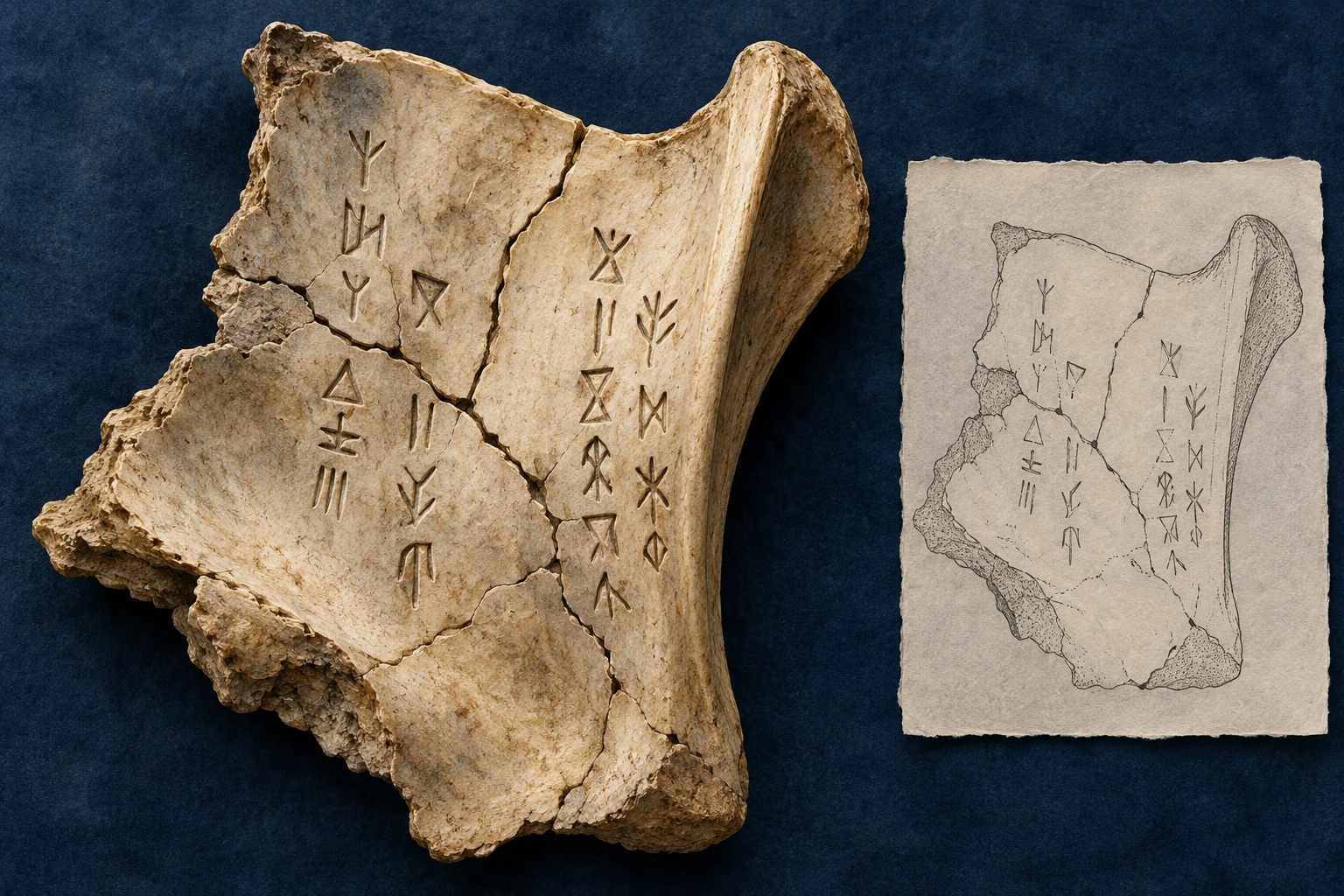
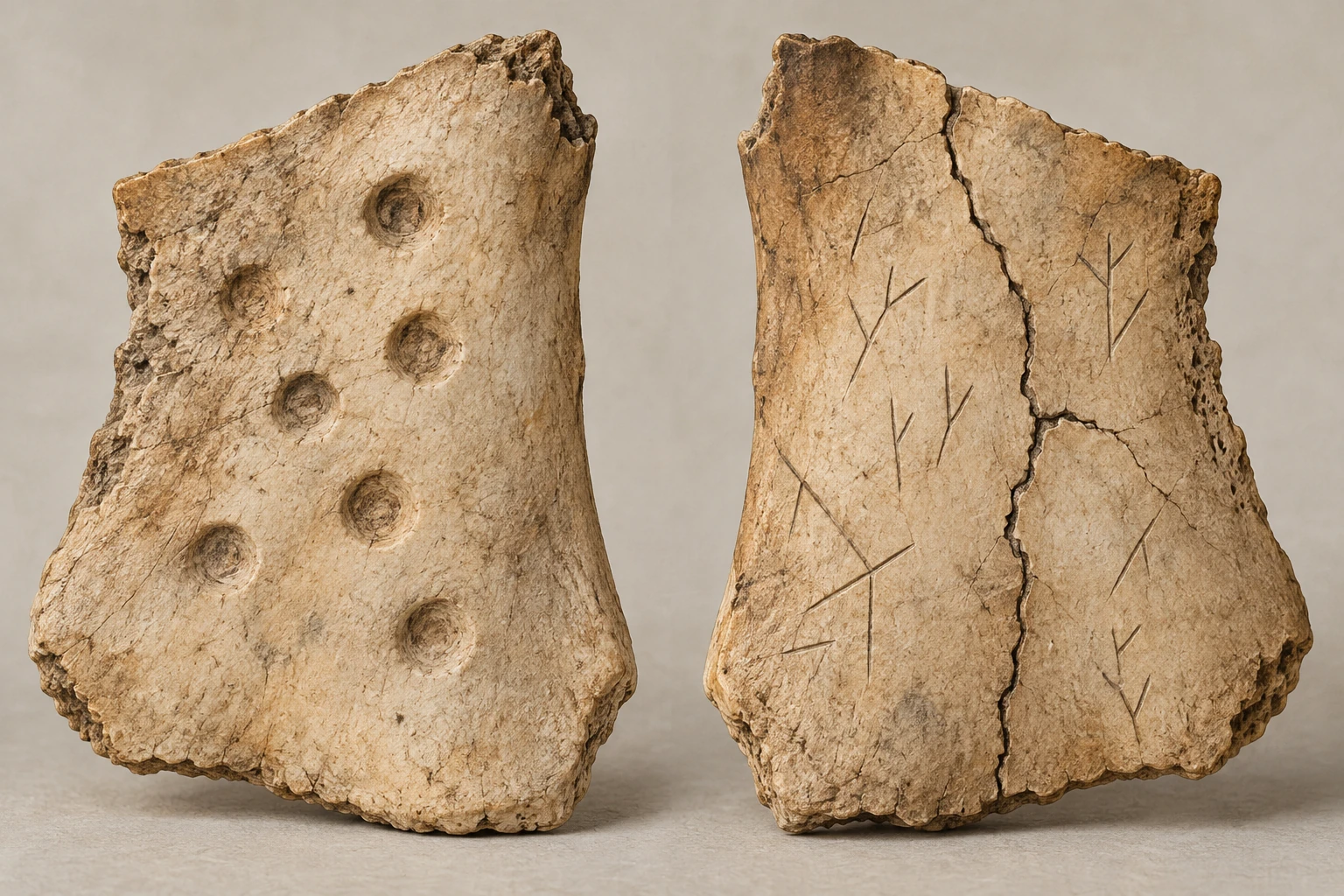
Archaeological concept; the marks are invented and carry no translation.
An oracle bone can carry two kinds of lines that are easy to confuse in a small photograph. Some are fractures. Others were deliberately cut as writing. Both belong to the object’s history, but they did different jobs. Begin by separating them, and the fragment becomes more than an evocative relic of prediction: it becomes evidence of preparation, ritual action, record keeping, and later interpretation.
Shang-period diviners used cattle shoulder blades and turtle plastrons in procedures involving heat and the reading of cracks. Inscriptions could record the subject and interpretation of a divination. The Penn Museum’s object guide places that practice in a royal context, concerned with political, social, and personal matters. It describes the cracks as a means through which diviners believed they received supernatural guidance.
The crack is not the sentence
That distinction is the first reading skill. A fracture does not turn into a written character merely because both are visible on the same surface. Nor does every surviving written passage include a complete question, prediction, and subsequent outcome. Breakage, omission, and the kind of record being made affect what remains.
Before asking for a translation, ask what the image shows. Is it the inscribed face, the reverse, a rubbing, a tracing, a modern reconstruction, or a photograph of a cast? Do the caption and catalog number identify the same object? Can you see where the fragment ends, rather than where an illustration has merely been cropped?
The Met’s oracle bone 67.43.16, for example, has an object record identifying inscribed bone, Shang attribution, and dimensions of 12.7 by 23.5 centimeters. Those modest facts give the image a material scale and an institutional identity. They do not by themselves provide a translation or establish that every visible mark is ancient writing.
A misplaced fragment and a careful refusal
In a 2001 first-person research account, scholar Victor H. Mair describes examining an oracle-bone fragment found among Penn’s cuneiform tablets. The object’s location in a museum drawer was a modern problem, not evidence of a Bronze Age journey from China to Mesopotamia. Registration records helped investigate its collection history.
Mair also discusses another fragment, 49-14-7B, only 1.4 by 1 centimeter. Too little of its inscription survived for him to offer a reading. That refusal is useful evidence of method: recognizing a category of object is not equivalent to recovering a lost sentence.
The same article raises concerns about a possibly later-added graph on one object and identifies another as a likely fake. These judgments belong to Mair’s published analysis; they remind us that cataloged collections can contain complicated histories of alteration, attribution, and reassessment. “It looks ancient” is not a sufficient authentication method.
Turn the object around
A surface with writing attracts attention first, but a three-dimensional object contains information that a front-facing image hides. Cambridge University Library’s Hopkins collection guide links digitized bones and records fifty in three-dimensional format. Its account of the imaging project describes how a model makes both finely incised marks and reverse-side divination pits available for closer viewing.
Use a model as an object study, not only as a rotating novelty. Choose one edge and follow it from front to back. Look for changes in thickness, the relation of a pit to a crack, and the difference between a deliberate hollow and a broken margin. If lighting controls are available, change the illumination gradually and notice which marks become clearer.
A digital surface is still an interpretation made through a recording process. Its resolution, texture, lighting, and completeness set limits. A feature absent from a model may have been too shallow, inaccessible, or poorly captured. That is different from demonstrating its absence on the physical object.
A four-column notebook for one fragment
You can do a serious ten-minute exercise without reading ancient Chinese. Choose one institutional object and make four short columns:
Visible: describe only what you can point to, such as a broken edge, a row of incisions, or a darkened area.
Cataloged: copy a few factual identifiers in your own notes, including the collection number, material, dimensions, and attributed period.
Interpreted: summarize the institution’s explanation and identify whose reading it is.
Unanswered: record what the available evidence cannot tell you.
Now review your first column. Did “burn mark” slip into it when you could only observe a dark patch? Move the proposed explanation into the interpretation column unless the source establishes it. Did “the king asked” appear when the translated fragment contains no surviving name? Mark that leap too.
The point is not to remove interpretation. It is to give it an address, so another reader can tell what supports it. A note with fewer confident claims may be more informative because its evidence remains visible.
A drawn line can clarify—and select
A modern research image may have passed through several transformations before it reaches a screen. The 2026 OBIMD dataset paper by Bang Li and colleagues distinguishes rubbing images, facsimiles, character annotations, and reading sequences. Its account explains that some non-character features emphasized in published drawings were omitted from its redrawn image layer to keep the selected representations aligned. A clear drawing is therefore a reason to ask what it was made to show.
Archaeological concept only. The marks have no translation and do not document an object.
Cambridge’s digital Chinese collections guide also places oracle-bone images alongside other recording formats and collection types. The presence of two-dimensional and three-dimensional resources gives a reader choices. It does not turn a tracing, rubbing, photograph, and surface model into equivalent substitutes for every question.
Try an ordinary analogy with a pencil drawing of a leaf. One drawing can emphasize the outline, another the veins, and a photograph the texture and shadows. All may accurately select features from the same object. Comparing them requires knowing the aim of each representation. It would be a mistake to conclude that the leaf had no veins because an outline drawing left them out.
For an oracle-bone viewing session, make a small “image passport”: object or publication identifier, representation type, stated creator or institution, and features the image emphasizes. Add a fifth line for what the image cannot establish alone. If the available page does not identify the format, record that uncertainty before attempting a character comparison.
Now look at the article’s conceptual illustration as a deliberately different case. Its generic marks carry no transcription and supply no historical evidence. It can focus attention on the distinction between a prepared surface, a fracture, and cut marks, while the actual reading must return to documented objects and scholarship. Visual appeal should not give an illustration the authority of a recorded specimen.
The same care applies to computational work. Grouping marks into an inscription, choosing a reading order, and assigning a character label are related but separate tasks. The dataset’s attention to contextual structure is a useful reminder that recognizing one isolated sign is not equivalent to reading a fragment’s complete statement.
When a line looks unusually clear, ask one more question before celebrating: clear for which task? That question gives the reader a practical way to appreciate modern access while keeping the underlying bone, the act of recording it, and the interpretation of its marks distinct.
Why a question is not an event report
Here is a deliberately invented modern example: “Will rain damage the harvest?” It records a concern. It does not establish that rain came, that a harvest failed, or even that rain was unusually likely. A later note reporting an outcome would provide a different kind of information.
The same logical care matters with ancient records. A translated concern about warfare, weather, or illness should not automatically become an event in a historical timeline. Grammar, textual convention, context, and surviving follow-up records have to carry that argument. Our invented sentence is a reminder about inference, not a translation of an oracle-bone inscription.
These objects are valuable partly because belief and practical concern meet on their surfaces. A record can reveal what mattered to a court without giving direct access to every life around it. Look at the crack, the cut line, the reverse, and the catalog history together. The resulting encounter is slower than a dramatic prediction story—and far more revealing.
You can read the letters of a word and still have no idea what it means. Try sounding out a sentence in an unfamiliar language that uses the Roman alphabet. The shapes are accessible; the vocabulary and grammar are another matter. Meroitic brings that distinction into the study of an ancient African kingdom.
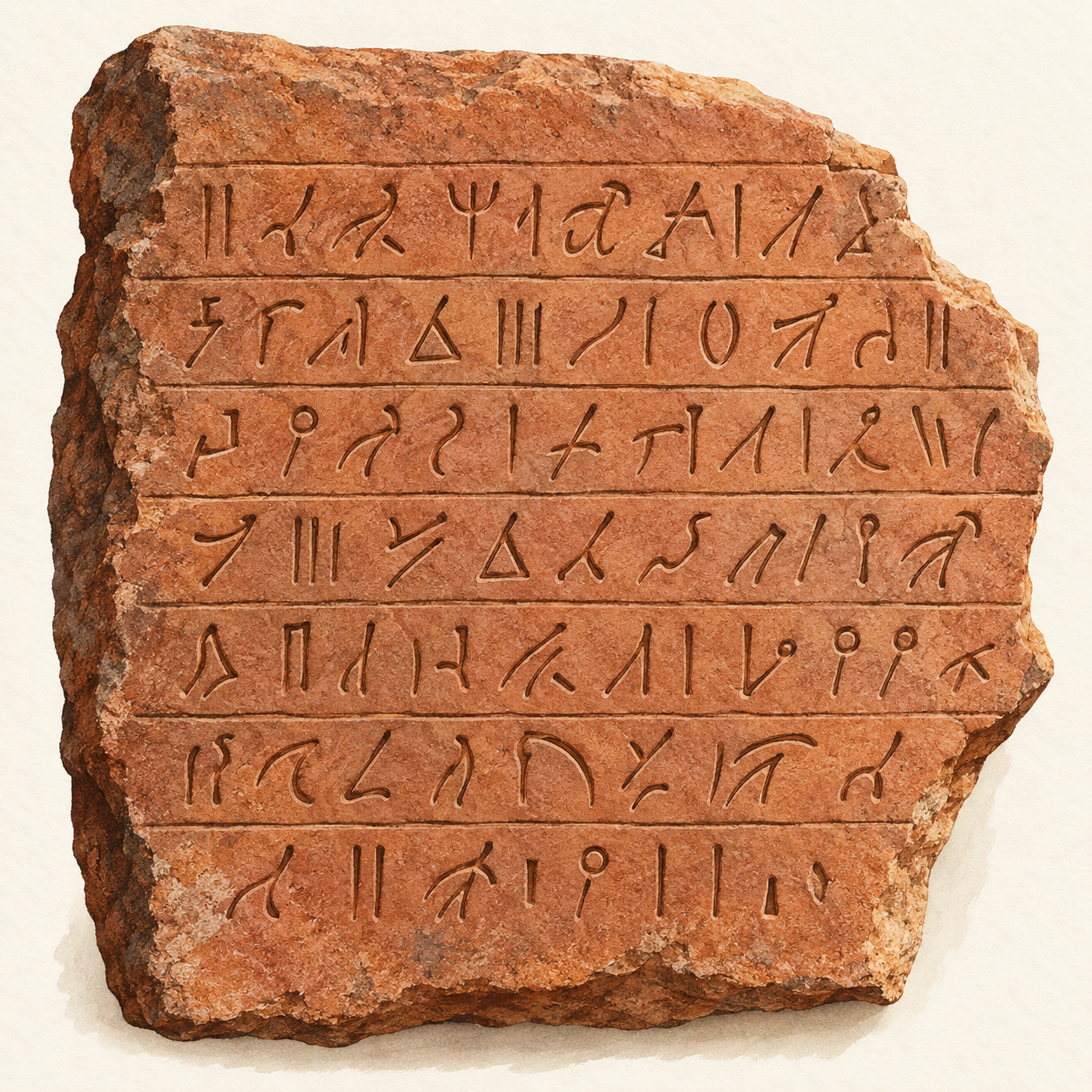
The language was used in Kush, centred in what is now Sudan. Researchers have recovered the basic sound values of its writing, yet understanding many extended passages remains difficult. This is neither a fully unlocked archive nor a complete blank. It is a field in which different parts of reading have progressed at different speeds.
This invented fragment suggests the appearance of an inscription; its marks are not a valid sentence or an archaeological facsimile.
Two related scripts, one difficult language
Meroitic has two written forms conventionally called hieroglyphic and cursive. The Unicode Standard describes their visual relationships to Egyptian hieroglyphic and demotic writing. Shared visual ancestry does not make the underlying language Egyptian; the adaptation served a different language.
The system is compact compared with Egyptian writing. Many consonant signs carry an inherent vowel unless another vowel is indicated, while some signs represent particular syllables. Calling the whole system simply an alphabet is a useful first approximation, but the conventions need to be learned rather than inferred from modern English spelling.
The label cursive also does not mean that all its signs join as in a modern handwriting exercise. Script names are historical conventions. Look at an inscription before allowing the name to decide what its lines must look like.
Francis Llewellyn Griffith's early twentieth-century work established the fundamental sign readings. A later researcher can consequently transliterate much of a text, representing its signs in another script. That makes comparison possible even where a complete translation is not available.
Meet a particular inscription
The Hamadab stela in the British Museum, EA1650, provides a concrete example. It combines an upper figurative scene with a long inscription. The museum record identifies the names Amanirenas and Akinidad. Recognition of names provides a foothold, but does not make every surrounding sentence transparent.
Mohamed Bashir's archaeological study places the inscription within Hamadab's sanctuary and urban setting. The monument belonged to a built environment, not simply a museum wall. Where a text stood, what a visitor could see and which figures appeared above it all belong to its public effect.
The text's length makes the remaining difficulty especially striking. A long inscription contains much information, but recovering it requires more than supplying a plausible historical narrative. Names, repeated sequences, grammatical forms and parallels have to fit together.
What a repeated name can—and cannot—do
Imagine an unfamiliar document in which you recognise the same person's name in several places. You have learned where the name appears. You may be able to compare what comes immediately before or after it. But without further knowledge, you cannot decide whether the person gives, receives, commands, remembers or is remembered.
This simple thought experiment explains why names matter without becoming a magic key. They anchor part of a sequence. Other inscriptions can then supply comparable contexts, and those comparisons can help identify grammatical patterns or recurring formulae.
Formulaic texts are particularly useful because recurrence reduces the number of changing elements. A repeated structure may reveal where a name, relationship or action belongs. More varied royal narratives pose different challenges, since they can introduce rarer vocabulary and more complex claims.
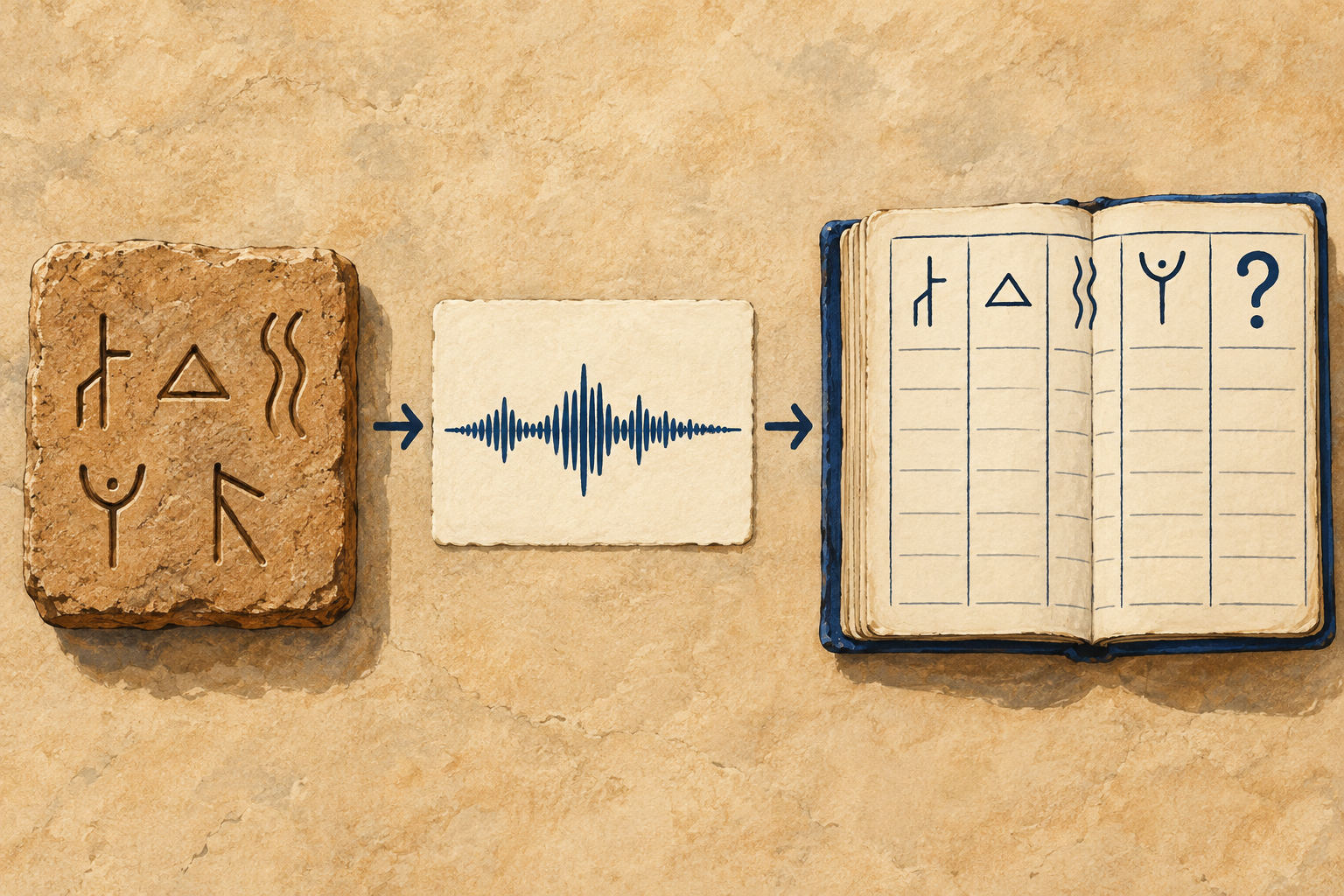
Recognizing signs, recovering sounds and explaining meaning are separate tasks. No sign-to-sound mapping is proposed here.
The illustration separates recognising a sign, rendering its sound and understanding a statement. None of its marks forms a verified Meroitic sentence. For a genuine inscription, use the museum record and its linked photography.
A five-minute stela study
Open the Hamadab stela record. Begin with the whole object. Where does the figurative area end and the inscription begin? How much of the monument is assigned to each? Then enlarge a short passage and follow the line arrangement without attempting a translation.
Write a two-part description. In the first part, record things visible in the image: surviving edges, line divisions, damage and the relation of figures to writing. In the second, record information supplied by the catalogue or a scholarly study: names, site and proposed historical setting.
Now ask a more demanding question: which part of your description would change if a linguist revised the interpretation of one word? The physical placement of the inscription would remain. A statement about exactly which event it describes might change. This separation lets progress in language research enrich the object without making every earlier observation worthless.
Progress has several forms
Claude Rilly's research addresses phonology, syntax and linguistic relationships. Those are related projects with different evidence. Classifying a language can help frame comparison; it does not supply a translation automatically. Identifying a grammatical ending can be a significant advance even when a long passage remains incomplete.
Modern digital encoding contributes another kind of infrastructure. Unicode provides characters for the two scripts, helping specialists represent text consistently in software. Encoding preserves distinctions a researcher has chosen to represent. It does not authenticate a proposed meaning or turn a font into a decipherment.
The word unreadable can therefore conceal too much. It blurs a damaged surface with an unidentified sign, an uncertain sound and a word whose meaning remains disputed. Naming the actual difficulty makes the research easier to understand and its achievements easier to recognise.
Meroitic's importance extends beyond the challenge it presents to modern scholars. These inscriptions belong to a society that recorded authority, relationships and beliefs in its own language. Each secure reading adds to our ability to study that history through local records. The work remains unfinished, and that is a reason to follow it carefully rather than replace its gaps with an invented fluent voice.
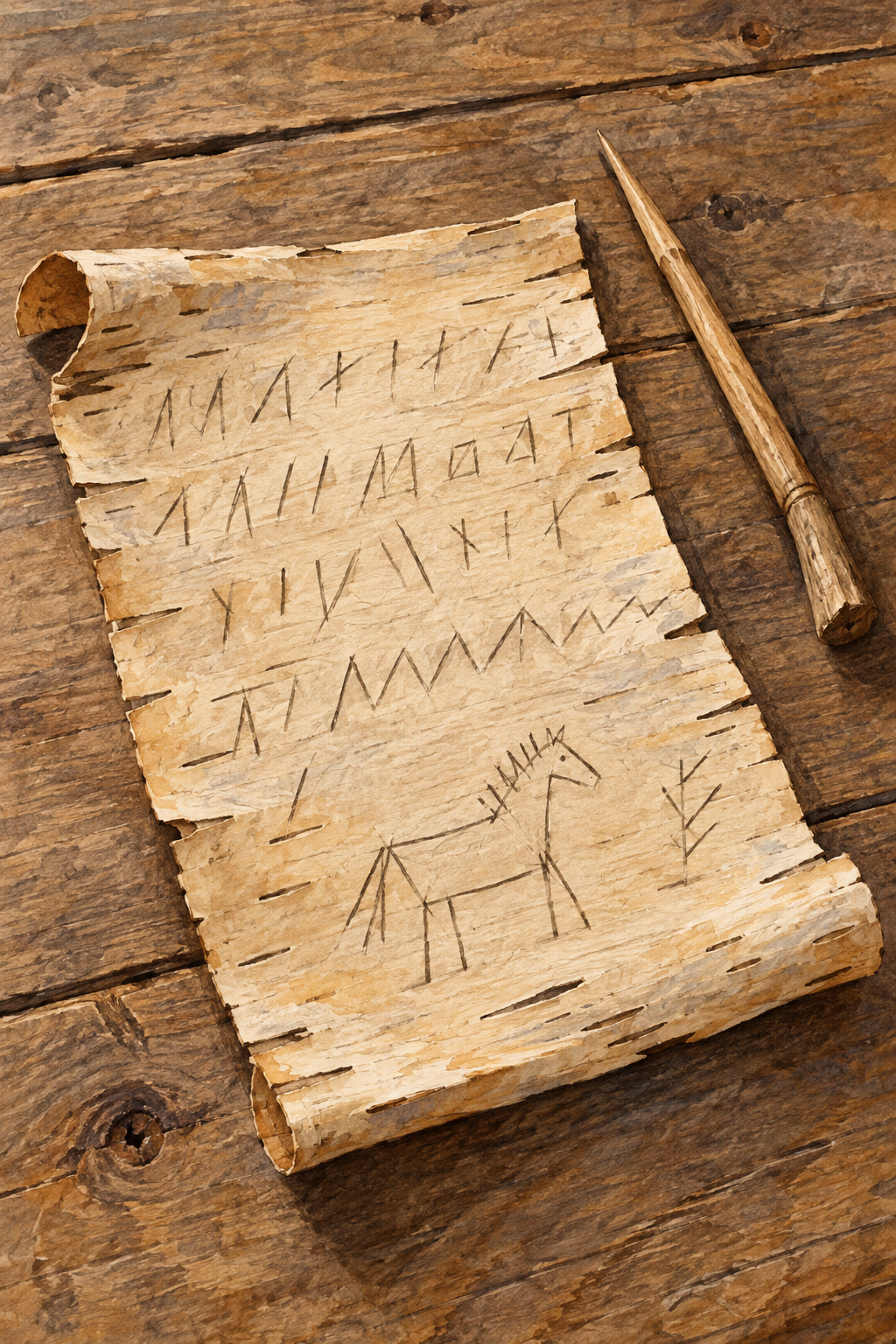
A medieval message does not have to announce a battle or preserve a royal decree. It can ask for a payment, keep a record of an obligation or give someone an instruction. Scratched on a strip of birch bark, ordinary writing can bring the past close through tasks that still feel recognisable.
The documents excavated at Novgorod and other sites in medieval Rus' are valuable partly because many were used and discarded. They survived outside the long copying histories of prestigious books. Archaeology recovered a different register of written life: brief, practical and often dependent on knowledge shared by sender and recipient.
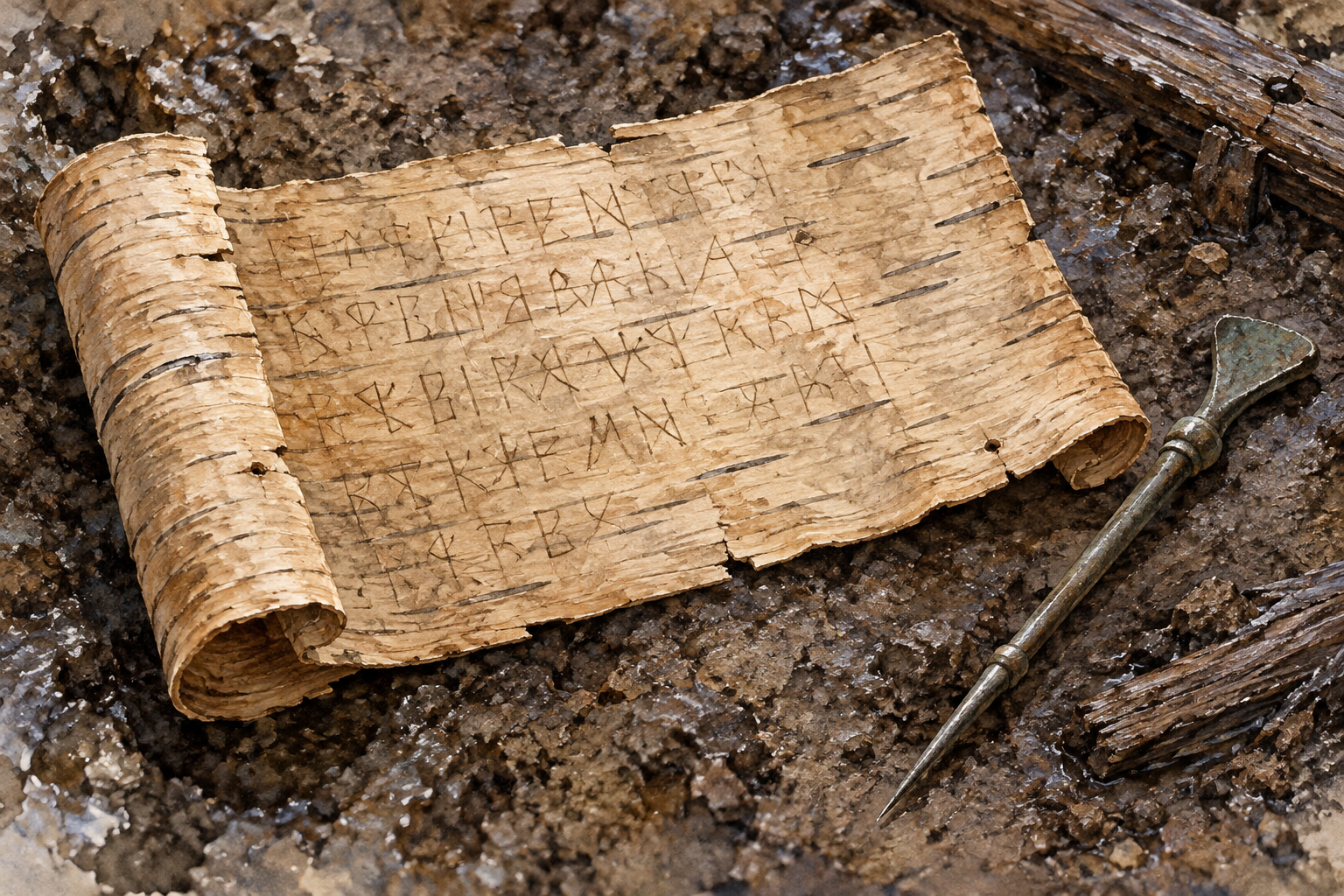
This imagined message illustrates bark and stylus as writing materials; it does not reproduce or translate an excavated letter.
A surface that keeps the scratch
In this tradition, the writer generally incised the bark with a pointed stylus rather than applying ink. The University of Hamburg's writing-material guide contrasts that practice with bark manuscripts elsewhere, including South Asian ink-written examples. The material can be shared while the techniques and reading traditions differ.
A scratched text is part of the surface. Lighting, damage and the grain of the bark can affect what a photograph makes visible. An apparently small groove may belong to a letter, a surface feature or a later mark. Close examination has to establish the inscription before interpretation can proceed.
The shape of a fragment matters as well. Was the message written across the available strip? Does a broken edge interrupt a line? Can the surviving piece belong to a longer document? A neat modern transcription can conceal how much of the original writing surface is missing.
The first find was everyday business
The State Historical Museum records the first Novgorod birch-bark document's discovery on 26 July 1951 at the Nerevsky excavation. It identifies Nina Akulova as the finder. The fragment concerns income or obligations associated with landowners and settlements, including payments in money and produce.
That is an excellent beginning for an archive of daily life. A list of obligations makes relationships visible: people owe, collect, account and communicate. The document is modest in scale, but the activity it records belongs to a wider economy.
The museum also describes earlier discoveries of bark pieces and pointed tools whose function had not been fully recognised. A securely identified text changed the way related objects could be understood. Archaeological interpretation can advance when one find makes an existing collection of clues fit together differently.
A child learning to write
Onfim's drawings and exercises provide another unusually direct encounter. A museum record describes a bark fragment with a rider, a fallen opponent and the name Onfim, dated around 1240–1260. The suggestion that the rider is an imagined self-portrait is an interpretation, not something the drawing can prove alone.
Exercises and drawings bring learning into the archaeological record. This imagined lesson is not a copy of Onfim's work.
The lesson illustration here is invented; it is not a reproduction of Onfim's work. The actual object is available through the State Historical Museum's cultural-collections feature. Comparing the two keeps an appealing general idea separate from the marks of a particular child.
Scholarly accounts connect Onfim's surviving exercises with stages of learning: letters, syllables and copied religious material. Writing practice and drawing occur within the same small body of evidence. The result makes education visible as an activity rather than merely a skill someone possessed.
It is easy to invent a child's thoughts around a vivid picture. A better first question is how the drawing and writing occupy the surface. What has been repeated? Where does a name appear? Which observations support a discussion of practice, and which require a more imaginative biography?
Read a brief message for what it leaves out
Short practical communication relies on context. If you send someone “bring the other one tomorrow,” both of you may understand perfectly. A reader seven centuries later would need to identify the object, the day, the relationship and the reason. Brevity can be evidence of shared knowledge rather than careless composition.
The same principle matters for bark letters. A request may omit information its recipient already knew. A debt list may have been a memory aid or an instruction to another person. Its function has to be argued from wording, layout and context.
Try a small modern exercise. Write a two-sentence household instruction, then remove every detail that the intended recipient already knows. Now give it to an imagined future reader who lacks that context. List three questions they could no longer answer. The exercise reveals why an apparently plain ancient note can demand substantial scholarship.
Surface: the fragment's outline, visible grooves, drawing and arrangement.
Identification: date range, find context and the reading of a name.
Interpretation: what the scene might represent and how it relates to learning.
Now return to the image. Which details became easier to notice after reading the record? Which claims still depend on specialist knowledge? A good catalogue can guide attention without making every interpretation directly visible on the surface.
For a deeper route, the University of Hamburg's study surveys the manuscript tradition, while Alexej Gippius's linguistic discussion considers writing and education. Compare how a museum object entry and a scholarly study organise the same kind of evidence for different readers.
Ordinary voices, uneven survival
The archive includes personal and business notes, educational exercises, religious texts and drawings. It widens the range of people and activities available for historical study. It does not establish that every resident wrote, or that every named sender personally scratched the words.
Preservation and excavation shape the sample. So do the decisions to discard a note, reuse a surface or leave a message in a particular place. Each surviving strip belongs to that chain of circumstances as well as to the conversation it once served.
The attraction lies in that meeting of scale and intimacy. A few scratched lines can reveal an obligation, an instruction or a learner's practice. The message needed doing in its own time. Its survival lets us investigate that need, and hear something beyond the grand public narratives that so often dominate the medieval past.
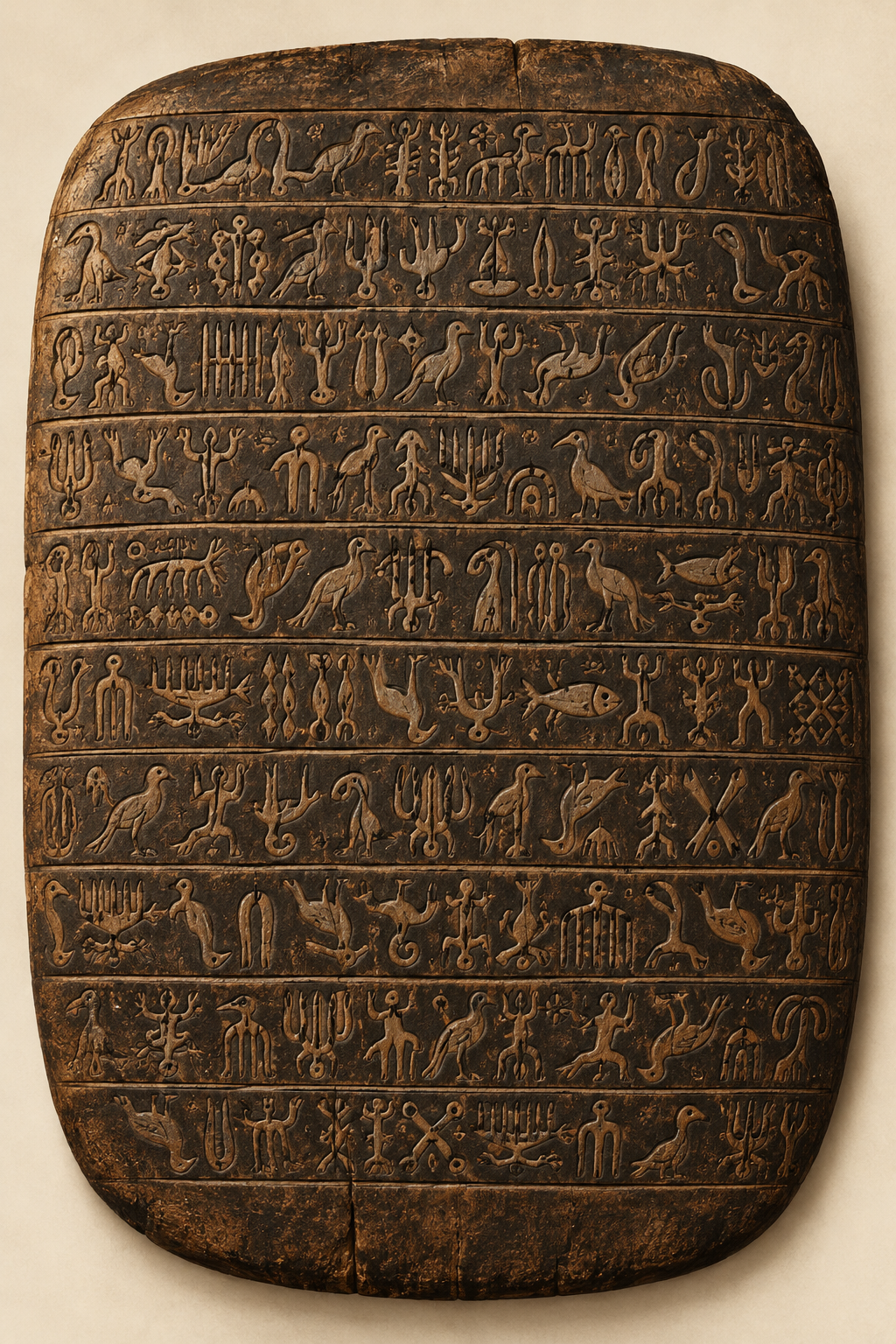
A carved bird can be recognisable without being readable. On the wooden objects bearing rongorongo, forms that resemble bodies, creatures and other shapes appear in organised sequences. The eye wants to turn recognition into a message. The research problem begins where that impulse stops.
Rongorongo belongs to Rapa Nui's cultural heritage. Its surviving corpus is small and dispersed, and no decipherment has achieved general acceptance. Yet research can still make substantial progress: document a surface more accurately, distinguish a carving from damage, compare sequences and investigate the age of the wood.
The carved marks are artistic suggestions, not an exact tablet, a sign list or a proposed translation.
First establish what the object is
A museum photograph does not always depict an original wooden tablet. The British Museum record Oc1981,Q.1642, for example, identifies a plaster cast. Its notes correct an earlier statement about the original's location, identifying the original object in Santiago, Chile.
This is more than a technicality. A cast, a photograph, a hand drawing and an original surface preserve different kinds of evidence. A cast may make the form available at a distance, while a botanical analysis requires the wooden object itself. A drawing can clarify a sign and also introduce choices about a worn groove.
Begin any comparison by recording the object identifier, material and kind of reproduction. That small habit prevents two pictures of the same underlying inscription from being mistaken for independent witnesses. It also makes later corrections easier to follow.
The direction of the lines is part of the evidence
One striking feature of many rongorongo inscriptions is the alternating orientation of successive lines, often called reverse boustrophedon. Following the next line involves turning the orientation around. The arrangement offers a structural clue about how a tablet could be followed or handled.
It does not by itself establish what a sign represents. A shape resembling an animal might function as a word, a sound-related element or something else within a conventional system. Modern familiarity with the pictured creature cannot settle the relationship between mark and language.
Repeated groups and the arrangement of lines do offer material for comparison. The challenge is to distinguish meaningful recurrence from visual resemblance, and to identify which forms count as variants of a sign. A dependable corpus is therefore part of decipherment, not a clerical task that can simply be assumed complete.
A clearer surface is a real discovery
The University of Bologna's INSCRIBE project has used three-dimensional documentation in its study of the tablets. A primary study of the Échancrée tablet, Text D, presents a model and reassesses earlier hand-drawn transcriptions. Surface geometry can reveal details that were difficult to see in a single photograph.
Think of moving a light across an incised surface. A groove can become visible from one direction and faint from another. A three-dimensional record offers additional ways to inspect those relationships. It can improve the account of what was carved, including damaged areas and possible corrections.
That improvement is consequential even if no translation follows. A proposed reading should be tested against the best available record of the signs. If its evidence rests on a feature introduced by a drawing, a more precise model can change the argument.
Four objects, several dates
A 2024 study by Silvia Ferrara and colleagues radiocarbon-dated wood from four tablets held in Rome. One sample yielded a mid-fifteenth-century date, while the others fell within the nineteenth century. The result is important for discussing whether the tradition began before European contact.
But radiocarbon analysis dates organic material, not the act of cutting a sign into it. A tree grows; wood is obtained; an object is prepared; signs are carved; the object is collected. These events can occur close together or be separated by substantial intervals.
The researchers consider the problem of old wood, including the possibility that a piece existed before inscription. The older result changes the evidence available for the debate. It cannot be converted automatically into the precise date of the text or the first invention of rongorongo.
A chronology puzzle
Suppose you know that wood formed before 1500 and that an object was in a documented collection by 1900. Which of those dates tells you when it was carved? Neither supplies an exact answer. The carving must be considered within a sequence of events, and further contextual evidence is needed to narrow it. This is a simplified reasoning example, not a date assigned to a particular tablet.
How to inspect a proposed solution
Choose one original-object photograph or a figure in the INSCRIBE research. Notice the row structure, then look for a group that seems to recur. Ask whether the source identifies it as a repeated sequence or whether that is only your visual impression. Do not attempt to turn the illustrative artwork here into a sign chart.
Now imagine a proposed translation of that group. What would make it persuasive? It should explain the same forms consistently elsewhere, address grammatical or structural patterns and remain open to independent testing. A vivid message attached to one attractive cluster has not yet met that standard.
It is also worth asking what the proposal does with inconvenient material. Does it explain damage and variants, or change the rules whenever a sign does not fit? Does it distinguish a transcription from a translation? Those questions are accessible to a careful reader without claiming expertise in the script.
Uncertainty belongs to a human history
The tablets are not culturally ownerless puzzles awaiting a spectacular outsider solution. They belong to the history of Rapa Nui people, and their collection and dispersal form part of the conditions under which they are now studied.
A useful account can acknowledge the unresolved language while remaining specific about objects, methods and findings. Better documentation and chronology reduce uncertainty in real ways. The reward is not always a hidden sentence finally spoken aloud. Sometimes it is a more faithful record of what survives, and a clearer understanding of the next question worth asking.